Gupt Navratri is one of the most spiritually charged windows in the Hindu calendar, and every year, thousands of devotees ask the same question: can this powerful worship actually be done from home, or does it require a temple and a qualified priest? This guide answers that question honestly, without exaggeration, so you can make an informed decision before Ashtami arrives.
Quick Answer
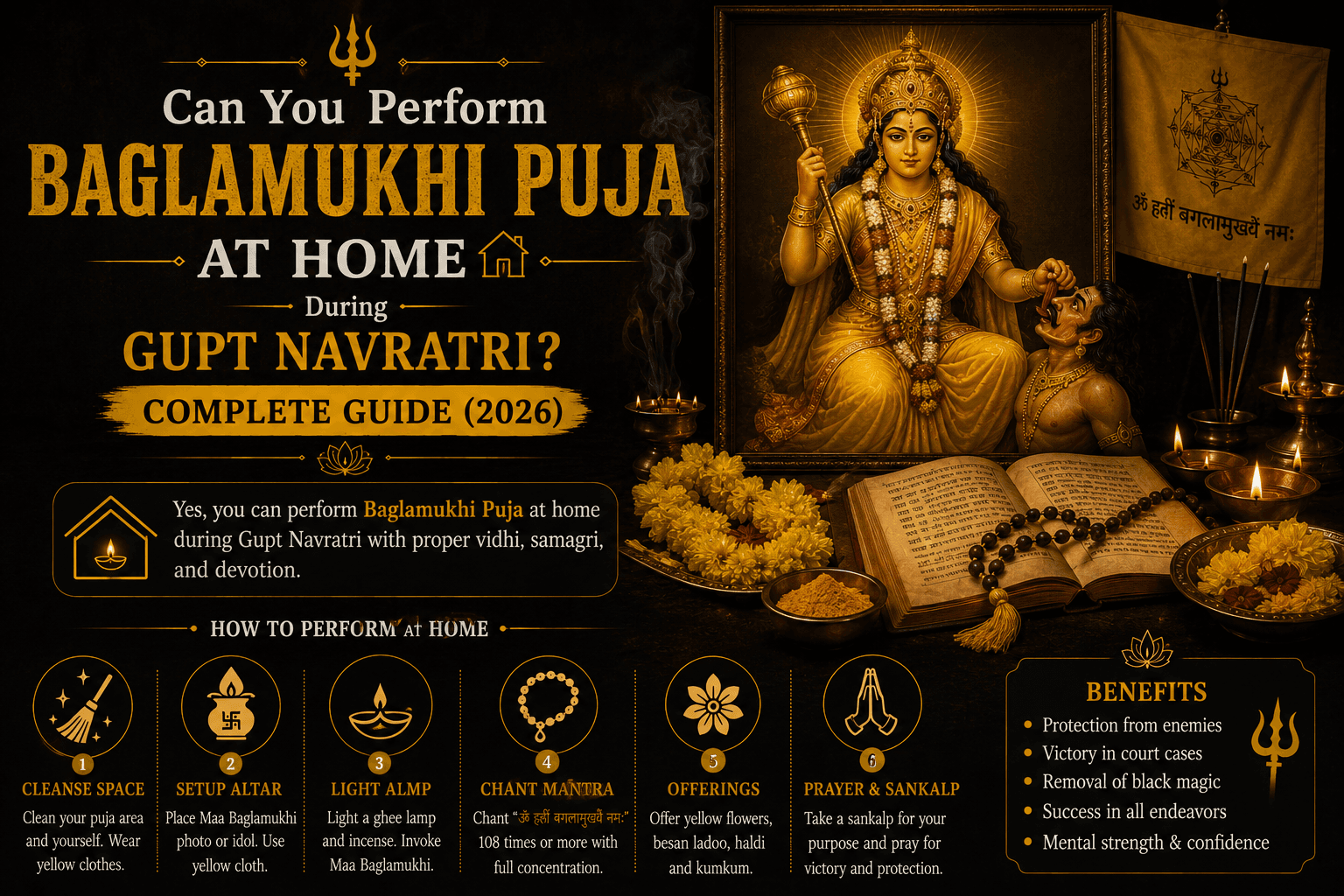
Yes, simple Baglamukhi worship such as mantra chanting, lighting a lamp, and offering yellow flowers can be done at home during Gupt Navratri. However, according to temple traditions, a full Baglamukhi Havan or Anushthan for serious problems like court cases or black magic is traditionally performed under an experienced Acharya at a recognized Siddha Peeth.
Key Takeaways
Basic Sadhana (chanting, lamp, flowers) is traditionally acceptable at home for most devotees
Havan, Tantric mantras, and multi-day Anushthans are traditionally reserved for trained Acharyas
Online Sankalp lets you participate in temple rituals without traveling to Nalkheda
Wrong mudras, mispronounced mantras, or incomplete vidhi are common beginner mistakes
Gupt Navratri 2026 (Ashadha) runs 15 to 23 July, with Ashtami falling on 22 July
Can Baglamukhi Puja Be Performed at Home?
Direct answer: Yes, a simplified form of worship dedicated to Maa Baglamukhi can be performed at home during Gupt Navratri. This includes lighting a lamp, offering yellow flowers, and chanting the Baglamukhi mantra with devotion. According to temple traditions, this level of worship is safe for most householders and does not require prior initiation.
Many devotees assume that any form of Baglamukhi worship must involve fire rituals or Tantric procedures. That is not accurate. As explained by experienced Acharyas, worship exists on a spectrum, from simple daily devotion to advanced Anushthans, and home practice generally sits at the simpler end of that spectrum.
The confusion usually comes from the fact that Maa Baglamukhi is associated with Stambhan Shakti, the power to still and control negative forces, which is often linked to intense problems like litigation or enemy influence. Because of this association, people assume the worship itself must always be intense. In reality, daily devotional practice and problem-specific Tantric ritual are two different things entirely.
Traditional Perspective
Direct answer: Traditionally, Sanatan Dharma has always allowed householders to practice basic devotion (Bhakti Marg) at home, while reserving specialized Tantric procedures for trained practitioners. This distinction is not modern; it comes from the Shastric division between general worship and Siddha-level ritual practice passed down through Acharya lineages.
According to temple traditions followed at Nalkheda, this division exists for a practical reason. Basic devotion builds a personal connection with the deity and creates a positive, disciplined mindset. Tantric procedures, on the other hand, involve precise Sanskrit pronunciation, specific hand gestures (mudras), and ritual sequences where even small errors are believed to reduce the intended effect or create unwanted energetic disturbance. This is why temple lineages have historically kept the two separate.
What Can Be Done at Home?
Direct answer: At home, devotees can safely chant the Baglamukhi mantra, read the Baglamukhi Chalisa, light a ghee lamp, offer yellow flowers and turmeric, and maintain a simple daily Sankalp throughout the nine days of Gupt Navratri. These practices do not require Tantric initiation.
Home Practice | Suitable For | Traditional Note |
|---|---|---|
Mantra chanting (108 times) | Most devotees | Use correct pronunciation; a recording helps |
Lighting a ghee lamp | All devotees | Keep the flame steady through the ritual |
Yellow flower and turmeric offering | All devotees | Yellow is considered Maa Baglamukhi's preferred colour |
Reading Chalisa or Kavach | All devotees | Builds devotional connection |
Simple daily Sankalp | All devotees | State name, intention, and gratitude mentally |
Basic meditation on the deity | All devotees | Ten to fifteen minutes is considered sufficient |
What Should Not Be Done Without Guidance?
Direct answer: According to temple traditions, Havan involving a consecrated fire pit, high-repetition Tantric mantras (Ugra Mantras), Uchchatan-type procedures, or any ritual aimed at a specific adversarial situation should not be attempted without an experienced Acharya, since incorrect execution is traditionally believed to reduce effectiveness or create imbalance.
Many devotees also try to combine multiple mantras or rituals found online without understanding their sequence, which experienced practitioners generally advise against. If your concern is serious, such as a prolonged court case or repeated business setbacks, it is traditionally recommended to consult an Acharya before attempting anything beyond basic devotion. You can request a personalised consultation to understand which level of ritual actually applies to your situation.
Temple Puja vs Home Puja
Direct answer: Temple puja, performed at a Siddha Peeth like Nalkheda, is traditionally considered more concentrated in effect because of the sacred geography and the presence of trained priests. Home puja is valuable for daily devotion but is generally not seen as a substitute for temple-based ritual in serious situations.
Factor | Home Puja | Temple Puja (Nalkheda) |
|---|---|---|
Suitable for | Daily devotion, gratitude, general wellbeing | Court cases, business loss, enemy issues, black magic concerns |
Ritual complexity | Simple, self-guided | Vedic vidhi performed by trained Acharyas |
Fire ritual (Havan) | Not recommended without guidance | Performed at consecrated Havan Kund |
Sankalp | Personal, informal | Formal, taken with name and gotra |
Traditional belief on intensity | Gentle, sustaining energy | Considered more concentrated per temple tradition |
Not sure if your situation needs home devotion or a full temple ritual? Speak with Acharya Ji before deciding so your Gupt Navratri worship is aligned with your actual need.
When Is Online Sankalp a Better Choice?
Direct answer: Online Sankalp is a better choice when a devotee cannot travel to Nalkheda but still wants a temple-grade ritual performed in their name. During Online Sankalp, the Acharya performs the Baglamukhi Puja or Havan at the temple while the devotee participates remotely through live video, with Prasad delivered afterward.
This option is commonly chosen by devotees who live far from Madhya Pradesh, have limited mobility, or simply cannot take time off during the Gupt Navratri window. It bridges the gap between doing nothing more than home chanting and physically travelling to the temple.
If temple travel is not possible for you this Gupt Navratri, an Online Baglamukhi Puja with live Sankalp lets you stay connected to Nalkheda Siddha Peeth from wherever you are.
Benefits of Performing Baglamukhi Puja at Nalkheda Siddha Peeth
Direct answer: Nalkheda is considered a Swayambhu (self-manifested) Siddha Peeth, and according to temple tradition, rituals performed here are believed to carry a more concentrated effect due to the sacred geography, unbroken worship lineage, and the guidance of an experienced Acharya overseeing every Sankalp personally.
Many devotees choose Nalkheda specifically during Gupt Navratri because Ashtami, the eighth day, is traditionally regarded as Maa Baglamukhi's own day among the ten Mahavidyas. Performing Sadhana on this specific day, at this specific temple, is a combination many devotees consider especially meaningful. You can read more about the temple's background and worship traditions on the Nalkheda temple guide.
Common Mistakes While Performing Puja at Home
Direct answer: The most common mistakes include incorrect mantra pronunciation, skipping the Sankalp step, using the wrong colour offerings, attempting Havan without proper fire safety or vidhi knowledge, and losing consistency across the nine days. These errors do not cause harm but are traditionally believed to reduce the ritual's effectiveness.
Mistake | Why It Matters | Better Approach |
|---|---|---|
Mispronouncing the mantra | Sanskrit sound structure is precise | Listen to a verified chant repeatedly before starting |
Skipping Sankalp | Ritual loses personal direction | Always state name and intention mentally or aloud |
Random object substitutions | Traditional items carry symbolic meaning | Stick to yellow flowers, turmeric, and ghee |
Attempting Havan indoors without guidance | Fire safety and vidhi errors are common | Keep Havan-level ritual for temple or guided sessions |
Breaking the nine-day continuity | Considered to weaken the cumulative effect | Set a fixed daily time you can realistically maintain |
Mixing unrelated mantras | Can create confusion in sequence | Follow one mantra consistently through the period |
Simple Home Worship Checklist
A clean, quiet corner of the home
A photo or small idol of Maa Baglamukhi
Yellow flowers and turmeric
A ghee lamp (diya)
A rosary (mala) for counting chants
A yellow cloth or asana to sit on
Home Preparation Before Gupt Navratri
Before Ghatasthapana on the first day, clean the worship space thoroughly, decide on a fixed time you can maintain for all nine days, and gather your offerings in advance so nothing interrupts your daily practice once Gupt Navratri begins. Many devotees also read the Baglamukhi Kavach once before starting, as a way of setting spiritual intention for the period.
Recommended Offerings
Offering | Significance |
|---|---|
Yellow flowers | Considered Maa Baglamukhi's preferred colour |
Turmeric (haldi) | Symbol of auspiciousness and purity |
Ghee lamp | Represents steady devotion and clarity |
Yellow sweets (besan ladoo or similar) | Traditional Prasad offering |
Yellow cloth | Used as seating or covering during worship |
Mantra Guidelines for Beginners
Beginners are traditionally advised to start with the core Baglamukhi mantra rather than more advanced Tantric variations. Correct pronunciation matters more than speed, so it is worth listening to an authentic chant before beginning your own practice. A full breakdown of meaning, structure, and chanting method is available in the Baglamukhi mantra guide, which is a useful reference before your first day of Gupt Navratri worship.
Can Women Perform Baglamukhi Puja at Home?
Direct answer: Yes, women can perform basic Baglamukhi worship at home during Gupt Navratri, including mantra chanting, lamp lighting, and flower offerings. Traditional practice generally advises avoiding ritual activity during menstruation, in line with broader Hindu worship customs, though personal devotion such as mental chanting is not restricted.
Can NRIs Participate?
Direct answer: Yes. NRIs and devotees living outside India can maintain the same simple home practices described above, and many also choose Online Sankalp so that a temple-grade ritual is performed in their name at Nalkheda while they participate through live video from anywhere in the world. Devotees based in the United States often use the dedicated Online Baglamukhi Puja for the USA service for this purpose.
Temple Puja vs Online Puja vs Home Puja (Detailed Comparison Table)
Aspect | Home Puja | Online Puja (Sankalp) | Temple Puja (In-Person) |
|---|---|---|---|
Location | Devotee's home | Nalkheda Siddha Peeth (remote participation) | Nalkheda Siddha Peeth (physical presence) |
Who performs it | The devotee | Trained Acharya, on devotee's behalf | Trained Acharya, with devotee present |
Best for | Daily devotion, gratitude | Devotees who cannot travel but want temple-grade ritual | Devotees seeking direct temple experience |
Havan possible | Not recommended | Yes, performed at temple | Yes |
Video proof | Not applicable | Yes, live or recorded | Optional, live participation |
Prasad | Not applicable | Delivered by courier | Received in person |
Who Should Choose Which Option? (Comparison Table)
Your Situation | Recommended Option |
|---|---|
You want to build daily devotional habits | Home Puja |
You are facing a mild, non-urgent concern | Home Puja with occasional consultation |
You are dealing with a court case, business loss, or enemy issue | Temple Havan or Anushthan at Nalkheda |
You cannot travel but want an authentic temple ritual | Online Sankalp |
You are unsure which category you fall into |
Step-by-Step Home Worship Schedule (Morning to Night)
Time | Activity |
|---|---|
Early morning (after bath) | Clean worship space, light the lamp |
Morning | Offer yellow flowers and turmeric, take Sankalp |
Morning | Chant the Baglamukhi mantra 108 times |
Midday | Read Chalisa or Kavach if time allows |
Evening | Light the lamp again, brief Aarti at home |
Night | Mental repetition of mantra before sleep, gratitude |
Dos and Don'ts Table
Do | Don't |
|---|---|
Maintain the same time daily for nine days | Skip days without good reason |
Use yellow offerings consistently | Substitute random unrelated items |
Learn correct mantra pronunciation first | Chant without understanding the sound structure |
Consult an Acharya for serious problems | Attempt Havan or advanced Tantric ritual alone |
Keep the practice simple and sincere | Expect home puja to replace temple-level ritual for major issues |
If your concern feels beyond what home worship can address, this is exactly what personalised guidance from Acharya Ji is for, before you decide on the right path this Gupt Navratri.
Frequently Asked Questions
1. Is it necessary to visit a temple during Gupt Navratri?
No, it is not mandatory. Basic devotion at home is traditionally acceptable, though temple or Online Sankalp is generally recommended for serious concerns.
2. Can I perform Baglamukhi Havan at home?
It is not traditionally recommended without guidance, since Havan involves specific fire ritual procedures best handled by a trained Acharya.
3. How many days should I chant the mantra during Gupt Navratri?
Traditionally, devotees chant across all nine days for continuity, with Ashtami considered the most significant single day.
4. What if I miss a day of chanting?
Simply resume the next day with sincerity. Traditional practice values consistency but does not treat a missed day as invalidating the entire period.
5. Do I need an idol, or is a photo enough?
A clear photo of Maa Baglamukhi is considered sufficient for home worship.
6. Can beginners chant the mantra without initiation?
Yes, the core mantra can generally be chanted by beginners, though advanced Tantric variations are traditionally reserved for initiated practitioners.
7. Is Online Sankalp as effective as visiting in person?
According to temple tradition, the ritual itself is performed identically at the temple; Online Sankalp simply changes how the devotee participates, not how the ritual is conducted.
8. What time of day is best for home worship?
Early morning after bathing is traditionally preferred, though evening worship is also acceptable if mornings are not possible.
9. Can children participate in family worship during Gupt Navratri?
Yes, children can participate in simple activities like lighting the lamp or offering flowers under adult supervision.
10. Is it safe to chant Tantric mantras found online?
Caution is advised. Advanced Tantric mantras are traditionally meant to be learned under a qualified Acharya rather than self-taught from unverified sources.
11. What should I do if I do not know my gotra for Sankalp?
A general Sankalp without gotra is acceptable at home; for temple-based Sankalp, the Acharya can guide you on alternatives.
12. Can I combine home puja with a temple ritual in the same Navratri?
Yes, many devotees do both, maintaining daily home devotion while also booking a specific ritual at the temple for a particular concern.
13. Does home puja help with career or business issues?
Basic devotion supports general positivity and discipline, but according to temple tradition, targeted issues are better addressed through a specific ritual guided by an Acharya.
14. How do I know if my problem needs a Havan instead of home puja?
If the issue is recurring, serious, or involves external opposition such as legal disputes, a consultation is traditionally recommended to assess the right level of ritual.
15. What is the significance of Ashtami during Gupt Navratri 2026?
Ashtami, falling on 22 July 2026, is considered Maa Baglamukhi's own day among the ten Mahavidyas, making it especially significant for her devotees.
16. Can I perform Baglamukhi Puja at home if I have never done any Sadhana before?
Yes, beginners can start with simple chanting and lamp lighting; there is no prerequisite experience needed for basic devotion.
17. Is Prasad available for devotees who only worship at home?
Prasad delivery is generally linked to a booked ritual at the temple or through Online Sankalp, not standalone home worship.
18. Should I consult an Acharya even for simple home worship?
It is not mandatory, but a brief consultation can help confirm you are following the correct sequence and offerings for your situation.
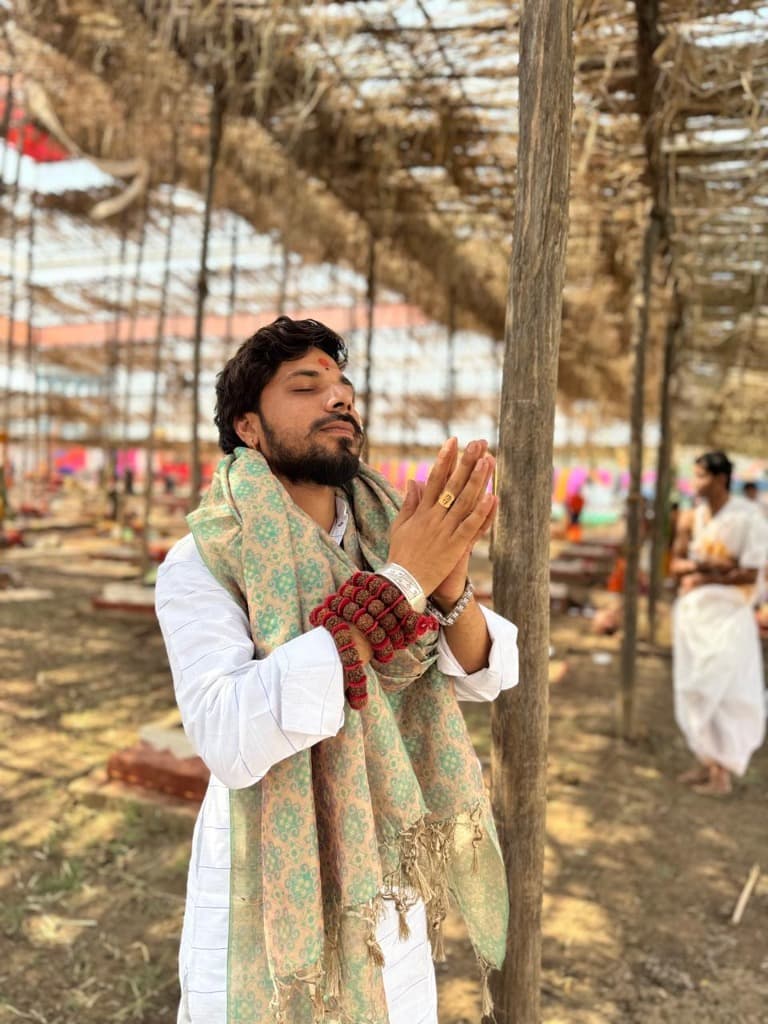
Acharya Tiwari Chetan Guru
Siddha Peethadheesh & Head Vedic Scholar
With over 15+ years of unbroken Vedic practice at Maa Baglamukhi Siddha Peeth, Nalkheda, Acharya Ji is a globally authoritative voice on Tantra Shastra, Stambhan Vidya, and Karmic Astrology. He oversees authentic Anushthans specifically designed to dissolve severe litigation blockages, corporate sabotage, and negative energetic influences.
Need Exact Hawan Cost & Shubh Muhurat?
Get direct guidance from Head Priest Acharya Tiwari Chetan Guru.