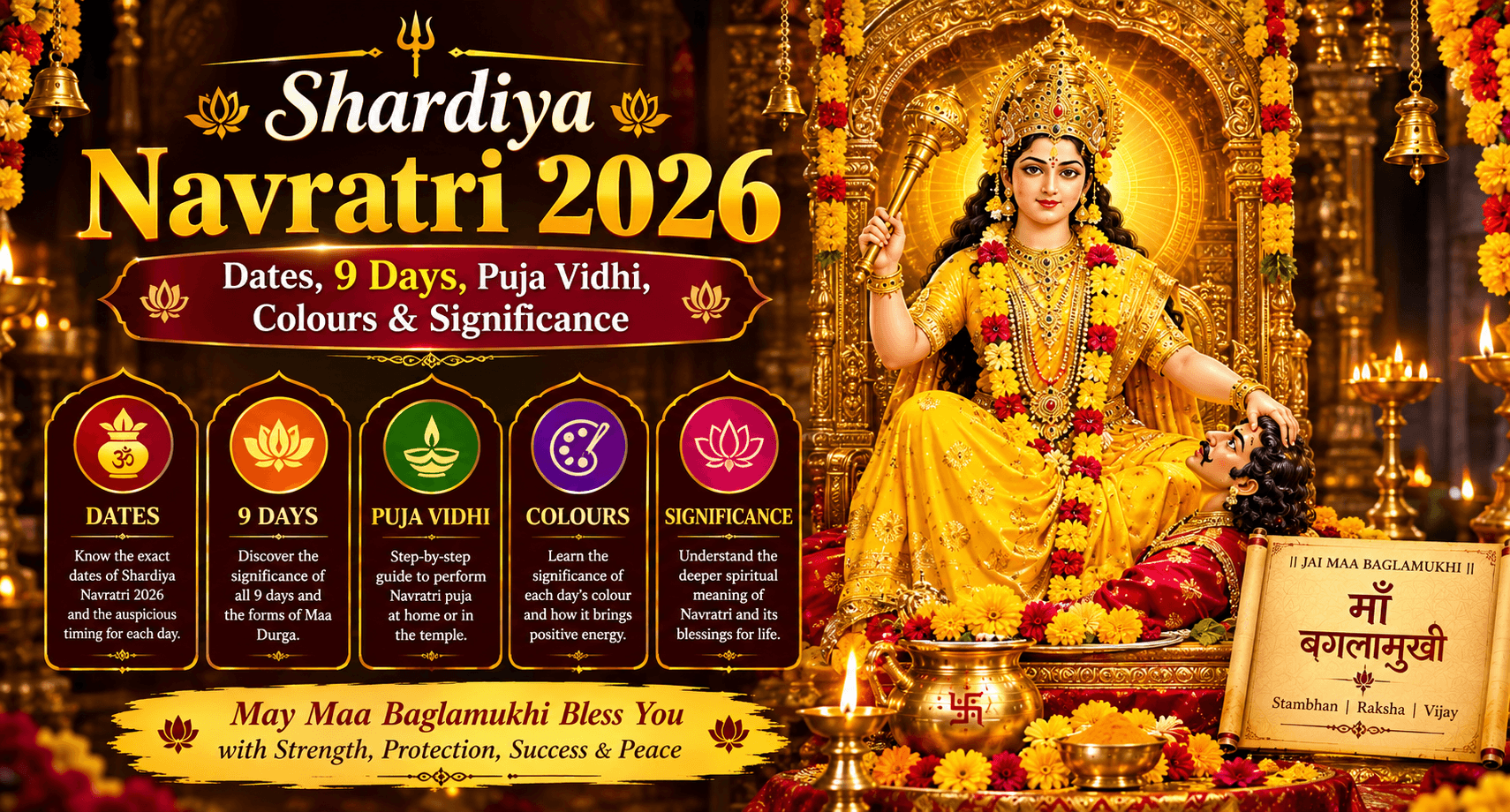

There is a particular kind of exhaustion that shows up when nothing you try seems to move forward — a case that keeps getting the next date, a business that stalls without an obvious reason, an opponent whose intentions you can feel but cannot prove. In the Baglamukhi tradition, this is exactly the space the Sarva Karya Siddhi chanting practice is meant to address: not one problem, but the accumulated resistance that touches every area of life at once.
This guide brings together the Sanskrit and Hindi text, the literal meaning, the correct jaap vidhi, and the honest boundaries of what chanting can and cannot do — written from the living practice at Nalkheda Siddha Peeth, one of Maa Baglamukhi's most revered Swayambhu (self-manifested) shrines.
Quick Answer Box
What is the Baglamukhi Sarva Karya Siddhi Mantra? It is not a single standalone verse but a chanting practice built around Maa Baglamukhi's core mantras — the Beej Mantra (HLEEM), the 36-letter Brahmastra Mool Mantra, and the Gayatri Mantra — recited together with the sankalp of sarva karya siddhi, meaning "success and completion in all undertakings." Different lineages combine or emphasise these verses differently, which is why the exact wording taught by one guru may vary slightly from another.
Why This Mantra Is Special
Most protective or victory mantras in Sanatan Dharma are aimed at a single outcome — winning a case, silencing a rival, attracting wealth. The Sarva Karya Siddhi sankalp is broader by design. It asks Maa Baglamukhi, the Goddess of Stambhan Shakti (the power to paralyze obstacles), to freeze whatever is blocking progress across career, legal matters, relationships, and inner steadiness — simultaneously. That is why devotees preparing for a big decision, a court hearing, a business launch, or a period of sustained bad luck are often guided toward this combined chanting practice rather than a single-purpose mantra.
Quick Highlights Table
Attribute | Details |
|---|---|
Deity | Maa Baglamukhi, 8th Mahavidya (Pitambara Devi) |
Core Mantras Used | Beej Mantra, 36-letter Brahmastra Mool Mantra, Gayatri Mantra |
Primary Purpose | All-round success, obstacle removal, protection |
Best Time | Brahma Muhurta (4–6 AM) or midnight |
Best Day | Tuesday or Thursday |
Recommended Mala | Haldi (turmeric) mala, 108 beads |
Ideal Count | 108 repetitions per sitting (1 mala) |
Direction | Facing East or North |
Prerequisite | Guru guidance recommended for the Brahmastra portion |
What Is Baglamukhi Sarva Karya Siddhi Mantra?
The Baglamukhi Sarva Karya Siddhi Mantra refers to the chanting sequence devotees use when their intention (sankalp) is general and complete success, rather than one narrow outcome. It is built on the same foundational verses found in the Baglamukhi Mantra tradition — the one-syllable Beej Mantra, the 36-letter Mool Mantra (also called the Brahmastra Mantra), and the Baglamukhi Gayatri Mantra — chanted in sequence, with the specific sankalp of sarva karya siddhi stated at the start of the sitting.
Featured Snippet Answer: The Baglamukhi Sarva Karya Siddhi Mantra is a chanting practice combining Maa Baglamukhi's Beej, Mool (36-letter Brahmastra), and Gayatri mantras, recited with the intention of success in all undertakings — career, legal matters, relationships, and inner strength — rather than one single outcome.
Origin and Traditional Importance
Maa Baglamukhi is worshipped as the eighth of the ten Mahavidyas in Shakta tradition, and her mantras belong to the Tantrokta (Tantric) canon rather than the purely Vedic one. According to temple tradition at Nalkheda, the lineage of these mantras traces back to the Mahabharata period, when Yudhishthira is said to have worshipped the Goddess at this very site before the war with the Kauravas, seeking clarity and the paralysis of adharmic forces opposing him.
Historically, the 36-letter Mool Mantra was reserved for court disputes and confrontation with hostile forces. Over generations, householders and sadhaks began combining it with the Beej and Gayatri mantras during personal sadhana whenever their need was not one crisis but an accumulation of stuck situations — this combined use is what popular tradition now refers to as chanting "for Sarva Karya Siddhi." You can read the temple's account of this lineage on the Nalkheda Temple history page.
Note on tradition: Because Baglamukhi sadhana is Tantric in nature, the exact wording, sequence, and count taught for "Sarva Karya Siddhi" chanting can differ between gurus, sampradayas, and family lineages. What follows reflects the vidhi followed at Nalkheda Siddha Peeth; if you have a personal guru, their instruction takes precedence.
Baglamukhi Sarva Karya Siddhi Mantra in Sanskrit
Beej Mantra:
ॐ ह्लीं बगलामुखी देव्यै नमः॥36-Letter Mool (Brahmastra) Mantra:
ॐ ह्रीं बगलामुखी सर्वदुष्टानां वाचं मुखं पदं
स्तम्भय जिह्वां कीलय बुद्धिं विनाशय ह्रीं ॐ स्वाहा॥
Gayatri Mantra:
ॐ बगलामुख्यै विद्महे स्तम्भिन्यै धीमहि तन्नो देवी प्रचोदयात्॥Baglamukhi Sarva Karya Siddhi Mantra in Hindi
बीज मंत्र: ॐ ह्लीं बगलामुखी देव्यै नमः॥
छत्तीस अक्षरी मूल (ब्रह्मास्त्र) मंत्र: ॐ ह्रीं बगलामुखी सर्वदुष्टानां वाचं मुखं पदं स्तम्भय जिह्वां कीलय बुद्धिं विनाशय ह्रीं ॐ स्वाहा॥
गायत्री मंत्र: ॐ बगलामुख्यै विद्महे स्तम्भिन्यै धीमहि तन्नो देवी प्रचोदयात्॥
English Transliteration
Beej Mantra: Om Hleem Baglamukhi Devyai Namah.
Mool Mantra: Om Hreem Baglamukhi Sarva Dushtanam Vacham Mukham Padam Stambhay Jihvam Keelay Buddhim Vinashay Hreem Om Swaha.
Gayatri Mantra: Om Baglamukhyai Vidmahe Stambhinyai Dheemahi Tanno Devi Prachodayat.
Pronunciation tip: "Hleem" and "Hreem" are nasalised — the sound should end with a soft hum, not a hard "m." If you are unsure of correct Tantric pronunciation (Shuddha Uccharan), it is safer to learn by listening to a qualified Acharya rather than reading transliteration alone.
Word-by-Word Meaning
Sanskrit Word | Meaning |
|---|---|
Om | Primordial cosmic sound |
Hleem / Hreem | Beej (seed) sound of Maa Baglamukhi's Stambhan (paralyzing) energy |
Baglamukhi | The Goddess with the yellow, arresting face — the 8th Mahavidya |
Sarva Dushtanam | Of all malicious/hostile beings |
Vacham | Speech |
Mukham | Mouth/face |
Padam | Feet/movement |
Stambhay | Paralyze, freeze |
Jihvam | Tongue |
Keelay | Nail down, immobilize |
Buddhim | Intellect |
Vinashay | Destroy (destructive intent, not the person) |
Swaha | Ritual offering into the sacred fire |
Vidmahe / Dheemahi / Prachodayat | Gayatri structure: "let us know / let us meditate / may She inspire us" |
Complete Meaning
Put together, the sequence asks the Goddess to first awaken her Stambhan energy (Beej Mantra), then specifically paralyze the speech, movement, and destructive intellect of those working against the devotee (Mool Mantra), and finally to illuminate the devotee's own consciousness so that decisions are made with clarity rather than fear (Gayatri Mantra). It is this three-part structure — protection, obstruction of the opposition, and inner clarity — that together supports the broader intention of sarva karya siddhi, success in all undertakings.
Why Is It Called Sarva Karya Siddhi?
"Sarva Karya Siddhi" literally means "accomplishment/success in all tasks." The name is used because this chanting combination is not restricted to one problem category. A devotee facing a court case, a business slump, and family tension at the same time would traditionally be guided toward this fuller practice rather than three separate single-purpose mantras, since the underlying blockage is treated as one root obstruction expressing itself in multiple areas of life. Acharya Ji at Nalkheda explains this further during personal consultation sessions, where the exact combination and count is tailored to the devotee's specific chart and situation.
Featured Snippet Answer: The mantra is called Sarva Karya Siddhi because its sankalp is not limited to one goal — it is chanted for success across career, legal, relationship, and personal challenges simultaneously, treating scattered obstacles as expressions of one root blockage.
Spiritual Significance
Maa Baglamukhi's iconography — golden-yellow complexion, seated on a throne, pulling an enemy's tongue with one hand and holding a mace in the other — visually represents Stambhan: the power to stop destructive momentum before it does damage. Chanting her mantras is traditionally understood not as a plea for miracles but as an alignment practice — steadying the mind, sharpening resolve, and (in the devotee's felt experience) reducing the anxious reactivity that often makes difficult situations worse. The Baglamukhi Yantra is often used alongside this chanting as a focal point for concentration.
Benefits of Chanting
Featured Snippet Answer: Regular, correct chanting of the Baglamukhi Sarva Karya Siddhi combination is traditionally associated with protection from hidden opposition, steadier decision-making under pressure, renewed confidence in career and business matters, and a calmer mental state during prolonged disputes — though outcomes vary by individual sincerity, guru guidance, and karmic factors.
Benefits Table
Category | Traditional Benefit |
|---|---|
Protection | Believed to create a subtle shield against ill-intentioned rivals, gossip, and hidden sabotage |
Success | Associated with removal of long-standing blockages in pending work and decisions |
Career & Business | Chanted before interviews, negotiations, and business launches for steadiness and favourable outcomes |
Mental Strength | Helps cultivate calm, focus, and resistance to fear during confrontation or crisis |
Legal Matters | Traditionally chanted alongside the Shatru Nashak Puja during ongoing court cases |
Spiritual Growth | Deepens concentration and is considered a stepping stone toward more advanced Mahavidya sadhana |
Protection Benefits
Devotees chant this combination specifically when they sense — but cannot prove — that someone is working against them: office politics, family disputes, or unexplained resistance to otherwise reasonable plans. The Stambhan energy is believed to blunt the effectiveness of such hidden opposition over time.
Success Benefits
Because the sankalp is broad, many devotees use this chanting before major life events — a property registration, a business tender, a job change — as a way of asking for the removal of unseen resistance rather than a guarantee of a specific result.
Career & Business Benefits
Professionals facing repeated setbacks — delayed promotions, stalled deals, sudden client losses — often pair this chanting with the Maa Baglamukhi Hawan for a more concentrated ritual intervention.
Mental Strength
Perhaps the most consistently reported experience among devotees is not a dramatic external change but an internal one: a felt reduction in panic, and greater patience while waiting for a resolution that is genuinely outside their control (such as a court date).
Important note: Anthropic's editorial standard, and ours, requires us to say this clearly: chanting is not a guaranteed mechanism for specific outcomes such as winning a legal case or a fixed financial result. It is a spiritual practice whose fruits are traditionally described as cumulative, subtle, and dependent on sincerity, correct method, and time.
Who Can Chant This Mantra?
Any sincere devotee of Maa Baglamukhi, regardless of gender, following correct purity practices
Working professionals, business owners, and students seeking clarity and steadiness
Those undergoing legal disputes, alongside (not instead of) proper legal counsel
Devotees who have received guidance from a qualified Acharya, especially for the Brahmastra portion
Who Should Avoid It?
Beginners attempting the 36-letter Brahmastra Mantra without any guidance — it is a fierce (Ugra) Tantric mantra and is traditionally taught with a guru's oversight
Anyone chanting with an intention to cause harm to another person — this is explicitly against the spirit of the mantra and considered spiritually harmful to the chanter
Those unable to maintain basic Satvik discipline (diet, cleanliness, abstinence) during the chanting period, as tradition holds this reduces the practice's benefit
Anyone in active mental health crisis without professional support — spiritual practice should complement, not replace, medical or psychological care
Correct Jaap Vidhi
Purify — Bathe and wear clean, preferably yellow, clothing.
Set up your space — Face East or North; place a Baglamukhi image or Yantra if available.
Light a lamp — Use a ghee or mustard oil lamp.
State your Sankalp — Silently or aloud, state your name, gotra (if known), and the intention of sarva karya siddhi.
Begin with the Beej Mantra — A few rounds to awaken focus.
Move to the Mool Mantra — 108 repetitions (1 full mala) if you have received guidance for it; otherwise continue with Beej and Gayatri only.
Close with the Gayatri Mantra — A few rounds to seek clarity and grace.
Conclude with Shanti Mantra — "Om Shanti Shanti Shanti" to close the sitting peacefully.
Refer to the full step-by-step Baglamukhi Puja Vidhi for the complete ritual sequence including Kalash Sthapana if you are performing this as part of a home puja rather than mantra-only sadhana.
Jaap Rules Table
Rule | Guidance |
|---|---|
Purity | Bathe before chanting; avoid chanting immediately after eating |
Diet | Satvik food only during the practice period; avoid alcohol and non-vegetarian food |
Silence | Maintain quiet, undisturbed surroundings |
Consistency | Same time and place daily strengthens the practice |
Mala | Use a dedicated mala only for this practice; do not share it |
Count | Complete full malas (108); avoid stopping mid-round without reason |
Best Time, Direction, Mala & Asana
Featured Snippet Answer: The best time to chant the Baglamukhi Sarva Karya Siddhi Mantra is Brahma Muhurta (4–6 AM) or midnight, facing East or North, seated on a yellow asana, using a Haldi (turmeric) mala of 108 beads — Tuesday and Thursday are considered especially auspicious days.
Best Time: Brahma Muhurta (4–6 AM) or midnight
Best Direction: East (for general success) or North (for protection-focused chanting)
Recommended Mala: Haldi (turmeric) mala; Sphatik (crystal) mala is an acceptable alternative
Correct Asana: A yellow or Kush-grass seat, kept exclusively for sadhana
Number of Jaaps: One full mala (108) per sitting is standard; advanced practitioners may do more under guru guidance
Morning vs Evening Table
Aspect | Morning (Brahma Muhurta) | Midnight |
|---|---|---|
Best For | Steady, sustained sadhana; students and professionals | Intense situations — active court cases, urgent obstacles |
Mind State | Naturally calm, fewer distractions | Requires more discipline and privacy |
Suitability | Recommended for most beginners | Recommended once basic practice is established |
Duration | 15–20 minutes typically sufficient | Can extend to a full mala or more |
Daily Practice Guide
For sustained results, tradition recommends a minimum 21 to 41-day continuous practice (chanting the same time and place daily without a gap) rather than occasional chanting. Missing a day is traditionally understood to require restarting the count, which is precisely why many devotees prefer to formalise sustained sadhana through a guided Baglamukhi Anushthan at Nalkheda rather than attempting a long solo count at home.
Rules Before Chanting
Complete a bath and wear clean clothing before sitting
Avoid chanting during menstruation if that is your personal or family tradition — practices vary, so follow your own comfort and guru's guidance
Do not chant on an empty stomach for extended sittings if it affects your health; light food beforehand is acceptable
Keep the chanting space clean and free of distractions
Never begin the Brahmastra portion out of anger or a desire to harm someone specific
Common Mistakes to Avoid
Rushing pronunciation — speed without correct Shuddha Uccharan reduces the mantra's intended vibrational effect
Skipping the Sankalp — chanting without a clearly stated intention is considered incomplete practice
Inconsistent timing — jumping between very different times each day breaks the rhythm tradition considers important
Using the mantra for harm — chanting the Brahmastra portion with vengeful intent is considered to backfire spiritually on the chanter
Self-teaching the Ugra portion from the internet alone — the 36-letter Mool Mantra is best learned with guidance; see our complete Baglamukhi Mantra guide for the fuller context before attempting it
Dos and Don'ts
Do | Don't |
|---|---|
Chant with a calm, sincere sankalp | Chant out of anger or revenge |
Maintain Satvik diet during the practice | Consume alcohol or non-vegetarian food during sadhana |
Use a dedicated mala | Let others use your sadhana mala |
Seek guru guidance for the Mool Mantra | Attempt advanced Tantric portions without any guidance |
Keep consistent timing | Chant sporadically and expect deep results |
Combine with real-world effort (legal, professional) | Treat chanting as a replacement for practical action |
Frequently Asked Questions
1. What is the Baglamukhi Sarva Karya Siddhi Mantra used for?
It is chanted for all-round success — removing obstacles across career, legal matters, business, and personal life — rather than one narrow goal.
2. Can beginners chant the full 36-letter Mool Mantra?
Beginners can start with the Beej and Gayatri mantras. The Mool (Brahmastra) Mantra is traditionally learned under a guru's guidance because of its Tantric, Ugra nature.
3. How many times should I chant it daily?
One full mala (108 repetitions) per sitting is the standard recommendation; some devotees do multiple malas under guided sadhana.
4. What is the best time to chant the Baglamukhi Sarva Karya Siddhi Mantra?
Brahma Muhurta (4–6 AM) or midnight are considered the most powerful windows, though any consistent quiet time can be used for daily practice.
5. Which mala should I use?
A Haldi (turmeric) mala is traditionally preferred for Baglamukhi sadhana; a Sphatik (crystal) mala is an acceptable alternative.
6. Can women chant this mantra?
Yes. Personal practices around timing during menstruation vary by family and lineage tradition — follow your own comfort and guru's guidance rather than a fixed universal rule.
7. Is it safe to chant without a guru?
The Beej and Gayatri mantras are generally considered safe for personal sadhana. The Mool/Brahmastra Mantra is best learned with a qualified Acharya's guidance given its Tantric nature.
8. How long before I see results?
Traditional teaching describes results as cumulative rather than instant, often discussed in the context of a 11 to 41-day sustained practice; individual experience varies and should not be treated as a guaranteed timeline.
9. Can this mantra help with a pending court case?
Devotees traditionally chant it alongside proper legal counsel and rituals such as the Shatru Nashak Puja — the mantra is a spiritual support, not a substitute for legal process.
10. What is the correct pronunciation of "Hleem" and "Hreem"?
Both are nasalised seed sounds, closer to a soft hum than a hard consonant. Listening to correct recitation from a qualified source is more reliable than reading transliteration alone.
11. Can I chant this mantra for someone else, like a family member? Yes, provided the sankalp names the person and their gotra, and the intention remains positive and protective, not aimed at harming a third party.
12. Is there a difference between Havan and just chanting the mantra?
Yes. Chanting (jaap) is a personal recitation practice; a Havan is a fire ritual that includes mantra recitation along with offerings into consecrated fire — Havan is generally considered more intensive and is usually performed by or under an experienced Acharya.
13. Do I need a Baglamukhi Yantra to chant this mantra?
A Yantra is not mandatory but is traditionally used as a focal point to deepen concentration during sadhana.
14. What should I avoid during the chanting period?
Alcohol, non-vegetarian food, harsh speech, and intentions of harm toward others are traditionally avoided throughout any dedicated chanting period.
15. Can NRIs or devotees outside India follow this practice?
Yes, the mantra and vidhi can be followed anywhere in the world; devotees seeking a temple-based ritual can also book an online Baglamukhi Puja performed on their behalf at Nalkheda Siddha Peeth with live video participation.
Conclusion
The Baglamukhi Sarva Karya Siddhi chanting practice brings together the Beej, Mool, and Gayatri mantras of Maa Baglamukhi under one broad sankalp — success and clarity across every area of life that currently feels stuck. Used correctly, with patience, correct pronunciation, and honest effort alongside real-world action, it is a practice many devotees turn to when they need more than a single fix — they need steadiness while several things resolve at once. As with all Tantric sadhana, guidance from a qualified Acharya makes the practice both safer and more grounded, and traditions do vary meaningfully between gurus and sampradayas, so treat this guide as a starting point rather than the final word.
If you would like this chanting supported by a formal ritual — a personalised Sankalp, a Baglamukhi Puja, or a complete Anushthan — at the sacred Swayambhu Nalkheda Siddha Peeth, Acharya Tiwari Chetan Guru and his team offer personal consultation before recommending the right ritual for your specific situation. You can book a puja online or speak with Acharya Ji directly to understand what best fits where you currently stand.
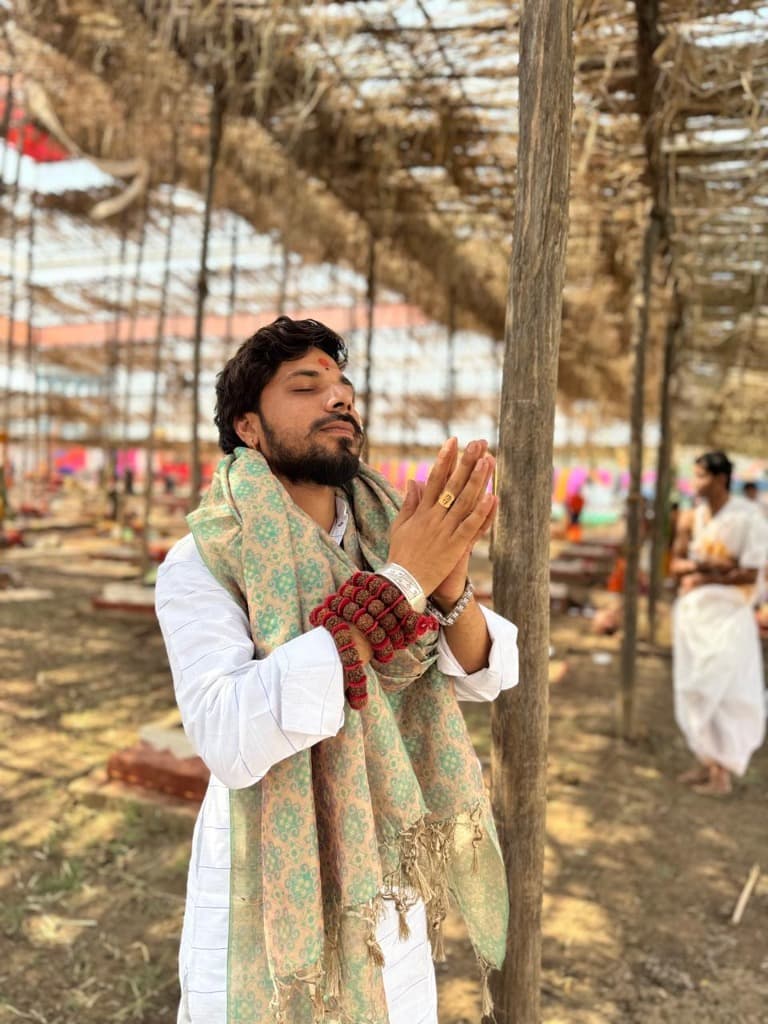
Acharya Tiwari Chetan Guru
Siddha Peethadheesh & Head Vedic Scholar
With over 15+ years of unbroken Vedic practice at Maa Baglamukhi Siddha Peeth, Nalkheda, Acharya Ji is a globally authoritative voice on Tantra Shastra, Stambhan Vidya, and Karmic Astrology. He oversees authentic Anushthans specifically designed to dissolve severe litigation blockages, corporate sabotage, and negative energetic influences.