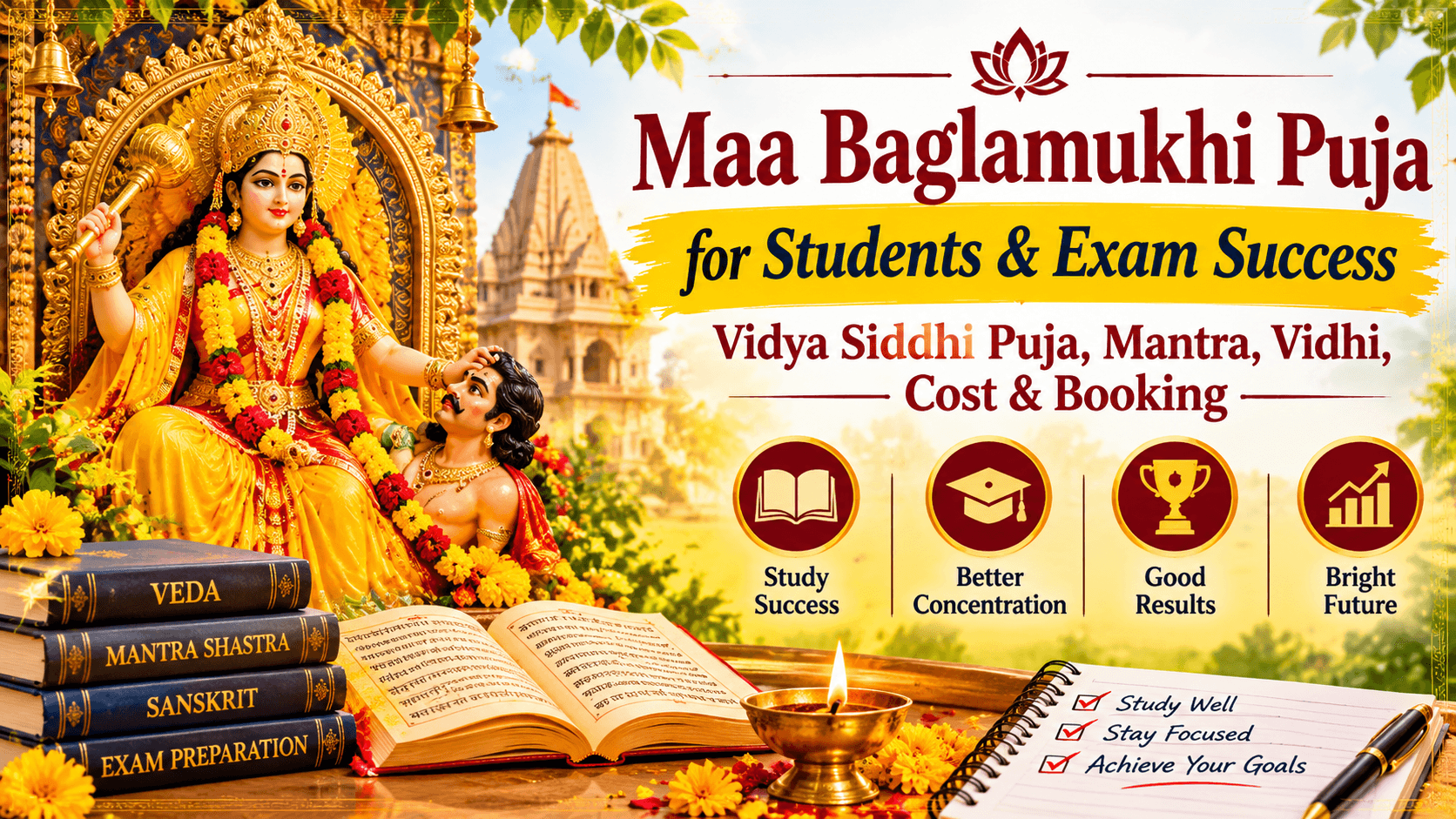
Exam season changes the mood of a home. Students stay up revising, parents worry in silence, and many families add prayer to the timetable. For devotees of Maa Baglamukhi, one of the ten Mahavidyas, that prayer often takes the form of a Student Vidya Puja or a Vidya Siddhi Puja.
This guide explains what these two services are, what the tradition says about them, which mantra can be learnt, how the Vidhi generally unfolds, how cost and booking work at Maa Baglamukhi Siddha Peeth, Nalkheda, and how faith can sit beside honest preparation. Worship is a matter of belief. It cannot promise marks, rank, admission or selection.
Maa Baglamukhi Vidya Siddhi Puja for Students at a Glance
Maa Baglamukhi Student Vidya Puja and Vidya Siddhi Puja are two devotional services listed on baglamukhihawan.com and performed at Nalkheda Siddha Peeth under Acharya Tiwari Chetan Guru. Families request them to seek blessings for learning and clarity. Prices are not displayed on the service pages, so they must be confirmed directly.
Detail | Information |
|---|---|
Puja | Maa Baglamukhi Student Vidya Puja and Vidya Siddhi Puja, listed as two separate services |
Traditional purpose | Seeking Maa Baglamukhi’s blessings for knowledge, focus and clarity in learning |
Who it is for | School and college students, competitive examination aspirants and parents arranging worship for a child |
Mantra | The Beej mantra Hleem (ह्लीं) is the seed syllable most consistently linked with her; wider practice should follow an Acharya’s guidance |
Vidhi | The service pages describe purification, Kalash Sthapana with Sankalp, then the main Puja and Havan |
Samagri | Not itemised on the service pages; confirm with the provider |
Cost | Not publicly displayed; a quotation follows consultation |
Booking | Booking form, WhatsApp or telephone through the booking page |
Location | Nalkheda, Agar Malwa, Madhya Pradesh |
Expected outcome | A matter of faith; academic results are not guaranteed |
What Is Maa Baglamukhi Vidya Siddhi Puja?
Vidya Siddhi joins two Sanskrit ideas: vidya, meaning knowledge, and siddhi, meaning accomplishment or mastery. A Vidya Siddhi Puja is worship offered to Maa Baglamukhi, with a personal Sankalp, in the hope of blessings for learning, wisdom and a clear mind.
Maa Baglamukhi is revered as the eighth of the ten Mahavidyas, usually pictured in yellow and known as Pitambara. Her name is tied to Stambhan Shakti, the power to halt or still. You can read more on the Maa Baglamukhi Mahavidya page. Some scholars, summarised on a Mahavidya study site drawing on David Kinsley’s work, read her as a symbol of sharply focused consciousness, which is one reason students and parents see her as relevant to study. That is an interpretation, and traditions do not all explain Vidya Siddhi in the same way.
Parents often arrange this worship because they want to place a child’s effort before the Goddess with humility. The Sankalp is central: the priest states the student’s name, gotra where known, and the intention before the deity. A Sankalp expresses hope and faith. It is not a contract with a result.
Why Do Students and Parents Consider Maa Baglamukhi Vidya Siddhi Puja?
Families usually describe their reasons as intentions, not outcomes. The most common are:
A prayer for knowledge and steady learning
Hope for calm concentration through long revision hours
Confidence while facing an important paper
Support for daily discipline during preparation
A wish to seek blessings before board, university or competitive examinations
For many believers the value lies in the pause itself: a family sits together with a shared intention, which can steady a stressful season. That is a personal experience, not a measured result. Marks still depend on understanding the syllabus, revising, practising and resting. Prayer can accompany that work. It cannot replace it, and no student should be told that a Puja is needed to pass.
Traditional Significance of Maa Baglamukhi Puja for Exam Success
In Shakta tradition, Maa Baglamukhi’s Stambhan Shakti is usually discussed as the stilling of harmful forces. Devotees who bring her worship into student life often read that stilling inwardly, as steadiness against distraction, fear and scattered effort. This is a devotional reading, not a fixed scriptural rule.
Two elements recur: devotion and Sankalp. The service pages also state that devotees should observe Satvik rules during the ritual, including avoiding alcohol and non-vegetarian food and keeping body and mind pure. Some families see this as in harmony with a disciplined study routine. No supernatural effect or guaranteed academic result should be assumed.
Maa Baglamukhi Mantra for Students and Vidya Siddhi
The seed mantra most consistently linked with Maa Baglamukhi is her Beej, Hleem. Drik Panchang lists it as her single-syllable mantra, and the site’s Beej Mantra guide explains its role.
Mantra | Devanagari | Transliteration |
|---|---|---|
Ekakshari Beej Mantra | ह्लीं | Hleem |
Tryakshari Mantra | ॐ ह्लीं ॐ | Om Hleem Om |
Meaning. A Beej syllable is a seed sound and has no dictionary translation. The Nalkheda resources describe Hleem as holding the concentrated, arresting energy of the Goddess. Some devotees recite it quietly as a way to settle attention before study.
How it is used. Recitation is usually done after bathing, seated in a clean, quiet place, with the Goddess’s image or Yantra in mind. This article sets no compulsory count and makes no claim that any number of repetitions secures a result. The conjunct “hl” is hard to pronounce, and printed sources sometimes render Baglamukhi mantras with different seed syllables, so learn the sound from a knowledgeable Acharya rather than from text alone.
Other mantras. The Baglamukhi Gayatri Mantra is the form most associated with intellect and understanding. Published wordings differ between sources, so this article does not fix a single version; confirm the wording and method with Acharya Ji. The longer 36-letter Mool Mantra, covered in the Mool Mantra guide and the main Baglamukhi Mantra resource, is linked on the site with a different intention, so it is not covered here.
Maa Baglamukhi Puja Vidhi for Students
The service pages describe three stages: purification, Kalash Sthapana with Sankalp, and the main Puja with Havan. A customary overview expands these as follows, though order and wording vary by tradition and officiating priest.
The place of worship and the participants are purified.
Offerings are gathered as advised.
Preliminary prayers, often to Lord Ganesha, open the rite.
Kalash Sthapana and Sankalp take place, stating the student’s name, gotra where known, and the intention.
Maa Baglamukhi is worshipped and the chosen mantra is recited.
A Havan is offered where it forms part of the selected ritual.
Aarti, closing prayers and Prasad conclude the Puja.
A simple home prayer is not the same as a specialised service performed by an Acharya, and neither should be presented as identical to the other. The Puja Vidhi guide and Havan Vidhi guide cover each stage in more depth, and the Maa Baglamukhi Hawan service describes the fire ritual itself.
Maa Baglamukhi Vidya Siddhi Puja Samagri
Common Puja Samagri
Flowers, roli or kumkum, akshat, clean water, a diya and incense are widely used. The site’s cost guide also mentions yellow flowers, turmeric and sweets as customary offerings.
Havan Samagri
Wood, ghee and Havan material depend on the ritual and the tradition. The Havan Samagri guide explains the usual items.
Additional Items
The service pages do not list ritual-specific items, so this article does not either. The booking page names complete Havan Samagri among its general inclusions; confirm what applies to your chosen Puja before buying anything. No item is compulsory for every Puja.
Difference Between Student Vidya Puja and Vidya Siddhi Puja
On the website, both services appear in a near-identical format. The difference lies in framing: the Student Vidya Puja is written for students, while the Vidya Siddhi Puja is framed more broadly, covering wisdom and success in study and professional life.
Detail | Student Vidya Puja | Vidya Siddhi Puja |
|---|---|---|
Service description | A ritual for students invoking Maa Baglamukhi’s wisdom, described in connection with focus, memory, exam stress and academic success | A ritual for wisdom, overcoming obstacles, academic and professional success, and divine protection |
Intended devotional purpose | Student-specific | Broader: study and professional life |
Ritual procedure | Purification, Kalash Sthapana and Sankalp, main Puja and Havan; confirm specifics | The same three stages are shown; confirm specifics |
Samagri | Not itemised; confirm with provider | Not itemised; confirm with provider |
Cost | Not displayed; quotation after consultation | Not displayed; quotation after consultation |
Booking | Contact, consultation and Muhurat, live Sankalp, Prasad delivery | The same booking journey is shown |
Neither page claims that one service is more powerful. Because the descriptions overlap, a student preparing for a specific examination can ask Acharya Ji which fits, and the consultation is the right place for that choice. Aspirants thinking about work after the examination may also read about the Career Success Puja.
➜ Compare the Student Vidya Puja and Vidya Siddhi Puja service pages
Link path: /puja/maa-baglamukhi-student-vidya-puja and /puja/maa-baglamukhi-vidya-siddhi-puja
Maa Baglamukhi Vidya Siddhi Puja Cost
Neither service page displays a price. The website’s Baglamukhi Puja cost guide explains that there is no single fixed rate, and that the amount depends on:
The selected Puja and its scope
The number of priests and the duration
The Samagri involved
The location and mode, whether temple, home or online
Any additional rituals, such as an added Havan
According to the booking page, the initial consultation is free, and dakshina is discussed only after Acharya Ji recommends the ritual that suits the situation. Ask for a quotation that names the ritual, lists inclusions, gives the total and states any courier charge. Prices shown elsewhere on the site for other services should not be assumed to apply here. This article does not repeat the general pricing guide.
How to Book Maa Baglamukhi Vidya Siddhi Puja Online
Booking runs through the website’s booking page by form, WhatsApp or telephone, followed by a consultation. The steps below follow what the website describes.
Read the Student Vidya Puja or Vidya Siddhi Puja page and decide which describes your need, or choose a consultation if unsure.
Contact the team through the form, WhatsApp or phone. If the form’s ritual menu does not name your service, choose the closest option and describe the request in the brief description box.
Share the details the booking FAQ lists: full name, gotra, date of birth and a clear description of the need.
Acharya Ji reviews the request and selects a Muhurat, according to the service pages.
Confirm the ritual, inclusions and final cost before agreeing.
The website says the Sankalp is performed in the student’s name, followed by Prasad delivery.
The pages do not describe instant booking or an online payment step, so confirm payment instructions directly. For a free consultation before deciding, use the consultation page.
➜ Confirm ritual details, availability and cost
Link path: /book-puja
Can Parents Arrange Maa Baglamukhi Puja for Their Children?
Yes. Parents commonly arrange devotional worship for children as part of family tradition. Share the student’s name and the details requested, ask which Puja is proposed and what the Sankalp will say, and confirm the inclusions. Speak to the child gently about it. A student should never feel that results depend on a Puja, or that the family’s worry rests on their shoulders.
Maa Baglamukhi Puja at Nalkheda
Maa Baglamukhi Siddha Peeth stands on Maa Baglamukhi Temple Road, Nalkheda, in Agar Malwa district, Madhya Pradesh. Four things are separate: the temple, which receives devotees for darshan; the devotional practice of Baglamukhi worship; the specific Puja service; and the booking arrangement.
For temple background, see the Nalkheda temple page, the temple history and the darshan guide. This article does not restate historical claims, and the service pages do not describe travel or facilities for these Pujas. Acharya Tiwari Chetan Guru’s profile is on the Acharya page.
Can Students Participate in Baglamukhi Puja Online?
The service pages say devotees can book online from anywhere, with the Sankalp performed in their name and live participation and Prasad offered. The booking page describes a video call for the Sankalp through WhatsApp. These are provider descriptions, so confirm that they apply to your chosen Puja and date. Families outside India can read the guide to booking Baglamukhi Puja from the USA, UK and abroad.
How Students Can Combine Devotion with Effective Exam Preparation
Faith can be a source of reassurance, but results come from preparation. These habits support both:
Build a realistic timetable and set small daily revision targets
Practise previous-year question papers and take timed mock tests
Keep a steady routine with regular sleep and short breaks
Cut avoidable distractions during study blocks
Ask teachers early when a concept is unclear
Plan the final week calmly: revision notes, admit card and travel
If exam pressure feels heavy or constant, talk to a parent, teacher or school counsellor, and to a doctor if needed. Worship can support a student’s faith, but it does not substitute for effort.
Frequently Asked Questions About Maa Baglamukhi Puja for Students
1. What is Maa Baglamukhi Vidya Siddhi Puja?
It is a devotional service in which a priest worships Maa Baglamukhi with a personal Sankalp, seeking blessings for wisdom, learning and clarity. On baglamukhihawan.com it is performed at Nalkheda Siddha Peeth. It is an act of faith and does not replace study or guarantee any academic result.
2. Why do students perform Vidya Siddhi Puja?
Most do so to seek blessings for knowledge, steadiness and confidence during preparation. Others arrange it before important examinations as a way of offering their effort to the Goddess. Some families value the calm that shared prayer brings. These are devotional reasons, and the Puja is never a requirement for passing.
3. Can parents arrange Maa Baglamukhi Puja for their children?
Yes. Parents commonly request the worship on behalf of a student, sharing the child’s name and other details the priest asks for. Ask which Puja is suitable and what the Sankalp will state. The child should feel supported, not pressured, and should keep studying regularly alongside the family’s prayers.
4. What is the traditional Maa Baglamukhi mantra for students?
No single mantra is mandatory. The Beej mantra Hleem (ह्लीं) is the seed syllable most consistently linked with Maa Baglamukhi, and the Baglamukhi Gayatri is associated with intellect. Wording and method vary by tradition, so confirm the mantra, pronunciation and any repetition count with a knowledgeable Acharya before regular recitation.
5. What is the meaning of Vidya Siddhi?
Vidya means knowledge and siddhi means accomplishment or mastery. Together the term points to the attainment of learning. In worship it expresses a prayer for wisdom and understanding. Traditions interpret it differently, so it should be read as a spiritual aspiration, not a promise of examination success.
6. What is the Puja Vidhi for students?
The service pages describe purification, Kalash Sthapana with Sankalp in the student’s name, and the main Puja with Havan. A customary overview adds preliminary prayers, mantra recitation, Aarti and Prasad. Exact steps vary with the selected Puja and the officiating priest, so confirm the sequence at consultation.
7. What Samagri is needed for Vidya Siddhi Puja?
Common items include flowers, roli or kumkum, akshat, water, a diya and incense, with Havan material if a fire ritual is performed. The service pages do not itemise Samagri, and the booking page lists complete Havan Samagri among general inclusions. Ask the provider what it supplies before buying anything.
8. How much does Maa Baglamukhi Vidya Siddhi Puja cost?
The service pages display no price, and the website’s cost guide explains there is no single fixed rate for Baglamukhi Puja. The amount depends on the ritual, priests, Samagri, duration and mode. Request a quotation after consultation that states inclusions and the total, and be cautious of anyone promising a result for a fee.
9. How can I book Student Vidya Puja online?
Open the Student Vidya Puja page, then use the booking page form, WhatsApp or telephone to share the student’s details and your requirement. Acharya Ji reviews the need and selects a Muhurat, after which the Sankalp is performed. Treat an enquiry as unconfirmed until the provider confirms the ritual, date and cost.
10. What is the difference between Student Vidya Puja and Vidya Siddhi Puja?
The website presents both in a near-identical format. The Student Vidya Puja is written specifically for students, while the Vidya Siddhi Puja is framed more broadly for wisdom and success in study and professional life. Neither is described as more powerful, so ask Acharya Ji which suits the student’s situation.
11. Can this Puja be arranged before board examinations?
Families do request worship ahead of board examinations. Because the booking process includes a consultation and selection of a Muhurat, it is sensible to enquire early rather than in the final days. Availability and dates are confirmed by the provider. The Puja is not a substitute for preparation or a promise of marks.
12. Can competitive examination aspirants arrange this Puja?
Yes, aspirants for entrance and recruitment examinations can request it, and the Vidya Siddhi Puja page frames its purpose to include professional success. Discuss the examination and timeline at consultation. Selection depends on preparation, competition and many factors beyond any ritual, and no outcome can be promised.
13. Can Maa Baglamukhi Puja be arranged at Nalkheda?
The service pages state that the Puja is performed at Nalkheda Siddha Peeth in Agar Malwa, Madhya Pradesh. Families who wish to attend in person should ask whether presence is possible for the chosen ritual and how it differs from a temple darshan visit. Confirm arrangements directly with the provider.
14. Can parents provide Sankalp details for their children?
Yes. The booking guidance mentions the devotee’s name, gotra and date of birth along with a short description of the need, and a parent can supply the student’s details. If the gotra is unknown, ask the priest how to proceed. Share information only through the provider’s official channels.
15. Is online participation available?
The website states that devotees can book online from anywhere, with the Sankalp performed in their name and live participation by video call through WhatsApp. Confirm whether this applies to your chosen Puja, the date, and whether any extra charges arise. Families abroad can also read the guide to booking from the USA, UK and abroad.
16. Is Prasad included in the Puja booking?
The website lists Prasad delivery as a step in its booking journey and names energised Prasad among booking inclusions, with Prasad couriered after the final offering. Delivery details, any courier charges and coverage outside India should be confirmed for your specific Puja before you make any payment.
17. Is there a specific day for Vidya Siddhi Puja?
No fixed day is stated on the service pages. They say Acharya Ji reviews your needs and selects the right Muhurat. Some mantra resources on the site mention Thursday for personal recitation, but that concerns individual practice, not a confirmed day for the priest-led Puja. Ask for the Muhurat at consultation.
18. Does Vidya Siddhi Puja guarantee exam success?
No. The Puja is an act of faith, and no responsible provider can guarantee marks, rank, admission or selection. Results depend on preparation, revision, practice, health and circumstances. Believers may find reassurance in prayer, but it should accompany consistent study, never replace it.
19. What should students confirm before booking?
Confirm the exact Puja name, whether Havan is included, the Sankalp details needed, the date and Muhurat, what the booking covers, how participation works, whether Prasad is included, the total cost and how the booking is confirmed. Written answers help avoid assumptions.
20. Where can I find the current Puja cost?
No price is displayed for these two services, so the current amount comes from the provider. Use the booking page, WhatsApp or phone to request a quotation, and read the cost guide for the factors involved. Prices shown for other Pujas on the site may not apply to Student Vidya or Vidya Siddhi Puja.
Final Thoughts
Maa Baglamukhi Vidya Siddhi Puja is, at its heart, a prayer for wisdom offered with a Sankalp. Understanding which service is on offer, what the Vidhi involves, and how cost and booking actually work lets a family decide calmly. Confirm every detail directly with the provider, keep expectations realistic, and let prayer stand beside patient, consistent study. Results are never guaranteed.
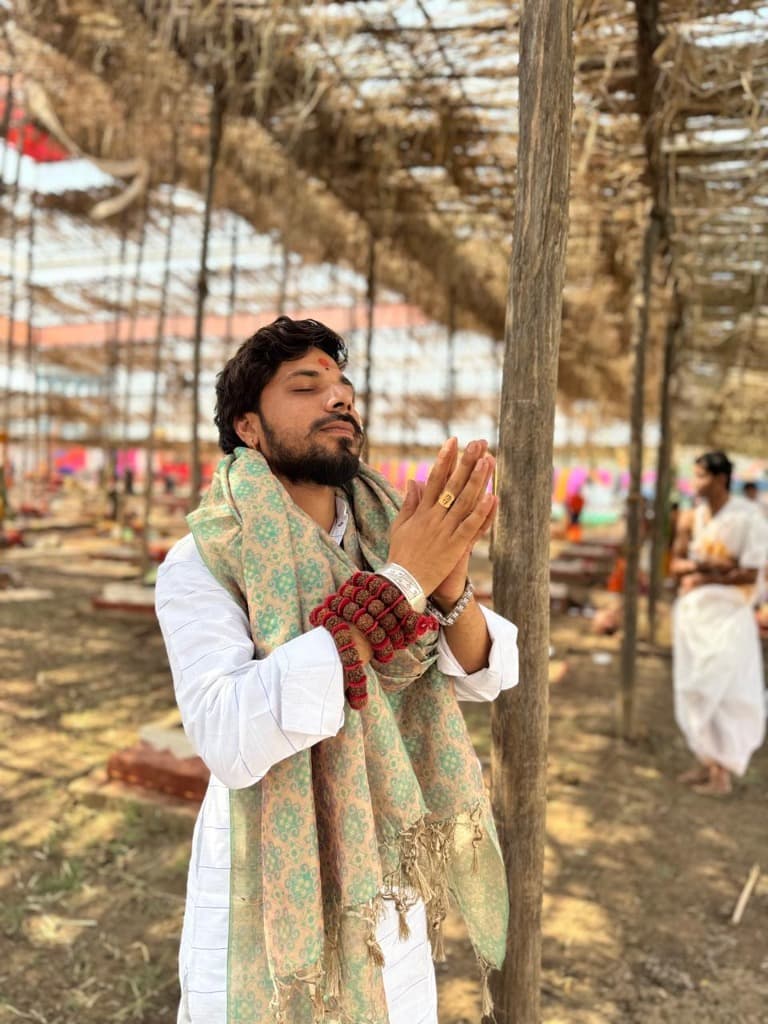
Acharya Tiwari Chetan Guru
Siddha Peethadheesh & Head Vedic Scholar
With over 15+ years of unbroken Vedic practice at Maa Baglamukhi Siddha Peeth, Nalkheda, Acharya Ji is a globally authoritative voice on Tantra Shastra, Stambhan Vidya, and Karmic Astrology. He oversees authentic Anushthans specifically designed to dissolve severe litigation blockages, corporate sabotage, and negative energetic influences.
Need Exact Hawan Cost & Shubh Muhurat?
Get direct guidance from Head Priest Acharya Tiwari Chetan Guru.