
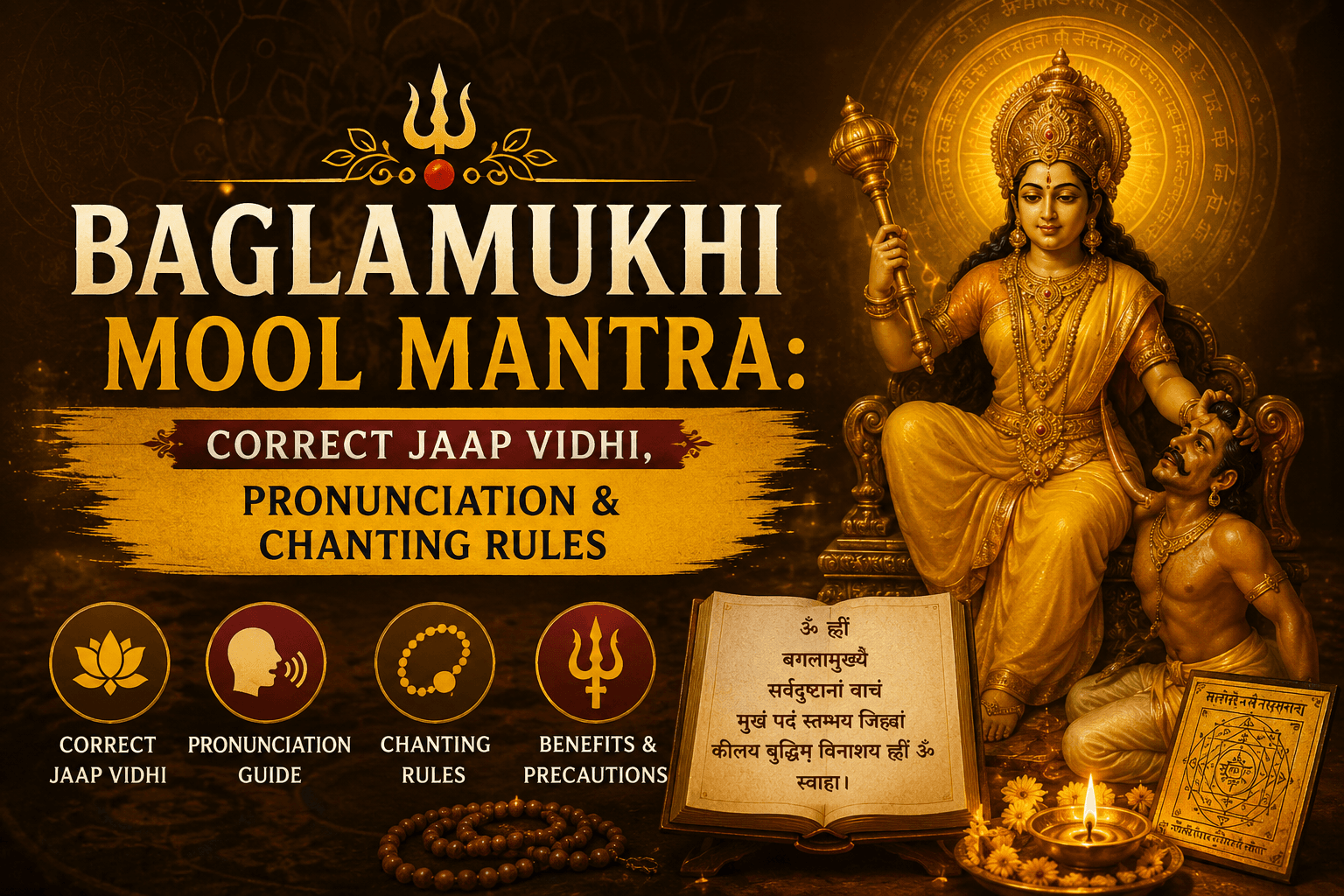
The Baglamukhi Mool Mantra is regarded as one of the most sacred mantras dedicated to Goddess Baglamukhi, the eighth Mahavidya in Sanatan Dharma. Devotees chant this powerful mantra to seek divine protection, inner strength, mental clarity, and the blessings of Maa Baglamukhi during spiritual practices, pujas, and havans.
In this comprehensive guide, you'll learn the authentic Baglamukhi Mool Mantra, its Sanskrit text, meaning, benefits, correct Jaap Vidhi, chanting rules, best time to chant, common mistakes to avoid, and answers to the most frequently asked questions—all in one place.
Why This Guide Matters
Many websites provide only the mantra, but few explain how to chant it correctly or the traditional practices associated with it. This guide is designed to help beginners and devotees understand the mantra in a structured and easy-to-follow way while maintaining respect for traditional Hindu practices.
Quick Highlights
You'll Learn | Details |
|---|---|
Original Mool Mantra | Sanskrit & Transliteration |
Meaning | Word-by-word & complete meaning |
Benefits | Spiritual, mental & practical significance |
Jaap Vidhi | Correct chanting method |
Best Time | Ideal time & direction |
Rules | Important dos & don'ts |
FAQs | Answers to common questions |
Quick Answer
What is the Baglamukhi Mool Mantra? It is the primary 36-syllable invocation of Goddess Baglamukhi, the eighth Mahavidya, used in every authentic Baglamukhi Puja, Havan, and Anushthan. It is chanted to invoke Stambhan Shakti, the goddess's power to still hostile speech, actions, and intent.
Where can I read the full meaning and benefits? This guide focuses on correct jaap vidhi, pronunciation, and chanting rules. For the complete meaning, spiritual significance, and benefit-by-benefit breakdown, see the Baglamukhi Mantra complete guide and the sacred text page for the Baglamukhi Mantra.
Note on tradition: Mantra practices in Hinduism vary by lineage, region, and guru-parampara. What follows reflects the Tantrokta Vidhi followed at Maa Baglamukhi Siddha Peeth, Nalkheda, under Acharya Tiwari Chetan Guru. Other traditions may prescribe minor variations, and that is normal within Sanatan Dharma.
What Is the Baglamukhi Mool Mantra?
The Mool Mantra, literally "root mantra," is the base invocation from which every other Baglamukhi mantra, whether for court cases, business, or protection, draws its energy.
It differs from the Beej Mantra ("Hleem" alone), which is a single-syllable seed sound, and from purpose-specific mantras written for a narrow situation.
The Mool Mantra is the complete, self-contained formula. It names the goddess, states the request, and closes the offering, all in one line.
Every Havan, Anushthan, and daily Sadhana performed at Nalkheda Siddha Peeth is anchored to this exact line. Getting its recitation right matters more than most devotees realise, which is the entire focus of this guide.
Baglamukhi Mool Mantra in Sanskrit and Hindi
Devanagari (Sanskrit/Hindi):
ॐ ह्लीं बगलामुखि सर्वदुष्टानां वाचं मुखं पदं स्तम्भय जिह्वां कीलय बुद्धिं विनाशय ह्लीं ॐ स्वाहा॥
This is the version followed in the Nalkheda tradition. You may also encounter it written with "ह्रीं" (Hreem) in place of "ह्लीं" (Hleem) on some traditional texts; both are accepted regional variants of the same beej, explained further in the pronunciation section below.
English Transliteration
Om Hleem Baglamukhi Sarva Dushtanam Vacham Mukham Padam Stambhaya Jihvam Kilaya Buddhim Vinashaya Hleem Om Swaha
Read it slowly first, syllable by syllable, before attempting full speed. Rushing transliteration is the single biggest source of pronunciation drift, covered in detail further down.
Word-by-Word Meaning (Padachheda)
Most guides give only the overall translation. Here is the mantra broken into its individual words, since knowing what each word is doing makes correct pronunciation and correct intention much easier to hold in mind while chanting.
Sanskrit Word | Literal Meaning | Function in the Mantra |
|---|---|---|
Om | Primordial cosmic sound | Opens the invocation |
Hleem | Beej (seed) of Baglamukhi's Stambhan Shakti | Activates the goddess's specific energy |
Baglamukhi | Name of the Goddess | Direct address to the deity |
Sarva | All | Qualifies "wicked ones" as universal, not selective |
Dushtanam | Of the wicked, of ill-intentioned people | Names who the prayer concerns |
Vacham | Speech | First faculty requested to be stilled |
Mukham | Mouth / face | Second faculty requested to be stilled |
Padam | Feet / movement | Third faculty requested to be stilled |
Stambhaya | Paralyze, still, immobilize | The core action-word (Stambhan) |
Jihvam | Tongue | Specific organ of false speech |
Kilaya | Pin down, nail, arrest | Reinforces Stambhaya with force |
Buddhim | Intellect | The faculty of scheming and planning |
Vinashaya | Destroy | Action requested on harmful intellect |
Hleem | Beej repeated | Seals the invocation |
Om | Cosmic sound repeated | Closes the address |
Swaha | Ritual offering exclamation | Formally offers the chant, as in a fire oblation |
Definition box: Stambhan is a Tantric term for the power to still, freeze, or immobilize a hostile force, whether it is a person's speech, action, or intent, without physically harming them. It is considered a defensive, restraining power rather than an offensive one.
Complete Meaning in Simple Words
Put together in plain English, the mantra is a prayer asking Maa Baglamukhi to still the speech, mouth, and movement of those who mean harm, to arrest their false tongue, and to dissolve the scheming intellect behind their actions, offered as a formal invocation.
For the fuller spiritual context of this meaning, including why Baglamukhi is called the goddess of Stambhan Shakti and how this connects to the wider Mahavidya tradition, the Baglamukhi Mantra complete guide covers it in depth.
Pronunciation Guide: Getting Every Syllable Right
Sanskrit mantras are sound-based practices. In Tantric tradition, the vibration matters as much as the meaning, so pronunciation is not a minor detail.
Break the mantra into these seven chanting units and practice each one slowly before joining them:
Om — a rounded "Aum" sound, held slightly, not clipped
Hleem — "H" + "L" blended softly, ending in a nasal "eem," not a hard "leem"
Baglamukhi — Bag-la-mu-khi, four even syllables, stress on the first
Sarva Dushtanam Vacham Mukham Padam — recited as one flowing phrase, each word given equal weight, no rushing through "Dushtanam"
Stambhaya — Stam-bha-ya, the "bh" is a soft aspirated sound, not a hard "b"
Jihvam Kilaya — Jih-vam Ki-la-ya, "Jihvam" should not collapse into "Jivham"
Buddhim Vinashaya Hleem Om Swaha — closing phrase, "Swaha" pronounced "Swa-haa," slightly extended on the final syllable
GEO answer block: How do you pronounce "Stambhaya" correctly? Say it as "Stam-bha-ya" with a soft aspirated "bh" (like the "bh" in "abhor"), not a hard English "b." This word carries the mantra's central instruction, so clarity here matters most.
Common Pronunciation Mistakes and Corrections
Common Mistake | Correct Form | Why It Matters |
|---|---|---|
Rushing "Sarva Dushtanam Vacham Mukham Padam" as one blur | Say each word distinctly, even if slower | Each word names a separate faculty being addressed |
Saying "Jivham" instead of "Jihvam" | Jih-vam (tongue) | A transliteration slip that changes the sound entirely |
Dropping the final "a" in "Stambhaya" and "Vinashaya" | Let both end on a soft "-ya" | Sanskrit verb endings carry grammatical meaning |
Treating "Hleem" and "Hreem" as errors of each other | Both are accepted beej variants across traditions | Neither is "wrong"; consistency within one Sadhana matters more than which variant you choose |
Ending abruptly after "Swaha" | Let "Swaha" trail slightly, as in a real offering | Swaha marks the formal close of the oblation |
Chanting silently in the mind only, without any lip or breath movement | Use at least a whisper (Upanshu Jaap) if not audible (Vaikhari Jaap) | Silent-only (Manasik) japa is considered an advanced stage, not a starting point |
Correct Jaap Vidhi: Step-by-Step
This is the exact sequence followed for Mool Mantra jaap in the Nalkheda tradition. Read it once fully before starting your own practice.
Snan (Bath): Take a bath and wear clean, preferably yellow, clothing before sitting for jaap.
Aasan (Seat): Sit on a yellow woollen or cotton asana. Avoid sitting directly on bare floor or metal.
Deepak (Lamp): Light a mustard oil or ghee lamp facing your seat.
Sankalp (Vow): Take water, rice, and a yellow flower in your right palm. State your name, gotra, and the honest purpose of your jaap, then release the water.
Ganesh Vandana: Offer a brief prayer to Lord Ganesha before beginning, as is customary before any Vedic practice.
Mala Shuddhi: Hold your Haldi Mala at heart level in your right hand, using the thumb and middle finger only, never the index finger.
Begin Jaap: Chant the full Mool Mantra once per bead, moving from bead to bead without skipping.
Sumeru Rule: On completing 108 beads, do not cross the Sumeru (the guru bead); reverse direction for the next round instead.
Closing: After your chosen number of rounds, touch the mala to your eyes, offer the merit of the jaap to the goddess, and sit in silence for a minute before rising.
CTA: If this is your first time attempting a structured jaap and you would prefer guided support, WhatsApp Acharya Tiwari Chetan Guru → for a personalised Sankalp and chanting schedule.
Best Time to Chant
Time Window | Suitability |
|---|---|
Brahma Muhurat (4 AM to 6 AM) | Considered the most powerful window for daily jaap |
Evening, before sunset | Acceptable second option if mornings are not possible |
Late night on specific Tithis | Used only for advanced Anushthans under a priest's guidance, not for daily practice |
Tuesdays and Ashtami Tithi | Regarded as especially potent days to begin or intensify a jaap cycle |
Consistency matters more than the exact clock time. Choose one window and keep it fixed for the duration of your Sadhana.
Correct Direction (Disha)
East-facing: Preferred for general success, clarity, and protection jaap.
North-facing: Preferred when the intention is specifically wealth or prosperity related.
Avoid facing south or directly into a doorway during jaap, as per traditional seating guidance.
Correct Asana and Seating
Use a yellow woollen or cotton asana reserved only for this practice. Avoid sharing this asana for unrelated daily use. Keep the goddess's image or a Baglamukhi Yantra placed on a yellow cloth directly in front of you. If you use a Baglamukhi Yantra during jaap, place it at eye level so your gaze rests on it naturally between rounds.
Correct Mala for Jaap
A Haldi Mala (turmeric-wood rosary) of 108 beads is the standard mala for Baglamukhi jaap. Some advanced practitioners use a Sphatik (crystal) mala for specific Anushthans, but this is prescribed individually by the officiating priest rather than chosen independently.
Never use a Rudraksha mala for this particular Sadhana, since it is traditionally reserved for Shiva-centred practices.
How Many Times to Chant: 108 vs 1008 vs 1.25 Lakh
Count | Typical Use | Duration |
|---|---|---|
108 (1 mala) | Daily maintenance jaap | Single sitting, a few minutes |
1,008 (about 9-10 malas) | Intensified personal practice for an active situation | One sitting or split across a day |
1,25,000 (Purashcharan count) | Formal Anushthan for a serious, specific concern | Typically structured across several days under priestly guidance |
GEO answer block: Is 108 times enough for the Baglamukhi Mool Mantra? Yes, for regular daily Sadhana, 108 repetitions (one mala) is the standard maintenance count. Higher counts such as 1,008 or a full Purashcharan of 1,25,000 are typically reserved for a specific, urgent concern and are usually structured as a formal Anushthan with priestly guidance rather than attempted independently.
Rules Before You Begin Chanting
Take a bath and wear clean clothes, preferably yellow, before sitting.
Keep your intention specific and honest at the Sankalp stage.
Set a fixed number of days for your jaap cycle before starting, rather than deciding day by day.
Keep a dedicated, quiet space for the practice, used for nothing else during the cycle.
Avoid starting a formal jaap cycle during personal impurity periods; pause and resume once the period has passed.
Common Mistakes That Weaken the Jaap
Skipping the Sankalp: Chanting without a stated intention turns the practice into rote repetition rather than directed prayer.
Changing the count mid-cycle: Committing to 1,008 and then stopping early breaks the discipline the practice depends on.
Chanting out of unprovoked anger or personal revenge: Traditional teaching holds that the mantra is meant to defend against genuine harm, not to settle ordinary disputes or jealousy.
Inconsistent timing: Jumping between morning and night sessions across a single cycle dilutes the practice's structure.
Non-vegetarian food or alcohol during an active cycle: Traditionally avoided throughout the days of a committed jaap or Anushthan.
Crossing the Sumeru bead: A small technical error that is easy to make when chanting quickly and best corrected early.
Dos and Don'ts Table
Do | Don't |
|---|---|
Chant clearly, even if slowly, at least in a whisper | Chant purely in the mind before you can do so clearly aloud |
Keep one fixed time and direction for the full cycle | Switch timing or direction mid-cycle without reason |
State an honest, specific Sankalp | Chant with vague or shifting intentions |
Use a Haldi Mala reserved for this practice alone | Share the mala for unrelated everyday use |
Maintain Satvik food during an active cycle | Consume non-vegetarian food, alcohol, or garlic-onion heavy meals during Sadhana days |
Complete the committed count before stopping | Abandon a committed jaap cycle partway through |
Who Can Chant This Mantra
Any sincere devotee facing genuine obstacles, be it legal disputes, workplace hostility, or a general need for protection and clarity, can chant this mantra with the correct vidhi. Beginners, working professionals, and long-time Sadhaks alike can practise it, provided the rules above are respected.
Who Should Avoid Chanting It
Those seeking to harm an innocent person out of jealousy or personal grudge, since traditional teaching holds the mantra loses its intended effect when misused this way.
Anyone unwilling to commit to at least basic purity and consistency rules for the duration of a cycle.
Those attempting very high counts (1,008 and above) without any priestly guidance, since higher-intensity practices are traditionally supervised.
Can Women Chant During Menstruation
Traditional Vedic practice generally advises pausing formal jaap and temple rituals during the menstrual period, resuming once it has passed. Practices on this point vary by family tradition and personal belief, and there is no single universal rule across all lineages. When in doubt, it is reasonable to pause the count and resume from where you left off once you are ready.
Can Beginners Start Directly With the Mool Mantra
Yes. Unlike some higher Tantric practices that require initiation (Diksha), the Mool Mantra can be chanted by beginners without a formal Diksha, provided it is done with respect, correct pronunciation, and an honest Sankalp. Those planning a large-count Anushthan (1,008 or above) are still encouraged to consult a priest first.
Meaning and Benefits at a Glance
This guide is focused on jaap vidhi, pronunciation, and rules. For the areas below, these existing guides go deeper:
Topic | Where to Read More |
|---|---|
Full meaning, origin, and spiritual significance | |
Court case and legal victory benefits | How Baglamukhi Mantra works for court cases, enemies, politics |
Business, career, and success benefits | |
Enemy protection and black magic removal | |
Beej Mantra and full sacred text | |
Strengthening jaap with a Yantra | Maa Baglamukhi Yantra complete guide and how to use the Yantra daily |
Frequently Asked Questions
1. What is the difference between the Baglamukhi Mool Mantra and the Beej Mantra?
The Mool Mantra is the complete 36-syllable invocation, while the Beej Mantra is just the single seed sound "Hleem." The Mool Mantra is used for full Sadhana, Havan, and Anushthan, while the Beej alone is used for shorter, focused practice.
2. How many times should I chant the Mool Mantra daily?
108 times, or one full mala, is the standard daily count for maintenance practice. Higher counts are typically reserved for a specific concern and structured as a formal cycle.
3. Is "Hleem" or "Hreem" the correct beej to use?
Both are accepted variants found across Baglamukhi texts and traditions. What matters more is staying consistent with one form for the full duration of your jaap cycle.
4. Can I chant the mantra without a mala?
A mala helps maintain an accurate count and keeps the mind focused, so it is strongly recommended. If one is genuinely unavailable, finger counting can be used temporarily.
5. What happens if I lose count mid-jaap?
Simply complete the current round to a natural stopping point and note it honestly rather than guessing. Consistency of intention matters more than achieving a perfect, unbroken count on any single day.
6. Do I need Diksha (initiation) before chanting the Mool Mantra?
No, the Mool Mantra can generally be chanted without formal Diksha. Larger-count Anushthans are the exception, where priestly guidance is recommended.
7. What is the Sumeru bead and why does it matter?
The Sumeru is the larger central or "guru" bead on the mala marking the start and end of a round. Tradition holds that it should never be crossed; instead, reverse the mala's direction for the next round.
8. Can I chant this mantra silently in my mind?
Silent (Manasik) chanting is considered an advanced stage. Beginners are generally advised to chant at least in a whisper (Upanshu Jaap) until the pronunciation feels fully secure.
9. What if I mispronounce a word during jaap?
Pause, correct yourself, and continue calmly. Sincere effort and steady practice matter more than isolated slips, though working through the pronunciation guide above will reduce them over time.
10. Can this mantra be chanted for someone else's protection?
Yes, provided the Sankalp names the specific person and the honest, protective intention behind it.
11. How long before results are typically noticed?
This varies widely by individual, intensity of practice, and the specific situation, and traditional belief holds there is no fixed or guaranteed timeline. Consistency across a committed cycle is generally considered more important than any single day's chanting.
12. Should I do the full jaap vidhi every single day, or can I simplify it?
The full vidhi is ideal, but on genuinely constrained days, a simplified version (Sankalp plus the mantra itself, without the full lamp and Ganesh Vandana steps) is considered acceptable. Try not to let simplification become the daily norm.
Conclusion
The Baglamukhi Mool Mantra works the same 36 syllables whether you are chanting it for protection, court case clarity, or general peace of mind. What changes the experience of chanting it is precision: correct pronunciation, a fixed vidhi, a committed count, and honest intention held from Sankalp to close.
Treat this guide as a working reference to return to each time you refine your practice, and treat the linked guides above as your next stop for the meaning, benefits, and situational uses of this mantra.
Book Baglamukhi Puja
Book an Authentic Baglamukhi Puja or Anushthan at Nalkheda Siddha Peeth →
If you would like this jaap performed on your behalf, or guided personally through it, Acharya Tiwari Chetan Guru conducts Sankalp-based Sadhana and Anushthan for devotees worldwide, online and in person at Nalkheda.
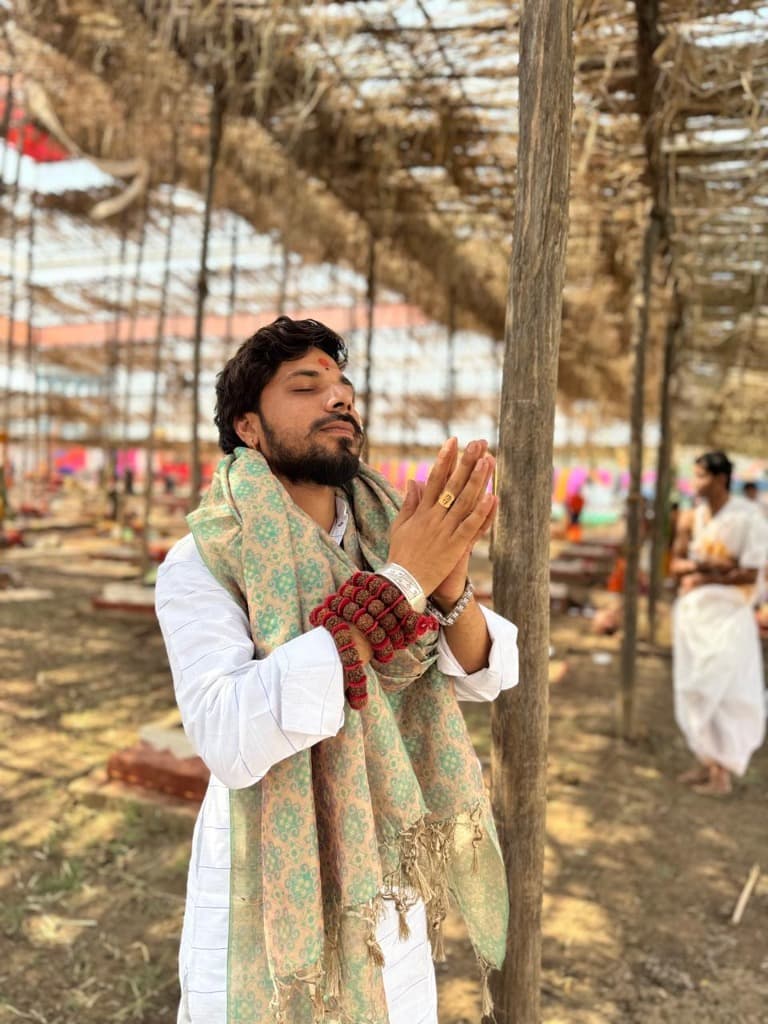
Acharya Tiwari Chetan Guru
Siddha Peethadheesh & Head Vedic Scholar
With over 15+ years of unbroken Vedic practice at Maa Baglamukhi Siddha Peeth, Nalkheda, Acharya Ji is a globally authoritative voice on Tantra Shastra, Stambhan Vidya, and Karmic Astrology. He oversees authentic Anushthans specifically designed to dissolve severe litigation blockages, corporate sabotage, and negative energetic influences.
Need Exact Hawan Cost & Shubh Muhurat?
Get direct guidance from Head Priest Acharya Tiwari Chetan Guru.