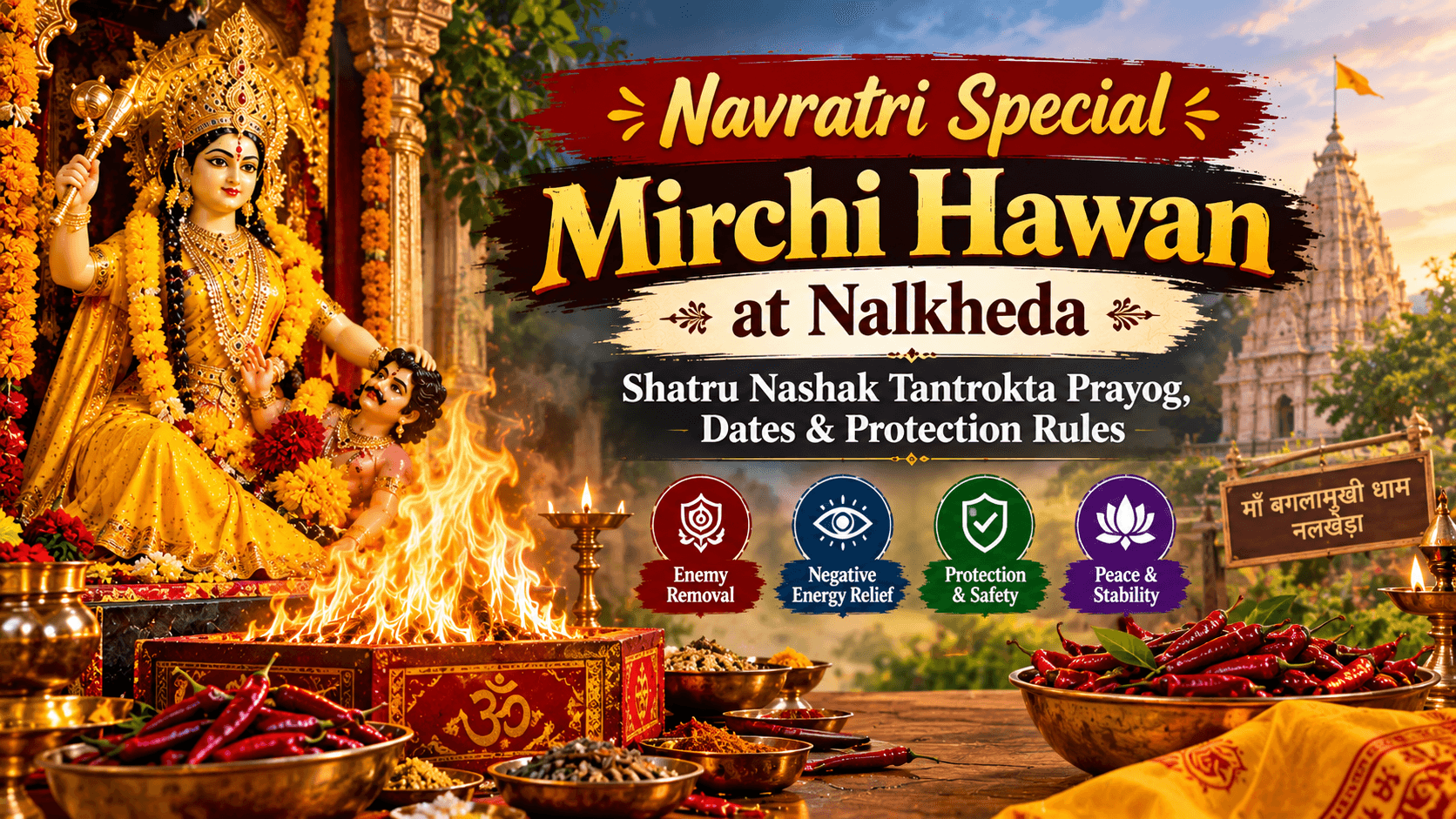
Mirchi Hawan is a name devotees use for a priest-led Baglamukhi fire ritual associated with the Shatru Nashak intention, meaning prayer for protection and relief from conflict. Shardiya Navratri 2026 runs from 11 to 19 October in most calendars. Because Mirchi Hawan has no single fixed procedure or date, readers should confirm the ritual, Muhurat, safety arrangements and availability directly with the temple before planning.
Navratri Mirchi Hawan at Nalkheda - Quick Overview
Detail | Information |
|---|---|
Ritual | Navratri Special Mirchi Hawan |
Deity tradition | Maa Baglamukhi, as worshipped at Nalkheda |
Location | Nalkheda, Agar Malwa, Madhya Pradesh |
Relevant dates | Navratri 11 to 19 October 2026 in most calendars; Ashtami and Navami on 19 October in several calendars; Vijayadashami 20 October |
Muhurat | Confirm with the relevant Panchang or performing priest |
Ritual purpose | Traditional prayer for protection and relief from conflict |
Preparation | Follow the performing priest’s instructions |
Cost | No Mirchi Hawan price is published; the temple page lists a Shatru Nashak Havan at ₹11,000 as a separate service |
Booking | Puja booking page or consultation; confirm Mirchi Hawan availability first |
What Is Mirchi Hawan?
Mirchi Hawan, also written Mirchi Havan, is a fire ritual in which red chillies are mentioned as part of the offerings within some Baglamukhi traditions. Devotees use the name for a Shatru Nashak style Havan, but no standard text defines it, and the procedure varies by lineage and priest.
Transparency matters here. Reliable, citable religious sources on this specific ritual are scarce. The material found online consists mostly of temple and service-provider pages, a 2020 travel blog that calls the Mirchi Havan at Nalkheda famous, and a 2026 press item listing it among rituals offered by a Nalkheda priest. These show that the term is in use. They do not document a procedure, and none is repeated here.
A general Havan offers ghee, wood and prepared samagri into consecrated fire with mantras. Mirchi Hawan is described by devotees as a more specialised, intention-specific variant. Do not assume every Baglamukhi Havan includes the same ingredients or steps, or that two providers using this name perform the same ritual. This article gives no mantras, ingredient lists or quantities, because the performing priest decides these.
Why Is Mirchi Hawan Associated With Maa Baglamukhi Worship?
Maa Baglamukhi is worshipped as one of the ten Mahavidyas within the Shakta tradition. She is traditionally associated with Stambhan, the power to still or restrain, including restraining harmful speech and obstruction. Her worship is commonly linked in devotional literature with themes of protection and the steadying of conflict. Devotees often connect yellow offerings and fire rituals with her.
These are religious interpretations and beliefs, not scientifically established guarantees. They describe what the tradition holds and what devotees seek, which is often courage, composure and a sense of spiritual shelter during hard times.
On its Nalkheda temple page, the website notes that Tuesday is regarded as an especially significant day for Maa Baglamukhi worship, and that a Shatru Nashak Havan is performed on every Amavasya. These are the site’s own statements of tradition and should be read as such. Other priests and families may follow different customs. For the temple’s background, see Maa Baglamukhi Temple, Nalkheda.
Navratri Mirchi Hawan 2026 - Dates and Muhurat
Shardiya Navratri 2026 begins on 11 October and runs to 19 October in most calendars, with Vijayadashami on 20 October. This year the tithis are compressed, so several calendars place both Durga Ashtami and Maha Navami on 19 October. No reliable source establishes a special date for Mirchi Hawan, so none is given here.
PanchangBodh’s computation for New Delhi shows Ashtami present at sunrise on 19 October and ending at 10:53 AM, with Navami following until 12:52 PM on 20 October. IBTimes India also reports Ashtami and Navami on 19 October. Calendars differ, however. SmartPuja counts the first day as 12 October, and Dekho Panchang lists Maha Navami on 20 October under the sunrise rule.
Ashtami and Navami hold a special place in Devi worship, and many households and temples hold a Havan on one of them, often with Kanya Pujan. Others choose another Navratri day, or a Tuesday, according to their lineage. No reliable evidence found establishes that Mirchi Hawan must be done on Ashtami or Navami, and no date is claimed to give better results.
Tithis are calculated from local sunrise, so Delhi timings cannot be applied to Nalkheda, and Nalkheda’s temple timings may differ from your city’s. Confirm the date and Muhurat with your local Panchang and the performing priest or temple. For more detail, see the Ashtami and Navami 2026 guide and the Shardiya Navratri 2026 main guide. Day-specific Havan details are in the Ashtami Havan and Navami Havan articles.
What Is Shatru Nashak Tantrokta Prayog?
Shatru Nashak is a compound of two Sanskrit words, shatru (adversary) and nashak (remover). Tantrokta means “as stated in the Tantras”, and prayog means an application or performance. Together, Shatru Nashak Tantrokta Prayog describes a priest-led ritual performed in the Tantric stream of Shakta worship with the intention of protection from adversity.
Many devotees read “shatru” broadly. It can mean a hostile person, but also obstruction, fear, anxiety and inner conflict. In this reading, the devotional intention is protection, restraint of one’s own reactions, clarity and strength while dealing with conflict. A devotee may undertake the worship while praying for courage, peace of mind or relief from a hard situation.
Some boundaries must be stated plainly. The ritual is not a substitute for lawful action, professional advice, personal safety measures or peaceful dispute resolution. It cannot be presented as a way to harm, control or remove another person, and no outcome is guaranteed. Not every practitioner follows one universal method, and secret instructions are not published here. The temple’s own page, for context, states that Havan should not be performed without an Acharya’s guidance.
Mirchi Hawan vs General Baglamukhi Havan vs Maha Havan
Durations and prices below are those listed on the temple page or service pages. Where nothing is published, the table says so.
Ritual | General Description | Devotional Intention | Duration | Booking Consideration |
|---|---|---|---|---|
Fire ritual with mantra-based offerings | General worship, protection, peace | Listed as 1 day; ₹11,000 | Standard service on the price list | |
Mirchi Hawan | Specialised Havan name in use by devotees and some providers | Protection and relief from conflict | Not published | No dedicated page or price found; confirm availability and details |
Listed service for protection from adversity | Protection, restraint, courage | Service card states 2 to 3 hours; temple price list says 1 day, ₹11,000 | Confirm exact inclusions | |
Larger, more elaborate fire ritual | Important Sankalps and milestones | Listed as 1 day; ₹21,000 | Confirm date and inclusions | |
Multi-day mantra practice | Sustained devotional discipline | 3 days, ₹31,000; 11 days, ₹51,000 | Longer commitment |
These terms are not interchangeable, and none is claimed to be more powerful than another. Do not assume the Shatru Nashak or general Havan price applies to Mirchi Hawan. The Anushthan format is covered in the Navratri Maha Anushthan guide.
How Is a Priest-Led Mirchi Hawan Arranged?
A devotee usually arranges a priest-led ritual through an established temple or Acharya. In outline:
Confirm the exact ritual name and its purpose, since names vary between providers.
Ask the performing priest which date and Muhurat are appropriate.
Confirm the location and whether the ritual is conducted in person or remotely.
Ask which samagri and arrangements are included.
Confirm the duration, current cost and Prasad arrangements, if applicable.
Follow the priest’s instructions for participation and completion.
No fixed Tantric procedure is described here. If you are unsure which ritual suits your intention, the website offers a consultation with the Acharya before booking.
Mirchi Hawan Samagri and Preparation
The actual ingredients depend on the ritual tradition and the priest conducting it. This article does not publish a recipe, quantities or an offering sequence. A general preparation checklist is more useful:
Confirmed Puja or Havan arrangements, with date and timing in writing
A clean, appropriate ritual space, where the ritual is held at your premises
Required offerings, as specified by the priest
Aarti and Prasad arrangements, where applicable
Personal participation instructions supplied by the priest, such as clothing or fasting guidance
For a Navratri observance, the Navratri Puja Samagri list covers general worship items and the Navratri vrat rules cover fasting. Neither is a Mirchi Hawan recipe.
Please do not burn chillies or other substances at home without expert guidance and proper ventilation. Chilli smoke is pungent and can strongly irritate the eyes, nose and lungs. The specific samagri used by a trained practitioner is separate from this general preparation and should not be copied.
Protection Rules and Safety Precautions
Protection, in the sense that matters most here, begins with practical care for everyone involved. These precautions are offered as sensible practice and not as fear-based rules. Nothing in them implies that a missed step brings bad luck or punishment.
Follow the qualified priest. Rely on the performing Acharya’s instructions for date, participation and completion.
Do not copy unverified procedures. An unfamiliar Tantric method taken from an unverified website or video can be unsafe, and many online descriptions are inaccurate.
Keep children and pets away from the fire and hot ritual materials.
Maintain ventilation and fire safety. Keep water or a fire extinguisher at hand and keep flammable items, curtains and clothing clear of the Kund.
Avoid inhaling smoke or exposing others to irritating fumes. People with asthma, allergies or heart or lung conditions, as well as pregnant women, the elderly and young children, should stay away from any smoke-producing ritual.
Do not use the ritual to threaten, intimidate, harass or target another person. Worship that seeks protection is different from worship aimed at harming someone, and nothing here supports the latter.
Do not base legal, medical or financial decisions on a ritual alone. Continue to follow your lawyer’s, doctor’s or adviser’s guidance.
Respect consent and comfort. Nobody should be pressed to join, and family members who are uncomfortable should be free to stay away.
Confirm temple requirements before travelling, including dress guidelines and conduct. The Nalkheda temple rules page is a starting point.
If a provider or website warns that missing a rule will bring harm, treat that as a sign to ask more questions.
Can Mirchi Hawan Be Arranged During Navratri at Nalkheda?
The website does not list Mirchi Hawan as a dedicated service page with a published price or duration. At the time of checking on 10 October 2026, a site banner on its Navratri Havan booking article referred to a “Special Tuesday Mirchi Hawan” and Navratri Anushthan, with a prefilled WhatsApp enquiry option. That shows the term is used by the site, but it is not a published service specification.
The listed services that are verifiable are the Shatru Nashak Puja, the Maa Baglamukhi Havan, the Maha Havan and the Anushthan. The temple page also describes a special nine-day Maa Baglamukhi Anushthan during Navratri. Availability for any specific Navratri date should be confirmed directly. For the festival picture, see Baglamukhi Havan during Navratri 2026.
Mirchi Hawan Cost and Booking Details
No price for Mirchi Hawan is published, so none is stated. The temple page lists a Shatru Nashak Havan at ₹11,000 as a one-day ritual and says listed prices include puja samagri, pandit dakshina and prasad, with custom requirements quoted separately. That figure applies to the Shatru Nashak Havan only and should not be assumed for Mirchi Hawan. The factors behind quotations are explained in the Baglamukhi Havan price guide.
Before booking, ask:
The exact ritual name
The date and expected duration
Whether it is performed at Nalkheda or elsewhere
Which samagri, priest dakshina and prasad are included
Whether live video participation or couriered Prasad is offered
The total price and any additional charges
Cancellation, rescheduling or other booking terms, if published (none were found on the pages reviewed)
Ask for the answers in writing before paying.
Online Booking From India and Abroad
The website states that devotees can book Maa Baglamukhi rituals online, and that its Online Havan is performed at Nalkheda on the devotee’s behalf, with live WhatsApp video and Prasad by courier. Whether Mirchi Hawan specifically is offered online is not confirmed, so ask first. Devotees abroad can also see the NRI online puja booking page and the online Navratri Puja booking guide.
Visit the relevant service or booking page.
Confirm the exact ritual and date with the service provider.
Ask for the current cost and inclusions.
Confirm the payment method and a booking acknowledgement, since the site does not describe an automated payment flow.
Ask how remote participation, live video or Prasad delivery works, and whether delivery reaches your country.
Frequently Asked Questions About Navratri Mirchi Hawan 2026
1. What is Mirchi Hawan?
It is a name devotees use for a specialised Baglamukhi fire ritual, in which red chillies are mentioned among the offerings. No standard text defines it, and the procedure varies by lineage and priest. Confirm the details with the performing priest.
2. What is Navratri Special Mirchi Hawan at Nalkheda?
It is the name the website’s banner uses for a Navratri offering at Nalkheda. No dedicated service page, price or duration is published, so confirm what it includes before planning.
3. When is Navratri in 2026?
Shardiya Navratri runs from 11 to 19 October 2026 in most calendars, with Vijayadashami on 20 October. Some calendars count from 12 October. Check your local Panchang for your city.
4. Is Mirchi Hawan performed on Ashtami or Navami?
It may be, depending on the priest’s tradition, but no reliable source found fixes it to either day. Several calendars place both on 19 October this year. Ask the performing priest which day they follow.
5. Is there a fixed date for Mirchi Hawan?
No fixed date was found in reliable sources. The site’s temple page speaks of Tuesdays and Amavasya in the context of Baglamukhi worship, but these are traditions, not rules. The priest confirms the date.
6. What does Shatru Nashak mean?
Shatru means adversary and nashak means remover. Devotionally, it is read as seeking protection and relief from conflict, and many devotees understand “shatru” to include obstruction and inner turmoil. It is not a promise to harm anyone.
7. What does Tantrokta Prayog mean?
Tantrokta means “as stated in the Tantras”, and prayog means performance. It describes a ritual done in the Tantric tradition by a priest. Methods differ between practitioners, and no single universal procedure exists.
8. Is Mirchi Hawan the same as general Baglamukhi Havan?
No. A general Havan offers ghee, wood and samagri with mantras, while Mirchi Hawan is described as a specialised variant. The two should not be treated as interchangeable, and the pricing and inclusions may differ.
9. What Samagri is used for Mirchi Hawan?
This depends on the priest and tradition, and no verified list is published here. Do not rely on online recipes. Ask the performing priest which samagri is used and whether it is included in the quoted price.
10. Can Mirchi Hawan be performed at home?
It is not recommended without a qualified priest. Chilli smoke can irritate the eyes and lungs, and the temple page advises against performing Havan without an Acharya’s guidance. If you wish to proceed, arrange it through a qualified priest with proper ventilation.
11. What safety precautions are important?
Follow the priest’s instructions, keep children and pets away, ensure ventilation and fire safety, avoid inhaling smoke, and keep vulnerable people away. Do not copy procedures from unverified sources, and never use a ritual to threaten or target anyone.
12. Does every Baglamukhi Havan include Mirchi Hawan?
No. A general Havan, a Shatru Nashak Havan, a Maha Havan and an Anushthan are separate services, each with its own details. Ask the provider exactly what is included.
13. How can I verify whether Mirchi Hawan is available at Nalkheda?
Contact the team through the booking or consultation page and ask for the ritual’s exact name, date, duration and inclusions. No dedicated Mirchi Hawan page was found at the time of writing, so a written confirmation is useful.
14. How much does Mirchi Hawan cost?
No price is published. The temple page lists a Shatru Nashak Havan at ₹11,000 and a standard Hawan at ₹11,000, both for one day, but that does not establish the Mirchi Hawan cost. Ask for a written quotation.
15. Can I enquire about online participation?
Yes. The website states that its Online Havan includes live WhatsApp video and Prasad by courier. Whether this applies to Mirchi Hawan must be confirmed, along with payment and delivery details.
16. Can the date differ according to the local Panchang?
Yes. Tithis follow local sunrise, so a date for Delhi may differ from one for Nalkheda or your city. Calendars also differ, with Navami shown on 19 or 20 October. Confirm with your Panchang and the priest.
17. Should Mirchi Hawan replace legal or professional advice?
No. It is a devotional practice and not a substitute for lawful action, medical care or financial advice. Continue to follow qualified professionals while you pray for strength and composure.
18. How do I enquire about a Navratri Havan booking?
Open the puja booking page, or speak with the Acharya through the consultation page. Share the ritual you are considering, your preferred date and your Sankalp, and ask for the cost and inclusions in writing.
Final Thoughts
Mirchi Hawan is a ritual name that carries a great deal of curiosity and not much documentation. The most useful approach is careful and practical: confirm the exact ritual with the temple, verify dates against your local Panchang, follow the performing priest, and treat safety as part of devotion.
At its heart, Shatru Nashak worship is prayer for protection, courage and clarity. It is a matter of faith and not a guaranteed way to control others or secure a worldly outcome, and it should always sit alongside lawful, practical and professional steps.
Enquire About Maa Baglamukhi Havan at Nalkheda During Navratri 2026
If you are considering a Maa Baglamukhi Puja or Havan this Navratri, you are welcome to enquire about the available services, the appropriate ritual for your intention, the date and the current booking process. Please ask whether Mirchi Hawan itself is offered for your preferred date, because this article cannot confirm it.
You may also speak with the Acharya before choosing, and read about the listed Shatru Nashak Puja while you decide. There is no need to hurry, and no outcome is promised.
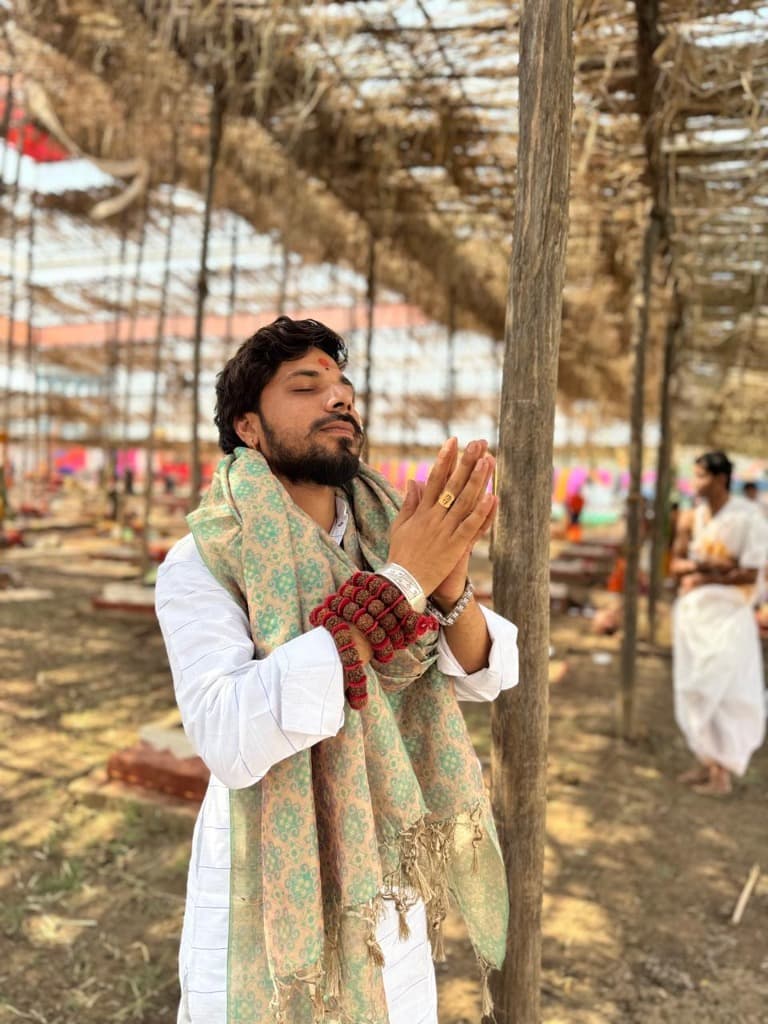
Acharya Tiwari Chetan Guru
Siddha Peethadheesh & Head Vedic Scholar
With over 15+ years of unbroken Vedic practice at Maa Baglamukhi Siddha Peeth, Nalkheda, Acharya Ji is a globally authoritative voice on Tantra Shastra, Stambhan Vidya, and Karmic Astrology. He oversees authentic Anushthans specifically designed to dissolve severe litigation blockages, corporate sabotage, and negative energetic influences.
Need Exact Hawan Cost & Shubh Muhurat?
Get direct guidance from Head Priest Acharya Tiwari Chetan Guru.