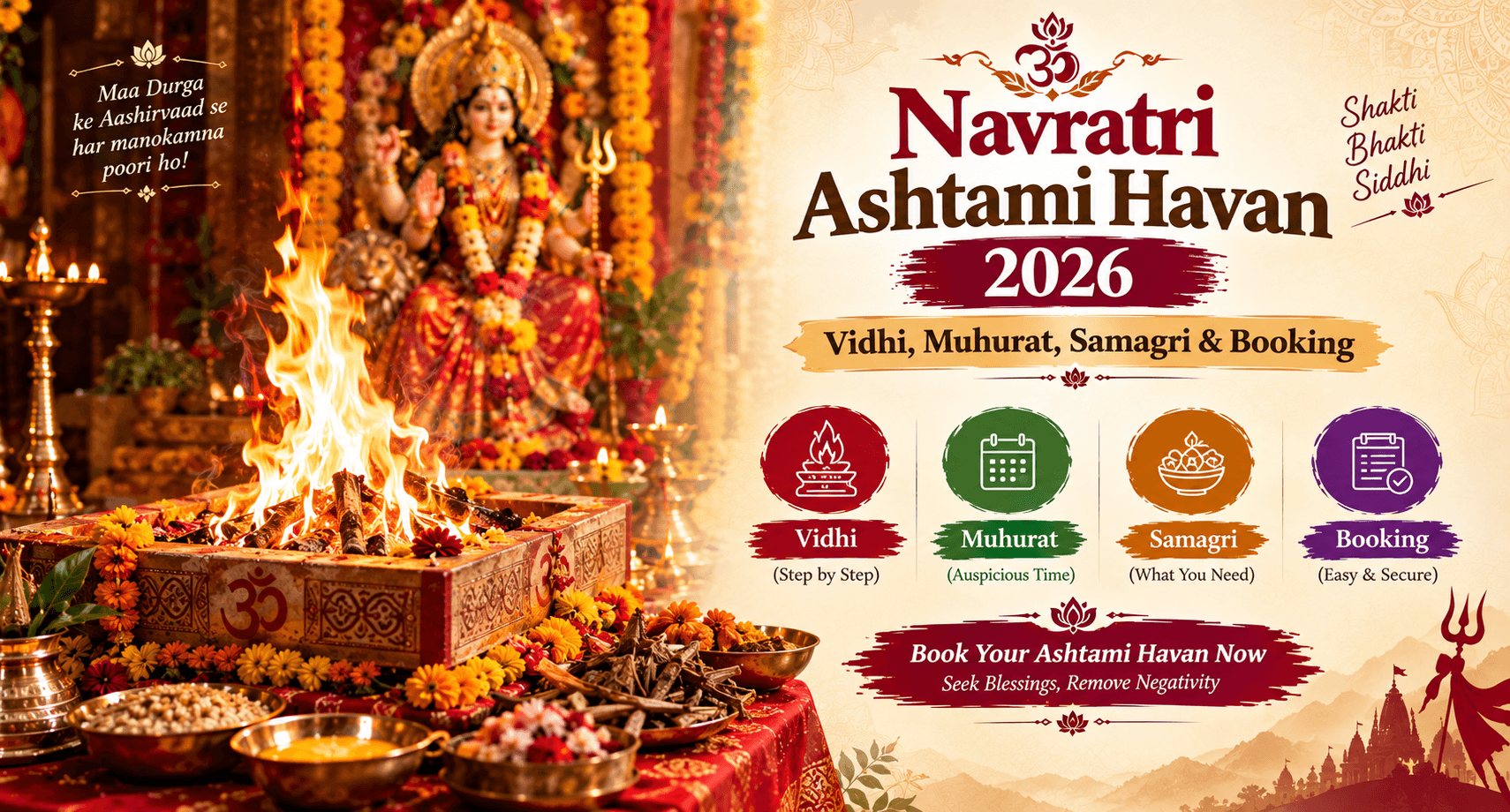
Maha Ashtami in Shardiya Navratri 2026 falls on Sunday, 18 October, according to the Panchang followed across most of North and Central India. Yes, Havan can be performed on Ashtami, it is one of the two most common days for the Navratri fire ritual, alongside Navami. A Navratri Ashtami Havan is a Vedic fire offering made specifically on this day, timed to the worship of Maa Mahagauri, the eighth form of the Navadurga. This guide covers the verified 2026 date, how Ashtami Muhurat is worked out, the complete Samagri list, a step-by-step Vidhi, the mantras used, and how devotees can book a priest-guided Ashtami Havan at the Maa Baglamukhi Siddha Peeth in Nalkheda if they would rather not perform the ritual alone.
Quick Answer: Navratri Ashtami Havan 2026
Detail | 2026 Date / Info |
|---|---|
Maha Ashtami | Sunday, 18 October 2026 |
Day | Sunday |
Navratri period | 11 to 20 October 2026 |
Ashtami Tithi | Begins morning of 18 October, extends into late morning of 19 October |
Ashtami Havan timing | No single Muhurat for all of India; varies by city and Panchang (see below) |
Kanya Pujan | Commonly observed on 18 or 19 October, by family tradition |
Sandhi Puja | At the Ashtami-Navami tithi junction; exact clock time is city-specific |
Maha Navami | Monday, 19 October 2026 |
Vijayadashami | Tuesday, 20 October 2026 |
A small number of Panchangs that apply the sunrise rule strictly to the transition point observe Ashtami and Navami together on 19 October. Both are correct within their own calculation method. Exact Havan Muhurat should always be confirmed against your city's Panchang or with your family priest.
When Is Navratri Ashtami Havan in 2026?
Maha Ashtami, also called Durga Ashtami, is the eighth day of Shardiya Navratri 2026 and falls on Sunday, 18 October. According to Panchang calculations followed across most of North India, the Ashtami Tithi begins on the morning of 18 October and continues into the late morning of 19 October, before Navami Tithi takes over. Because Ashtami is the tithi prevailing at sunrise on the 18th, this is the date marked for Maha Ashtami on most calendars, including the one followed on this site.
This is also why date confusion comes up every single year. A Tithi does not always match a 24-hour civil day; it can start partway through one day and run into the next. A smaller group of Panchangs, applying the sunrise rule strictly to the transition itself, treat Ashtami and Navami as merging into a single day of observance on 19 October. Neither approach is wrong. The difference reflects genuine regional and Panchang variation, not an error on anyone's part. For the complete tithi breakdown behind this, the Shardiya Navratri 2026 Ashtami and Navami guide lays out both calculation methods in detail.
Ashtami Havan Muhurat 2026
Muhurat, in the context of a Havan, refers to the astrologically favourable window traditionally chosen for lighting the sacred fire and beginning the mantra sequence. For Ashtami Havan, this window is generally worked out from the Ashtami Tithi timing for a specific city, combined with any Rahu Kaal or other inauspicious periods that a family or priest wants to avoid.
Because tithi transitions are calculated from local sunrise, the practical Muhurat for Ashtami Havan can shift by a few hours between cities that are otherwise close together. A window that works for Delhi is not automatically correct for Ujjain or Nalkheda. This is precisely why this article does not print a single "8:00 AM to 10:00 AM" Muhurat and present it as valid nationwide. That kind of blanket timing, seen on many generic sites, is one of the more common sources of confusion during Navratri.
Sandhi Puja, where observed, is traditionally performed at the exact junction of the last 24 minutes of Ashtami Tithi and the first 24 minutes of Navami Tithi, a roughly 48-minute window whose clock time depends entirely on the Ashtami-Navami transition for that location. Devotees in and around Nalkheda, Agar Malwa, wanting an exact ritual timing for Havan or Sandhi Puja should confirm it through a current local Panchang or by speaking with a Vedic Acharya, rather than relying on a generic online time calculated for a different city.
What Is Navratri Ashtami Havan?
Havan, also known as Homa, is a Vedic fire ritual in which offerings of ghee, samagri and specific herbs are made into a consecrated fire while mantras are recited. During Navratri, this offering is directed toward Devi in her various forms, and when performed specifically on Ashtami, it is timed to the worship of Maa Mahagauri.
The difference between an ordinary Navratri Puja and a Havan is mainly one of scale. A daily Puja usually involves a diya, flowers and an aarti. A Havan adds a consecrated fire, specific Samagri offered as ahuti, and a structured mantra sequence. Devotees traditionally believe that offerings made into Agni carry a devotee's prayer directly to the deity, though this guide presents that as a traditional belief rather than a claim of guaranteed outcome.
Why Is Havan Performed on Ashtami?
Maha Ashtami is widely regarded as one of the most spiritually significant days of the nine-night observance, marked by intensified worship of Maa Mahagauri and, in many households, the peak of the Navratri fast. Several traditions converge on this day:
Special worship of Maa Mahagauri with white or light-coloured offerings, as she is traditionally associated with purity and calm strength
Kanya Pujan, in the many families that follow the Ashtami tradition rather than the Navami one
Sandhi Puja, in regions and communities that observe this junction ritual, more common in Bengal, Assam, Odisha and parts of eastern India, though increasingly followed elsewhere too
A concluding or near-concluding Havan, in households that treat Ashtami as the primary ritual day of the nine
Regional variation matters here. In much of North and Central India, including Madhya Pradesh, Ashtami and Navami are both widely used for Havan and Kanya Pujan, with the choice generally coming down to family Sampradaya rather than a fixed rule.
Navratri Ashtami Havan Samagri List
Samagri | Purpose / Traditional Use | Essential or Optional |
|---|---|---|
Havan Kund | Fire pit or vessel where the sacred fire is established | Essential |
Havan Samagri (mixed offering material) | Primary material offered into the fire with each ahuti | Essential |
Dry wood / Samidha | Fuel for the sacred fire | Essential |
Ghee | Poured or offered with each ahuti | Essential |
Camphor | Used to help establish the fire and during aarti | Essential |
Kalash with water | Kept nearby as part of the broader Ashtami Puja setup | Essential |
Flowers, preferably white or red | Offered during the Devi worship portion | Essential |
Kumkum / Roli and Akshat | Used for tilak and Devi worship | Essential |
Fruits and coconut | Naivedya, with the coconut generally reserved for Purnahuti | Essential |
Bhog ingredients (kheer, halwa or a satvik sweet) | Offered after the Havan, and shared with Kanya Pujan if performed the same day | Essential |
Sandalwood (chandan) | Used in tilak, sometimes added to samagri | Optional |
Sesame seeds (til) and barley (jau) | Sometimes added to the samagri mixture | Optional |
Incense (dhoop/agarbatti) | Used through the Puja and Havan | Commonly used |
Cotton wicks | Used alongside the diya near the Havan area | Commonly used |
Quantities depend heavily on the scale of the ritual and the number of participants. A simple family Havan needs far less than an Anushthan-style ritual with a prescribed ahuti count. For a broader shopping checklist covering the rest of Navratri worship, see the Navratri Puja Samagri List 2026. For a closer look at what goes into a Baglamukhi Havan specifically and why, the Baglamukhi Havan Samagri guide explains the composition in more detail.
Navratri Ashtami Havan Vidhi, Step by Step
Preparation and cleanliness. Clean the puja and Havan area early in the morning, bathe, and wear clean clothing, ideally white or a light colour associated with Ashtami.
Sankalp. Take a brief spoken intention stating your name, gotra and purpose, either yourself or with a priest's guidance. The exact wording is tradition-specific and best followed as taught within your own family.
Ganesh and Kalash worship. Many households begin with an invocation to Lord Ganesha, as is customary before most Hindu rituals, followed by worship of the Kalash established at Ghatasthapana.
Devi invocation. Invoke Maa Mahagauri with kumkum, akshat, flowers and a lit diya.
Establish the sacred fire. Prepare the Havan Kund with wood arranged safely, and light it carefully only once the space is confirmed to be ventilated and clear of flammable material nearby.
Mantra and ahuti. Recite the chosen mantra and offer ahuti, a small portion of samagri and ghee, into the fire at the point where the mantra ends in "Swaha."
Repeated ahuti. This is generally repeated a number of times; the exact count depends on family tradition or a priest's guidance.
Devi-related offerings. Offer fruits, coconut pieces and Ashtami bhog as naivedya during the sequence.
Purnahuti. Conclude the Havan with a final, larger offering, typically including a whole coconut, ghee and camphor.
Prasad and aarti. Perform the closing aarti with the household, then distribute prasad.
Kanya Pujan, where observed. Many households that follow the Ashtami tradition perform Kanya Pujan either just before or just after the Havan.
Completion. Allow the fire to burn down naturally where practical, and clean the area only once the fire and ash have fully cooled.
A short safety note for home Havan: never leave the fire unattended even briefly, keep children and pets at a safe distance, ensure the room is well ventilated, keep water or sand nearby, and avoid overloading the kund with samagri or wood at once, since this can cause the fire to flare unpredictably.
Ashtami Havan Mantras and Ahuti
The most commonly used mantra for Ashtami Havan ahutis is a short Durga mantra, generally recited as "Om Dum Durgayei Namah Swaha" with each offering. Many households also chant Maa Mahagauri's specific mantra on this day, given her presiding role over Ashtami.
The traditional Durga Gayatri Mantra, drawn from Vedic tradition, is also used by some households and priests:
Om Katyayanaya Vidmahe Kanyakumari Dhimahi Tanno Durgih Prachodayat
"Swaha" is spoken at the completion of each ahuti, marking the moment the offering enters the fire, and is used consistently across nearly all Vedic Havan traditions. More elaborate mantra sequences tied to a specific Anushthan or Tantric practice are generally taught through direct guidance or initiation from a qualified priest, rather than picked up from a general article. This guide covers the standard, widely used Ashtami Havan mantra practice; readers wanting an advanced or Sankalp-specific sequence are better served consulting an Acharya directly.
Can You Perform Ashtami Havan at Home?
Yes. A simple Ashtami Havan, with basic samagri and a modest number of ahutis, is commonly performed at home following one's own family tradition, and a priest is not treated as mandatory for a modest ritual of this kind. The whole household, including children old enough to participate, can take part in the puja and aarti portions.
Priest guidance becomes more useful when the ritual is meant to be more elaborate, when a specific Sankalp needs to be worded correctly, or when a family does not have an established tradition of its own to follow. The basic difference is one of structure and scale: a simple home Havan with a handful of ahutis is different from a priest-led ritual involving a personalised Sankalp, a prescribed ahuti count, and Vedic procedure followed to the letter. Both are considered valid, and the choice depends on family custom, available guidance and practical circumstances.
Ashtami Havan vs Navami Havan
Point | Ashtami Havan | Navami Havan |
|---|---|---|
Date in 2026 | Sunday, 18 October | Monday, 19 October |
Presiding Devi | Maa Mahagauri | Maa Siddhidatri |
Traditional context | Peak of Devi worship and fasting for many households | Concluding rituals before Vijayadashami |
Kanya Pujan | Common, especially where family tradition marks Ashtami as the primary day | Equally common, especially where the fast concludes this day |
Purnahuti | Performed by some households on this day | Most common day for the concluding Havan |
Regional variation | Widely followed across North and Central India | Widely followed, and slightly more common as the "final Havan" day |
Neither day is treated as more correct than the other. The decision generally comes down to which tithi a family's own tradition emphasises, and both are equally valid ways to observe the Ashtami-Navami window of Navratri.
Ashtami Havan and Kanya Pujan
Ashtami and Kanya Pujan are closely linked in many North Indian households, since Ashtami is the day a significant number of families choose for this ritual, alongside or shortly after the Havan. There is no fixed sequence that applies everywhere; some households complete the Havan first and then move to Kanya Pujan, while others reverse the order, generally depending on when the girls are available to attend.
For the complete Kanya Pujan process, including age and number guidance, the full Samagri list, and the traditional bhog of puri, kala chana and halwa, the Kanya Pujan 2026 guide covers this in complete detail so it is not repeated here.
Baglamukhi Havan During Navratri Ashtami
A general Navratri Ashtami Havan, as described above, is a complete ritual in its own right and needs nothing further. Separately, Navratri is also traditionally regarded as one of the most significant windows for worship of the ten Mahavidyas, of which Maa Baglamukhi is one of the most revered. For devotees who already hold a personal or family connection to Maa Baglamukhi, Ashtami, being one of the two most spiritually charged days of the nine, is commonly chosen for a dedicated Maa Baglamukhi Hawan, performed with a personalised Sankalp taken in the devotee's name and gotra.
This is offered purely as a devotional option for those already inclined toward Baglamukhi worship, not as a requirement of Navratri Ashtami observance itself, and no puja or Havan performed here is presented as guaranteeing legal, financial, health or enemy-related outcomes. Devotees traditionally associate the ritual with protection, obstacle removal and inner strength, and it is worth exploring on that understanding.
Devotees wanting a priest-guided Baglamukhi Havan this Ashtami can explore the service here → Maa Baglamukhi Hawan at Nalkheda Siddha Peeth
Ashtami Havan at Nalkheda
The Maa Baglamukhi Siddha Peeth in Nalkheda, Agar Malwa, is where devotees who want a Vedic Acharya to conduct their Ashtami Havan on their behalf can have it performed with a personalised Sankalp in their name and gotra. For devotees who are unable to travel to Nalkheda during Navratri, this Havan can be booked online, with the temple's Acharyas conducting the ritual and Sankalp on the devotee's behalf, following the same Vedic procedure used for an in-person visit.
Devotees who are unsure whether an Ashtami Havan, a dedicated Baglamukhi Puja, or a longer Anushthan best matches their intention are welcome to speak with the Acharya beforehand rather than guessing which service to book.
Not sure which ritual fits your Sankalp this Navratri? → Speak with Acharya Ji before booking
How to Book Navratri Ashtami Havan at Nalkheda
Booking a priest-guided Ashtami Havan follows a straightforward process:
Choose the appropriate Puja or Havan. Decide between a general Navratri Ashtami observance and a dedicated Maa Baglamukhi Hawan, based on your own devotional inclination.
Share devotee details. Provide your name, contact details and gotra if known; the temple team assists if the gotra is not known.
Provide Sankalp information. State the purpose of your Sankalp so the Acharya can guide the ritual appropriately.
Confirm the booking. Complete the booking through the online Puja booking page.
Ritual performed on Ashtami. The Havan is conducted according to the selected service, with your personalised Sankalp included.
Prasad dispatched. Blessed Prasad is prepared and dispatched to the devotee after the ritual, wherever delivery is available.
For devotees planning their entire Navratri period, including Ghatasthapana, daily worship and the Ashtami-Navami window together, the Navratri Puja Booking 2026 guide covers the full online booking process for Puja, Havan and Anushthan at Nalkheda. Pricing for Baglamukhi Havan services is shown against each service at the time of booking; the Baglamukhi Puja Cost guide explains what typically affects cost across the different service types.
Who May Consider a Priest-Guided Ashtami Havan?
A priest-guided Ashtami Havan is generally considered by devotees who:
Cannot perform the complete ritual sequence themselves, or are not confident in the mantra and Sankalp procedure
Want the structure and reassurance of Vedic guidance from a trained Acharya
Live outside Nalkheda or outside India and want the ritual performed on their behalf with a personalised Sankalp
Want a properly worded, personalised Sankalp rather than a generic one
Prefer a structured, temple-conducted Ashtami observance over an improvised home ritual
This is presented as a devotional option rather than a necessity. Many households perform a complete and meaningful Ashtami Havan at home every year. Devotees are encouraged to make this choice based on their own comfort and tradition, not on any promise of a specific medical, legal or financial outcome.
Frequently Asked Questions
When is Ashtami Havan in 2026?
Maha Ashtami falls on Sunday, 18 October 2026, according to most North Indian Panchangs, though a minority of Panchangs place it together with Navami on 19 October.
Can Havan be performed on Ashtami?
Yes. Ashtami is one of the two most widely followed days for Navratri Havan, alongside Navami.
What time should Ashtami Havan be performed?
There is no single Muhurat valid for all of India. The exact timing depends on the Ashtami tithi window for your specific city, and should be confirmed with a local Panchang or priest.
Can I perform Ashtami Havan at home?
Yes, a simple home Havan with basic samagri and a modest number of ahutis is commonly performed at home, following your own family's tradition.
What Samagri is required for Ashtami Havan?
A Havan Kund, havan samagri, dry wood, ghee, camphor, flowers, akshat, roli, fruits and a coconut for Purnahuti form the practical core. See the full list above for essential and optional items.
Is Kanya Pujan performed before or after Havan?
There is no single mandatory sequence. Some households complete the Havan first, others perform Kanya Pujan before it, depending on family custom.
Can Havan be performed on Navami instead?
Yes. Navami is equally widely followed, particularly by households whose fast and worship conclude on the ninth day.
What is the difference between Ashtami and Navami Havan?
Ashtami Havan is timed to Maa Mahagauri's worship, while Navami Havan is more commonly treated as the concluding Havan before Vijayadashami. Both are equally valid.
Is Sandhi Puja the same as Havan?
No. Sandhi Puja is a separate, time-specific ritual performed at the exact junction of Ashtami and Navami tithis, distinct from the broader Havan.
Can I book Ashtami Havan at Nalkheda online?
Yes, devotees anywhere can book a priest-guided Ashtami Havan online, with the ritual and Sankalp performed on their behalf by the temple's Acharyas.
Can someone perform the ritual on my behalf?
Yes, this is the basis of the online booking service, where a Vedic Acharya performs the Havan with your personalised Sankalp in your name and gotra.
How can I get guidance for choosing the right Baglamukhi ritual?
Devotees unsure which service fits their Sankalp can consult the Acharya directly before booking, rather than choosing at random.
Conclusion
Navratri Ashtami Havan 2026 falls on Sunday, 18 October, with Navami following on Monday, 19 October and Vijayadashami on Tuesday, 20 October. Correct timing matters more than an elaborate setup: gathering the Samagri in advance, following a clear Vidhi, and confirming the exact Muhurat against your own city's Panchang covers what most households genuinely need. Whether performed simply at home or through a priest-guided ritual, an Ashtami Havan remains a meaningful part of the Navratri observance.
For devotees who would prefer a fully guided, Vedic-procedure Havan this Ashtami, particularly those with a personal connection to Maa Baglamukhi, the temple's Havan service remains available through the festival.
Ready to book your Ashtami Havan at Nalkheda? → Book Puja Now
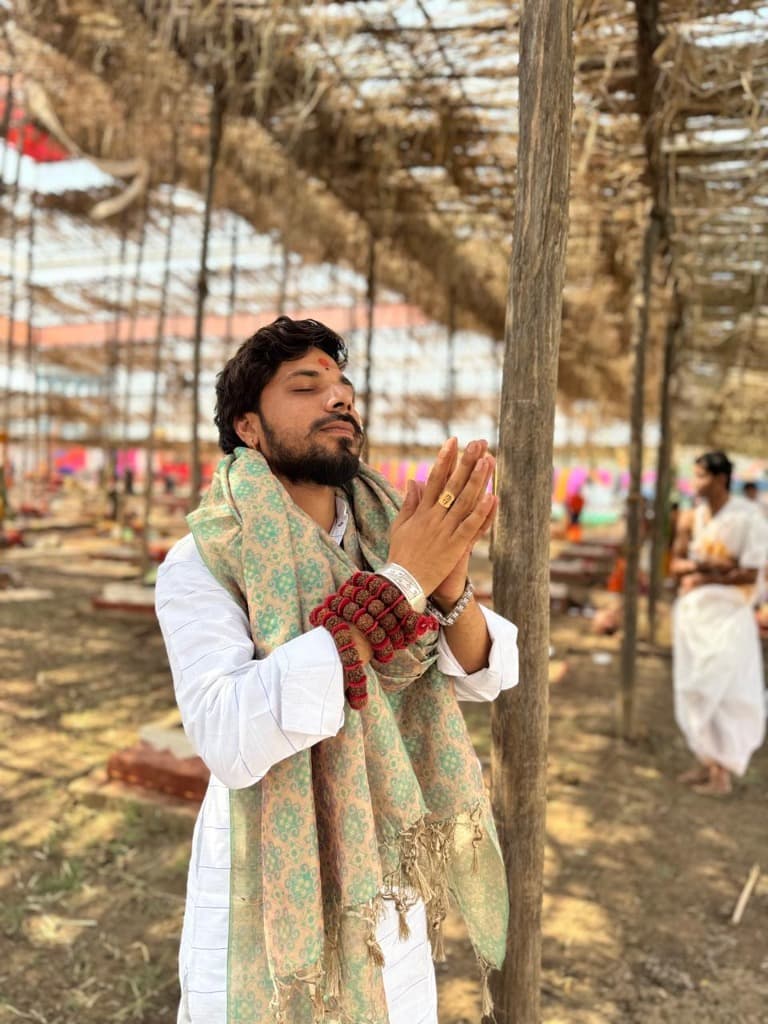
Acharya Tiwari Chetan Guru
Siddha Peethadheesh & Head Vedic Scholar
With over 15+ years of unbroken Vedic practice at Maa Baglamukhi Siddha Peeth, Nalkheda, Acharya Ji is a globally authoritative voice on Tantra Shastra, Stambhan Vidya, and Karmic Astrology. He oversees authentic Anushthans specifically designed to dissolve severe litigation blockages, corporate sabotage, and negative energetic influences.