

Ghatasthapana marks the opening ritual of Shardiya Navratri, and it is also the part of the festival that generates the most last-minute questions - what date is it this year, what time window is auspicious, what items are actually needed, and how is it done. Because the date shifts every year with the lunar calendar and the Muhurat depends on the Pratipada tithi and sunrise timing for a given location, generic answers often leave devotees more confused than before. This guide brings together the verified 2026 date, a general Muhurat explanation with the location caveats that matter, a practical Samagri list, and a step-by-step Vidhi that reflects commonly followed traditions rather than a single rigid method.
Ghatasthapana, also called Kalash Sthapana, is traditionally performed on the first day of Shardiya Navratri, and in 2026 that day falls on Sunday, 11 October, during the Ashwina Shukla Pratipada tithi. The exact Muhurat window depends on sunrise and tithi timing for a specific city, so this guide explains the general auspicious period - typically the early morning hours or the midday Abhijit Muhurat - rather than presenting one fixed time as universal. It also covers the traditional Samagri list, a general Vidhi followed by many households, and common questions devotees ask before setting up their Kalash at home.
Table of Contents
What Is Ghatasthapana?
Shardiya Navratri 2026 Ghatasthapana Date
Ghatasthapana Muhurat 2026
Ghatasthapana Samagri List
How to Perform Ghatasthapana - General Vidhi
How to Prepare the Kalash for Ghatasthapana
Can Ghatasthapana Be Performed at Home?
Important Ghatasthapana Rules
Common Ghatasthapana Mistakes to Avoid
Ghatasthapana and Daily Navratri Puja
Ghatasthapana During Shardiya Navratri and Devi Worship
Baglamukhi Puja During Shardiya Navratri
Frequently Asked Questions
Need Guidance for Devi Puja During Shardiya Navratri?
What Is Ghatasthapana?
Ghatasthapana is the ritual installation of a sacred Kalash (pot) that formally opens Shardiya Navratri. According to Hindu tradition, the Kalash represents the invocation of Goddess Durga's presence into the home, and the ritual is performed once, on the first day of Navratri, before the nine days of daily Devi worship begin. "Ghata" refers to the pot itself, and "Sthapana" means installation or establishment - together, the word describes the act of setting up this vessel as a focal point for the nine nights of worship that follow. The ritual is closely tied to the worship of Maa Shailputri, whose day coincides with Ghatasthapana.
Shardiya Navratri 2026 Ghatasthapana Date
Ghatasthapana for Shardiya Navratri 2026 falls on Sunday, 11 October 2026, during the Ashwina Shukla Pratipada tithi. This is the same day that opens the full nine-day festival, and it is followed by daily worship of the Navadurga through 19 October, concluding with Vijayadashami on 20 October. For the complete day-by-day breakdown of the festival, including the colour calendar and each day's Devi, you can refer to the Shardiya Navratri 2026 dates and nine-day worship guide.
Pratipada tithi this year begins on the evening of 10 October and extends into 11 October, which is why Ghatasthapana is performed on the 11th rather than the 10th - the ritual should ideally be completed while Pratipada is active and, according to tradition, before midday. Because tithi timings are based on precise astronomical calculations tied to a specific location, devotees are encouraged to confirm the exact Pratipada window for their own city using a current Panchang before finalising their morning schedule.
Ghatasthapana Muhurat 2026
The Ghatasthapana Muhurat for 2026 generally falls within the first third of the day on 11 October, with the midday Abhijit Muhurat available as a commonly used alternative if the morning window is missed. Muhurat timings differ by a few minutes from city to city because they depend on local sunrise, so no single time can be treated as correct for every location in India.
Information | Details |
|---|---|
Ghatasthapana Date | 11 October 2026 (Sunday) |
Relevant Tithi | Ashwina Shukla Pratipada |
General Morning Window | Roughly 6:00 AM to 10:15 AM (varies by city) |
Abhijit Muhurat (alternative) | Roughly 11:45 AM to 12:35 PM (varies by city) |
Location Note | Timings shown are approximate reference windows; confirm exact minutes for your city via a current Panchang |
Traditionally, Ghatasthapana is avoided during Chitra Nakshatra and Vaidhriti Yoga where they overlap with the morning window, and some Panchangs flag this for parts of the day in 2026. This is a detail worth checking with a local priest or Panchang rather than assuming it applies uniformly, since Nakshatra and Yoga timings also shift by location. If you are unsure which window applies to you, it is generally more useful to consult a Panchang specific to your city than to follow a single number found online.
Ghatasthapana Samagri List
The Samagri required for Ghatasthapana can vary by family and regional tradition, but the following items are commonly used across most households that perform the ritual.
Samagri | Traditional Use or Context |
|---|---|
Clay or copper Kalash (pot) | The central vessel representing the invocation of the Goddess |
Wide earthen pot / tray | Used as a base for sowing barley (Jau) seeds |
Barley seeds (Jau) | Sown in soil near or under the Kalash; their growth over nine days is traditionally seen as a sign of prosperity |
Clean soil | Base layer for sowing the barley seeds |
Holy or clean water | Filled inside the Kalash |
Mango leaves or Ashoka leaves | Placed at the mouth of the Kalash |
Coconut | Placed on top of the Kalash, often wrapped in red cloth |
Red cloth | Used to wrap the coconut and to cover or decorate the Kalash |
Mauli / sacred thread | Tied around the neck of the Kalash |
Supari (betel nut), coins, akshat (rice) | Traditionally placed inside the Kalash |
Turmeric (haldi) and kumkum (roli) | Used for decoration and tilak during the ritual |
Diya and oil or ghee | For lighting a lamp, which some families keep burning through the nine days as an Akhand Jyot |
Flowers, fruits, and Naivedya | Offered to the Kalash and the deity as part of the worship |
Incense (Agarbatti) and camphor (Kapoor) | Used during the Aarti that follows |
Not every family includes every item on this list, and some regional traditions add or substitute specific materials - for example, some households use seven types of grain instead of only barley, or a brass pot instead of clay or copper. It is best to follow the Samagri list your own family typically uses, or to check with a priest if you are setting up Ghatasthapana for the first time.
How to Perform Ghatasthapana - General Vidhi
The steps below reflect a commonly followed general Vidhi. Exact Ghatasthapana procedures may vary according to family, region, and religious tradition, so treat this as a practical overview rather than the only correct sequence.
Prepare and clean the Puja area. Clean the space where the Kalash will be placed, ideally in the northeast corner of the home, and cover the area with a fresh cloth or wooden platform (chowki).
Arrange the required traditional Samagri. Gather the Kalash, barley seeds, soil, coconut, mango or Ashoka leaves, red cloth, mauli, and other items the evening before, so nothing is missing on the morning of the ritual.
Prepare the soil bed and sow the barley. Spread a layer of clean soil in a wide earthen tray, scatter the barley seeds evenly, and cover them lightly with another thin layer of soil.
Prepare the Kalash. Fill the pot with clean or holy water, add supari, coins, and akshat, then place mango or Ashoka leaves at the mouth of the pot.
Establish the Kalash. Place the prepared Kalash over the soil tray where the barley has been sown, position the coconut wrapped in red cloth on top, and tie the mauli around the neck of the pot.
Perform the Sankalp. Many traditions include a spoken intention (Sankalp) at this stage, dedicating the nine days of worship to a specific purpose. Families who are unfamiliar with the exact wording often prefer to have a priest guide this step.
Begin Devi worship. Light a diya, offer flowers and Naivedya, and perform the first Aarti of the day, dedicated to Maa Shailputri.
Continue daily Navratri worship. From this point, the Kalash remains in place for nine days, and daily worship continues for each form of the Navadurga.
How to Prepare the Kalash for Ghatasthapana
The Kalash is traditionally understood as more than a container - it represents the seat of the Goddess for the duration of Navratri, which is why its preparation is treated with care. Most households use a clean copper or clay pot, since these materials are traditionally considered auspicious for this purpose, though some families also use brass. The pot is generally cleaned and dried well in advance, filled with water, and layered with symbolic items such as coins, betel nut, and rice before being sealed with mango leaves, a coconut, and a red cloth.
Because these details can differ - some traditions fill the Kalash with Ganga water specifically, others do not; some tie a Mauli thread around the neck, others skip this step - it helps to prepare the Kalash the way your own family has always done it, rather than mixing instructions from multiple sources. If your household does not have an established method, asking an elder or a priest beforehand is generally more reliable than assembling a procedure from scattered online guides.
Can Ghatasthapana Be Performed at Home?
Yes, Ghatasthapana can be performed at home, and this is in fact how the majority of Indian households observe it every year. Many families have followed a home-based Ghatasthapana tradition for generations, using the Samagri and Vidhi passed down within the family. That said, practices genuinely differ - some households prefer a priest to be present for the Sankalp and initial worship, particularly if they are performing an extended Anushthan alongside Navratri, while others manage the entire ritual themselves without difficulty.
If you are performing Ghatasthapana for the first time or are unsure about a specific step, it is reasonable to seek guidance rather than guess. This is not a sign of doing something wrong - it simply reflects that Vidhi details vary enough across regions that a short conversation with someone experienced can resolve most doubts quickly.
Important Ghatasthapana Rules
Confirm the correct date and Pratipada tithi timing before the day arrives, rather than relying on a general date alone
Check the Muhurat specific to your city through a current Panchang, since timings shift by location
Clean the Puja area and bathe before beginning the ritual, as cleanliness is considered important across most traditions
Follow your family's established Samagri list and Vidhi where one exists, rather than substituting items without reason
Avoid using a cracked or damaged Kalash
If performing the ritual for the first time, consider seeking guidance from a knowledgeable family member or priest
Remember that customs for direction, materials, and timing can vary by region, so a rule followed in one community may not apply everywhere
Common Ghatasthapana Mistakes to Avoid
Following an unverified Muhurat found online without checking it against a Panchang for your own city. Many pages publish a single national timing that does not account for local sunrise differences.
Copying instructions from a social media post without understanding the reasoning behind them. Not every viral Vidhi reflects a well-established tradition.
Mixing elements from multiple, unrelated regional traditions into one ritual. This can create confusion rather than a coherent practice.
Assuming one method applies everywhere in India. Ghatasthapana Vidhi genuinely differs between regions, and neither version is more "correct" than the other.
Ignoring an established family custom in favour of a generic online guide. If your family has followed a specific method for years, that tradition generally takes precedence over an unfamiliar version.
Ghatasthapana and Daily Navratri Puja
Once the Kalash is established, it becomes the centre of daily worship for the rest of Navratri. Most households perform a morning and evening Aarti in front of the Kalash, offer fresh flowers and Naivedya each day, and continue watering the barley seeds so they sprout by the later days of the festival. The specific deity honoured each day changes according to the Navadurga sequence, moving from Maa Shailputri on Day 1 through to Maa Siddhidatri on Day 9. For the complete day-wise Devi calendar and each day's traditional significance, the Shardiya Navratri 2026 dates and nine-day worship guide covers this in detail.
Many families also observe fasting rules during this period, ranging from a full nine-day fast to a lighter or partial observance, and these customs vary just as widely as the Ghatasthapana Vidhi itself.
Ghatasthapana During Shardiya Navratri and Devi Worship
Ghatasthapana is not a standalone ritual - it is the formal starting point of a nine-day period of Devi worship that culminates in Vijayadashami. According to Hindu tradition, establishing the Kalash on Day 1 is what allows the subsequent nine days of prayer, fasting, and Havan to proceed as a connected spiritual practice rather than isolated daily rituals. This is part of why the Muhurat for Ghatasthapana receives so much attention each year - many devotees feel that beginning the festival at an auspicious time sets the tone for the days that follow, even though the outcome of any ritual remains a matter of personal faith rather than a guaranteed result.
Baglamukhi Puja During Shardiya Navratri
Shardiya Navratri is traditionally regarded as an important window for Devi worship, and some devotees extend this practice to the ten Mahavidyas, among which Maa Baglamukhi holds a particularly revered place. For devotees who already maintain a personal or family connection to Baglamukhi worship, the days following Ghatasthapana can be combined with a dedicated Maa Baglamukhi Puja or Baglamukhi Havan, performed according to appropriate Sankalp and traditional guidance.
The Samagri principles discussed above for Ghatasthapana broadly echo the care taken in Baglamukhi Havan Samagri preparation, where specific materials and procedure matter for a properly conducted ritual. Devotees who wish to undertake a more structured practice across the nine days, rather than a single Puja, can also look into a Baglamukhi Anushthan timed to the Navratri period. As with Ghatasthapana itself, these are devotional practices rooted in tradition and personal faith, not guarantees of a specific outcome.
Frequently Asked Questions About Ghatasthapana 2026
When is Ghatasthapana in 2026?
Ghatasthapana for Shardiya Navratri 2026 falls on Sunday, 11 October, during the Ashwina Shukla Pratipada tithi.
What is Ghatasthapana?
Ghatasthapana is the ritual installation of a sacred Kalash that formally opens Shardiya Navratri, traditionally understood as inviting the Goddess's presence into the home for the nine days of worship.
What is the Ghatasthapana Muhurat for 2026?
The general auspicious window falls in the early morning to mid-morning hours, with the midday Abhijit Muhurat as a common alternative. Exact minutes vary by city, so a local Panchang should be checked.
Can Ghatasthapana Muhurat vary by city?
Yes, because Muhurat depends on sunrise and tithi timing, which differ across locations, the exact window can shift by anywhere from a few minutes to over an hour between cities.
What is needed for Ghatasthapana?
Common Samagri includes a Kalash, barley seeds, soil, coconut, mango or Ashoka leaves, red cloth, mauli, and items such as supari, coins, and akshat, though the exact list varies by family.
Can Ghatasthapana be performed at home?
Yes, most households perform Ghatasthapana at home following their family's established Samagri and Vidhi, though some prefer a priest's guidance for the Sankalp.
What is Kalash Sthapana?
Kalash Sthapana is another name for Ghatasthapana - both terms refer to the same ritual of installing the sacred pot on the first day of Navratri.
What is the difference between Ghatasthapana and Kalash Sthapana?
There is no difference in meaning; the two terms are used interchangeably for the same ritual, with regional and linguistic preference determining which name is more commonly used.
What happens after Ghatasthapana?
After Ghatasthapana, daily worship continues for nine days, with each day dedicated to a different form of the Navadurga, followed by Vijayadashami.
Which Devi is worshipped on the first day?
Maa Shailputri is worshipped on Day 1, the same day as Ghatasthapana.
Can family traditions differ for Ghatasthapana?
Yes, the Samagri, Vidhi, and even the direction in which the Kalash is placed can differ significantly between families and regions.
What should be avoided while performing Ghatasthapana?
It is best to avoid using a damaged Kalash, relying on an unverified Muhurat, or mixing unrelated regional traditions without understanding them.
Is Ghatasthapana performed only once during Navratri?
Yes, Ghatasthapana is performed once, on the first day of Navratri, and the established Kalash then remains in place through the remaining eight days.
Can beginners perform Ghatasthapana at home?
Yes, though beginners unfamiliar with the exact steps often find it helpful to consult a family elder or priest before attempting it independently for the first time.
What if I am unsure about the correct Muhurat?
If you are unsure, checking a Panchang specific to your city or consulting a knowledgeable priest is more reliable than following a single timing published for a different location.
Is Ghatasthapana connected with daily Navratri Puja?
Yes, Ghatasthapana establishes the Kalash that becomes the focal point for the daily Aarti and offerings performed throughout the nine days.
Can a priest provide guidance for Ghatasthapana?
Yes, many families consult a priest for the Sankalp or for clarifying Vidhi details, particularly when performing an extended Puja or Anushthan alongside Navratri.
Where can I get guidance for Devi Puja during Navratri?
Guidance is available through Acharya Tiwari Chetan Guru at Nalkheda Siddha Peeth, who can be contacted for Navratri-related Puja questions.
Need Guidance for Devi Puja During Shardiya Navratri?
If you are setting up Ghatasthapana for the first time, or would like guidance on combining your Navratri observance with a traditional Maa Baglamukhi Puja, Havan, or Anushthan, it can help to speak with someone experienced before the festival begins rather than during the ritual itself. Questions about Sankalp wording, Samagri arrangement, or how to structure worship across the nine days are common, and clarifying them in advance makes the actual days of Navratri considerably smoother.
Discuss your Navratri Puja plans → baglamukhihawan.com/book-consultation
This guidance is offered as traditional devotional support, not as a promise of any specific outcome from performing the ritual.
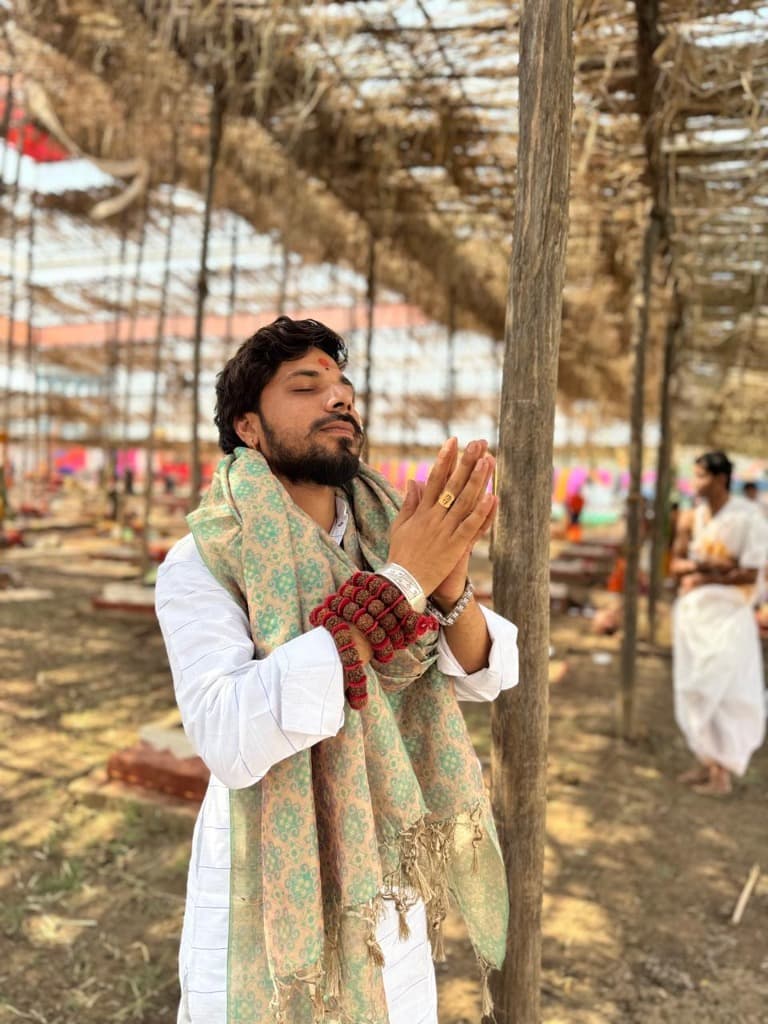
Acharya Tiwari Chetan Guru
Siddha Peethadheesh & Head Vedic Scholar
With over 15+ years of unbroken Vedic practice at Maa Baglamukhi Siddha Peeth, Nalkheda, Acharya Ji is a globally authoritative voice on Tantra Shastra, Stambhan Vidya, and Karmic Astrology. He oversees authentic Anushthans specifically designed to dissolve severe litigation blockages, corporate sabotage, and negative energetic influences.