
QUICK ANSWER BOX
What is Gupt Navratri Puja Vidhi?
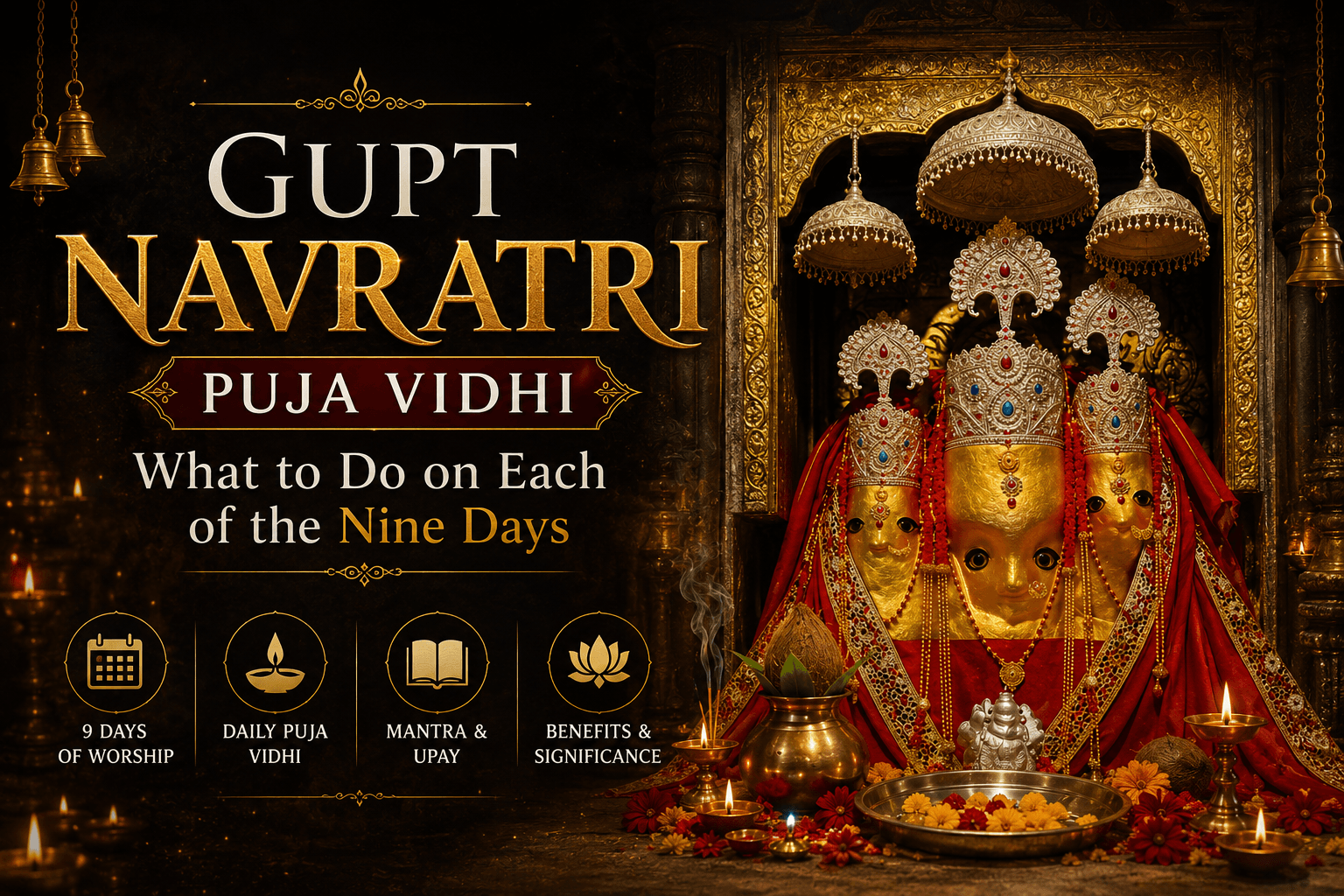
Gupt Navratri puja vidhi is the daily ritual practice followed during the nine-day secret Navratri - observed in Ashadha (15-23 July 2026) and Magh (January-February). Each day begins with a bath, lighting a ghee diya, offering yellow flowers to your Mahavidya, and chanting the mantra minimum 108 times. The Sadhana is kept completely secret - not announced to anyone. For Maa Baglamukhi devotees, Ashtami on 22 July is the peak day where mantra jaap should reach 1,008 times minimum.
BLOG CONTENT - Copy paste karo
Gupt Navratri Puja Vidhi - What to Do on Each of the Nine Days
Gupt Navratri 2026 starts on 15 July and ends on 23 July. Nine days. Each day has a specific energy, a specific Mahavidya, and a specific intention behind the Sadhana.
Most people who observe Gupt Navratri do one of two things - they either follow a generic routine without understanding why each day matters, or they skip most days and only focus on Ashtami. Both approaches miss the point.
This guide gives you the complete Gupt Navratri puja vidhi - what to do each day, what mantra to chant, what to offer, and why Ashtami on 22 July is the day everything in this nine-day window builds toward.
Before You Begin - The Golden Rules of Gupt Navratri Sadhana
Before the puja vidhi itself, these rules apply to all nine days without exception.
Keep it secret. Gupt means hidden. The Sadhana you do during these nine days should not be announced, discussed, or shared - not even with family. This is not superstition. The energy of Sadhana is concentrated when it is contained. The moment you speak about it publicly, its power disperses.
Be consistent. Missing even one day breaks the Sadhana. If you commit to the nine-day vidhi, you must follow through for all nine days. If you can only commit to Ashtami alone, do only Ashtami - but do it completely.
Yellow is her color. Maa Baglamukhi's color is yellow. Wear yellow clothes during puja if possible. Offer yellow flowers - marigold, champa, or any yellow variety. Use a yellow aasan to sit on during mantra jaap.
Fixed time daily. Perform the puja at the same time each day - ideally before sunrise or in the early morning. Consistency of time strengthens the Sadhana.
No meat, alcohol, or tamasic food during the nine days. This applies to all Navratri Sadhana - Gupt Navratri included.
The Daily Puja Vidhi - Follow This Every Day
This is the base vidhi for each of the nine days. The Mahavidya and intention shift each day - but this practice remains the same.
Step 1 - Shuddhi (Purification)
Bathe before puja. Wear clean clothes - preferably yellow or white. Clean your puja space. Sprinkle Gangajal if available.
Step 2 - Diya and Dhoop
Light a ghee diya. Light dhoop or agarbatti - sandalwood or camphor preferred.
Step 3 - Idol or Yantra
Place Maa Baglamukhi's idol or yantra in front of you. If you do not have either, a clean image on paper placed on a yellow cloth works.
Step 4 - Offerings
Offer yellow flowers. Offer haldi - turmeric is sacred to Maa Baglamukhi. Offer yellow sweets like besan ladoo or haldi rice. Offer water in a copper vessel.
Step 5 - Mantra Jaap
Chant the Baglamukhi mantra with full focus and intention. Minimum 108 times daily. Use a rosary to count - rudraksha or haldi mala preferred.
The mantra:
Om Hleem Baglamukhi Sarva Dushtanam Vacham Mukham Padam Stambhay Jihvaam Keelaya Buddhim Vinashaya Hleem Om Swaha
If this full mantra feels difficult to begin with, use the beej mantra:
Om Hleem Baglamukhi Devyai Namah
For a complete understanding of what this mantra means word by word and how it works, read: Baglamukhi Mantra - Complete Guide to Meaning, Benefits and Chanting Vidhi
Step 6 - Dhyan (Meditation)
After the jaap, sit quietly for 5-10 minutes. Eyes closed. Hold your intention clearly in your mind - your court case, your situation, your purpose for this Sadhana. This is not optional. The intention is what directs the shakti.
Step 7 - Prasad
Offer the sweet to Maa first, then consume it yourself. Do not share the Prasad during the Sadhana period.
Day-by-Day Guide - All Nine Days
Day 1 - Ghatasthapana (15 July, Wednesday)
Mahavidya: Maa Kali
Energy: Liberation, fearlessness, beginning
Day 1 is the foundation. Everything you do today sets the tone for the next eight days.
On Ghatasthapana, a sacred kalash is established - filled with water, mango leaves, and a coconut placed on top. This kalash represents the Divine Mother's presence being formally invited into the Sadhana. If you are doing this at home, establish the kalash in your puja room and keep it there for all nine days.
What to do today:
Take your formal Sankalp - your declaration of intent. State clearly, internally or aloud, why you are beginning this Sadhana. What situation are you bringing to Maa? What are you asking for? Be specific.
Chant this additional mantra for Maa Kali today:
Om Krim Kalikayai Namah - 108 times
Then follow the full daily vidhi above.
If you are participating through Nalkheda Siddha Peeth: Your live WhatsApp Sankalp happens today. Acharya Ji formally takes your name, gotra, and intention and establishes your Sankalp at the Peeth on your behalf. This is the starting point of the Full Anushthan.
Days 2 to 7 - The Sadhana Days (16-21 July)
Mahavidyas: Tara, Tripura Sundari, Bhuvaneshwari, Chhinnamasta, Tripura Bhairavi, Dhumavati
Energy: Building, deepening, preparing
These six days are where most people lose focus - and where the Sadhana is actually built.
There is a temptation to think that only Ashtami matters and to do minimal puja on the in-between days. This is the wrong approach. The six Sadhana days are what charge the Ashtami puja with accumulated energy. Think of it like charging a battery - each day adds to the voltage. Ashtami is when the full charge is released.
What to do each day:
Follow the complete daily vidhi every morning without fail. On each specific day, add the following:
Day 2 (Maa Tara - 16 July): Add coconut water as an offering. Maa Tara is associated with water and transformation.
Day 3 (Tripura Sundari - 17 July): Offer red flowers alongside the yellow. Tripura Sundari governs beauty and auspiciousness.
Day 4 (Bhuvaneshwari - 18 July): Offer seasonal fruits. Bhuvaneshwari is the mother of all creation and receives all natural offerings.
Day 5 (Chhinnamasta - 19 July): No additional offering needed. Increase your meditation time by 10 minutes today. Inner focus is her preference.
Day 6 (Tripura Bhairavi - 20 July): Offer camphor in the diya. Bhairavi is fierce - this day intensifies the protection aspect of your Sadhana.
Day 7 (Dhumavati - 21 July): Keep the puja space completely silent. No music, no background noise. Dhumavati governs dissolution - her day requires stillness. Begin mentally preparing for Ashtami tomorrow.
Mantra for all Sadhana days: The Baglamukhi mantra - 108 times minimum, every single day.
Day 8 - Ashtami (22 July, Wednesday) - The Peak
Mahavidya: Maa Baglamukhi
Energy: Maximum. This is her day.
Everything in the nine-day window builds toward today.
Maa Baglamukhi is the eighth Mahavidya - which is why Ashtami, the eighth day, is aligned with her energy in a way no other day in the calendar year can replicate. When Ashtami falls during Gupt Navratri, as it does on 22 July 2026, the shakti available is at its absolute annual peak.
What to do today - extended vidhi:
Wake before sunrise. Bathe in cold water if possible.
Wear yellow clothes. Sit on a yellow aasan facing the idol or yantra.
Mantra jaap: minimum 1,008 times. Set aside two to three hours for this. Use a mala. Count carefully.
The full Ashtami mantra:
Om Hleem Baglamukhi Sarva Dushtanam Vacham Mukham Padam Stambhay Jihvaam Keelaya Buddhim Vinashaya Hleem Om Swaha
After the jaap, perform a small hawan if possible - even a simple one with ghee, havan samagri, and sesame seeds. If a hawan is not possible, light five ghee diyas around the idol and offer each one while chanting the mantra.
For the complete list of what goes into a proper Baglamukhi hawan, read: Complete Baglamukhi Havan Samagri List
State your intention clearly. After the mantra jaap and hawan, sit in dhyan for at least 15-20 minutes. Hold your specific situation in your mind with complete clarity. Name the court case, the enemy, the problem. Maa Baglamukhi's shakti is most effective when directed precisely.
Do not speak about this puja to anyone today. Not before, not after.
Day 9 - Navami Parana (23 July, Thursday)
Mahavidya: Maa Matangi and Maa Kamala
Energy: Conclusion, completion, gratitude
Parana is the formal end of the fast and Sadhana. Today is not just a closing formality - it has its own significance.
What to do today:
Follow the complete daily vidhi one final time.
After the puja, perform the Purna Ahuti - the final complete offering. Offer 108 drops of ghee into the diya flame while chanting the mantra.
Visarjan: The kalash established on Day 1 is formally concluded today. Pour the kalash water into a plant or running water - not into a drain. This releases the accumulated Sadhana energy into the earth.
Express gratitude. Sit for 10 minutes in silence after the final puja. No mantra, no intention - just gratitude. This closes the Sadhana properly.
If you participated through Nalkheda Siddha Peeth, your Prasad is dispatched today after the Purna Ahuti - with courier tracking to your address worldwide.
Gupt Navratri Samagri List - What You Will Need
Item | Purpose |
|---|---|
Yellow flowers (marigold) | Daily offering to Maa Baglamukhi |
Haldi (turmeric) | Sacred to Baglamukhi - whole or powder |
Pure cow ghee | Diya and hawan |
Dhoop or agarbatti (sandalwood) | Daily purification |
Yellow aasan | Sitting mat for mantra jaap |
Rudraksha or haldi mala (108 beads) | Counting mantra jaap |
Kalash (copper or clay) | Ghatasthapana on Day 1 |
Mango leaves (5 to 7) | Kalash decoration |
Coconut | Placed on top of kalash |
Besan ladoo or yellow sweets | Daily prasad |
Hawan samagri | For hawan on Ashtami |
Sesame seeds (til) | Hawan ahuti |
Gangajal | Purification - optional but recommended |
What If You Cannot Do the Full Nine-Day Vidhi?
Life happens. Not everyone can commit to all nine days. Here is what to do:
If you can only do one day - do Ashtami, 22 July. This is Maa Baglamukhi's day. Even one properly conducted Ashtami puja with full mantra jaap and clear intention carries more weight than nine incomplete days.
If you can do three days - do Day 1 (Ghatasthapana), Day 8 (Ashtami), and Day 9 (Parana). This creates a proper opening, peak, and closing.
If you miss a day in between - do not abandon the Sadhana. Continue from the next day, acknowledge the gap, and increase your jaap count the following day to compensate.
If your situation is serious - a court case with a hearing this month, active black magic, or a decision that genuinely changes your life - do not rely on a home puja alone. The nine-day Maa Baglamukhi Anushthan conducted by an experienced Acharya at a Swayambhu Siddha Peeth is in a different category entirely.
The Difference Between Doing This Yourself and Having It Done at Nalkheda
This is an honest section - not a sales pitch.
Home puja is real. The Sadhana you do yourself carries genuine merit and shakti. If you follow this vidhi sincerely for all nine days, something shifts. That is not marketing - it is the nature of consistent Sadhana.
But there is a difference between home puja and what happens at a Swayambhu Siddha Peeth conducted by someone who has done this same Sadhana every year since 2010.
At Maa Baglamukhi Siddha Peeth, Nalkheda, Acharya Tiwari Chetan Guru conducts the nine-day Maa Baglamukhi Maha Hawan and Anushthan with thousands of mantra jaap repetitions, yantra puja, and Purna Ahuti - all at the site where Maa Baglamukhi herself is self-manifested. The idol was not installed. It appeared. This is what Swayambhu means.
You can participate from anywhere in the world. Sankalp is taken live on WhatsApp on Day 1. Updates come every day. You watch Ashtami live. Prasad arrives at your door with tracking.
No advance payment is needed to start a conversation.
Reserve Your Gupt Navratri 2026 Sankalp - See Pass Options
Or talk first - WhatsApp Acharya Ji directly. No payment needed.
Explore Further
Sacred Clarifications
About Baglamukhi Havan &
Puja in Nalkheda
Gupt Navratri puja vidhi is the daily ritual practice followed during the nine-day secret Navratri. Each day involves bathing before puja, lighting a ghee diya, offering yellow flowers, and chanting the Baglamukhi mantra minimum 108 times. The Sadhana is kept completely secret. For Baglamukhi devotees, Ashtami on 22 July 2026 is the peak day - mantra jaap should reach 1,008 times.
For Maa Baglamukhi devotees, chant: Om Hleem Baglamukhi Sarva Dushtanam Vacham Mukham Padam Stambhay Jihvaam Keelaya Buddhim Vinashaya Hleem Om Swaha - 108 times daily. On Ashtami, chant 1,008 times. The beej mantra Om Hleem Baglamukhi Devyai Namah can be used as an alternative for daily jaap. Full details in the Baglamukhi Mantra Complete Guide.
Observe the daily puja vidhi for all nine days - bath, diya, yellow flowers, mantra jaap, and meditation. Keep it completely secret. On Ashtami (22 July), increase your mantra jaap to 1,008 times and spend extra time in dhyan with your intention clearly held in mind.
Yes. Follow the vidhi in this guide - clean puja space, yellow flowers, ghee diya, and daily mantra jaap. Keep it completely secret. For serious situations such as court cases or black magic, having an experienced Acharya conduct the Sadhana at a Swayambhu Siddha Peeth produces significantly stronger results. Learn about Maa Baglamukhi Anushthan for serious situations.
Yellow flowers, haldi, pure ghee, dhoop or agarbatti, yellow aasan, rudraksha or haldi mala, kalash with mango leaves and coconut, yellow sweets for prasad, and hawan samagri for Ashtami. Full details also available on the Maa Baglamukhi Hawan page.
No. Acharya Ji conducts live Sankalp via WhatsApp video call. Devotees from USA, UK, UAE, Australia and 35+ other countries participate every year. Prasad is couriered worldwide with tracking. See Gupt Navratri 2026 pass options for full details.
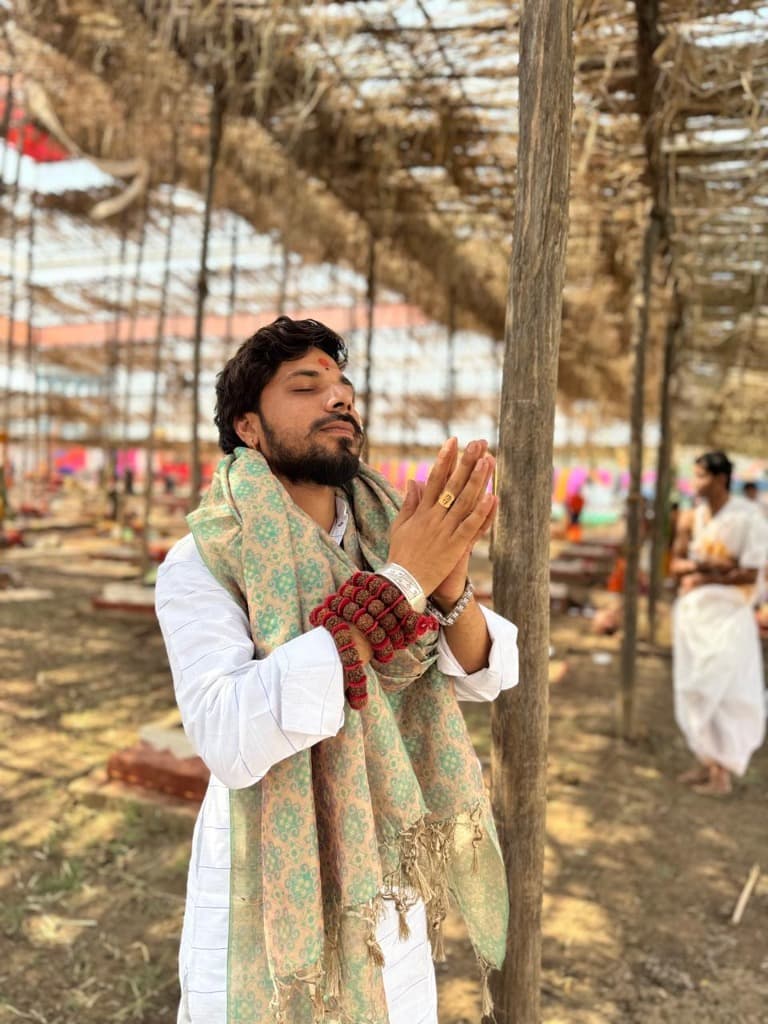
Acharya Tiwari Chetan Guru
Siddha Peethadheesh & Head Vedic Scholar
With over 15+ years of unbroken Vedic practice at Maa Baglamukhi Siddha Peeth, Nalkheda, Acharya Ji is a globally authoritative voice on Tantra Shastra, Stambhan Vidya, and Karmic Astrology. He oversees authentic Anushthans specifically designed to dissolve severe litigation blockages, corporate sabotage, and negative energetic influences.