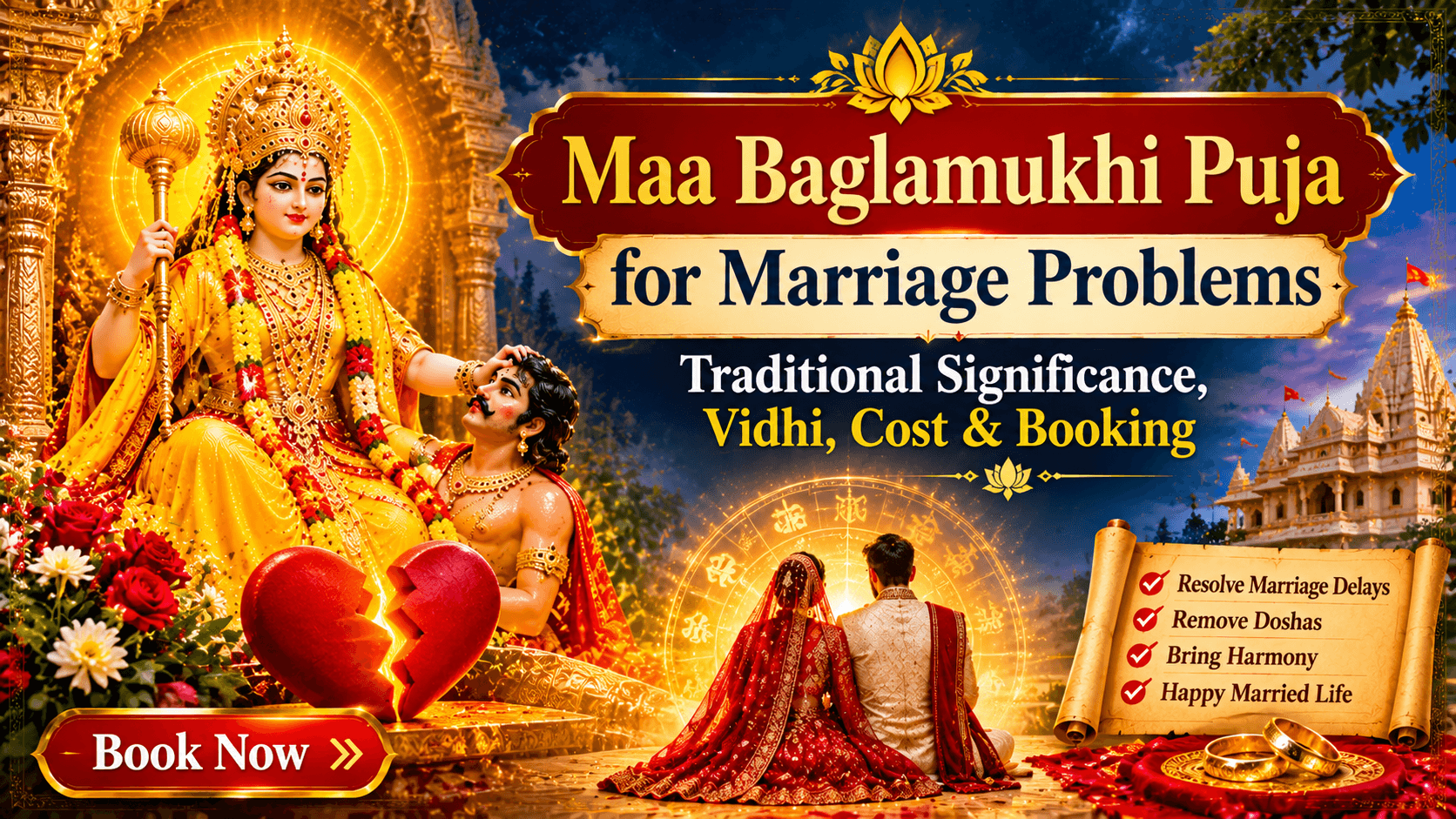
Marriage-related difficulties rarely arrive alone. A proposal that does not move forward, two families who cannot agree, doubts about compatibility, or a married couple who have stopped talking can leave a person searching for answers in many directions, including devotion. Some devotees turn to a traditional Puja during such periods, not to replace practical effort, but to seek steadiness and blessings.
This guide explains how Maa Baglamukhi worship is understood in the context of marriage-related concerns, what a general Vidhi and Samagri look like, which factors shape the cost, and how to enquire about a Puja at Nalkheda. It describes a devotional practice only. No Puja can guarantee a marriage, a reconciliation or another person’s decision.
Maa Baglamukhi Puja for Marriage Problems at a Glance
Short answer: Maa Baglamukhi Puja for marriage problems is a devotional ritual in which a devotee prays to Maa Baglamukhi, with a personal Sankalp, for relief from obstacles connected with marriage. The website does not list it as a separate fixed service, so the exact ritual, cost and arrangements are decided after a consultation. No outcome is guaranteed.
Detail | Information |
|---|---|
Puja | Maa Baglamukhi Puja, offered with a Sankalp related to marriage concerns |
Topic | Delays, family disagreements, compatibility concerns, marital disagreements |
Traditional context | Maa Baglamukhi is worshipped as the eighth Mahavidya and as a goddess of stambhan, the power to still or halt obstacles |
Devotional significance | Devotees seek steadiness, clarity and relief; this is a matter of faith |
Vidhi | A general framework of Sankalp, invocation, mantra, offerings, Aarti and Prasad; the exact Vidhi depends on the priest and tradition |
Samagri | Common devotional items; specialised items only as advised by the Acharya |
Cost | No marriage-specific price is published; general ritual prices appear on the Nalkheda temple page |
Location | Nalkheda Siddha Peeth, Agar Malwa, Madhya Pradesh |
Booking | WhatsApp, phone, booking form or consultation page; the initial consultation is described as free |
Important note | Religious practices and beliefs vary; no specific outcome can be guaranteed |
Understanding Marriage Problems and Traditional Devotional Practices
“Marriage problems” is a broad phrase. It can describe very different situations, and each one deserves its own thinking:
Delay in finding a suitable match or finalising a proposal
Disagreement within a family about a marriage
Differences between two families
Compatibility concerns between two people
Communication difficulties
Disagreements within a marriage
Emotional stress around marriage decisions
In Hindu devotional life, prayer and ritual have long been used to find meaning and calm during uncertain periods. A Puja can give a person a structured way to express hope, slow down and feel supported. That value is real for many devotees, but it is different from solving the underlying situation.
Religious practice does not replace honest conversation, family discussion, professional counselling or legal advice. It also does not diagnose why a difficulty exists. If a marital situation involves safety concerns, abuse or legal questions, the right first step is qualified professional or legal support, with worship as a personal addition if the person wishes.
Maa Baglamukhi Worship and Marriage-Related Concerns
Maa Baglamukhi is traditionally counted as the eighth of the ten Mahavidyas. She is known as Pitambara Devi, the goddess dressed in yellow, and is usually described as the power of stambhan, the ability to still, halt or silence. That is why her worship is commonly linked with protection and with overcoming obstacles.
An honest point is worth stating early. In traditional sources, Maa Baglamukhi is not primarily presented as a goddess of marriage. Marriage-related worship in popular tradition is more often directed to Goddess Parvati or Katyayani, and the Katyayani vrata of the Gopis described in the Bhagavata Purana is a commonly cited example. Devotees who approach Maa Baglamukhi in this context usually do so for a different reason: they feel stuck, and they pray for obstacles to be stilled.
Why might a devotee do this during a hard period?
Some approach her as the deity who removes hindrances, hoping for a clearer path.
Some find the discipline of yellow offerings, mantra and a calm routine steadying in itself.
Some read stambhan inwardly, as steadying a restless mind and heated speech during family tension. This is an interpretation, not a rule.
Stambhan should never be read as power over another person. Traditional belief and guaranteed outcomes are two different things, and this article stays with the first. If you would like to begin with the general service, the website describes the Maa Baglamukhi Puja on its service page.
Situations in Which Devotees May Seek Spiritual Guidance
Different concerns call for different thinking. It would be wrong to suggest that every situation needs the same Puja.
1. Delay in Marriage
Some devotees include prayer and worship in their routine while a match is still uncertain. Families also consult an astrologer about Mars-related Mangal Dosha; the website has a separate Mangal Shanti Puja page and an article on marriage delays and Mangal Dosh for that specific question.
2. Family Disagreements About Marriage
Here, prayer can offer patience and perspective. It cannot be expected to change another family’s decision. Open discussion and, where useful, a trusted elder or mediator remain the practical route.
3. Marriage-Related Obstacles
Repeated setbacks, such as proposals that stall or plans that keep slipping, can leave people wanting spiritual guidance. A consultation with the Acharya can help clarify which ritual, if any, suits the Sankalp.
4. Marital Disagreements
For couples, respectful communication matters most. Professional counselling may help as well. Worship can sit alongside these steps as a personal source of calm.
5. Emotional Stress Related to Marriage
Stress around marriage decisions is common. Support from family and friends, practical planning and, where needed, a counsellor are valuable. Prayer can be one part of coping, not the whole of it.
Maa Baglamukhi Puja Vidhi for Marriage-Related Concerns
Short answer: a general Maa Baglamukhi Puja follows a familiar devotional order, from preparation and Sankalp to Aarti and Prasad. The exact Vidhi varies by family tradition and by the officiating priest, and this guide does not set out a specialised Tantric procedure.
Prepare a clean Puja space. Clean the area, bathe, and wear clean clothes. Yellow is traditionally associated with Maa Baglamukhi.
Pray and take Sankalp. State your name, Gotra if known, and your prayer intention.
Invoke Maa Baglamukhi according to your family tradition, usually after worshipping Lord Ganesha.
Offer flowers and devotional items, such as yellow flowers, turmeric, fruits and sweets.
Recite mantras where this is part of your tradition and where you have been taught properly.
Perform Aarti and prayer. The site’s Baglamukhi Aarti is available for reference.
Distribute Prasad to the family or those present.
Complete the Puja according to the priest’s guidance.
Home worship and a priest-led ritual are not the same thing. Lighting a lamp, offering flowers and praying quietly at home is a simple devotional routine. A temple Puja or Havan is performed by trained priests on your behalf. The site’s Baglamukhi Puja Vidhi guide gives general background, and its mantra jaap rules article explains why chanting should follow proper guidance.
Many websites publish a fixed marriage mantra with a chanting count and a promised result. This guide does not, because mantra practice is traditionally taught by a guru and no result can be promised. The Mangal Shanti Puja page also asks devotees to observe Satvik rules during the ritual, including avoiding alcohol and non-vegetarian food. Practices differ by family and region.
Maa Baglamukhi Puja Samagri
Short answer: the common items are simple and devotional. Specialised items depend on the ritual, the priest and the Sankalp, and should be taken only from the Acharya or the service provider.
Common Devotional Items
Flowers, with yellow flowers commonly offered to Maa Baglamukhi
Roli or Kumkum
Akshat (unbroken rice)
A Diya
Incense
Water
Fruits, sweets and Prasad
Aarti items
The website’s guidance for temple visits also mentions yellow flowers, laddoos and bananas as common offerings, and yellow or white attire.
Additional Ritual Items
Specialised Samagri, including Havan items, may differ according to the ritual, the priest and the Sankalp. Do not treat optional items as mandatory, and do not buy ritual items for an online Puja unless the team asks you to. For a booked ritual, the booking page lists complete Havan Samagri among the inclusions, and the temple price list says listed prices include samagri, so confirm what applies to your booking. The site’s Havan Samagri guide lists items used in Baglamukhi Havan in general.
Maa Baglamukhi Puja for Marriage Problems: Cost
Short answer: the website does not publish a price for a marriage-specific Puja, so devotees should request a current quotation. The Nalkheda temple page lists prices for general rituals, which can help you understand the range of options.
The 2026 price list on the Nalkheda temple page shows these general rituals:
Ritual | Duration | Listed price |
|---|---|---|
Maa Baglamukhi Basic Puja | 1 day | ₹5,100 |
Maa Baglamukhi Havan (Standard) | 1 day | ₹11,000 |
Maa Baglamukhi Maha Havan | 1 day | ₹21,000 |
Maa Baglamukhi Anushthan | 3 days | ₹31,000 |
The page states that these prices include puja samagri, pandit dakshina and prasad, and that online Havan includes live WhatsApp video and Prasad by courier. These are general rituals, not marriage-specific packages, and the Mangal Shanti Puja page shows no figure. Treat the table as context, not a quotation.
Factors that commonly shape the cost:
Which ritual is recommended for your Sankalp
How long the ritual takes
Whether a Havan is included
Samagri and priest arrangements
Whether you attend in person or take part online
Prasad dispatch to your address
The booking page says the initial consultation is free and that the offering is discussed after the Acharya recommends a ritual. Ask for the final amount and inclusions in writing. The site’s Puja cost and booking process guide explains how pricing works across services.
How to Enquire About Maa Baglamukhi Puja at Nalkheda
The Puja is performed at Nalkheda Siddha Peeth in the Agar Malwa district of Madhya Pradesh. The Nalkheda temple page describes the temple as a traditionally revered Baglamukhi Siddha Peeth, and its history draws on traditional accounts rather than established records.
Short answer: contact the team, describe your concern, take the consultation, and confirm the ritual, date, cost and arrangements before you proceed.
Find the relevant service page. Start with the general Puja services and review the pages closest to your concern.
Review the available information. Read what each page states and note what it leaves out.
Submit an enquiry. Use WhatsApp, phone (+91 90743 42490) or the booking form.
Share your details. The booking page lists your full name, Gotra, date of birth and a clear description of your concern. The form has no marriage option in its ritual list, so choose “Not Sure - Need Consultation” and describe your concern in the box.
Confirm ritual details. Speak with Acharya Ji about the procedure, the Muhurat and who should be named in the Sankalp.
Confirm cost and arrangements. Ask for the current cost and inclusions in writing.
Finalise only with clear information. An enquiry is not a confirmed booking.
For devotees who cannot travel, the website describes a Sankalp performed at Nalkheda with live participation by WhatsApp video and Prasad delivery. Ask how this works for your location and time zone. The site also has a guide for devotees booking from the USA, UK and abroad. If you plan to visit, check how to reach Nalkheda and the temple timings before travelling.
[ GOLD BUTTON - white bold text ]
Enquire About Your Puja at Nalkheda →
Link path: baglamukhihawan.com/book-puja
Page: Book Puja
If you prefer to talk first, the consultation page is the better starting point.
Marriage-Related Devotional Worship vs Aakarshan Puja
These two topics are often searched together, but they are not the same thing. The distinction helps you read the right information.
Point | Marriage-related devotional worship | Aakarshan Divya Puja |
|---|---|---|
Starting point | A concern such as delay, disagreement or stress | A named service on the website |
Typical search wording | “puja for marriage problems”, “marriage delay puja” | “Aakarshan Puja” |
What a reader needs | Context, Vidhi, cost and booking steps for a marriage-related concern | Details of that specific service |
People describe their situations in very different ways, and a general article about marriage concerns should not automatically be treated as an Aakarshan service. The website does not describe a separate ritual for each name, so the actual procedure for your Sankalp must be confirmed with the provider. For readers who want the specific service, the Aakarshan Divya Puja article covers it in detail.
One point applies to both. Neither should be understood as a way to force love, marriage, obedience or another person’s consent. A Sankalp about your own patience, conduct and openness is consistent with devotional practice. A Sankalp that depends on another person changing their mind is not.
7 Things to Confirm Before Booking a Maa Baglamukhi Puja
The exact name of the Puja. Ask which ritual is being proposed, since there is no separate marriage service page.
The purpose and Sankalp. Ask how your concern will be worded, and who is named in it.
The ritual procedure. Ask what will actually be performed and whether a Havan is included.
The duration, if applicable. Ask how long the ritual takes and whether it is one day or several.
The Samagri arrangements. Ask who provides the items and whether you need to arrange anything.
The total cost and inclusions. Ask for the figure in writing, including Prasad dispatch and any extras.
The booking confirmation and contact process. Ask how confirmation, updates and payment will work, and keep the answers in writing.
Responsible Expectations: What This Puja Cannot Promise
A Puja is a devotional practice. Traditionally, devotees may pray for guidance and steadiness, and practices vary by family and region. No specific personal or relationship outcome can be guaranteed.
In particular, no Puja can guarantee a marriage, a love marriage, a reconciliation, the return of a partner, the removal of delays, family approval, a change in someone’s feelings or a result within a fixed number of days. Treat any provider who promises these with caution. Any approach that involves coercion, manipulation, controlling another person’s choices or ignoring consent is outside the spirit of devotion and should be avoided.
Frequently Asked Questions
1. What is Maa Baglamukhi Puja for marriage problems?
It is a devotional Puja in which a devotee prays to Maa Baglamukhi, with a personal Sankalp, for relief from marriage-related obstacles. It is an act of faith and no outcome is guaranteed.
2. Does the website list a separate marriage Puja?
No separate marriage service page is listed. Related pages include Maa Baglamukhi Puja, Havan and Mangal Shanti Puja. The Acharya recommends the ritual after consultation.
3. Why do some devotees approach Maa Baglamukhi for marriage concerns?
Maa Baglamukhi is worshipped as the goddess of stambhan, who stills obstacles. Devotees who feel stuck often seek her blessings for clarity and steadiness. This reflects belief, not a guaranteed result.
4. Is this the same as Swayamvara Parvati or Katyayani worship?
No. Those are separate traditions dedicated to other deities and are more commonly associated with marriage. Maa Baglamukhi worship is generally linked with removing obstacles. Follow the tradition that suits you and your family.
5. Who can enquire about this Puja?
Unmarried devotees facing delay and married couples can both seek devotional guidance. Ask the team who should be named in the Sankalp, especially if someone else is involved.
6. Can the Puja solve family disagreements?
It cannot change another family’s decision. Devotees may pray for patience and perspective, but conversation and mediation remain the practical route to resolving disagreements.
7. What is the general Vidhi?
A typical order is preparation, Sankalp, invocation, offerings, mantra where taught, Aarti, Prasad and completion. The exact Vidhi varies by family tradition and by the officiating priest.
8. Which Samagri is needed?
Common items include flowers, Roli or Kumkum, Akshat, a Diya, incense, water, fruits and sweets. Specialised items depend on the ritual, so take them only from the Acharya or provider.
9. How much does the Puja cost?
No marriage-specific price is published. The Nalkheda temple page lists general rituals, such as a Basic Puja at ₹5,100. Please contact the provider for the current cost and inclusions.
10. Can the Puja be booked online?
The website describes online participation through a live WhatsApp video Sankalp. Confirm how this works for your location and ask for the arrangement in writing before paying.
11. Where is the Puja performed?
The website states that rituals are performed at Nalkheda Siddha Peeth in Agar Malwa, Madhya Pradesh. Ask the team whether you may attend in person.
12. What details do I need to share when booking?
The booking page asks for your full name, Gotra, date of birth and a description of your concern. If you do not know your Gotra, ask the team for guidance.
13. Is marriage guaranteed after performing a Puja?
No. A Puja is a spiritual practice, not a guarantee. No marriage, reconciliation or family approval can be promised, and results are never assured within a fixed time.
14. How is this different from Aakarshan Puja?
Aakarshan Divya Puja is a specific named service, while this topic covers marriage-related concerns generally. Neither is a way to control another person. Confirm the ritual with the provider.
15. Can devotional worship replace counselling?
No. Worship can offer personal comfort, but counselling, family discussion and professional or legal advice address practical needs. Many devotees use both.
Final Thoughts
Maa Baglamukhi worship in the context of marriage is best approached with clear eyes. It is a devotional practice rooted in faith, offered at Nalkheda through a consultation-led process, and it works best alongside honest communication and practical steps. Read what the website states, ask about anything it does not, and keep your confirmations in writing.
If it feels right for you, you are welcome to enquire and decide at your own pace.
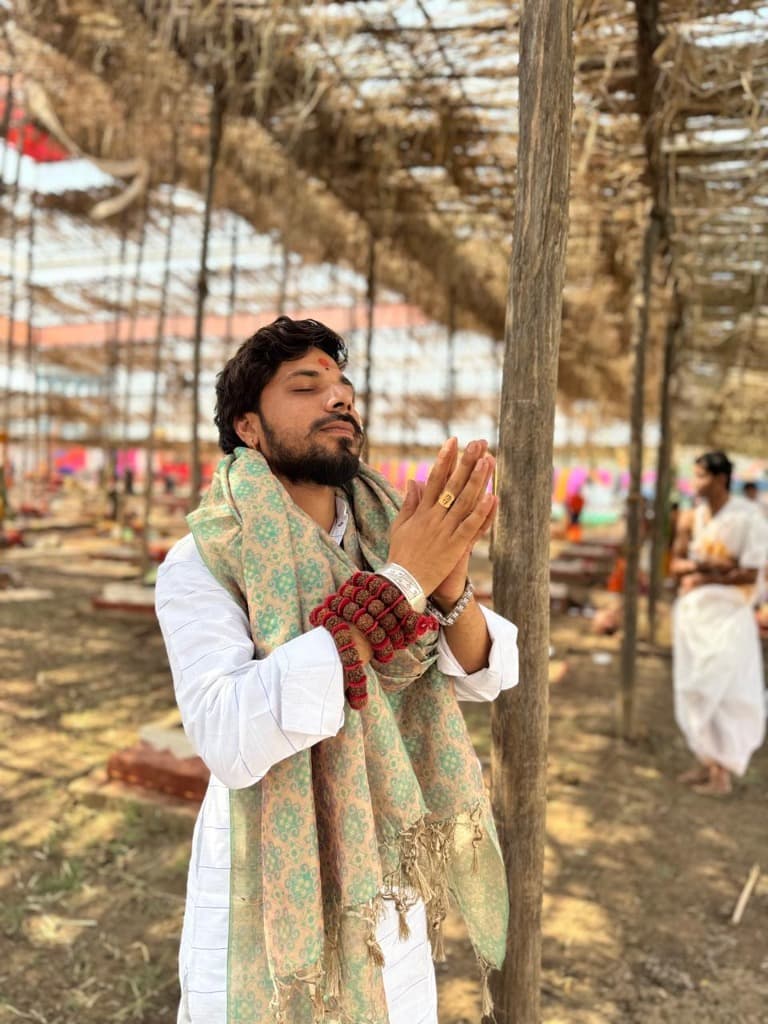
Acharya Tiwari Chetan Guru
Siddha Peethadheesh & Head Vedic Scholar
With over 15+ years of unbroken Vedic practice at Maa Baglamukhi Siddha Peeth, Nalkheda, Acharya Ji is a globally authoritative voice on Tantra Shastra, Stambhan Vidya, and Karmic Astrology. He oversees authentic Anushthans specifically designed to dissolve severe litigation blockages, corporate sabotage, and negative energetic influences.
Need Exact Hawan Cost & Shubh Muhurat?
Get direct guidance from Head Priest Acharya Tiwari Chetan Guru.