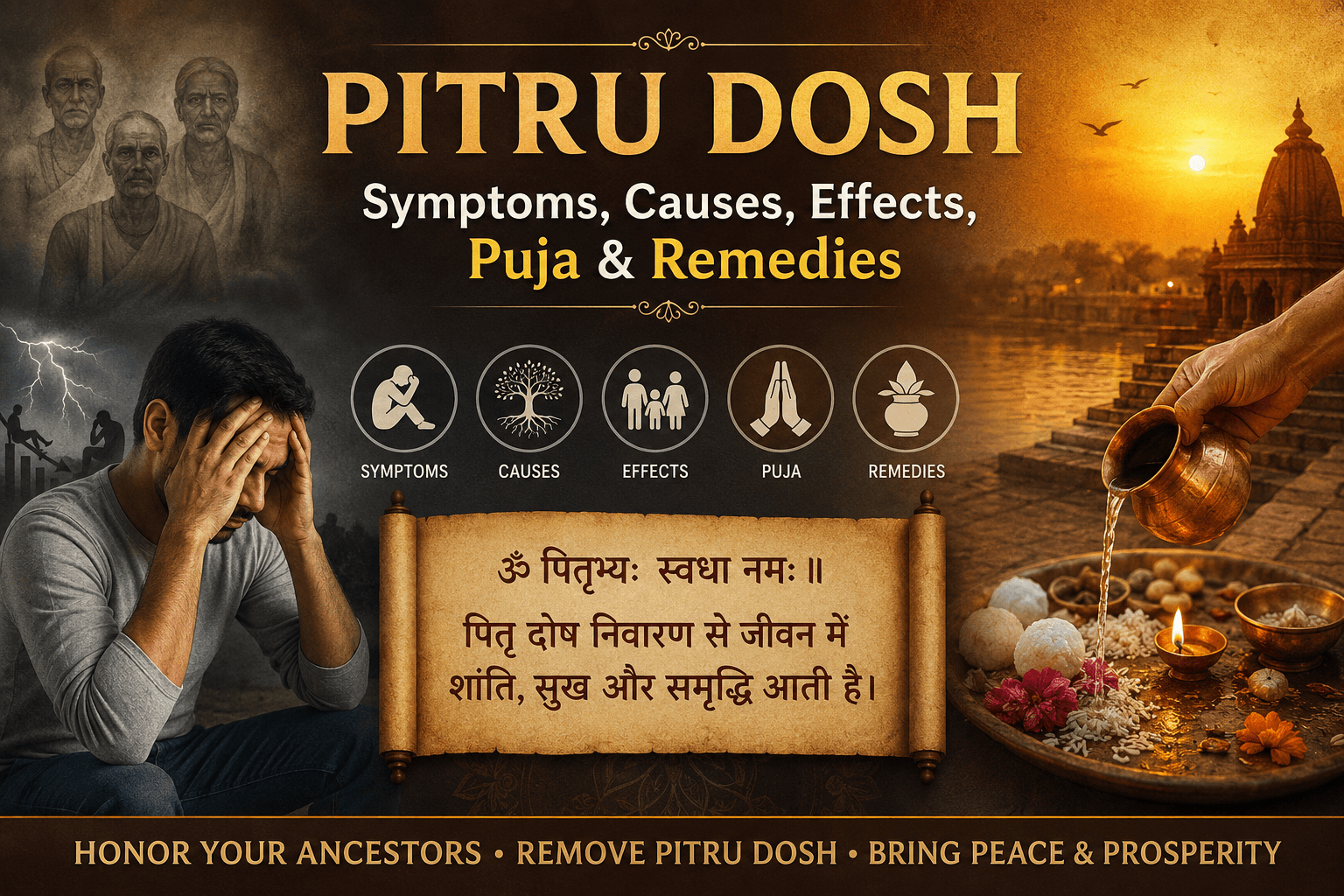
Pitru Dosh is a concept in Vedic astrology and Hindu ancestral tradition, believed to arise when ancestors' souls remain unsatisfied due to incomplete rites or unresolved family karma. It is traditionally checked through the Sun, Moon, Rahu, Ketu, and the 9th house in a Kundli, and is addressed through remedies like Tarpan, Pind Daan, Shradh, and a dedicated Pitru Dosh Nivaran Puja — especially during Pitru Paksha.
Quick Answer Box
Question | Short Answer |
|---|---|
What is Pitru Dosh? | A Vedic astrology concept describing ancestral karmic imbalance, traditionally linked to unfulfilled rites for departed family members. |
What are its commonly mentioned symptoms? | Recurring family friction, repeated obstacles, delays in important life events, and other patterns some traditions associate with ancestral imbalance — none of which are proof on their own. |
What causes it, astrologically? | Traditions point to afflictions involving the Sun, Rahu, Ketu, the 9th house, or its lord, along with neglected or incomplete ancestral rites. |
What are the traditional remedies? | Shradh, Tarpan, Pind Daan, charity in ancestors' memory, and a Pitru Dosh Nivaran Puja performed with proper Sankalp. |
Is Pitru Paksha important for these rituals? | Yes — it is widely regarded as the most suitable period in the Hindu calendar for ancestor-related observances. |
Disclaimer: The information below reflects traditional Hindu astrological and spiritual beliefs. These are matters of faith and tradition, not scientifically verified facts, and should never replace qualified medical, financial, legal, or professional advice.
Table of Contents
What Is Pitru Dosh?
In Sanskrit, "Pitru" (or Pitra) refers to ancestors — the departed members of one's family lineage — and "Dosha" means a flaw, affliction, or imbalance. Put together, Pitru Dosh describes a condition where the ancestral line is believed to carry an unresolved spiritual debt or disturbance.
This is a concept rooted in Vedic astrology (Jyotish Shastra) and Hindu ancestral tradition, not in modern medicine or science. It draws on the idea, found in texts like the Garuda Purana, that every person owes three debts at birth — Deva Rin (debt to the gods), Rishi Rin (debt to sages and teachers), and Pitru Rin (debt to one's ancestors). Traditions hold that this debt is repaid through rituals such as Shradh and Tarpan.
It's worth being clear from the outset: Pitru Dosh is a belief system, interpreted differently by different astrologers, priests, and regional traditions. Some families follow it closely; others observe ancestral rites simply as an act of remembrance, without attaching astrological significance at all. Neither approach is "wrong" — both fall within the wide spectrum of Sanatan Dharma practice.
Pitru Dosh in Kundli: How Is It Traditionally Identified?
Vedic astrologers who work with this concept generally look at a combination of planetary positions rather than any single placement. Commonly discussed factors include:
The Sun — considered significant to ancestral matters (particularly the paternal line) in several astrological schools.
Rahu and Ketu — the shadow planets (lunar nodes), which many astrologers associate with karmic and ancestral patterns when they closely aspect or conjoin the Sun or Moon.
The 9th house — traditionally linked to father, forefathers, and dharma in Vedic astrology, making afflictions here relevant to this discussion.
The 9th house lord — its placement and strength are sometimes factored in alongside the above.
It's important to understand that astrologers differ meaningfully in how they read these combinations. Some schools weigh the Sun-Rahu axis heavily; others give more importance to the Moon or to the 9th house lord specifically. A planetary placement that one astrologer flags as significant may be read quite differently by another. For this reason, no single combination should be treated as automatic or definitive proof of Pitru Dosh — a proper reading typically involves looking at the chart as a whole, along with the dasha (planetary period) running at the time.
If you want a structured assessment rather than guesswork, a personal consultation is usually more reliable than trying to self-diagnose from generic online descriptions.
Pitru Dosh Symptoms: What Are the Commonly Associated Signs?
Below are patterns that some traditions associate with Pitru Dosh. This is not a diagnostic checklist — it is an overview of what is commonly discussed in astrological and ancestral-worship literature.
Traditionally Associated Pattern | Important Context |
|---|---|
Recurring conflicts within the family | Can equally stem from communication issues, financial stress, or unresolved personal differences |
Repeated obstacles in important life plans | May have entirely practical explanations — timing, preparation, market conditions, etc. |
Difficulties around family or progeny that some traditions link to ancestral imbalance | Has well-documented medical and biological explanations that a qualified doctor should be consulted for |
Financial or career stagnation traditionally attributed to ancestral imbalance | Often tied to market cycles, skill gaps, or industry conditions |
Recurring ancestral or family-related concerns surfacing across generations | Family patterns can also be social, financial, or behavioural in origin |
Dreams or emotional experiences involving deceased relatives, where traditionally interpreted | Dreams are widely studied in psychology and often reflect memory, grief, or subconscious processing |
A necessary clarification: none of the above patterns are unique to Pitru Dosh, and none of them confirm its presence. Family conflict, financial setbacks, delays, and health concerns all have ordinary practical, psychological, medical, or social explanations, and should be examined through the appropriate professional lens first. Vedic astrology treats these as possible symptoms worth exploring through a proper Kundli reading — not as a self-diagnosis checklist, and never as a substitute for professional help in the relevant field.
What Causes Pitru Dosh According to Vedic Tradition?
Different schools of thought within Hindu tradition offer varying explanations for how Pitru Dosh is believed to arise. Commonly discussed causes include:
Neglected ancestral rites — where Shradh, Tarpan, or other prescribed rituals were not performed after a family member's passing.
Unresolved ancestral obligations — situations where a departed family member's final wishes, debts, or duties were left incomplete.
Improper or incomplete traditional rites — Antyeshti (last rites) or subsequent Shradh ceremonies conducted without following prescribed procedure.
Astrological combinations interpreted as Pitru Dosha — as discussed in the Kundli section above, certain planetary patterns that astrologers read as indicative.
Ancestral karma as understood in some traditions — a broader idea that karmic patterns can be inherited or carried forward across a family lineage.
These are traditional interpretations, and different astrologers and priests emphasize different causes. It would be inaccurate to say Pitru Dosh always occurs for one specific reason, such as "angry ancestors" — Vedic tradition itself presents this as a nuanced, multi-factor concept rather than a single fixed cause-and-effect rule.
Effects of Pitru Dosh According to Traditional Beliefs
The following are commonly discussed within Vedic astrology and ancestral worship traditions. They are described here using traditional-attribution language, since none of these are scientifically established causal effects.
Family and Relationships
Some traditions hold that ancestral dissatisfaction can be reflected in recurring domestic friction or a lack of harmony within the household. Astrologers who work with this concept often view family disputes through this lens when other explanations don't seem to fit the pattern the family is experiencing.
Career and Finances
Traditionally, some astrologers connect Pitru Dosh with unexplained stagnation in career growth or business matters, particularly when a person or family feels they have "done everything right" without seeing corresponding results.
Marriage and Progeny
Certain traditions associate delayed marriages or difficulties around family growth with ancestral imbalance. This is a sensitive area, and families are strongly encouraged to also seek relevant medical and professional guidance rather than relying solely on an astrological explanation.
Emotional and Ancestral Concerns
Many devotees report a general sense of unease, or a felt need to reconnect with their family's ancestral roots. Traditionally, this is seen as one of the more subtle effects — less about outward events, and more about a devotee's inner sense of incompleteness regarding their lineage.
Across all of these categories, the same caution applies: these are traditional interpretations offered as one possible lens, not scientific or diagnostic claims about your specific circumstances.
Pitru Dosh Remedies
Vedic and ancestral-worship traditions describe several remedies, most centered around honoring departed ancestors with sincerity and proper ritual procedure:
Shradh — a structured ceremony performed to honor a specific ancestor, typically on the corresponding lunar tithi (date) of their passing.
Tarpan — the offering of water, often mixed with black sesame seeds, to ancestors as an act of spiritual nourishment.
Pind Daan — offerings made (traditionally rice or barley-based) where appropriate, as part of a fuller ancestral rite.
Pitru Paksha observances — many families concentrate their annual ancestral rituals within this fortnight (see the dedicated section below).
Amavasya (new moon) remembrance — some traditions observe ancestral prayers specifically on Amavasya dates through the year.
Charity or daan in the ancestors' memory — giving in a departed relative's name is a widely followed practice across Hindu tradition.
Feeding those traditionally included in ancestral observances, where appropriate to one's family custom.
Prayer or mantra chanting, according to one's own family or regional tradition.
A dedicated Pitru Dosh Nivaran Puja, where a priest performs a focused ritual with Sankalp specifically addressing ancestral imbalance.
It's worth stating plainly: no single ritual is claimed to "guarantee" the removal of Pitru Dosh. These remedies are performed with sincerity and faith, as part of an ongoing tradition of honoring one's ancestors — not as a one-time transaction with a promised outcome.
Pitru Dosh Puja: Vidhi, Purpose & What to Expect
Devotees typically consider a Pitru Dosh Puja when they wish to formally and respectfully address ancestral matters — whether prompted by a Kundli reading, a family tradition, or simply a desire to honor their lineage more deliberately.
The general purpose of the ritual, as traditionally understood, is to offer proper spiritual attention to ancestors who may not have received complete rites, and to reaffirm the living family's respect and gratitude toward their lineage.
At the Pitra Dosh Puja (Advanced) offered at Nalkheda Siddha Peeth, the ritual generally follows the structure common to Vedic pujas performed at the temple:
Preparation and purification — the ritual space and materials are readied according to traditional practice.
Sankalp — the officiating Acharya takes a formal vow, chanting the devotee's name and stated intention, dedicating the ritual specifically to them and their family.
Main puja and Havan — the core worship is performed, including the sacred fire ritual.
Devotees observing the ritual, or its associated period, are generally expected to follow Satvik conduct — avoiding alcohol and non-vegetarian food, and maintaining physical and mental purity during the relevant days.
Before booking any Pitru Dosh–related ritual, it's worth having a personal consultation so the priest can understand your specific family situation and Gotra before recommending the appropriate Sankalp.
When Is the Best Time for Pitru Dosh Puja?
Traditionally, ancestral rituals are tied to the lunar calendar rather than fixed calendar dates:
Pitru Paksha — the fortnight most widely regarded as suited to Shradh, Tarpan, and related ancestral rites. In 2026, Pitru Paksha runs from 26 September to 10 October, concluding on Sarva Pitru Amavasya.
Amavasya (new moon) — considered significant for ancestral remembrance throughout the year, not only during Pitru Paksha.
The ancestor's specific tithi — many families prefer to perform Shradh on the exact lunar date corresponding to their ancestor's passing, rather than any fixed date.
Other family-specific dates — some households follow their own regional or family custom for when ancestral rites are performed, which can vary across communities.
If the exact tithi of an ancestor's passing is unknown, Sarva Pitru Amavasya (the final day of Pitru Paksha) is traditionally treated as the appropriate day to perform rites on their behalf.
Pitru Dosh Puja During Pitru Paksha
Pitru Paksha holds particular significance for anyone considering ancestral rituals, and this is worth understanding in a little more depth given how many devotees plan their Shradh and Tarpan specifically around this window.
During these sixteen days, tradition holds that departed souls remain closer to the earthly realm, making it an especially meaningful time to offer Tarpan and Pind Daan. This is one reason so many families choose to concentrate their annual ancestral observances — including any Pitru Dosh Nivaran Puja they may be considering — within this specific fortnight rather than spreading them across the year.
If you have been planning to address a Pitru Dosh–related concern that came up in a Kundli reading, or simply wish to formally honor your ancestors this year, Pitru Paksha is widely considered the most appropriate window to do so — whether through a home-based Tarpan or a fuller temple-based Shradh and Havan performed on your behalf.
Pitru Dosh Puja at Nalkheda Siddha Peeth
The Pitra Dosh Puja (Advanced) is performed at the Nalkheda Siddha Peeth, Madhya Pradesh — the temple seat associated with Maa Baglamukhi, under the guidance of Acharya Tiwari Chetan Guru and the temple's team of Acharyas.
The ritual is conducted on-site at the temple, with the devotee's Sankalp taken in their name (and Gotra, where known) before the ceremony begins. Devotees do not need to travel to Nalkheda in person to participate — the Puja Vidhi followed at the temple allows for the Sankalp and ritual details to be shared with devotees remotely as part of the booking process described below.
How to Know Whether You Should Consider Pitru Dosh Puja
It's worth repeating a point already made through this article: you should not self-diagnose Pitru Dosh based on symptoms alone. Family friction, financial setbacks, health concerns, and delays in life events are common human experiences with a wide range of ordinary explanations, and deserve to be examined through the appropriate professional channel — medical, financial, legal, or psychological — before, or alongside, any spiritual interpretation.
A more grounded approach is to:
Have your Kundli properly reviewed by an experienced astrologer, rather than relying on generic symptom lists.
Treat any astrological finding as one input among several, not a conclusion in itself.
Remember that ancestral rituals can be meaningful purely as acts of remembrance and devotion, entirely apart from any astrological framing — many families perform Shradh and Tarpan every year simply out of respect for their lineage, without connecting it to "problems" at all.
If, after reflection or a proper consultation, you feel a dedicated ritual would bring you and your family peace of mind, that is a reasonable and personal decision rooted in faith — not one that needs to be justified by fear.
Pitru Dosh Puja Booking: How the Process Works
Based on the booking journey described for pujas at Nalkheda Siddha Peeth, the process generally follows these steps:
Contact the team — reach out via WhatsApp or phone call to share your basic details and describe your situation.
Consultation — Acharya Ji or the temple team reviews your circumstances and helps identify the appropriate Muhurat (auspicious timing) for your ritual.
Sankalp and ritual — your personalized Sankalp is performed at the sacred Nalkheda Siddha Peeth, with your name and intention formally included in the ceremony. Live participation is offered for devotees who wish to witness the ritual remotely.
Prasad delivery — blessed Prasad is dispatched to your address following the completion of the puja.
Devotees are typically asked to share their full name, Gotra (if known), and a description of their concern so the ritual can be conducted with the correct Sankalp. No fixed price is quoted without first understanding the specific situation and the type of ritual required.
If you'd like to explore this further, you can book your Pitra Dosh Puja here, or start with a consultation with Acharya Ji if you're unsure which ritual fits your situation. For those also exploring other astrologically discussed afflictions alongside Pitru Dosh, the temple additionally offers a Kaal Sarp Dosh Pooja and a Graha Shanti Puja for planetary afflictions more broadly, as well as a Santan Sukh Prapti Puja for couples navigating family-related concerns. Devotees who want to understand the ritual structure in more depth beforehand can also read the temple's general Puja Vidhi and Havan Vidhi guides, or learn more about Acharya Tiwari Chetan Guru, who oversees the rituals at Nalkheda Siddha Peeth.
Key Takeaways
Pitru Dosh is a traditional Vedic astrology and ancestral-worship concept — not a scientifically established diagnosis.
It is generally examined through the Sun, Rahu, Ketu, and the 9th house in a Kundli, but interpretations vary across astrologers.
Commonly associated "symptoms" have ordinary practical, medical, financial, or psychological explanations and should not be self-diagnosed.
Traditional remedies include Shradh, Tarpan, Pind Daan, charity, and a dedicated Pitru Dosh Nivaran Puja.
Pitru Paksha (26 September – 10 October, 2026) is widely regarded as the most appropriate period for ancestral rituals.
No ritual is claimed to guarantee outcomes — these practices are performed with faith, sincerity, and respect for one's lineage.
Always pair any spiritual approach with appropriate medical, financial, or legal guidance where relevant.
Frequently Asked Questions
What is Pitru Dosh?
Pitru Dosh is a concept from Vedic astrology and Hindu ancestral tradition, referring to a believed imbalance connected to unresolved ancestral rites or karmic patterns within a family lineage. It is a matter of tradition and faith rather than a scientific diagnosis.
What are the symptoms of Pitru Dosh?
Some traditions associate patterns like recurring family conflict, repeated obstacles, or delays in major life events with Pitru Dosh. These patterns are common human experiences with many possible explanations, and are not proof of Pitru Dosh on their own.
How is Pitru Dosh identified in a Kundli?
Astrologers commonly look at the Sun, Rahu, Ketu, the 9th house, and its lord. Different schools weigh these factors differently, so a proper reading typically considers the whole chart rather than one placement alone.
What causes Pitru Dosh?
Traditional explanations include neglected or incomplete ancestral rites, unresolved family obligations, and certain planetary combinations. Different traditions emphasize different causes, so there is no single universally agreed explanation.
Can Pitru Dosh affect family life?
Some traditions suggest a connection between ancestral imbalance and family friction, career stagnation, or delays in marriage. These are traditional interpretations, not scientifically proven causes, and other explanations should always be considered first.
What are the traditional remedies for Pitru Dosh?
Common remedies include Shradh, Tarpan, Pind Daan, charity in the ancestors' name, and a dedicated Pitru Dosh Nivaran Puja performed with proper Sankalp — typically during Pitru Paksha or on Amavasya.
Is Pitru Paksha a good time for Pitru Dosh Puja?
Yes, Pitru Paksha is widely regarded in Hindu tradition as the most suitable period for Shradh, Tarpan, and other ancestral rituals, including a Pitru Dosh Nivaran Puja. In 2026, it falls from 26 September to 10 October.
What is Pitru Dosh Nivaran Puja?
It is a focused ritual performed with a personal Sankalp, intended to address ancestral concerns through structured worship, offerings, and Havan, conducted by a priest on the devotee's behalf.
How is Pitru Dosh Puja performed?
At Nalkheda Siddha Peeth, the ritual generally follows preparation and purification, a personalized Sankalp taken in the devotee's name, and the main puja and Havan, performed by the temple's Acharyas.
How can I book Pitra Dosh Puja at Nalkheda Siddha Peeth?
You can reach out via WhatsApp or phone to share your details and situation, after which the temple team helps identify a suitable Muhurat before performing your Sankalp and ritual, with Prasad sent to you afterward. You can start on the booking page.
This article is intended for general informational purposes and reflects traditional Hindu astrological and spiritual beliefs. It is not medical, financial, or legal advice. For personal guidance on your specific situation, please consult the relevant qualified professional, and speak with an experienced Vedic astrologer or priest for spiritual matters.
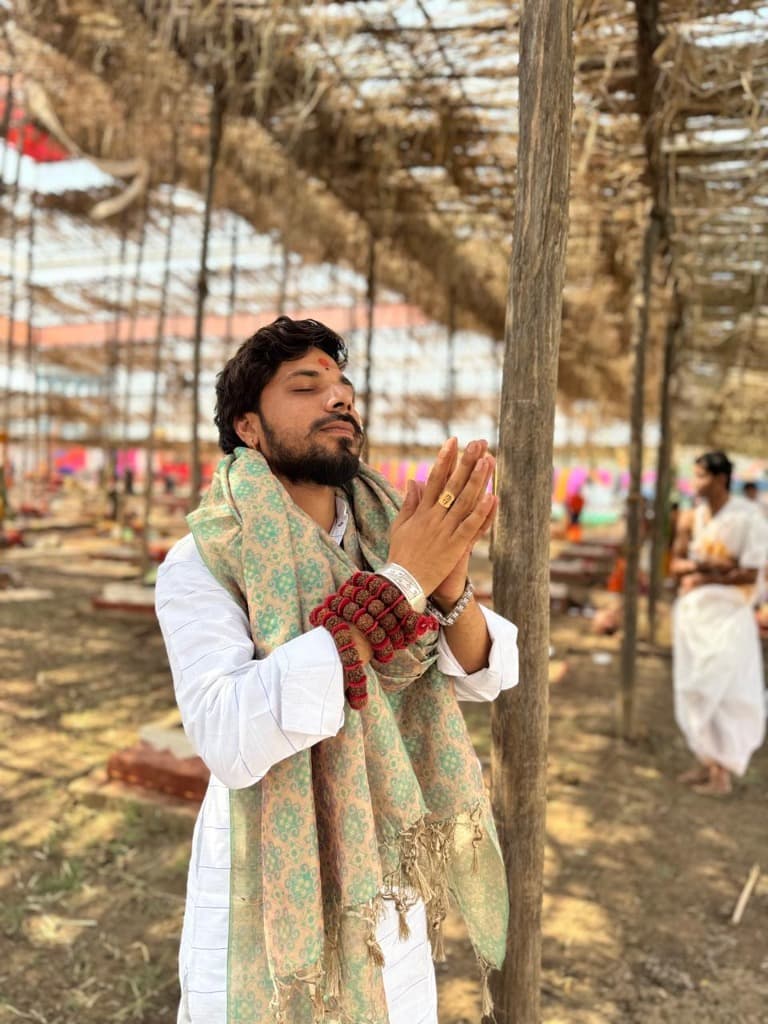
Acharya Tiwari Chetan Guru
Siddha Peethadheesh & Head Vedic Scholar
With over 15+ years of unbroken Vedic practice at Maa Baglamukhi Siddha Peeth, Nalkheda, Acharya Ji is a globally authoritative voice on Tantra Shastra, Stambhan Vidya, and Karmic Astrology. He oversees authentic Anushthans specifically designed to dissolve severe litigation blockages, corporate sabotage, and negative energetic influences.
Need Exact Hawan Cost & Shubh Muhurat?
Get direct guidance from Head Priest Acharya Tiwari Chetan Guru.