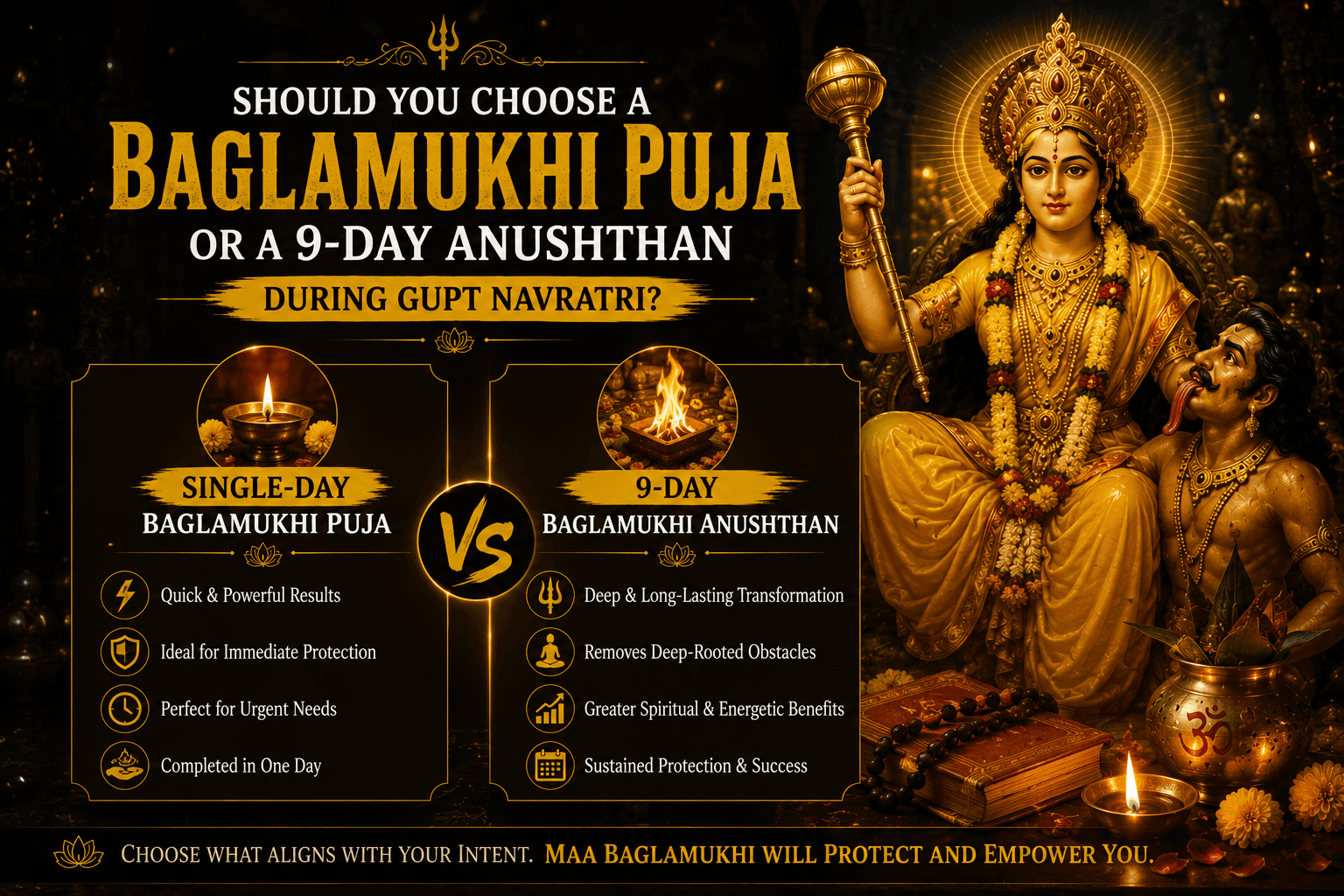
If you are planning to observe Gupt Navratri with Maa Baglamukhi's worship this year, you have probably run into the same question that stops most devotees before they book anything: should this be a single-day puja, or does your situation call for a full 9-day Anushthan?
It is a fair question, and an important one. The two are not simply a smaller and larger version of the same thing. They differ in purpose, intensity, and the kind of situation each is traditionally meant to address. Choosing the wrong one is not dangerous, but it can leave you underprepared for a serious problem, or committing more time and discipline than a simple situation genuinely needs. This guide walks through both options honestly, without pushing you toward the more elaborate choice by default, so you can decide with a clearer head.
Quick Answer: A single-day Baglamukhi Puja is generally suited to recent or moderate concerns, first-time devotees, and general blessings, while a 9-day Anushthan is traditionally recommended for long-running court cases, serious enemy problems, and repeated obstacles. According to Hindu traditions, the right choice depends on the depth and duration of your situation, not on which option sounds more powerful.
Key Takeaways
A single-day puja and a 9-day Anushthan serve different purposes. Neither is automatically better than the other.
Temple traditions suggest matching the ritual's intensity to how long-standing and serious your situation is.
First-time devotees and those seeking general protection are usually well served by a single-day puja.
Long-pending court cases, persistent enemies, and repeated failures are the classical reasons devotees undertake a full Anushthan.
Speaking with an experienced Acharya before deciding removes most of the guesswork, especially for complex situations.
Why Devotees Get Confused Between Puja and Anushthan
Quick Answer: Confusion usually comes from generic online advice that treats every ritual as interchangeable, and from marketing language that pushes longer rituals as automatically superior, rather than matching the ritual to the actual situation.
Most devotees searching for guidance online run into two extremes. One side suggests a single puja fixes everything. The other insists that only a lengthy Anushthan produces real results. Neither is accurate. According to Hindu traditions, different rituals exist precisely because devotees arrive with different needs. A student wanting exam success and a business owner facing years of litigation are not in the same position, and temple traditions have never suggested they should follow the same path. The confusion fades once you stop asking "which is more powerful" and start asking "which matches what I am actually dealing with."
What Is a Single-Day Baglamukhi Puja?
Quick Answer: A single-day Baglamukhi Puja is a focused ritual completed in one sitting, involving sankalp, mantra chanting, and often a havan, generally suited to moderate or recent concerns rather than deeply entrenched problems.
Purpose
A single-day puja is designed to invoke Maa Baglamukhi's blessings and her Stambhan Shakti in a concentrated, complete ritual. It is not a lesser version of an Anushthan. It is a complete ritual in its own right, appropriate for situations that do not require sustained, multi-day intervention.
Procedure
The puja typically opens with sankalp in the devotee's name and gotra, followed by invocation of Maa Baglamukhi through her mool mantra. Many devotees choose to include a havan, where turmeric, yellow flowers, and ghee are offered into a sacred fire while the mantra is chanted. The ritual concludes with aarti and the preparation of prasad. You can read the step-by-step procedure in more detail on our Baglamukhi Havan page.
Duration
A single-day puja is generally completed within a few hours, often between two and four hours depending on whether a havan is included and how elaborate the sankalp is.
Who Should Choose It
Devotees who are new to Baglamukhi worship, those seeking general protection or blessings, and those dealing with a recent or moderate obstacle are usually well suited to this option.
Advantages
Requires a smaller time commitment than a multi-day ritual
A gentle, complete introduction for first-time devotees
Suitable for situations that are recent rather than deeply entrenched
Can be repeated on future auspicious days if needed
Limitations
Traditionally considered less suited to long-standing or severe situations
Does not offer the sustained, cumulative focus of a multi-day Anushthan
May need to be followed by another puja later if the underlying issue persists
What Is a 9-Day Baglamukhi Anushthan?
Quick Answer: A 9-day Baglamukhi Anushthan is a sustained ritual observed across all of Gupt Navratri, involving daily sankalp, mantra japa, havan, and a concluding Purna Ahuti, traditionally recommended for serious, long-standing, or deeply entrenched problems.
Purpose
An Anushthan is built around sustained repetition. Rather than a single, complete invocation, it asks the devotee, or the Acharya performing it on their behalf, to return to the same focused practice every day for nine days. Many devotees believe this consistency is what gives the Anushthan its traditional association with deeper, more stubborn problems.
Daily Rituals
Sankalp: A fresh or continued sankalp is observed each day, keeping the devotee's name, gotra, and intention at the centre of the practice.
Japa: Mantra chanting is repeated daily, often in significantly higher counts than a single-day puja, building cumulative focus across the nine days.
Havan: Daily or periodic havan offerings are made through the observance, depending on the specific Anushthan chosen.
Purna Ahuti: The Anushthan concludes with a final, larger offering on the last day, generally timed close to or on Ashtami, considered Maa Baglamukhi's most significant day within Gupt Navratri.
Who Should Choose It
Devotees facing long-pending court cases, sustained opposition from adversaries, repeated professional or business setbacks, or a pattern of obstacles that has resisted simpler remedies are the ones temple traditions generally point toward this option.
Advantages
Sustained daily focus across the entire Gupt Navratri window
Traditionally associated with deeper, more entrenched situations
Culminates on Ashtami, considered the most spiritually significant day for Maa Baglamukhi's worship
Suited to devotees committed to consistent spiritual discipline
Time Commitment
A 9-day Anushthan requires daily participation or daily updates if performed on your behalf, generally around an hour a day if you are personally involved, though this varies by the specific Anushthan and whether an Acharya is conducting it for you.
Still weighing your options? Every situation is different, and a short conversation often makes the choice obvious. Talk to Acharya Ji Before Deciding
Single-Day Puja vs 9-Day Anushthan: Comparison Table
Feature | Single-Day Puja | 9-Day Anushthan |
|---|---|---|
Duration | A few hours, completed in one sitting | Spread across all nine days of Gupt Navratri |
Best For | Recent concerns, general blessings, first-time devotees | Long-standing, serious, or repeated problems |
Ritual Intensity | Focused and complete, moderate intensity | Sustained and cumulative, higher intensity |
Recommended Situations | Mild obstacles, general protection, exam or interview support | Long court cases, persistent enemies, business losses, repeated failures |
Participation | Can be a single sitting, in person or online | Requires daily involvement or daily updates over nine days |
Preparation | Minimal, decided a day or two in advance | More planning, often decided before Gupt Navratri begins |
Cost Factors | Reflects a single ritual session | Reflects nine days of sustained ritual work, higher overall involvement |
Follow-up Rituals | May be repeated later if the concern persists | Concludes with Purna Ahuti on the final day |
Traditional Recommendation | Suitable as a first step for most devotees | Reserved for situations experienced Acharyas assess as requiring deeper intervention |
When Should You Choose a Single-Day Puja?
Quick Answer: A single-day puja generally suits recent obstacles, first-time devotees, general blessings, and devotees working within tight time constraints.
Recent obstacles: If the difficulty you are facing has appeared only in the last few weeks or months, a single, focused puja is traditionally considered sufficient as a first response.
First-time devotees: If you have never performed Baglamukhi worship before, starting with a single-day puja lets you experience the ritual without committing to nine days immediately.
General blessings: Devotees seeking protection, clarity, or Maa Baglamukhi's general grace, without a specific severe crisis, are usually well served by this option.
Time limitations: If your schedule genuinely cannot accommodate nine days of involvement, even indirectly, a well-performed single-day puja is a complete ritual in its own right, not a compromise.
When Should You Choose a 9-Day Anushthan?
Quick Answer: A 9-day Anushthan is traditionally recommended for long-running court cases, business obstacles, repeated failures, serious enemy issues, generational problems, and devotees seeking deeper spiritual discipline during Gupt Navratri.
Long-running court cases: Cases that have stretched across years, with repeated delays or setbacks, are the classical example temple traditions associate with a full Anushthan rather than a single puja.
Business obstacles: Sustained losses, partnership disputes, or a pattern of professional sabotage are often addressed with the deeper focus a multi-day ritual allows. Our Shatru Nashak Puja is frequently combined with an Anushthan in these cases.
Repeated failures: If the same kind of setback keeps recurring despite your best efforts, an Anushthan's sustained repetition is traditionally believed to address patterns more effectively than a single sitting.
Serious enemy issues: Persistent harassment, sabotage, or hostility from a known or unknown adversary is one of the primary traditional reasons devotees choose the fuller ritual.
Spiritual discipline: Some devotees choose the Anushthan not because of a crisis, but because they want to use all nine days of Gupt Navratri for sustained personal sadhana.
Generational problems: Difficulties that seem to repeat across a family, from health to prosperity to relationships, are sometimes approached with an Anushthan performed with the whole family's wellbeing in the sankalp.
Decision Checklist
Quick Answer: If your situation is longer than a year, financially significant, or involves suspected negative energy, temple traditions generally point toward a 9-day Anushthan. Shorter-term or general concerns are usually well matched to a single-day puja.
If YES... | Recommended Option |
|---|---|
Court case longer than one year | 9-Day Anushthan |
Business losses over a sustained period | 9-Day Anushthan |
Negative energy or black magic concerns | 9-Day Anushthan |
Marriage delay without a specific crisis | Single-Day Puja, with an Anushthan if it has persisted for years |
Career obstacles that are recent | Single-Day Puja |
General blessings or protection | Single-Day Puja |
This checklist is meant as a starting point, not a final answer. If you fall between two rows, or your situation does not fit neatly into any of them, that is exactly when a short conversation with an Acharya is more useful than trying to self-diagnose from a table.
Not sure which row fits your situation? A quick conversation can save you from choosing the wrong ritual for what you are facing. Discuss Your Situation on WhatsApp
Who Should Consult an Acharya Before Deciding
Personalised guidance matters most when your situation does not fit a simple category. Experienced Acharyas generally recommend a short conversation before booking, especially if you are dealing with more than one issue at once, such as a court case combined with business losses, or if you are unsure whether your problem counts as recent or long-standing. A conversation also helps if you are considering an Anushthan but are unsure whether your schedule can genuinely support nine days of involvement. Acharya Tiwari Chetan Guru typically discusses the specific situation with each devotee before recommending a single-day puja, a full Anushthan, or a combination of rituals such as an Anushthan paired with a targeted Havan.
Common Myths About Puja and Anushthan
Myth: An Anushthan always gives faster results. In reality, temple traditions describe the Anushthan as deeper and more sustained, not faster. A single-day puja can be entirely appropriate, and effective, for the situation it is meant for.
Myth: Longer rituals are always better. A nine-day commitment performed half-heartedly is generally considered less valuable than a single-day puja performed with full sincerity and focus.
Myth: Everyone should do a 9-day ritual during Gupt Navratri. Many devotees perform a single, well-focused puja every Gupt Navratri without ever needing the fuller Anushthan, and this is a complete and traditional practice.
Myth: A one-day puja is ineffective. According to Hindu traditions, a single-day puja is a complete ritual, not an incomplete one. Its scope is simply different from an Anushthan's.
Myth: You must choose one option and cannot combine them. Some devotees start Gupt Navratri with a single-day puja and later decide, with an Acharya's guidance, to extend into a fuller Anushthan if needed.
Myth: Only serious sinners or unlucky people need an Anushthan. Choosing a longer ritual reflects the nature of the situation, not anything about the devotee's character or past.
Myth: Online participation makes either ritual less powerful. Temple tradition holds that sankalp is defined by name, gotra, and intention, not by physical presence, so online participation in either option is considered complete.
Myth: Results are guaranteed if you choose the "right" ritual. No temple or Acharya can ethically promise a specific outcome. Both rituals are matters of devotional faith and traditional practice, not guaranteed remedies.
Online Participation
Quick Answer: Both a single-day puja and a 9-day Anushthan can be performed on a devotee's behalf through online sankalp, with the Acharya conducting the ritual at Nalkheda and sharing updates over WhatsApp along with worldwide prasad delivery.
For a single-day puja, online sankalp involves sharing your name, gotra, and intention, after which the puja is performed at the correct time and a video update is shared with you. For a 9-day Anushthan, the same principle applies daily, with updates typically shared at key points across the nine days rather than after every single session, culminating in confirmation of the Purna Ahuti.
This format works well for several kinds of devotees:
NRIs who cannot travel to Madhya Pradesh but want an authentic ritual performed at Nalkheda on their behalf
Senior citizens for whom travel or long hours of participation are not practical
Busy professionals who want to observe Gupt Navratri meaningfully without restructuring their entire work schedule
If you would like to understand this format in more depth, our guide on why Navratri is the most powerful time for Baglamukhi Havan covers the reasoning behind online sankalp further.
Why Many Devotees Choose Nalkheda During Gupt Navratri
Nalkheda holds a particular place in Baglamukhi worship because it is regarded as a Swayambhu Siddha Peeth, a site where the goddess's presence is considered self-manifested rather than installed through consecration. Temple traditions describe this distinction as significant for both single-day pujas and full Anushthans, since the setting in which a ritual is performed is considered part of its traditional strength. Acharya Tiwari Chetan Guru has personally conducted Gupt Navratri rituals at this Siddha Peeth since 2010, which is part of why many devotees choose to anchor either option here rather than performing it independently. You can read more about the site's background on our page covering the history and significance of the Nalkheda temple.
Common Questions Before Booking
How much time is needed? A single-day puja typically needs two to four hours on the chosen day. A 9-day Anushthan needs daily involvement, often around an hour a day if you are personally participating, or periodic check-ins if the Acharya is conducting it on your behalf.
Can family members join? Yes. Family members can be included in the sankalp, and many devotees choose to name their whole household when the concern affects the family as a unit, particularly for an Anushthan.
Can Sankalp be taken online? Yes. Sankalp can be taken remotely in the devotee's name and gotra for both a single-day puja and a full Anushthan, with the ritual performed at Nalkheda on your behalf.
Can Puja start on any Gupt Navratri day? A single-day puja can generally be performed on any day within the nine, though Ashtami is considered especially significant. A 9-day Anushthan is traditionally started as close to Day 1 as possible so it can run its full course.
Can I convert a Puja into an Anushthan? In some cases, yes. If a single-day puja is booked and the devotee later feels a fuller ritual is needed, this can often be discussed with the Acharya, though starting an Anushthan as early as possible in Gupt Navratri is generally preferred over converting midway.
Common Mistakes Devotees Make While Deciding
Choosing an Anushthan purely because it sounds more powerful, without matching it to the actual situation
Choosing a single-day puja for a problem that has persisted for years, expecting the same depth of effect
Not discussing the situation with an Acharya before booking either option
Assuming online participation is less authentic than being physically present
Booking too close to Ashtami, leaving no time for a full Anushthan to run its course
Ignoring family context when the issue affects the household rather than one individual
Treating either ritual as a substitute for practical steps, such as legal counsel or professional advice
Expecting a guaranteed outcome rather than approaching the ritual as a matter of faith and tradition
Switching between rituals or Acharyas mid-way out of impatience rather than genuine reassessment
Not preparing basic details in advance, such as gotra and a clear description of the situation, which slows down the booking conversation
Every situation is different, and that is exactly why a conversation helps more than a checklist alone. Speak with Acharya Ji Before You Book
Final Thoughts
There is no single correct answer to whether you need a single-day Baglamukhi Puja or a full 9-day Anushthan this Gupt Navratri. What matters is an honest look at your situation: how long it has persisted, how deeply it has affected you, and how much you are genuinely able to commit to. Temple traditions have kept both options available precisely because devotees arrive in different circumstances, not because one is a lesser version of the other. If you remain unsure after reading this, that uncertainty itself is a reasonable enough reason to have a short conversation before deciding anything. You can also explore our full range of Baglamukhi Puja and Anushthan options to see what fits before you reach out.
Ready to decide, or still want a second opinion first? Acharya Tiwari Chetan Guru personally reviews each devotee's situation before recommending a ritual. No advance payment to start a conversation. Book Your Puja or Anushthan | Ask Acharya Ji First
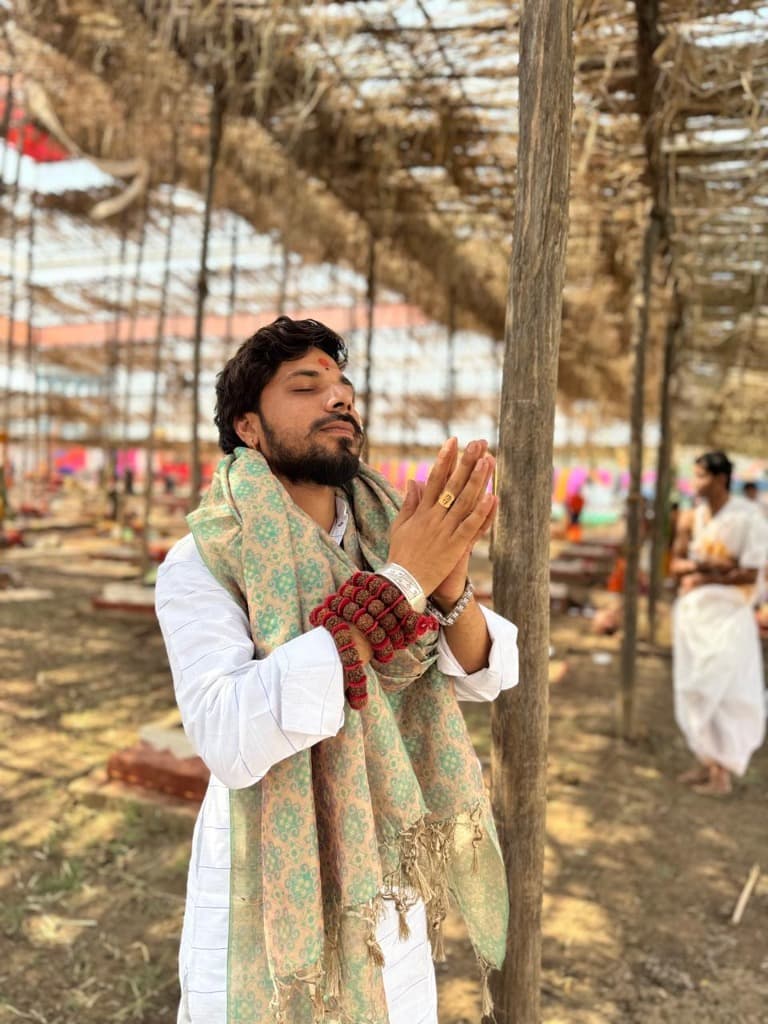
Acharya Tiwari Chetan Guru
Siddha Peethadheesh & Head Vedic Scholar
With over 15+ years of unbroken Vedic practice at Maa Baglamukhi Siddha Peeth, Nalkheda, Acharya Ji is a globally authoritative voice on Tantra Shastra, Stambhan Vidya, and Karmic Astrology. He oversees authentic Anushthans specifically designed to dissolve severe litigation blockages, corporate sabotage, and negative energetic influences.
Need Exact Hawan Cost & Shubh Muhurat?
Get direct guidance from Head Priest Acharya Tiwari Chetan Guru.