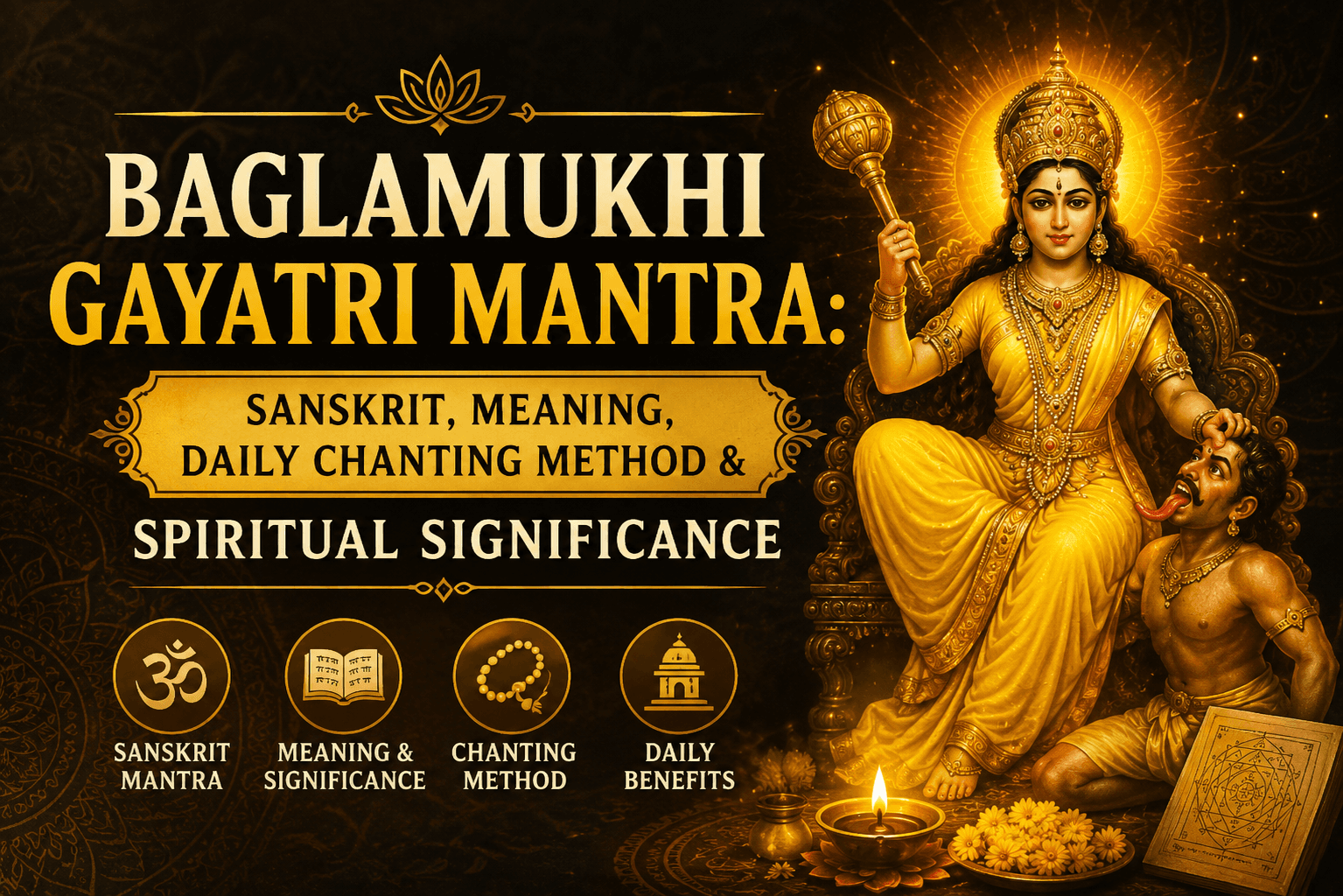
Among the many prayers offered to the eighth Mahavidya, the Baglamukhi Gayatri Mantra holds a special place. It is shorter than the Mool Mantra, gentler in tone, and easier for a beginner to hold in memory. Yet it carries the same seed of devotion: a request for clarity, steadiness, and protection from the Goddess who governs Stambhan Shakti, the power to still and quiet what is harmful.
This guide walks through the mantra's Sanskrit text, its Hindi rendering, a word-by-word breakdown, correct pronunciation, and the daily chanting method as followed in Vedic and Tantric tradition. It is written for devotees who want to chant correctly and understand what they are saying, not just repeat sounds.
🪔Quick Answer
Baglamukhi Gayatri Mantra: "ॐ बगलामुख्यै विद्महे स्तम्भिन्यै धीमहि तन्नो देवी प्रचोदयात्॥" "Om Baglamukhyai Vidmahe Stambhinyai Dheemahi Tanno Devi Prachodayat"
It means: We meditate upon Goddess Baglamukhi, who holds the power of Stambhan (stillness and control). May that Goddess inspire and guide our intellect. It is best chanted 108 times daily, early morning, facing east, with a yellow (haldi) mala, after invoking the Baglamukhi Beej Mantra.
Why This Guide Matters
Search results on this mantra are often thin, copied from one another, or mix up the Gayatri Mantra with the longer Mool Mantra. Some sites give the version without "cha" (and), some with it, and few explain why the difference exists or what each word means.
This article brings together the Sanskrit, the Hindi, the transliteration, the literal word-by-word meaning, correct pronunciation, and a chanting method rooted in how it is actually practised at Maa Baglamukhi Siddha Peeth, Nalkheda, under the guidance of Acharya Tiwari Chetan Guru. It is meant to be the single page you need, whether you are chanting for the first time or refining a practice you already have.
Quick Highlights
Aspect | Detail |
|---|---|
Mantra Type | Gayatri-pattern devotional mantra |
Presiding Deity | Maa Baglamukhi, 8th Mahavidya |
Core Power Invoked | Stambhan Shakti (stillness, control, protection) |
Ideal Chant Count | 108 times (1 mala), or in multiples |
Ideal Time | Brahma Muhurat, 4 AM to 6 AM |
Ideal Direction | Facing East or North |
Recommended Mala | Haldi (turmeric) or yellow Vaijayanti mala |
Related Mantra | |
Suitable For | Students, professionals, those seeking mental clarity and protection |
What is the Baglamukhi Gayatri Mantra?
The Baglamukhi Gayatri Mantra is a short devotional chant built on the same grammatical structure as the universal Gayatri Mantra: an invocation, a meditation on the deity's power, and a prayer for guidance. It differs from the Baglamukhi Mool Mantra, which is a longer Tantric formula used in formal puja and havan for specific outcomes like enemy stambhan or court case protection.
The Gayatri form is quieter in intent. It does not name an adversary or an obstacle. It simply asks the Goddess to still the mind and guide the intellect (buddhi), which is why many devotees use it as a daily personal practice, separate from ritual-specific mantras chanted during a Baglamukhi Havan or Anushthan.
Featured Snippet Answer: The Baglamukhi Gayatri Mantra is a short Sanskrit prayer to the eighth Mahavidya, Maa Baglamukhi, that asks for guidance and mental clarity through her Stambhan Shakti. It follows the classic Gayatri format used across Hindu tradition for different deities, and is chanted daily for steadiness, protection, and calm decision-making.
Origin of the Gayatri Mantra Format
The Gayatri Mantra format originates in the Rigveda, where it was first addressed to Savitr, the solar deity, in the Gayatri metre (24 syllables in three lines of eight). Over centuries, the same three-part structure, an address, a meditation on divine power (Vidmahe), and a prayer for illumination (Dheemahi... Prachodayat), was adapted by different sampradayas for their chosen deity.
This is how mantras like the Durga Gayatri, Saraswati Gayatri, Ganesha Gayatri, and the Baglamukhi Gayatri came into practice within Shakta and Tantric traditions. The Baglamukhi Gayatri Mantra applies this same format to the eighth Mahavidya, replacing Savitr's solar energy with Baglamukhi's Stambhan Shakti.
Featured Snippet Answer: The Gayatri Mantra format comes from the Rigveda, originally addressed to the solar deity Savitr. Later Shakta and Tantric traditions adapted the same three-line structure for other deities, including Maa Baglamukhi, replacing the original meditation on light with a meditation on her power of Stambhan (stillness and control).
Baglamukhi Gayatri Mantra in Sanskrit
॥ श्री बगलामुखी गायत्री मंत्र ॥
ॐ बगलामुख्यै विद्महे स्तम्भिन्यै धीमहि तन्नो देवी प्रचोदयात्॥
Some lineages chant a slightly extended version with the connective "cha" (and):
ॐ बगलामुख्यै च विद्महे स्तम्भिन्यै च धीमहि तन्नो बगला प्रचोदयात्॥
Note on variation: Both forms are chanted across different guru parampara and are grammatically valid. The version without "cha" is the more commonly used and taught form at Nalkheda. Devotees initiated into a specific tradition should follow the version given by their own guru rather than switching between them.
Featured Snippet Answer: The Baglamukhi Gayatri Mantra in Sanskrit is "ॐ बगलामुख्यै विद्महे स्तम्भिन्यै धीमहि तन्नो देवी प्रचोदयात्॥" A slightly longer variant with "cha" (and) is also used in some traditions. Both are considered valid; the choice usually follows the devotee's guru or lineage.
Baglamukhi Gayatri Mantra in Hindi
For devotees more comfortable reading Devanagari without diacritical marks, here is the mantra written in plain Hindi:
ॐ बगलामुख्यै विद्महे स्तम्भिन्यै धीमहि तन्नो देवी प्रचोदयात्
पाठ करते समय शब्दों को स्पष्ट और शांत स्वर में बोलें। जल्दबाजी में मंत्र बोलने से उच्चारण बिगड़ जाता है, इसलिए हर शब्द को धीरे-धीरे और स्पष्ट रूप से बोलना चाहिए।
Featured Snippet Answer: हिंदी में बगलामुखी गायत्री मंत्र है: "ॐ बगलामुख्यै विद्महे स्तम्भिन्यै धीमहि तन्नो देवी प्रचोदयात्।" इसे शांत मन से, स्पष्ट उच्चारण के साथ, प्रतिदिन 108 बार जाप करना चाहिए।
English Transliteration
Om Baglamukhyai Vidmahe Stambhinyai Dheemahi Tanno Devi Prachodayat
Broken into chanting units for practice:
Segment | Pronunciation Guide |
|---|---|
Om | Ohm (long, resonant "O") |
Baglamukhyai | Bug-la-mook-yai |
Vidmahe | Vid-ma-hay |
Stambhinyai | Stum-bhin-yai |
Dheemahi | Dhee-ma-hee |
Tanno | Tun-no |
Devi | Day-vee |
Prachodayat | Pra-cho-da-yat |
Featured Snippet Answer: The English transliteration of the Baglamukhi Gayatri Mantra is "Om Baglamukhyai Vidmahe Stambhinyai Dheemahi Tanno Devi Prachodayat." Reading it slowly in segments, rather than as one long word, helps beginners get the Sanskrit sounds right before attempting fluent recitation.
<a id="word-meaning"></a>
Word-by-Word Meaning
Sanskrit Word | Literal Meaning |
|---|---|
Om | The primordial cosmic sound, used to open most Vedic mantras |
Baglamukhyai | Unto Goddess Baglamukhi (dative case, "to/for") |
Vidmahe | We come to know, we understand |
Stambhinyai | Unto she who possesses Stambhan Shakti, the power to still and paralyse negativity |
Dheemahi | We meditate upon, we contemplate |
Tanno (Tat + Nah) | That, unto us |
Devi | O Goddess |
Prachodayat | May she inspire, illuminate, and guide (specifically the intellect, buddhi) |
Featured Snippet Answer: Word by word, the mantra reads: Om (cosmic sound), Baglamukhyai (unto Goddess Baglamukhi), Vidmahe (we come to know), Stambhinyai (unto she who holds the power of stillness), Dheemahi (we meditate upon), Tanno Devi (that Goddess, unto us), Prachodayat (may she inspire our intellect).
Complete Meaning
Put together, the mantra translates roughly as: "Om. We come to know and meditate upon Goddess Baglamukhi, who holds the divine power of Stambhan. May that Goddess inspire and guide our intellect."
Unlike the Mool Mantra, which directly commands stillness upon an enemy's speech and intention, the Gayatri form is reflective. It is not asking the Goddess to act on someone else. It is asking for inner guidance, a settled mind, and clear judgment, so that the devotee's own thoughts and words become steady and controlled.
Featured Snippet Answer: The complete meaning of the Baglamukhi Gayatri Mantra is a prayer of meditation: the devotee acknowledges Goddess Baglamukhi's power of Stambhan and asks her to guide and steady their own intellect. It is an inward-facing prayer for clarity, unlike the outward-facing Mool Mantra used for specific protective rituals.
Why is This Mantra Powerful?
Sanskrit mantras are traditionally understood to carry power through three elements: the sound vibration itself (shabda), the meaning held within the sound (artha), and the devotion and intention of the one chanting (bhava). The Baglamukhi Gayatri Mantra is considered effective in this tradition because it combines all three, an ancient sound pattern, a clear meaning tied to steadiness and clarity, and repeated devotional practice.
It is important to state this plainly: spiritual practices like mantra chanting are a matter of faith and tradition, not a guaranteed mechanism with proven outcomes in the way medicine or science works. The value described here reflects what devotees and practising priests within this tradition hold to be true, not a promise of results.
Featured Snippet Answer: In Vedic and Tantric understanding, a mantra's power comes from its sound vibration, its meaning, and the devotee's sincerity. The Baglamukhi Gayatri Mantra is regarded as powerful because it combines a well-established Sanskrit structure with a meaning centred on mental steadiness, repeated through consistent daily devotion.
Spiritual Significance
Maa Baglamukhi is the eighth of the ten Mahavidyas and is closely associated with Vaak Siddhi, mastery over speech, and Stambhan Shakti, the power to halt and neutralise negative forces. Within this framework, the Gayatri Mantra serves a specific spiritual function: it turns the devotee's attention inward before any outward-facing ritual practice.
Many devotees chant this Gayatri Mantra as a preparatory step before the Beej Mantra or Mool Mantra, treating it as an invocation that settles the mind and establishes a respectful connection with the Goddess before more intensive Tantric practice begins. You can read more about the Beej and Mool forms in the complete Baglamukhi Mantra guide.
Featured Snippet Answer: The Baglamukhi Gayatri Mantra's spiritual significance lies in its role as an inward, settling prayer. It is often chanted before the Beej or Mool Mantra to calm the mind and establish devotional focus, connecting the practitioner to Maa Baglamukhi's Stambhan Shakti before more intensive Tantric practice.
Benefits of Chanting
Devotees within this tradition associate the following with sincere, consistent chanting of the Baglamukhi Gayatri Mantra. These are traditional beliefs held by practitioners, not guaranteed medical or legal outcomes.
Protection Benefits
A sense of a subtle shield against negativity, gossip, and hidden ill will
Traditionally chanted alongside the Baglamukhi Yantra practice for added focus
Mental Peace
A calmer, less reactive state of mind during stressful periods
Reduced tendency toward impulsive speech in arguments or disputes
Confidence
A steadier voice and manner when speaking in difficult situations, meetings, or public settings
Support for those preparing for interviews, exams, or important conversations
Spiritual Growth
A daily discipline that builds consistency and devotion (sadhana)
A gentle entry point into more advanced Baglamukhi practices over time
Benefit Area | What Devotees Report |
|---|---|
Protection | Subtle sense of being shielded from negativity and harmful speech |
Mental Peace | Reduced anxiety, calmer reactions under pressure |
Confidence | Steadier communication, especially in confrontation or public speaking |
Spiritual Growth | Consistent daily sadhana, deeper connection to Devi worship |
Featured Snippet Answer: Devotees associate the Baglamukhi Gayatri Mantra with mental peace, steadier confidence in speech, a sense of protection from negativity, and gradual spiritual growth through consistent daily practice. These are traditional beliefs rooted in devotion, not clinical or guaranteed outcomes.
Who Can Chant This Mantra?
The Baglamukhi Gayatri Mantra is generally considered accessible to any sincere devotee, unlike some Tantric Beej Mantras that are traditionally reserved for those with formal initiation (diksha). It is commonly chanted by:
Students preparing for exams or seeking better focus
Professionals facing workplace conflict, office politics, or high-pressure roles
Anyone going through a legal dispute who also wants a personal, reflective practice alongside formal puja
Devotees of Devi worship in general, including those who follow other Mahavidyas or Durga forms
Featured Snippet Answer: The Baglamukhi Gayatri Mantra can generally be chanted by any sincere devotee without requiring formal Tantric initiation, unlike some Beej Mantras. It is commonly practised by students, working professionals, and anyone seeking mental clarity, steadiness, or a personal daily connection to Devi worship.
Who Should Avoid It?
Those who wish to use mantra chanting to cause harm to another person. This mantra, like all forms in this tradition, is meant for one's own clarity and protection, not for causing injury to others.
Individuals who have been specifically advised against a particular practice by their own guru or family tradition should follow that guidance.
Chanting during states of active impurity as understood in one's own tradition, such as immediately after specific personal or family events, is generally deferred until the period passes. Practices vary by family and region, so this is best confirmed with one's own priest or elder.
Featured Snippet Answer: There is no strict prohibition on who can chant the Baglamukhi Gayatri Mantra, but it should never be used with an intention to harm another person. Individual families and gurus may also advise pausing practice during specific periods of personal impurity, and that guidance should be followed over generic rules.
<a id="chanting-method"></a>
Correct Daily Chanting Method
Best Time
Brahma Muhurat, roughly 4 AM to 6 AM, is considered the most favourable window for chanting, since the mind is naturally quieter before the day's activity begins. Evening chanting, after sunset and before sleep, is the accepted alternative for those who cannot manage an early start.
Best Direction
Facing East (toward the rising sun) is most commonly recommended. Facing North, the direction associated with spiritual energy in Vastu tradition, is also acceptable.
Best Mala
A Haldi (turmeric) mala or a yellow Vaijayanti mala is traditionally used for Baglamukhi practice, since yellow is the Goddess's associated colour. A tulsi or rudraksha mala is not typically used for this specific mantra.
Correct Sitting Position
Sit on a clean yellow or white asana (mat), spine upright, in a quiet space. A simple cross-legged seated posture (sukhasana) is sufficient; elaborate postures are not required for this Gayatri form.
Number of Jaaps
One full mala, 108 repetitions, is the standard daily count. Beginners can start with 11 or 21 repetitions and build up gradually. For a fixed period of sadhana, some devotees commit to 108 repetitions daily for 21 or 41 days.
Morning vs Evening Chanting
Aspect | Morning Chanting | Evening Chanting |
|---|---|---|
Best Window | 4 AM to 6 AM (Brahma Muhurat) | After sunset, before sleep |
Mind State | Naturally quiet, fewer distractions | Settling down after the day |
Best Suited For | Those starting a new sadhana, students, early risers | Working professionals with early morning constraints |
Traditional View | Considered the most powerful window | Fully acceptable alternative |
Featured Snippet Answer: The Baglamukhi Gayatri Mantra is best chanted during Brahma Muhurat (4 AM to 6 AM), facing east, seated on a clean asana, using a yellow Haldi mala for 108 repetitions. Evening chanting after sunset is an accepted alternative for those unable to wake early.
Rules Before Chanting
Bathe or wash hands and feet before sitting for japa.
Wear clean clothes, preferably yellow, if available.
Light a ghee lamp or incense if convenient, though it is not mandatory.
Take a brief sankalp (intention) in your mind before starting, stating your purpose for chanting.
Keep the mala below chest height and use the middle finger and thumb to move the beads, avoiding the index finger.
Do not step over the mala or place it on the floor.
Maintain a steady, unhurried pace rather than rushing to finish the count.
Featured Snippet Answer: Before chanting the Baglamukhi Gayatri Mantra, devotees are advised to bathe, wear clean (preferably yellow) clothing, sit facing east on a clean mat, take a brief mental sankalp, and use a yellow mala held below chest height, moving beads with the thumb and middle finger.
Common Mistakes
Rushing the count: Chanting fast to finish 108 quickly reduces the reflective value of the mantra. Slow, clear repetition matters more than speed.
Mixing up mantras: Confusing the Gayatri form with the Mool Mantra, or blending words from both, changes the meaning. Learn and chant each separately.
Skipping pronunciation practice: Sanskrit conjuncts like "stambhinyai" are easy to mispronounce. It helps to practise slowly before attempting full-speed recitation.
Chanting with a harmful intention: Using this or any mantra with intent to harm another person goes against the spirit of the practice.
Irregular practice: Chanting intensely for a few days and then stopping breaks the discipline that gives daily sadhana its value.
Featured Snippet Answer: The most common mistakes when chanting the Baglamukhi Gayatri Mantra are rushing through the repetitions, confusing it with the longer Mool Mantra, mispronouncing Sanskrit conjuncts, and practising irregularly instead of maintaining a steady daily routine.
Pronunciation Guide
The trickiest part of this mantra for new chanters is "Stambhinyai," a five-syllable word with a conjunct consonant cluster. Break it down as: Stum + bhin + yai. Practise each part separately before joining them.
Common Error | Correct Pronunciation |
|---|---|
"Bug-la-mook-eye" (rushed) | "Bug-la-mook-yai" (clear "yai" ending) |
"Stam-bin-yai" (dropped conjunct) | "Stum-bhin-yai" (soft "bh" sound retained) |
"Dee-ma-hi" (flat) | "Dhee-ma-hee" (aspirated "dh," long vowels) |
"Pra-cho-da-yat" said too fast | Slow down on "cho-da" before closing with "yat" |
A simple practice method: chant the mantra slowly five times while reading the transliteration, then five times from memory, checking against the text again if unsure. This builds accuracy before speed.
Featured Snippet Answer: The Baglamukhi Gayatri Mantra's most difficult word is "Stambhinyai," pronounced "Stum-bhin-yai" with a soft aspirated "bh." Beginners should read the transliteration aloud slowly for several repetitions before attempting to chant from memory at a natural pace.
Frequently Asked Questions
1. What is the Baglamukhi Gayatri Mantra?
It is a short Sanskrit prayer to Maa Baglamukhi, the eighth Mahavidya, following the traditional Gayatri format. It asks the Goddess to guide the devotee's intellect through her power of Stambhan.
2. How do I chant the Baglamukhi Gayatri Mantra correctly?
Sit facing east in a clean space, use a yellow mala, and chant "Om Baglamukhyai Vidmahe Stambhinyai Dheemahi Tanno Devi Prachodayat" slowly and clearly, ideally 108 times, during Brahma Muhurat.
3. What is the best time to chant this mantra?
Brahma Muhurat, between 4 AM and 6 AM, is considered the most favourable time. Evening chanting after sunset is an accepted alternative.
4. How many times should I chant the Baglamukhi Gayatri Mantra? The standard count is 108 times, one full mala. Beginners may start with fewer repetitions, such as 11 or 21, and build up gradually.
5. What is the difference between the Baglamukhi Gayatri Mantra and the Mool Mantra?
The Gayatri Mantra is a reflective, inward-facing prayer for clarity and guidance. The Mool Mantra is a longer, more specific Tantric formula used in formal rituals for outcomes like enemy stambhan or legal protection.
6. Can beginners chant the Baglamukhi Gayatri Mantra without initiation?
Yes. Unlike some Tantric Beej Mantras, the Gayatri form is generally open to sincere devotees without requiring formal diksha, though guidance from a knowledgeable priest is always helpful.
7. What are the benefits of chanting the Baglamukhi Gayatri Mantra? Devotees associate it with mental peace, steadier confidence in speech, a sense of protection from negativity, and gradual spiritual growth through consistent practice. These are traditional beliefs, not guaranteed outcomes.
8. Which direction should I face while chanting?
East is most commonly recommended, with North as an acceptable alternative.
9. Which mala should be used for this mantra?
A Haldi (turmeric) mala or yellow Vaijayanti mala is traditional, since yellow is associated with Maa Baglamukhi.
10. Can women chant the Baglamukhi Gayatri Mantra during menstruation?
Practices vary by family, region, and personal tradition. Some devotees pause chanting during this period; others continue with a simpler mental repetition. It is best to follow the guidance of your own family tradition or priest rather than a single fixed rule.
11. Is the Baglamukhi Gayatri Mantra safe to chant daily?
Yes, it is considered a gentle, daily-practice mantra suitable for regular use, unlike some intensive Tantric formulas that require specific conditions or guidance.
12. Can this mantra be chanted for exam success or job interviews? Many students and professionals chant it for mental clarity and steadier confidence before important events. It is a devotional practice for inner steadiness, not a substitute for preparation and effort.
13. Should I chant the Beej Mantra, Mool Mantra, or Gayatri Mantra first?
Many devotees begin with the Gayatri Mantra to settle the mind, followed by the Beej Mantra, and then the Mool Mantra if their practice includes it. This order is a common tradition, though it can vary by lineage.
14. What does "Stambhinyai" mean in this mantra?
It means "unto she who holds Stambhan Shakti," referring to Maa Baglamukhi's power to still, pause, and neutralise negative forces.
15. Where can I learn the correct chanting method with proper guidance?
You can consult directly with Acharya Tiwari Chetan Guru at Nalkheda Siddha Peeth for guidance on chanting method, sankalp, and personalised practice.
Conclusion
The Baglamukhi Gayatri Mantra is a small, steady practice with a clear meaning: a request for guidance, clarity, and protection through Maa Baglamukhi's Stambhan Shakti. It does not need elaborate ritual to begin, only a clean space, a quiet mind, and consistency.
For devotees who want to take their practice further, whether through the Beej Mantra, the Mool Mantra, a personal Baglamukhi Puja, or a formal Havan at Nalkheda Siddha Peeth, the Gayatri Mantra is a fitting place to start. As with all spiritual practice, results and experience vary from person to person, and guidance from a qualified priest or one's own guru tradition is always valuable.
Book Baglamukhi Puja
If you would like this mantra chanted as part of a formal, personalised ritual, sankalp taken in your name and gotra, guided by Acharya Tiwari Chetan Guru at Nalkheda Siddha Peeth.
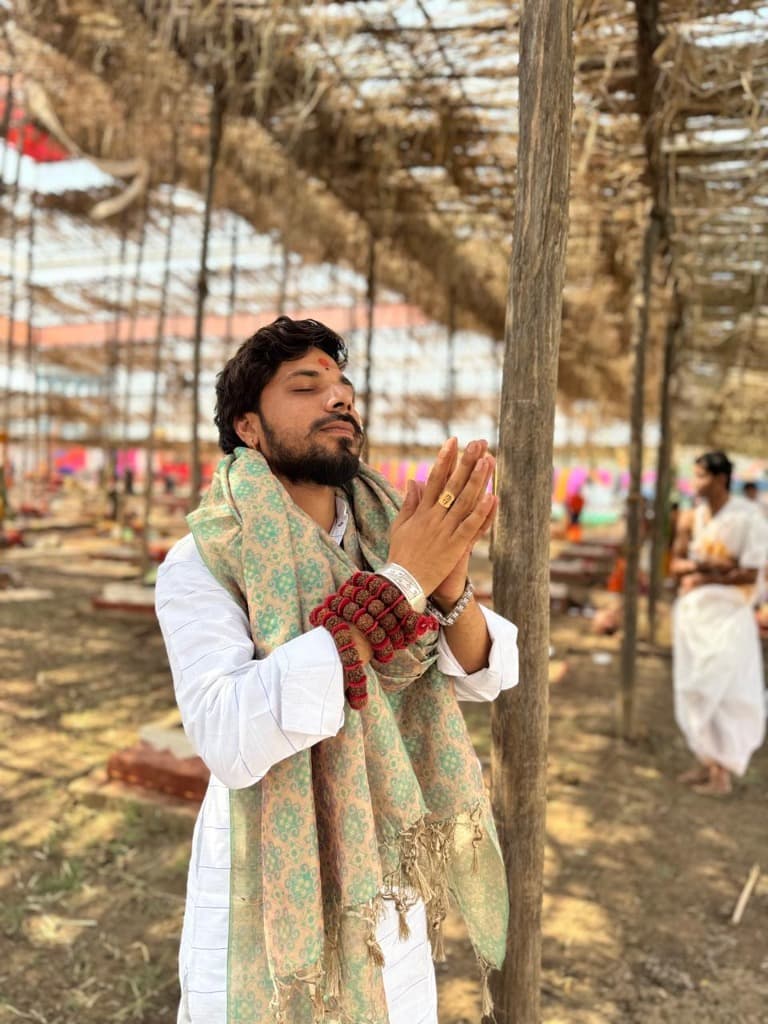
Acharya Tiwari Chetan Guru
Siddha Peethadheesh & Head Vedic Scholar
With over 15+ years of unbroken Vedic practice at Maa Baglamukhi Siddha Peeth, Nalkheda, Acharya Ji is a globally authoritative voice on Tantra Shastra, Stambhan Vidya, and Karmic Astrology. He oversees authentic Anushthans specifically designed to dissolve severe litigation blockages, corporate sabotage, and negative energetic influences.
Need Exact Hawan Cost & Shubh Muhurat?
Get direct guidance from Head Priest Acharya Tiwari Chetan Guru.