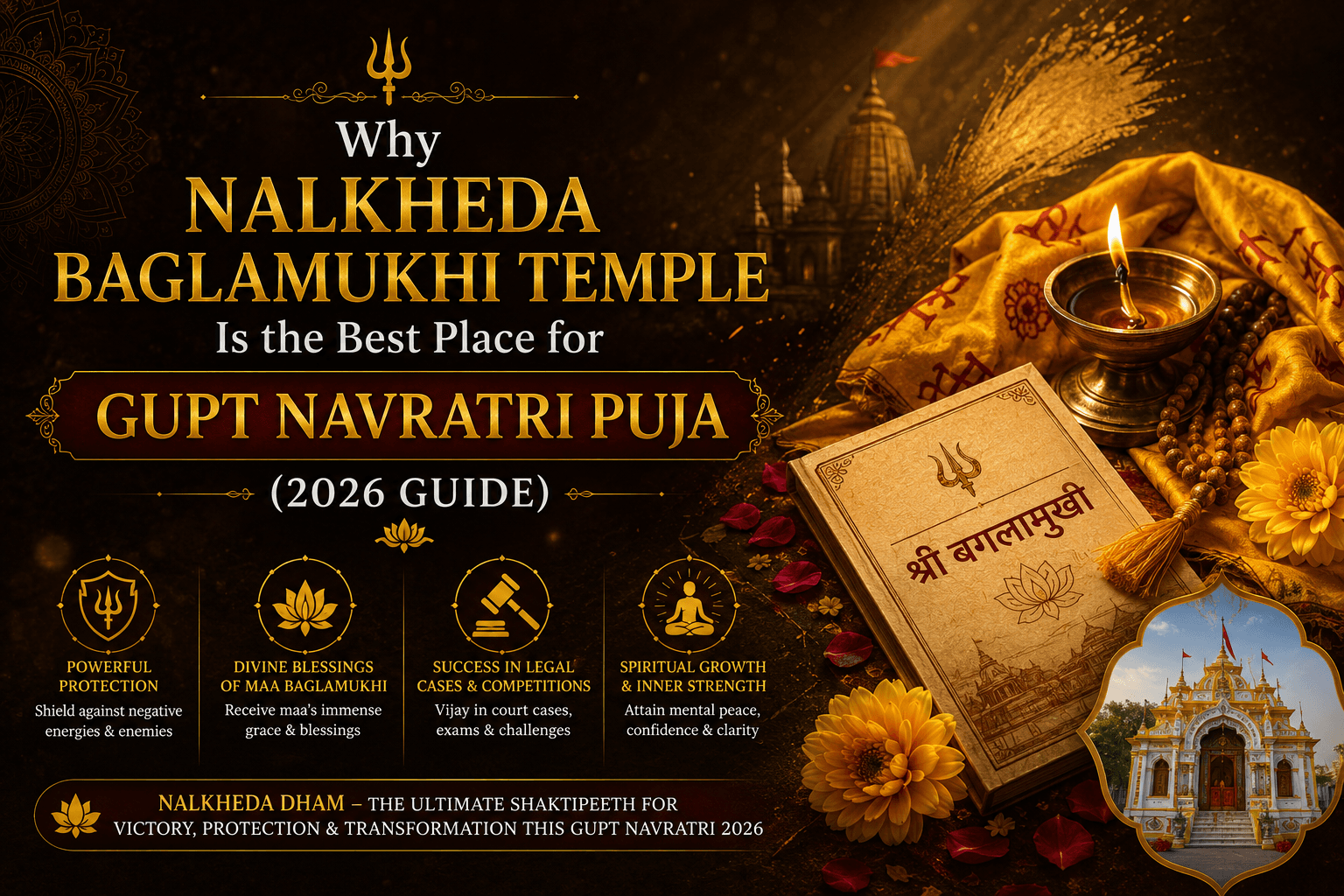
Gupt Navratri is the most powerful window in the Vedic calendar for Mahavidya sadhana, and no destination is more closely tied to that power than Nalkheda. If you are searching for where to perform Baglamukhi Puja this Gupt Navratri, this guide gives you the temple's history, the spiritual logic behind it, and a clear path to book your ritual - whether you travel to Madhya Pradesh in person or join through online Baglamukhi Puja.
Quick Answer
Nalkheda Baglamukhi Temple in Agar Malwa, Madhya Pradesh, is considered the best place for Gupt Navratri Baglamukhi Puja because it is a Swayambhu (self-manifested) Siddha Peeth on the banks of the Lakhundar River, with an unbroken Vedic worship tradition dating back to the Mahabharata era. Its concentrated tantric energy amplifies the goddess's Stambhan (paralyzing) power - the exact force devotees invoke for court case victory, enemy protection, and obstacle removal. Combined with authentic Vedic execution under Acharya Tiwari Chetan Guru, Nalkheda offers a level of ritual purity and results-orientation that few other Baglamukhi sites can match.
Why Nalkheda Temple Is Famous
Nalkheda's fame does not come from tourism marketing. It comes from a documented, centuries-old spiritual reputation as one of the most potent seats of Maa Baglamukhi's presence on Earth.
Swayambhu status - the deity is believed to have manifested here on her own, not installed by human hands, which Vedic tradition treats as the highest form of spiritual authenticity.
Riverbank location - the temple sits on the banks of the Lakhundar River, a setting traditionally associated with heightened tantric energy in Shakta worship.
Continuous worship - generations of Acharyas have performed uninterrupted rituals here, building what practitioners describe as a dense, self-reinforcing energy field.
High-stakes devotee history - lawyers, politicians, and business leaders facing serious litigation or rivalry have historically traveled specifically to this Baglamukhi Temple in Nalkheda rather than more accessible alternatives.
This combination - self-manifestation, location, continuity, and a track record with serious cases - is why Nalkheda is repeatedly named as India's foremost Baglamukhi Siddha Peeth.
History of Nalkheda Temple
The temple's origins are traced back to the Mahabharata era, making it one of the oldest active Shakti Peethas associated with the Dasa Mahavidya tradition. According to Vedic and Puranic references maintained by the temple's lineage of Acharyas, the site was recognized early as a natural energy center for Baglamukhi worship - long before organized temple architecture existed there.
Over centuries, successive generations of Vedic scholars settled at Nalkheda specifically to safeguard and continue this worship. This is different from temples built later around relics or events; Nalkheda's sanctity is rooted in the belief that the goddess's Stambhan Shakti was already present in the land itself. You can read the full temple history for the detailed timeline, including the temple's connection to the broader Mahavidya network that includes Pitambara Peeth in Datia.
This unbroken chain of ritual - not a revival or reconstruction - is the core reason practitioners consider Nalkheda's energy "live" rather than symbolic.
Why Devotees Visit During Gupt Navratri
Gupt Navratri, observed in the Ashadha and Magha months, is fundamentally different from the more public Chaitra and Sharad Navratris. It is the period reserved in Shakta tradition for secret, high-intensity Mahavidya sadhana - the ten Mahavidyas, including Baglamukhi, are invoked with tantrokta (tantric) methods rather than purely devotional ones.
Devotees choose to perform their Gupt Navratri Baglamukhi Puja specifically at Nalkheda during this window for several reasons:
Amplified energy window - Gupt Navratri is considered a period when cosmic energy for tantric sadhana peaks, and performing the ritual at a Siddha Peeth compounds this effect rather than diluting it.
Privacy of intent - Tantra Shastra emphasizes that rituals for protection or victory over enemies should remain confidential (Gupt Sadhana). Gupt Navratri's low-profile nature aligns naturally with this requirement.
Faster resolution for urgent problems - devotees dealing with active court cases, sudden business setbacks, or ongoing harassment often report choosing this specific period because the ritual's effects are believed to manifest more decisively.
Ashtami Sadhana - the eighth day of Gupt Navratri is considered especially potent for Mahavidya worship, and limited Sankalp slots are reserved at Nalkheda specifically for this day each year.
Importance of Baglamukhi Sadhana
Maa Baglamukhi is the eighth of the ten Mahavidyas and is uniquely associated with Stambhan - the power to freeze, immobilize, or paralyze negative forces. Her name combines "Valga" (to bridle or restrain) and "Mukhi" (face), reflecting her role as the deity who controls hostile speech, intention, and action.
Baglamukhi Sadhana is considered essential specifically when ordinary effort has failed:
Legal cases that drag on despite strong evidence
Competitors or colleagues working through hidden, indirect sabotage
Sudden, unexplained business or financial decline
Chronic anxiety or fear with no identifiable physical cause
Where other Mahavidya practices focus on abundance, wisdom, or transformation, Baglamukhi Sadhana focuses on restoring control when an external force is actively working against the devotee. This is why it is often described as a defensive and corrective practice rather than a purely devotional one.
Benefits of Performing Baglamukhi Puja
Area of Life | Benefit of Baglamukhi Puja |
|---|---|
Legal matters | Removes obstruction in litigation, supports favorable verdicts, neutralizes false testimony |
Career & business | Protects against sabotage, workplace politics, and sudden client or deal loss |
Protection | Shields against black magic, evil eye (nazar), and negative occult influence |
Mental clarity | Reduces anxiety, restores sleep, dissolves the sense of an unseen force working against you |
Relationships | Neutralizes third-party interference and restores understanding in strained relationships |
Spiritual growth | Builds inner confidence, discipline, and the authority to speak and act decisively |
Most devotees report the earliest shift - deep mental calm and reduced anxiety - within the first few days, with external, real-world changes (court movement, financial recovery) typically unfolding over 11 to 41 days, depending on the depth of the problem.
Who Should Perform This Puja
Baglamukhi Puja is not a generic ritual for casual wishes. It is best suited for devotees facing specific, serious circumstances:
Individuals involved in prolonged court cases or legal disputes
Professionals or business owners dealing with hidden enemies or corporate sabotage
Families experiencing repeated, unexplained misfortune suggestive of black magic or nazar dosha
Anyone facing persistent anxiety or fear with no clear physical cause
Devotees seeking Shatru Nash (destruction of enmity) or protection before a major life event
Those preparing for elections, negotiations, or high-stakes decisions where opposition is expected
Because the ritual is tantric and intense (Ugra) in nature, Vedic tradition recommends it be performed only by a qualified Acharya rather than attempted independently at home - simple prayer and chanting of the Baglamukhi Chalisa are appropriate for home practice, but full Havan and Anushthan require ritual precision.
Nalkheda vs Other Baglamukhi Temples: A Quick Comparison
Factor | Nalkheda Siddha Peeth | Other Baglamukhi Temples |
|---|---|---|
Origin | Swayambhu (self-manifested), Mahabharata-era | Often installed later, without self-manifestation status |
Worship continuity | Unbroken Vedic tradition for centuries | Varies; many have gaps or modern establishment |
Specialization | Court case victory, Shatru Nash, protection | General worship, less focused on Ugra rituals |
Ritual guidance | Personally led by an experienced Acharya lineage | Often outsourced to rotating or junior priests |
Online access | Live Sankalp via WhatsApp, worldwide prasad delivery | Limited or no structured online puja infrastructure |
Transparency | Photo/video updates through the ritual | Rarely documented for remote devotees |
Online Baglamukhi Puja Process
For devotees who cannot travel to Madhya Pradesh, the temple's online process is designed to preserve the ritual's full spiritual weight despite the physical distance. Vedic tradition holds that Sankalp - the devotee's name, gotra, and stated intention - functions as an energetic connection regardless of location, especially when the ritual is performed at a Siddha Peeth as concentrated as Nalkheda.
The typical online process for Baglamukhi Havan or Anushthan includes:
A free consultation to understand your specific problem
Selection of an auspicious muhurat aligned with your horoscope
Collection of your name, gotra, and sankalp details
A live WhatsApp video call at the exact ritual time, so you personally witness your Sankalp
Continuous photo and video updates as the mantra jaap and havan progress
A final video of the Purna Ahuti (final offering)
Worldwide courier delivery of energized prasad, yantra, and raksha sutra, with tracking
Why Choose Our Services
Baglamukhi Hawan at Nalkheda differentiates itself through structural safeguards that generic online puja services do not offer:
Personal guidance, no subcontracting - every ritual is led directly by Acharya Tiwari Chetan Guru, with 25+ years of dedicated Baglamukhi Sadhana and over 5,000 rituals performed.
Diagnosis before prescription - rather than selling a fixed package, the process starts with understanding your actual problem before recommending a specific Puja, Havan, or Anushthan.
Zero-Fake Guarantee - live video Sankalp and continuous photo/video proof mean you see your ritual actually happening, not a generic recorded ceremony.
Site-specific power - because the ritual is performed physically inside the Nalkheda Siddha Peeth, online devotees benefit from the same concentrated energy field as in-person visitors.
Complete confidentiality - in line with the Tantric principle of Gupt Sadhana, your problem and ritual details remain private.
Step-by-Step Booking Process
Contact Acharya Ji directly via WhatsApp or call for a free initial consultation.
Describe your situation - court case, enemy trouble, business decline, or protection needs - so the correct ritual can be recommended.
Receive your recommended puja - your Gupt Navratri package may include Puja, Havan, or a multi-day Anushthan depending on severity.
Confirm your muhurat and share your full name and gotra for the Sankalp.
Join the live Sankalp via WhatsApp video call at the scheduled time.
Receive live updates throughout the ritual via photos and video.
Track your prasad as the energized items are dispatched to your address after the Purna Ahuti.
To reserve a Gupt Navratri slot, book your Baglamukhi Puja before Ashtami Sadhana dates fill, as these slots are limited each year.
Common Mistakes Devotees Should Avoid
Expecting instant results. A long-standing court case or deep-rooted problem does not resolve in 24 hours. Genuine rituals set a cosmic process in motion that typically unfolds over 11 to 41 days.
Choosing the wrong ritual. A generic wealth puja will not resolve a problem rooted in a hidden enemy. Accurate diagnosis matters more than ritual size.
Announcing the ritual publicly. Tantra Shastra advises Gupt Sadhana - discussing your ritual with the person or situation it targets can create spiritual resistance.
Skipping the consultation step. Booking a puja without first describing your actual problem often leads to the wrong ritual being performed.
Ignoring Sattvic discipline. Devotees are advised to maintain a vegetarian diet and avoid alcohol on the day of Sankalp, as purity of intent directly affects the ritual's impact.
Attempting the Havan independently at home. Baglamukhi rituals are Ugra (fierce) in nature and require exact mantra pronunciation and fire offerings; home practice should be limited to Chalisa or simple prayer.
Frequently Asked Questions
1. Why is Nalkheda considered the best place for Gupt Navratri Baglamukhi Puja?
Nalkheda is a Swayambhu Siddha Peeth with unbroken Vedic worship since the Mahabharata era, giving it a concentrated tantric energy field that amplifies the effect of rituals performed during Gupt Navratri.
2. What is Gupt Navratri and when is it in 2026?
Gupt Navratri is a nine-day period in the Ashadha and Magha months reserved for secret, tantric Mahavidya sadhana. Check the Gupt Navratri page for the exact 2026 dates and Ashtami Sadhana schedule.
3. Can I perform Baglamukhi Puja online during Gupt Navratri?
Yes. Devotees anywhere in the world can join via live WhatsApp video call for their Sankalp, with photo and video updates throughout the ritual and prasad delivered by courier.
4. Is Nalkheda better than Pitambara Peeth in Datia for this puja?
Both are highly regarded Baglamukhi sites. Nalkheda is specifically known as a self-manifested Siddha Peeth with a documented Mahabharata-era origin, and is often preferred for court case and enemy-related rituals.
5. What problems does Baglamukhi Puja specifically address?
Prolonged court cases, hidden enemies, sudden business decline, black magic or nazar dosha, workplace politics, and chronic unexplained anxiety.
6. How long does a Baglamukhi Havan take?
A standard Havan takes 2 to 4 hours. A Maha Anushthan involving extended mantra chanting can span 9 to 11 days.
7. Do I need to know my gotra to book this puja?
No. If your gotra is unknown, Kashyap Gotra is used, as Vedic tradition considers it the universal origin gotra for all devotees.
8. When will I see results after the puja?
Most devotees report mental clarity within the first few days, with tangible external results typically appearing between 11 and 41 days after the ritual.
9. Is it safe to perform this puja online instead of visiting in person?
Yes. Sankalp made in your name and gotra is considered energetically connected to the ritual regardless of physical distance, especially when performed at a Siddha Peeth.
10. What is included in the Gupt Navratri puja package?
Depending on your situation, this may include Puja, Havan, or a multi-day Anushthan, along with live Sankalp, continuous updates, and dispatch of energized prasad, yantra, and raksha sutra.
11. Can women perform or book Baglamukhi Puja?
Yes. There is no gender restriction - women can book, take Sankalp, and participate either in person at Nalkheda or via live video call.
12. How much does Baglamukhi Puja cost at Nalkheda?
Pricing varies by ritual intensity - a basic puja typically starts around ₹5,100, with Havan and Anushthan priced according to duration and complexity. A consultation will clarify what your specific situation requires.
Book Your Gupt Navratri Baglamukhi Puja at Nalkheda Now
Gupt Navratri's Ashtami Sadhana slots at the Nalkheda Siddha Peeth are limited every year. If you are facing a court case, hidden enemies, business setbacks, or persistent negative energy, this is the window Vedic tradition considers most powerful for resolution.
Book Your Gupt Navratri Baglamukhi Puja → or message directly on WhatsApp at +91 9074342490 for a free consultation with Acharya Tiwari Chetan Guru before you book.
Conclusion
Nalkheda's standing as the best destination for Gupt Navratri Baglamukhi Puja comes down to three things: a genuinely ancient, self-manifested energy source; an unbroken lineage of authentic Vedic practice; and a ritual process - online or in person - built around transparency rather than promises. For devotees dealing with court cases, hidden enemies, or negative energy, performing this puja during Gupt Navratri at a Siddha Peeth of Nalkheda's stature is not just a spiritual preference - it is the traditionally prescribed combination of time, place, and intention for results that last.
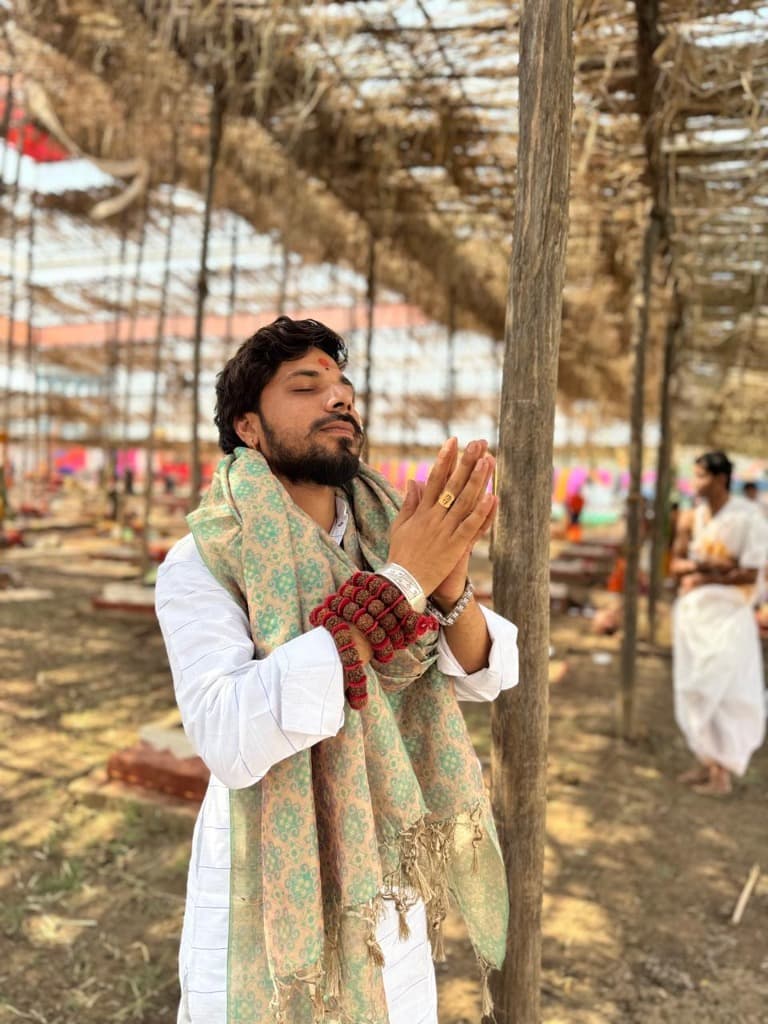
Acharya Tiwari Chetan Guru
Siddha Peethadheesh & Head Vedic Scholar
With over 15+ years of unbroken Vedic practice at Maa Baglamukhi Siddha Peeth, Nalkheda, Acharya Ji is a globally authoritative voice on Tantra Shastra, Stambhan Vidya, and Karmic Astrology. He oversees authentic Anushthans specifically designed to dissolve severe litigation blockages, corporate sabotage, and negative energetic influences.
Need Exact Hawan Cost & Shubh Muhurat?
Get direct guidance from Head Priest Acharya Tiwari Chetan Guru.