
Pitru Dosh Puja is a Vedic ritual performed to honor departed ancestors and traditionally address ancestral karmic imbalance in a family lineage. Pitru Paksha, the sixteen-day fortnight from 26 September to 10 October 2026, is widely regarded in Hindu tradition as the most appropriate window for this ritual, as it is considered the period when ancestral energies are closest to the living. The Puja generally involves Sankalp, invocation, ancestral offerings and Havan performed by a qualified Acharya. Devotees can enquire about Pitru Dosh Puja at Nalkheda Siddha Peeth through a WhatsApp or phone consultation before booking.
Quick Answer Box
Question | Short Answer |
|---|---|
What is Pitru Dosh Puja? | A Vedic ritual performed with personal Sankalp to offer peace to departed ancestors and traditionally address ancestral karmic imbalance in a family line. |
Why is Pitru Paksha considered important for ancestral rituals? | It is the fortnight in the Hindu calendar set aside specifically for Shradh, Tarpan and ancestral remembrance, and is traditionally regarded as the most suitable period for these observances. |
When is Pitru Paksha 2026? | 26 September 2026 to 10 October 2026, concluding on Sarva Pitru Amavasya. |
What is the best time for Pitru Dosh Puja? | The specific tithi (lunar date) of the ancestor's passing, or Sarva Pitru Amavasya on 10 October 2026 if that tithi is not known. |
What are the traditional benefits? | Ancestral peace, family harmony, spiritual satisfaction and the traditional repayment of Pitru Rin (ancestral debt), according to Vedic belief. |
Can Pitru Dosh Puja be performed at Nalkheda? | Yes. Pitra Dosh Pooja is offered at Nalkheda Siddha Peeth in Standard and Advanced forms, with worldwide participation and Prasad delivery. |
How can someone enquire or book the Puja? | Through a WhatsApp message, a phone call, or the booking page, followed by a consultation to confirm the right Sankalp and Muhurat. |
Disclaimer: This article reflects traditional Hindu astrological and spiritual beliefs. These are matters of faith, not scientifically verified facts, and should not replace qualified medical, financial, or legal advice.
Table of Contents
Pitru Dosh Puja During Pitru Paksha: How It Differs From Shradh and Tarpan
Pitru Dosh Puja vs Pitru Paksha Shraddh: What Is the Difference?
What Is Pitru Dosh Puja?
"Pitru" refers to one's ancestors, and "Dosh" (or Dosha) means an affliction or imbalance. In Vedic astrology and Hindu ancestral tradition, Pitru Dosh describes a belief that a family's ancestral line carries an unresolved spiritual debt, often connected with incomplete rites or unfulfilled obligations toward departed family members. Traditions rooted in texts such as the Garuda Purana describe three debts owed at birth, Deva Rin, Rishi Rin and Pitru Rin, and hold that the debt to one's ancestors is repaid through rituals such as Shradh, Tarpan and a dedicated Pitru Dosh Nivaran Puja.
It is worth distinguishing between two related but separate ideas. Pitru Dosh as an astrological concept is generally examined through a Kundli reading, most commonly by looking at the Sun, Rahu, Ketu and the 9th house. Pitru-related ancestral rituals, on the other hand, are performed by many families every year purely as an act of remembrance, entirely apart from any astrological reading. For readers who want a deeper look at how Pitru Dosh is identified, its commonly discussed causes, and traditional symptoms, the temple's dedicated guide on Pitru Dosh symptoms, causes and remedies covers that ground in detail. This article instead focuses on the Puja itself, its Vidhi, the best time to perform it during Pitru Paksha 2026, and how the booking process works.
Why Is Pitru Paksha Important for Pitru Dosh Puja?
Pitru Paksha, literally the "fortnight of the ancestors," is a sixteen-day period in the Hindu lunar calendar dedicated to Shradh, Tarpan and related ancestral observances. According to Sanatan Dharma tradition, the souls of the departed are believed to remain close to the earthly realm during this period, making it the time most families set aside for offering Tarpan, sacred water mixed with sesame seeds, and for other rites intended to bring the ancestors spiritual satisfaction.
This is also the period when families who wish to perform a dedicated Pitru Dosh Nivaran ritual tend to schedule it, since Pitru Paksha concentrates a year's ancestral observances into a single window rather than spreading them across the calendar. Shradh performed on the ancestor's specific tithi, charitable giving in their memory, and prayer are all part of this same tradition. None of these practices are presented as guaranteed remedies; they are performed with sincerity, as an act of devotion and repayment of what tradition calls Pitru Rin.
Pitru Paksha 2026 Dates
Pitru Paksha 2026 begins with Purnima Shraddh on 26 September 2026 and concludes with Sarva Pitru Amavasya on 10 October 2026. The table below gives a general overview; exact tithi timings and Muhurats vary by location and should always be confirmed against a local Panchang before finalizing a date.
Date (2026) | Tithi / Occasion | Traditional Significance |
|---|---|---|
26 September | Purnima Shraddh | Shradh for ancestors who passed on a Purnima (full moon) tithi |
27 September | Pratipada Shraddh | First day of the Krishna Paksha fortnight |
28 Sep – 9 Oct | Dwitiya through Chaturdashi Shraddh | Each day corresponds to the lunar tithi of an ancestor's passing |
10 October | Sarva Pitru Amavasya (Mahalaya Amavasya) | Final day of Pitru Paksha; performed for all ancestors, especially where the exact tithi is unknown |
Because tithis are lunar and can shift by a day depending on sunrise and regional Panchang calculations, families planning a Shradh or Pitru Dosh Puja on a specific date are encouraged to verify the exact tithi with the officiating Acharya before the Sankalp is finalized.
Pitru Dosh Puja During Pitru Paksha: How It Differs From Shradh and Tarpan
Pitru Paksha involves several related but distinct observances, and it helps to understand how they differ before deciding what to book.
Shradh is a structured ceremony performed for a specific ancestor, generally on the lunar tithi corresponding to their passing. Tarpan is the offering of water, usually mixed with black sesame seeds, made as an act of spiritual nourishment to ancestors. Both are typically performed annually, during Pitru Paksha or on Amavasya dates through the year.
A Pitru Dosh Nivaran Puja, by contrast, is a more focused ritual undertaken specifically when a family wishes to address a broader sense of ancestral imbalance, whether prompted by a Kundli reading, a long-standing family concern, or simply a wish to honor the lineage more deliberately, through a dedicated Sankalp, worship and Havan. Many families choose to perform this specific Puja during Pitru Paksha precisely because the fortnight is already set aside for ancestral matters, which is why the two are so often discussed together, even though they are not identical rituals.
If you are looking to perform Pitru Dosh Puja during Pitru Paksha 2026, you can explore the Pitra Dosh Pooja offered at Nalkheda Siddha Peeth and enquire about the Sankalp appropriate to your family's situation.
Pitru Dosh Puja Vidhi
The Puja Vidhi followed for Pitra Dosh Pooja at Nalkheda Siddha Peeth is structured around the general Vedic Puja format used across the temple's rituals, adapted for ancestral worship.
Preparation and Purification
The ritual space and materials are readied according to traditional practice before the ceremony begins. Devotees are asked to observe Satvik conduct in the days leading up to the Puja, avoiding alcohol and non-vegetarian food, and maintaining physical and mental purity.
Kalash Sthapana and Sankalp
The officiating Acharya takes a formal Sankalp, chanting the devotee's name, and Gotra where known, along with the specific intention for the ritual. This step formally dedicates the Puja to the devotee's ancestors.
Main Puja and Havan
The core worship is performed, including invocation, ancestral offerings and the sacred fire ritual. Where Tarpan and related ancestral offerings are part of the specific service booked, these are conducted as part of this stage.
Concluding Rituals and Prasad
Once the Havan and offerings are complete, the ritual concludes, and Prasad is prepared for dispatch to the devotee. For devotees taking part remotely, this stage is typically shown through a live WhatsApp video connection.
You can read the temple's general Puja Vidhi and Havan Vidhi guides for a fuller explanation of how Vedic rituals are structured at Nalkheda.
Benefits of Pitru Dosh Puja During Pitru Paksha
The benefits described below reflect traditional Vedic and ancestral-worship beliefs. They are not medical, financial or legal claims, and no outcome is guaranteed.
Ancestral remembrance — devotees formally honor and remember departed family members through Sankalp and offerings.
Spiritual peace — traditionally believed to bring inner peace to the person performing the ritual, as an act of devotion toward their lineage.
Family harmony — many families perform this Puja with the intention of restoring peace and goodwill within the household.
Fulfilment of traditional obligations — the ritual is seen as a way of repaying Pitru Rin, the debt owed to one's ancestors, as described in Vedic tradition.
Emotional closure — devotees often describe a sense of having formally honored a family member whose rites may have been incomplete or delayed.
Devotional discipline — observing Satvik conduct and performing the Sankalp is, in itself, treated as a spiritually meaningful practice.
Traditionally, some practitioners also associate ancestral rituals with broader family wellbeing, though this article deliberately avoids presenting the Puja as a guaranteed remedy for marriage, career, health, or financial outcomes. If you are looking to perform Pitru Dosh Puja during Pitru Paksha 2026 for reasons connected to your family's ancestral history, you can enquire about the appropriate Sankalp through a consultation with the temple's team.
Who Should Consider Pitru Dosh Puja?
A Pitru Dosh Puja is generally considered by:
Families where an astrologer has identified Pitru Dosh in a Kundli reading.
Devotees who wish to formally perform Shradh, Tarpan or a dedicated ancestral ritual during Pitru Paksha.
Families whose ancestral rites were incomplete, delayed, or performed without full traditional procedure.
Devotees who simply wish to honor their lineage more deliberately, independent of any astrological reading.
It is worth repeating a point that deserves emphasis: life difficulties should not be self-diagnosed as Pitru Dosh. Family friction, financial setbacks, health concerns and delays in major life events have ordinary practical, medical, financial or psychological explanations, and deserve to be examined through the relevant professional channel first, or alongside, rather than in place of, any spiritual interpretation. A structured Kundli reading, rather than a generic symptom list, is the more reliable way to understand whether a dedicated Puja is appropriate for your family.
Best Time for Pitru Dosh Puja During Pitru Paksha 2026
Ancestral rituals are traditionally tied to the lunar calendar rather than a single fixed date:
The ancestor's specific tithi — many families prefer to perform Shradh on the lunar date corresponding to their ancestor's passing, which falls somewhere within the 26 September to 10 October 2026 window.
Sarva Pitru Amavasya — 10 October 2026, the final day of Pitru Paksha, is traditionally used when the exact tithi is not known.
Aparahna Kaal — many traditions consider the early afternoon period the appropriate time of day for Shradh-related rituals, though the exact timing depends on sunrise, sunset and the local Panchang for a given date and location, and should be confirmed with the officiating Acharya rather than assumed.
If you are looking to perform Pitru Dosh Puja during Pitru Paksha 2026 but are unsure which date applies to your family, you can enquire with the temple's team so the correct tithi and Muhurat can be confirmed before your Sankalp is finalized.
Pitru Dosh Puja on Sarva Pitru Amavasya 2026
Sarva Pitru Amavasya, also called Mahalaya Amavasya, falls on 10 October 2026, the concluding day of Pitru Paksha. This day is traditionally regarded as suitable for performing rites on behalf of all ancestors collectively, particularly where individual tithis are unknown or where a family wishes to honor its lineage as a whole rather than a single relative.
Many devotees specifically time their Pitru Dosh Puja to this date because it is widely followed across regions and does not require prior knowledge of an ancestor's exact passing date. As with the rest of Pitru Paksha, this is a matter of tradition and personal or family conviction rather than a claim that this particular day produces different or superior results compared to a Shradh performed on the correct individual tithi.
Pitru Dosh Puja at Nalkheda
Pitra Dosh Pooja is offered at Nalkheda Siddha Peeth, in Nalkheda, Agar Malwa district, Madhya Pradesh, the temple seat associated with Maa Baglamukhi, under the guidance of Acharya Tiwari Chetan Guru and the temple's team of Acharyas. The ritual is conducted on-site at the temple, with the devotee's Sankalp taken in their name, and Gotra where known, before the ceremony begins.
Devotees do not need to travel to Nalkheda in person. The booking process allows the Sankalp and ritual details to be shared with devotees remotely, with live participation offered over WhatsApp video for those who wish to witness the ritual as it happens. Once the Puja is complete, Prasad is dispatched to the devotee's address, and the service is available to devotees across India and abroad, including through the temple's dedicated international booking page for NRI devotees.
For devotees who are unsure whether Pitru Dosh Nivaran Anushthan at Nalkheda Siddha Peeth in Nalkheda is the right choice for their family, a preliminary consultation with Acharya Ji is available before any booking is confirmed. Those researching the temple itself, including its history, timings and how to reach Nalkheda, can also refer to the Nalkheda Siddha Peeth temple guide.
What Is Included: Standard vs Advanced Pitra Dosh Pooja
Nalkheda Siddha Peeth offers two forms of Pitra Dosh Pooja, distinguished by the depth and duration of the ritual rather than by any difference in the core Vedic procedure.
Service Element | ||
|---|---|---|
Preparation & Purification | Included | Included |
Personalized Sankalp | Included | Included, with extended mantra chanting |
Main Puja & Havan | Included | Included, with more extensive offerings |
Worldwide availability | Yes | Yes |
Prasad delivery | Yes | Yes |
Live WhatsApp participation | Yes | Yes |
Positioning | Suited to a focused, single-ritual ancestral Puja | Suited to families seeking a more comprehensive ancestral ritual with deeper mantra chanting and offerings |
Separately, the Pitru Paksha festival page also lists Shradh Puja on a specific tithi, a combined Shradh, Tarpan and Havan single-day ritual, and a multi-day Pitru Dosh Nivaran Anushthan as available Sadhana options specifically for the Pitru Paksha season, each with live Sankalp on WhatsApp and worldwide Prasad, and no advance payment required before booking verification.
Pitru Dosh Puja Cost 2026
Both the Standard and Advanced Pitra Dosh Pooja pages, along with the dedicated Pitru Paksha 2026 service page, confirm that no fixed price is quoted without first understanding the specific family situation and the type of ritual required. Cost depends on factors such as the Sankalp involved, whether a single-day or multi-day Anushthan is chosen, and any specific offerings the family wishes to include.
As a general point of reference, published starting prices for other pujas and havans conducted at Nalkheda Siddha Peeth begin from around ₹5,100, though this figure applies to the temple's broader price list and not specifically to Pitru Dosh Puja, which remains consultation-based. For an accurate quote for your family's Pitru Dosh Puja during Pitru Paksha 2026, the recommended step is a free consultation with the temple's team, who can confirm both the Sankalp required and the associated cost before you book.
How to Book Pitru Dosh Puja During Pitru Paksha 2026
The booking process for Pitru Dosh Puja at Nalkheda Siddha Peeth follows the same structure used across the temple's Puja services:
Contact the team — reach out via WhatsApp or a phone call to +91 9074342490, or start directly through the booking page.
Share your details — provide your full name, Gotra if known, and a description of your family's situation or the ancestor for whom the ritual is intended.
Consultation — Acharya Ji or the temple team reviews your details and helps confirm the appropriate Muhurat within the Pitru Paksha 2026 window, or on Sarva Pitru Amavasya if the exact tithi is unknown.
Sankalp and ritual — your personalized Sankalp is performed at Nalkheda Siddha Peeth, with live participation available over WhatsApp video for devotees who wish to witness the ceremony.
Prasad delivery — blessed Prasad is dispatched to your address once the Puja is complete.
No advance payment is required before booking verification, and cost is confirmed only after your consultation. If you would like guidance on which specific ritual, Standard Pitra Dosh Pooja, Advanced Pitra Dosh Pooja, or the broader Pitru Dosh Nivaran Anushthan offered during Pitru Paksha, best matches your family's situation, you can begin with a consultation with Acharya Ji before finalizing your Sankalp.
Pitru Dosh Puja vs Pitru Paksha Shraddh: What Is the Difference?
Aspect | Pitru Dosh Puja | Pitru Paksha Shraddh |
|---|---|---|
Purpose | Address a broader sense of ancestral imbalance, often prompted by a Kundli reading or family concern | Honor a specific ancestor on their corresponding lunar tithi |
Basis | Vedic astrology combined with ancestral worship tradition | Ancestral worship tradition, generally performed annually |
Typical rituals | Sankalp, invocation, ancestral offerings, Havan | Sankalp, Tarpan, Pind Daan where applicable |
Who may perform it | Any devotee, often at a family's collective request | Traditionally performed for a specific departed relative |
Timing | Frequently scheduled within Pitru Paksha, though not exclusive to it | Tied to the ancestor's specific tithi, generally within Pitru Paksha |
Traditional context | Framed around resolving an ongoing ancestral concern | Framed around annual remembrance and gratitude |
Common Mistakes to Avoid During Pitru Paksha
Choosing a date without checking the tithi. Tithis are lunar and can shift by a day; confirm the correct date with the officiating Acharya rather than relying on a generic calendar.
Copying rituals from unverified sources. Vidhi details differ by region and tradition; follow the guidance of the priest performing your Sankalp.
Confusing Shradh with a Pitru Dosh Nivaran Puja. As explained above, the two serve related but different purposes.
Relying on fear-based claims. No credible tradition guarantees a specific outcome; be cautious of anyone who promises one.
Assuming every life difficulty means Pitru Dosh. Ordinary practical, financial, medical or psychological explanations should always be considered first.
Performing unfamiliar rituals without guidance. A structured Sankalp performed under an experienced Acharya is preferable to an improvised home ritual, particularly for a dedicated Pitru Dosh Nivaran Puja.
Frequently Asked Questions
What is Pitru Dosh Puja?
Pitru Dosh Puja is a Vedic ritual performed with a formal Sankalp to honor departed ancestors and traditionally address ancestral karmic imbalance in a family lineage, generally performed by a priest on the devotee's behalf.
Is Pitru Paksha a good time for Pitru Dosh Puja?
Yes. Pitru Paksha is widely regarded in Hindu tradition as the most suitable period in the year for ancestral rituals, including a dedicated Pitru Dosh Puja, since it is the fortnight already set aside for Shradh and Tarpan.
When is Pitru Paksha 2026?
Pitru Paksha 2026 runs from 26 September to 10 October 2026, beginning with Purnima Shraddh and concluding with Sarva Pitru Amavasya.
When is Sarva Pitru Amavasya 2026?
Sarva Pitru Amavasya falls on 10 October 2026, the final day of Pitru Paksha, and is traditionally used for ancestors whose exact tithi is unknown.
What are the benefits of Pitru Dosh Puja?
Traditionally believed benefits include ancestral peace, spiritual satisfaction, family harmony and the symbolic repayment of Pitru Rin, the debt owed to one's ancestors. These are matters of faith rather than guaranteed outcomes.
What is the difference between Pitru Dosh Puja and Shraddh? Shraddh honors a specific ancestor on their corresponding tithi, while a Pitru Dosh Puja is a more focused ritual addressing broader ancestral concerns, often performed within the Pitru Paksha window.
Can Pitru Dosh Puja be performed during Pitru Paksha?
Yes, many families specifically choose to perform their Pitru Dosh Nivaran Puja during Pitru Paksha, since the fortnight is already dedicated to ancestral observances.
What is the best time for Pitru Dosh Puja?
The ancestor's specific tithi within Pitru Paksha is generally preferred, or Sarva Pitru Amavasya on 10 October 2026 if that tithi is unknown. Exact timing should be confirmed against a local Panchang.
Can Pitru Dosh Puja be booked at Nalkheda?
Yes. Standard and Advanced Pitra Dosh Pooja are both offered at Nalkheda Siddha Peeth, with worldwide availability and Prasad delivery.
Can Pitru Dosh Puja be performed online or on behalf of someone? Yes. Devotees do not need to travel to Nalkheda. The Sankalp is performed in the devotee's name at the temple, with live participation available over WhatsApp video for those who wish to witness the ritual remotely.
How much does Pitru Dosh Puja cost?
No fixed price is quoted without a consultation, since cost depends on the specific ritual and Sankalp your family requires. A free consultation with the temple's team will confirm the applicable cost.
How can I book Pitru Dosh Puja?
You can reach out via WhatsApp or phone, or start directly through the booking page, after which the temple team helps confirm the right Muhurat and Sankalp before your Puja is performed.
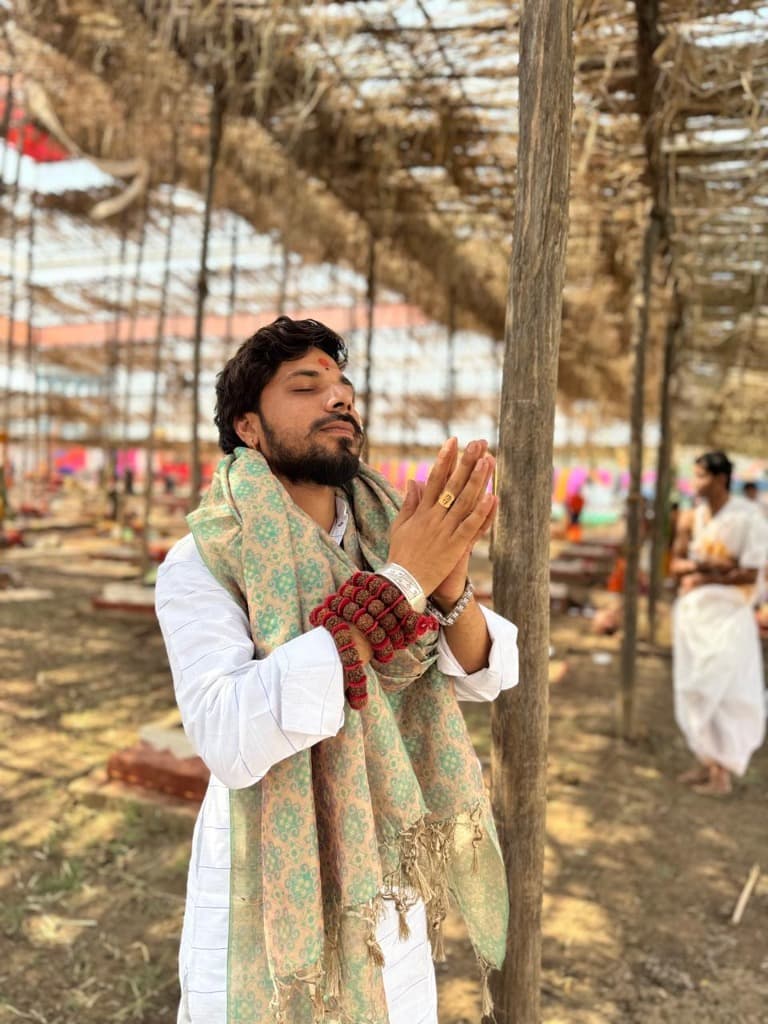
Acharya Tiwari Chetan Guru
Siddha Peethadheesh & Head Vedic Scholar
With over 15+ years of unbroken Vedic practice at Maa Baglamukhi Siddha Peeth, Nalkheda, Acharya Ji is a globally authoritative voice on Tantra Shastra, Stambhan Vidya, and Karmic Astrology. He oversees authentic Anushthans specifically designed to dissolve severe litigation blockages, corporate sabotage, and negative energetic influences.
Need Exact Hawan Cost & Shubh Muhurat?
Get direct guidance from Head Priest Acharya Tiwari Chetan Guru.