Quick Answer — Navratri 2026 Bhog at a Glance
Shardiya Navratri 2026 runs from Sunday, 11 October to Monday, 19 October 2026, with Vijayadashami on Tuesday, 20 October. Each of the nine days is dedicated to one form of the Navadurga, and many households follow a traditional day-wise naivedya or bhog for each form.
The widely followed sequence is:
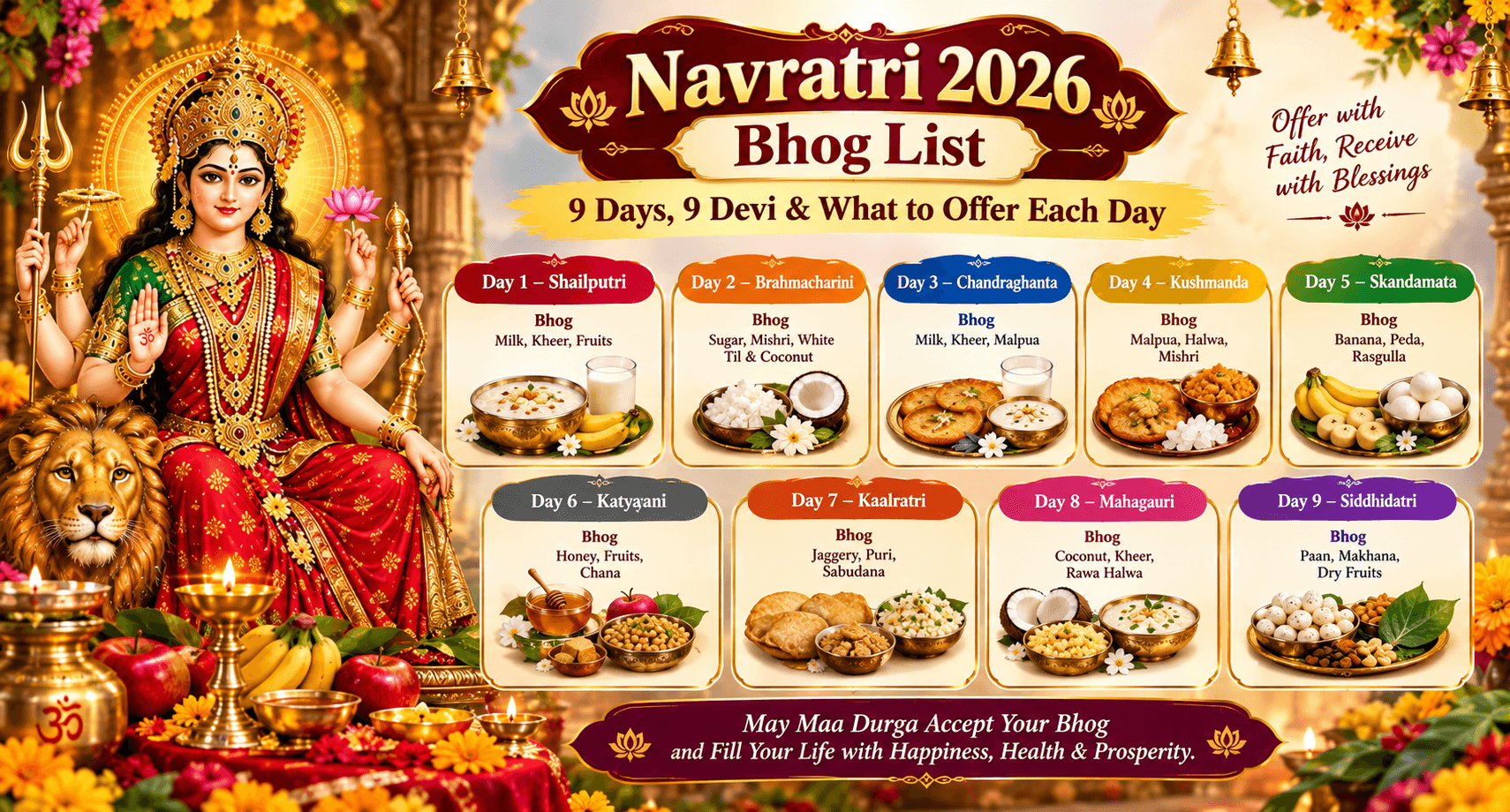
Ghee → Sugar → Kheer → Malpua → Banana → Honey → Jaggery → Coconut → Sesame (Til)
Two things worth knowing before you plan your shopping list. First, this nine-item list is a widely followed North Indian tradition, published in mainstream panchangs — it is not a menu prescribed uniformly across every Hindu tradition. Second, in Bengal, South India, Maharashtra and Gujarat the bhog looks quite different, and none of those traditions is following the list incorrectly.
If you are planning the full nine days of worship, our complete guide to Shardiya Navratri 2026 dates, 9 days and puja vidhi covers the rituals and fasting practice alongside the offerings.
Navratri 2026 Bhog List — 9 Days at a Glance
Day | Date (2026) | Goddess | Traditional Bhog | Common Alternative | Traditional Association |
|---|---|---|---|---|---|
1 | Sun, 11 Oct | Maa Shailputri | Desi ghee | Suji halwa made in pure ghee | Health, purity, a clean beginning |
2 | Mon, 12 Oct | Maa Brahmacharini | Sugar | Mishri, or fresh fruit | Simplicity, perseverance, penance |
3 | Tue, 13 Oct | Maa Chandraghanta | Kheer | Plain milk, rabri, payasam | Courage, protection, calm |
4 | Wed, 14 Oct | Maa Kushmanda | Malpua | Any flour-based sweet, or halwa | Radiance, dispelling darkness |
5 | Thu, 15 Oct | Maa Skandamata | Banana | Any fresh seasonal fruit | Nurture, motherhood, vitality |
6 | Fri, 16 Oct | Maa Katyayani | Honey | Honey-sweetened halwa or laddoo | Directing strength constructively |
7 | Sat, 17 Oct | Maa Kalaratri | Jaggery (gur) | Gur laddoo, or lapsi with ghee | Removal of fear and negativity |
8 | Sun, 18 Oct | Maa Mahagauri | Coconut | Nariyal laddoo, coconut barfi | Purity, serenity, completion of tapas |
9 | Mon, 19 Oct | Maa Siddhidatri | Sesame (til) | Til laddoo; halwa-puri-chana for Kanya Pujan | Fulfilment, siddhi, protection |
A note on the dates. Navratri days follow the lunar tithi, so a few panchangs observe the Ashtami vrat on 19 October rather than 18 October because the Ashtami tithi is still running at sunrise that morning. The bhog sequence itself is unaffected — keep the vrat by your family's panchang and the day-count by the calendar. Day-by-day worship details for each form are on the Shardiya Navratri nine-day section.
9 Days, 9 Devi & Traditional Bhog
Day 1 — Maa Shailputri (Sunday, 11 October 2026) — Desi Ghee
The first day belongs to Shailputri, the daughter of the Himalaya, and to Ghatasthapana, when the kalash is installed and the Goddess is invoked into the home. Pure desi ghee is the traditional naivedya.
Ghee is the substance of the havan, of the diya and of temple cooking. Offering it on the opening day is essentially an offering of purity and of the household's best.
How to offer: a small katori of pure ghee placed on the puja thali is sufficient and entirely traditional. Most families, however, prefer something that can be shared afterwards as prasad, so they offer suji halwa prepared in ghee.
If ghee is unavailable: a ghee-based sweet from a clean shop is acceptable in most households. Set up the kalash correctly first — our Ghatasthapana 2026 muhurat, vidhi and samagri guide covers the timing and the samagri, and the Day 1 Maa Shailputri page explains her worship.
Day 2 — Maa Brahmacharini (Monday, 12 October 2026) — Sugar
Brahmacharini is the Goddess in her ascetic, unmarried form — the embodiment of tapasya and restraint. Her bhog is deliberately plain: sugar, or mishri.
This is the one day where the simplicity of the offering is the point. A goddess associated with austerity is not offered an elaborate sweet. Many families place mishri with a few tulsi leaves and fresh fruit and leave it at that.
Practical note: mishri keeps well, needs no preparation and distributes easily to children — genuinely the easiest bhog of the nine days. Her worship is described on the Day 2 Maa Brahmacharini page.
Day 3 — Maa Chandraghanta (Tuesday, 13 October 2026) — Kheer
Chandraghanta, the married form who wears the half-moon on her forehead, is offered kheer — rice cooked slowly in full-fat milk with sugar.
Milk-based offerings are among the oldest forms of naivedya in Indian worship, and kheer is the household version of that tradition. In Tuesday's case there is a practical convenience too: kheer made in the morning stays fresh through the day's aarti.
Alternative: plain milk is perfectly acceptable if you cannot cook. In the South the equivalent offering is payasam; in parts of North India, rabri. Read more on the Day 3 Maa Chandraghanta page.
Day 4 — Maa Kushmanda (Wednesday, 14 October 2026) — Malpua
Kushmanda is revered as the form whose smile brought the cosmos into being, and whose radiance is compared to the sun. Her bhog is malpua, a sweet flour-and-milk pancake fried in ghee.
The richness is intentional. Where Day 2 is austere, Day 4 is abundant, and the contrast is part of how the nine days are structured.
If malpua is too much work: any flour-based sweet fried in ghee, or plain suji halwa, is commonly substituted. Some South Indian households offer savoury lentil fritters on this day instead. Upang Lalita Vrat also falls on this date in 2026. See the Day 4 Maa Kushmanda page.
Day 5 — Maa Skandamata (Thursday, 15 October 2026) — Banana
Skandamata, the mother of Kartikeya, is worshipped in her nurturing aspect, and her offering is the simplest of all: fresh bananas.
Families with children often give this day particular attention. The banana needs no cooking, no sugar and no shopping trip, which is part of why the custom survived so widely.
Alternative: any fresh, unblemished seasonal fruit. Offer an odd number where your family follows that custom, wash the fruit, and keep it whole rather than cut where possible. Details on the Day 5 Maa Skandamata page.
Day 6 — Maa Katyayani (Friday, 16 October 2026) — Honey
Katyayani is the warrior form born to destroy Mahishasura. Her bhog is pure honey — and the pairing is meaningful. The fiercest form receives the sweetest offering, which tradition reads as the balancing of strength with gentleness.
How to offer: a small bowl of raw honey, or a sweet made with honey in place of sugar. Honey is also poured over a coconut half in some households.
Note on children: honey is not given to infants under one year old. Substitute fruit for their share of the prasad. Saraswati Avahan also falls on this date in 2026; her worship is on the Day 6 Maa Katyayani page.
Day 7 — Maa Kalaratri (Saturday, 17 October 2026) — Jaggery
Kalaratri is the most intense of the nine forms, worshipped as the destroyer of fear, darkness and negative influence. Her bhog is jaggery (gur), or sweets made from jaggery.
Saptami is traditionally a significant night for protective worship, which is why many devotees choose this window for a Maa Baglamukhi havan seeking relief from obstruction and hostility.
Alternative: gur laddoo, or lapsi — broken wheat cooked with ghee and jaggery, which is the common offering in parts of Gujarat and Rajasthan. See the Day 7 Maa Kalaratri page.
Day 8 — Maa Mahagauri (Sunday, 18 October 2026) — Coconut
Mahagauri is the serene, luminous form who emerges after long penance. Her bhog is the coconut — whole, or as coconut-based sweets.
The coconut is the standard offering across almost every Hindu ritual, which makes Ashtami the most universally recognised bhog day of the nine.
How to offer: a whole coconut with the husk, or a broken coconut with the water offered separately. Nariyal laddoo and coconut barfi are the usual household versions. Ashtami is also the day many families perform Kanya Pujan, covered further below, and worship guidance is on the Day 8 Maa Mahagauri page.
Day 9 — Maa Siddhidatri (Monday, 19 October 2026) — Sesame (Til)
Siddhidatri, the bestower of siddhis, completes the Navadurga. Her traditional bhog is sesame seeds (til) — offered plain, or as til laddoo made with jaggery.
Til carries a long association with protective and completion rituals in Indian tradition, which is why it closes the cycle rather than opening it.
In practice, Navami in most North Indian homes is dominated by a different menu entirely: halwa, puri and kala chana prepared for Kanya Pujan. Both can coexist — til as the naivedya on the thali, the halwa-puri-chana as the meal. Maha Navami 2026 also carries Ayudha Puja and Navami Homa. See the Day 9 Maa Siddhidatri page.
Why Is a Different Bhog Offered on Each Day?
Naivedya is one of the sixteen upacharas of traditional worship. Offering food is an expression of hospitality: the Goddess is treated as an honoured guest in the home, and you serve her before you eat.
The day-wise variation follows from the Navadurga structure. Each of the nine forms carries a distinct character — austere, nurturing, fierce, serene — and the offerings were matched to that character over time. Plain sugar for the ascetic form, rich malpua for the radiant one, honey for the warrior.
Three things are worth being clear about:
The Navadurga worship itself rests on established Puranic tradition and is followed across sampradayas.
The specific nine-item food list is a widely followed custom, popularised through panchangs and household practice. It is not a scripturally fixed menu binding on every tradition.
Traditional texts associate each offering with particular qualities — health, courage, protection from negativity. These are traditional associations, framed as such. No food guarantees a material outcome, and no reputable tradition claims otherwise.
Bhog vs Naivedya vs Prasad — What's the Difference?
Naivedya is the ritual act of presenting food before the deity during puja — one of the sixteen upacharas.
Bhog refers to the food itself, presented to the deity. In everyday usage "bhog lagana" means to make that offering.
Prasad is what the same food becomes after it has been offered and accepted. It is then distributed and consumed.
In practice the three words are used interchangeably in most households, and that is not wrong — the distinction matters mainly when you are reading ritual instructions. The sequence is what counts: prepare → offer → wait → distribute. Food that has not been offered is simply food; it becomes prasad through the offering.
How to Offer Bhog During Navratri at Home
A workable sequence for a household puja:
Clean the kitchen and yourself first. Bathe before cooking the bhog. The kitchen surface, utensils and your hands should be clean.
Cook fresh, and do not taste while cooking. Naivedya is offered untasted. This is the rule most commonly emphasised and most commonly forgotten.
Use dedicated or clean utensils. Many families keep a separate thali, katori and spoon for puja use.
Complete the basic puja — light the diya and dhoop, offer water, flowers, akshat and tilak as your family does.
Place the bhog before the deity, on a clean plate or leaf, usually to the right of the diya.
Offer water alongside where your tradition includes achamana, and sprinkle a few drops of water around the plate.
Chant your Devi mantra or the day's name, and mentally offer the food.
Leave the offering undisturbed for a short period — a few minutes is enough; some families leave it through the aarti.
Perform the aarti, then take the bhog down and distribute it as prasad.
Keep it proportionate to your day. A katori of kheer offered attentively is worth more than an elaborate spread rushed through.
What Should Be Avoided in Navratri Bhog?
Practices vary by family and region, so treat this as the common sattvic baseline rather than a universal rule:
Onion and garlic are avoided in bhog in the overwhelming majority of households during Navratri, and in nearly all temple kitchens.
Non-vegetarian food is not offered as Navratri bhog in sattvic household practice. Some Shakta and regional traditions include bali and non-vegetarian offerings in specific temple contexts; that is a distinct tradition, not the household norm.
Stale, reheated or leftover food is not offered. Bhog is cooked fresh the same day.
Tasted food is not offered, as noted above.
Fasting-specific rules differ: households observing a full vrat often use only sendha namak, kuttu or singhara atta and sabudana, and avoid regular grains, salt and pulses. If your family is fasting, the bhog usually follows the same restrictions.
Cut fruit that has begun to brown, bruised fruit, or anything stored uncovered overnight is avoided.
If your family's practice differs from any of this, follow your family's practice. There is no single food code applicable to every household observing Navratri.
Can You Offer the Same Bhog Every Day?
Yes. Offering the same bhog on all nine days is acceptable and widely done.
The day-wise list is a beautiful tradition, but it is not a requirement, and no vrat is invalidated by simplifying it. Many households — particularly working families and devotees living alone — offer fruit and milk daily, or a small quantity of mishri and a fruit, through the entire nine days.
If a specific item is unavailable on its day, three options are all traditionally acceptable:
Offer a close substitute from the alternatives column in the table above.
Offer fruit, milk or mishri, which are appropriate naivedya on any day.
Offer the item on a later day and note the intention during the sankalp.
What the tradition actually asks for is cleanliness, freshness, sincerity and consistency — not variety.
Ashtami & Navami Bhog 2026
Durga Ashtami falls on Sunday, 18 October 2026 with coconut as the traditional bhog. Maha Navami falls on Monday, 19 October 2026 with sesame.
These are the two days most families mark with the fullest worship, and in North India both are dominated by halwa, puri and kala chana, prepared for Kanya Pujan and shared afterwards with the household. Families ending a nine-day vrat commonly break the fast with this meal after the puja.
In the eastern tradition the same days carry Sandhi Puja and Kumari Puja, with a very different bhog — khichuri, labra, begun bhaja and payesh served at the pandal. In South India, Navami carries Ayudha Puja and offerings of sundal and payasam.
Devotees who conclude the nine days with a fire ritual may find our note on why Navratri is considered the most powerful time for a Baglamukhi havan useful for understanding the traditional reasoning behind a Navami havan.
Kanya Pujan Bhog — What Food Is Prepared?
The classic Kanya Pujan (Kanjak) meal in North India is suji halwa, puri and dry kala chana, cooked fresh in the morning without onion or garlic, and served by hand to nine young girls — often with a young boy included as Langur or Batuk Bhairav.
A few practical points that matter more than the menu:
Cook it fresh that morning. This meal, more than any other during Navratri, is expected to be freshly prepared.
Serve it yourself, with your own hands, after the feet-washing, tilak and kalawa.
Keep it plain and mild. The girls are usually between two and ten; heavily spiced food is inappropriate.
Check for allergies quietly with the parents before serving, particularly where the halwa contains nuts.
Ask about quantity rather than overloading plates. Wasted prasad defeats the purpose.
Regional variation is real. Bengal observes Kumari Puja, most famously at Belur Math, worshipping a single girl in a formal public ceremony. Gujarat and Maharashtra fold Kanya Bhoj into the Ashtami observance at home. In the South, girls and women are invited during Golu, offered haldi-kumkum and sent home with sundal and small gifts. None of these is a lesser form of the same tradition.
What Happens to Bhog After It Is Offered?
Once offered, the food becomes prasad and is meant to be eaten and shared, not stored indefinitely.
The usual practice: take the thali down after the aarti, distribute to everyone present beginning with elders, share with neighbours or visitors, and set aside a small portion where your family gives to a cow, a bird or a person in need. Prasad is consumed the same day.
What to avoid: leaving the offered food sitting until it spoils, throwing it in the bin, or storing it for days. If a large quantity was prepared, distribute rather than discard. Flowers, water and any inedible offerings are collected and disposed of respectfully — typically in a clean place, in a river or under a tree — rather than in household waste.
Navratri 2026 Bhog Shopping List for All 9 Days
Buy this once before 11 October and you are set for the nine days:
Core day-wise items
Pure desi ghee (Day 1, and for cooking throughout)
Sugar and mishri (Day 2)
Full-fat milk and rice for kheer (Day 3)
Maida or atta, milk, sugar for malpua (Day 4)
Bananas — buy fresh, not in bulk (Day 5)
Raw honey (Day 6)
Jaggery / gur (Day 7)
Coconut, whole (Day 8) — buy two
Sesame seeds, white til (Day 9)
For Ashtami / Navami and Kanya Pujan
Suji, atta and oil for halwa and puri
Dry kala chana — soak the night before
Chunri, kalawa, small gifts and dakshina
Puja essentials for the nine days
Diya, ghee or oil, cotton batti, dhoop, camphor
Roli, akshat (unbroken rice), gangajal
Fresh flowers and mango leaves
Separate puja thali, katori and spoon
Region-dependent, buy only if your family follows it
Broken wheat for lapsi (Gujarat, Rajasthan)
Chana dal, moong or peanuts for sundal (South India)
Gobindobhog rice, panch foron for khichuri bhog (Bengal)
Simple Navratri Bhog Ideas for Busy Families
Nine days of cooking is not realistic for most households, and no tradition demands it.
Fruit and mishri — appropriate naivedya on any of the nine days, needs no preparation.
Plain milk — traditional, sufficient, and available in every kitchen.
Instant kheer using leftover cooked rice, milk and sugar — fifteen minutes on Day 3.
Store-bought sweets from a clean, reputable shop are accepted in most households; buy fresh the same day.
Batch the laddoos. Til and coconut laddoos keep for several days, so make both on a weekend and use them for Days 8 and 9.
Dry fruit and makhana are a safe everyday offering where your family permits them during vrat.
Cook elaborately on the one or two days you can. Keep the rest simple. That is what most households actually do.
Regional Variations in Navratri Bhog
The nine-item list is genuinely popular — but it is North Indian, and presenting it as a pan-Indian rule would be inaccurate.
North India (UP, MP, Rajasthan, Delhi, Bihar, Punjab). The day-wise list is followed most closely here, alongside household vrat food, and the nine days culminate in Kanjak with halwa-puri-chana.
Gujarat. Navratri centres on Garba and on the Garbo, with fasting widely observed. Offerings tend toward simple prasad, fruit, lapsi and coconut-based sweets rather than a strict nine-item sequence.
Maharashtra. Ghatasthapana on Pratipada, daily aarti and Saraswati Puja shape the observance, with puran poli and naivedya of seasonal preparations common around the final days.
West Bengal, Odisha and Assam. Durga Puja follows its own calendar from Shashthi to Dashami, and the bhog is a full cooked meal — khichuri, labra, begun bhaja, chatni, payesh and mishti — served communally at the pandal. The nine-item day-wise list has little place in this tradition.
South India. Golu displays, Saraswati Puja and Ayudha Puja define the nine days. Sundal — a dry preparation of chana, moong, peanuts or black-eyed beans, varied daily — is the characteristic offering, along with payasam and coconut rice.
If your family follows one of these traditions, follow it. The list in this article is a reference, not a correction.
Devi Worship at Nalkheda Siddha Peeth During Navratri
Alongside household naivedya, Navratri is the period when devotees travel to Devi shrines for structured, acharya-guided worship. At the Maa Baglamukhi Temple, Nalkheda, one of the most revered Siddha Peeths of the Dasha Mahavidya tradition, the nine days see a sharp rise in puja, havan and anushthan performed with the full ritual samagri and naivedya.
Maa Baglamukhi is worshipped within the Dasha Mahavidya tradition as the stambhana shakti. Devotees facing prolonged litigation, opposition or persistent obstruction traditionally undertake Maa Baglamukhi Puja or a nine-day anushthan during Navratri, with the sankalp on the first day and the concluding havan on Navami. Our guide to Maa Baglamukhi Navratri puja at Nalkheda, its rituals and significance explains what the ritual actually involves.
Planning Your Navratri 2026 Worship
The bhog gives the nine days their rhythm; the worship gives them their meaning. Settle three things before 11 October: the Ghatasthapana muhurat for your city, the form your fast will take, and whether you wish to conclude with a havan.
Devotees who would like a traditional Devi puja, havan or nine-day anushthan performed at Nalkheda under the temple acharya's guidance can book a puja for Navratri 2026, or book a consultation first to discuss which ritual suits their situation. Navratri slots fill early, so an enquiry a few weeks ahead is advisable.
No ritual here is offered with a promise of a fixed outcome. What tradition holds is that sincere worship, performed correctly, is worthwhile in itself.
Frequently Asked Questions — Navratri 2026 Bhog
1. What is the bhog for each day of Navratri 2026? Ghee, sugar, kheer, malpua, banana, honey, jaggery, coconut and sesame, from Day 1 (11 October) to Day 9 (19 October). Each is matched to the Navadurga form worshipped that day. This is the widely followed North Indian sequence; regional traditions offer different foods.
2. What is offered to Maa Shailputri on Day 1? Pure desi ghee, on Sunday, 11 October 2026 — the day of Ghatasthapana. A small katori of ghee on the puja thali is the traditional form. Most households instead offer suji halwa prepared in ghee, since it can be shared afterwards as prasad.
3. What is the bhog for Maa Brahmacharini? Sugar or mishri, on Monday, 12 October 2026. Brahmacharini is the ascetic form of the Goddess, associated with penance and restraint, so the offering is deliberately plain. Many families add fresh fruit. No cooking is required for this day.
4. What should be offered to Maa Chandraghanta? Kheer, on Tuesday, 13 October 2026 — rice cooked in full-fat milk with sugar. Plain milk is an accepted substitute if you cannot cook. In South Indian households the equivalent offering is payasam; in parts of North India, rabri.
5. What is offered to Maa Kushmanda? Malpua, on Wednesday, 14 October 2026. Kushmanda is associated with cosmic radiance, and the offering is correspondingly rich. If malpua is impractical, any flour-based sweet fried in ghee, or plain suji halwa, is commonly offered in its place.
6. What is the bhog for Maa Skandamata? Bananas, on Thursday, 15 October 2026. Skandamata is worshipped as the nurturing mother of Kartikeya, and the offering is the simplest of the nine. Any fresh seasonal fruit works as a substitute. Wash the fruit and offer it whole where possible.
7. What is offered to Maa Katyayani? Honey, on Friday, 16 October 2026. The pairing of the warrior form with the sweetest offering is read traditionally as balancing strength with gentleness. Honey-sweetened halwa or laddoo is an accepted alternative. Do not give honey prasad to infants under one year.
8. What should be offered to Maa Kalaratri? Jaggery, on Saturday, 17 October 2026, offered plain or as gur laddoo. Kalaratri is worshipped as the remover of fear and negativity. In Gujarat and Rajasthan, lapsi — broken wheat cooked with ghee and jaggery — is the common form of this offering.
9. What is the bhog for Maa Mahagauri? Coconut, on Sunday, 18 October 2026, which is Durga Ashtami. A whole coconut is the traditional offering; nariyal laddoo and coconut barfi are the common household versions. Ashtami is also when many families perform Kanya Pujan with halwa, puri and chana.
10. What is offered to Maa Siddhidatri? Sesame seeds (til), on Monday, 19 October 2026, offered plain or as til laddoo with jaggery. In practice most North Indian homes also prepare halwa, puri and kala chana on Navami for Kanya Pujan. Both can be done — til as naivedya, the meal for the girls.
11. What is the difference between bhog and prasad? Bhog is the food presented to the deity; prasad is the same food after it has been offered and is then distributed and eaten. Naivedya is the ritual act of offering. The words are used interchangeably in everyday speech, which is not incorrect.
12. Can we offer the same bhog every day during Navratri? Yes. Offering fruit, milk or mishri on all nine days is entirely acceptable and widely practised. The day-wise list is a tradition, not a requirement, and simplifying it does not affect your vrat or puja in any way.
13. Can fruits be offered as Navratri bhog? Yes, on any of the nine days. Fresh, washed, unblemished fruit is appropriate naivedya throughout Navratri and is the most practical option for working households. Bananas are specifically associated with Day 5, but fruit is never out of place.
14. What should be done with bhog after the puja? Take it down after the aarti and distribute it as prasad the same day, beginning with elders. Share with family, neighbours or visitors, and set aside a portion for a cow, bird or person in need if your family follows that custom. Do not let it spoil.
15. Is onion and garlic allowed in Navratri bhog? No. Onion and garlic are avoided in bhog in the overwhelming majority of households and in temple kitchens during Navratri. Households observing a full vrat also typically use only sendha namak and avoid regular grains and pulses.
16. What food is prepared for Kanya Pujan? Suji halwa, puri and dry kala chana, cooked fresh that morning without onion or garlic. It is served by hand to nine young girls, often with a young boy as Langur. Keep the food mild and check quietly for allergies before serving.
17. Can bhog be tasted while cooking? No. Naivedya is traditionally offered untasted, which is why families cook the bhog separately from the household meal. This is among the most commonly emphasised rules of offering, and the one most often overlooked.
18. Do I have to cook the bhog myself? Not necessarily. Sweets bought fresh the same day from a clean, reputable shop are accepted in most households. Cooking at home is preferred where practical, but store-bought offerings are not considered improper by most family traditions.
19. Is the nine-day bhog list the same across India? No. The nine-item list is a North Indian tradition. Bengal offers a full khichuri-and-labra bhog during Durga Puja, South India offers sundal and payasam through the Golu period, and Gujarat and Maharashtra follow their own practices. All are complete traditions.
20. What bhog should be offered on Vijayadashami 2026? Vijayadashami falls on Tuesday, 20 October 2026 and sits outside the nine-day bhog sequence. Customs vary widely — North India commonly prepares a festive thali of puri, chana and halwa, Bengal shares mishti during Sindoor Khela, and the South offers payasam and obbattu.
Acharya Tiwari Chetan Guru
Siddha Peethadheesh & Head Vedic Scholar
With over 15+ years of unbroken Vedic practice at Maa Baglamukhi Siddha Peeth, Nalkheda, Acharya Ji is a globally authoritative voice on Tantra Shastra, Stambhan Vidya, and Karmic Astrology. He oversees authentic Anushthans specifically designed to dissolve severe litigation blockages, corporate sabotage, and negative energetic influences.