Navratri 2026 Mantra List at a Glance
Shardiya Navratri 2026 runs from Sunday, 11 October to Monday, 19 October 2026, with Vijayadashami on Tuesday, 20 October. Each of the nine days is dedicated to one form of the Navadurga, and each form has a traditional mantra drawn from the Navadurga Stotram and from the simple naam (namaskar) mantras used in daily worship.
Two mantras exist for every day, and the difference matters:
The naam mantra — a short "Om Devi … Namah" form. Easy, safe for anyone, suitable for mala jaap.
The dhyana shloka — a longer verse from the Navadurga Stotram that describes the Devi's form. Traditionally recited once or a few times during puja rather than repeated on a mala.
Beginners are traditionally advised to start with the naam mantra. The full nine-day table is below, and the complete day-by-day worship for each form is covered across the Shardiya Navratri nine-day section of this website.
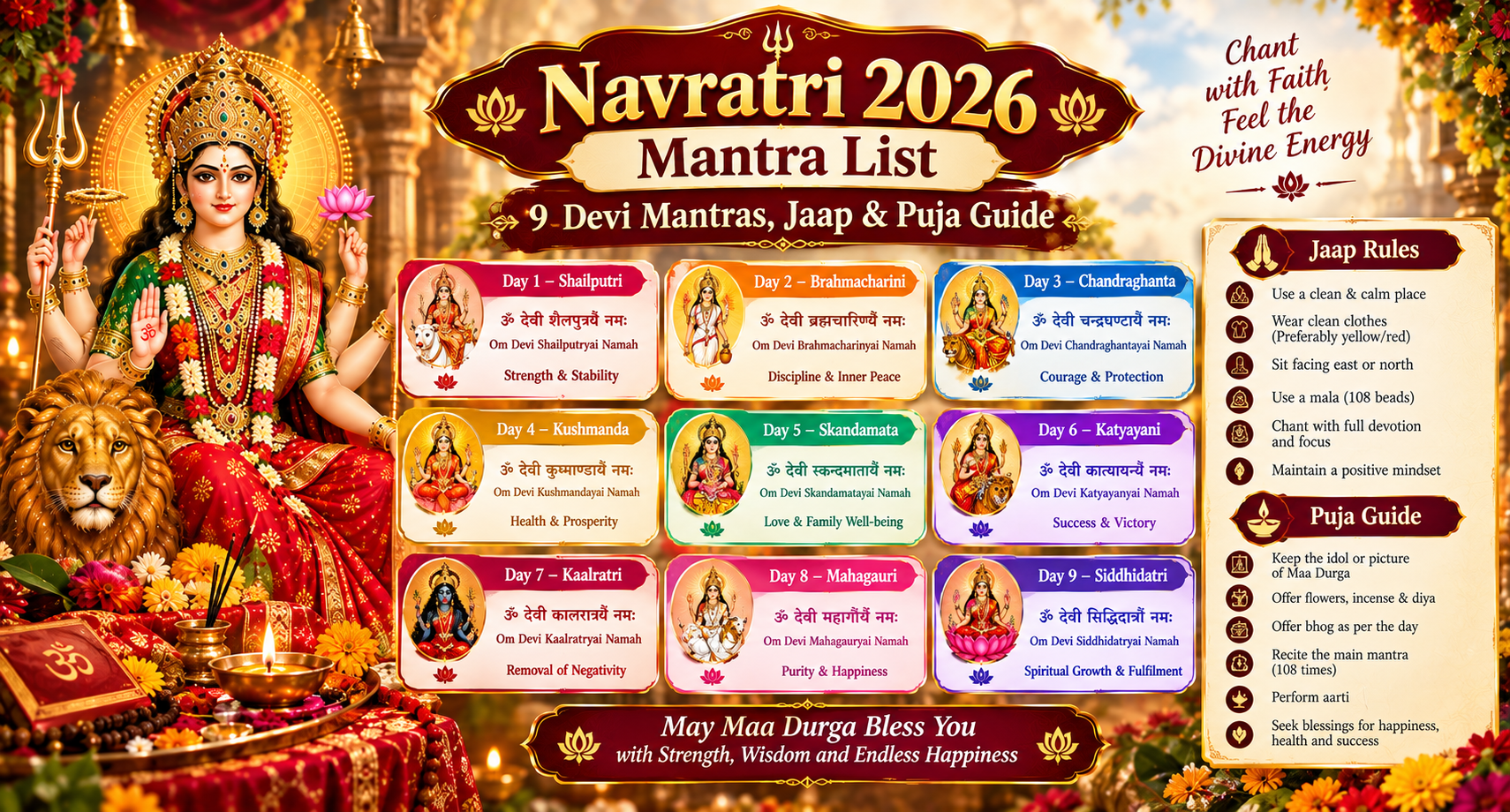
Day | Date | Devi | Naam Mantra | Traditionally Associated With |
|---|---|---|---|---|
1 | Sun, 11 Oct | Shailputri | ॐ देवी शैलपुत्र्यै नमः | Grounding, steady beginning |
2 | Mon, 12 Oct | Brahmacharini | ॐ देवी ब्रह्मचारिण्यै नमः | Discipline, patience, study |
3 | Tue, 13 Oct | Chandraghanta | ॐ देवी चन्द्रघण्टायै नमः | Courage, protection |
4 | Wed, 14 Oct | Kushmanda | ॐ देवी कूष्माण्डायै नमः | Vitality, dispelling darkness |
5 | Thu, 15 Oct | Skandamata | ॐ देवी स्कन्दमातायै नमः | Nurture, wellbeing of children |
6 | Fri, 16 Oct | Katyayani | ॐ देवी कात्यायन्यै नमः | Strength, resolve |
7 | Sat, 17 Oct | Kalaratri | ॐ देवी कालरात्र्यै नमः | Removal of fear and negativity |
8 | Sun, 18 Oct | Mahagauri | ॐ देवी महागौर्यै नमः | Purity, calm, completion of tapas |
9 | Mon, 19 Oct | Siddhidatri | ॐ देवी सिद्धिदात्र्यै नमः | Fulfilment, siddhi |
A note on the dates. Navratri follows the lunar tithi, not the calendar, so a few panchangs observe the Ashtami vrat on 19 October because the Ashtami tithi is still running at sunrise that morning. This does not change the mantra sequence. Follow the panchang your family or temple uses.
What Are Navratri Mantras?
A Navratri mantra is a Sanskrit invocation addressed to a particular form of the Goddess, recited during the nine days of Navratri worship.
Most of the mantras in common use come from two sources. The Navadurga Stotram supplies the nine dhyana shlokas — verses that describe each form's appearance, vahana and attributes, and ask for her grace. The namaskar mantras are the simple "Om Devi … Namah" constructions used in daily puja, sankalp and mala jaap.
Alongside these sit the broader Durga mantras — the Navarna Mantra, the Siddha Kunjika Stotram, and verses from the Durga Saptashati — which are not day-specific and may be recited throughout the nine days.
In Hindu devotional practice, the mantra is understood as a way of holding attention on the Devi rather than a formula that produces an effect by itself. The tradition consistently places sincerity, cleanliness and regularity above count or complexity.
Why Do Devotees Chant Mantras During Navratri?
Four reasons appear repeatedly in traditional practice.
Invocation. Navratri worship begins with Ghatasthapana, when the Goddess is invoked into the kalash. Mantra is the means by which that invocation and each day's worship is carried out. If you are setting up the kalash this year, the Ghatasthapana 2026 muhurat, vidhi and samagri guide sets out the opening sequence.
Continuity across nine days. A daily mantra gives structure. Devotees who cannot perform elaborate puja still keep the thread by chanting the day's mantra morning and evening.
Concentration during vrat. Fasting is easier to sustain when the mind has something to hold. Mantra jaap is the traditional companion to the Navratri vrat for exactly this reason.
Familiarity with the nine forms. Each dhyana shloka is essentially a description. Reciting it over nine days is how most devotees come to know the Navadurga as distinct forms rather than as one name repeated nine times.
Navratri 2026: 9 Days, 9 Devi Mantras
Day 1 — Maa Shailputri Mantra (Sunday, 11 October 2026)
Naam mantra: ॐ देवी शैलपुत्र्यै नमः — Om Devi Shailaputryai Namah
Dhyana shloka: वन्दे वाञ्छितलाभाय चन्द्रार्धकृतशेखराम्। वृषारूढां शूलधरां शैलपुत्रीं यशस्विनीम्॥
Vande vānchhita-lābhāya chandrārdha-kṛta-śekharām, vṛṣārūḍhāṁ śūladharāṁ Śailaputrīṁ yaśasvinīm.
Meaning: I bow to the illustrious Shailputri, who wears the crescent moon as her crown, rides the bull and holds the trident.
Traditional significance: Shailputri is the daughter of the Himalaya — the Goddess in her first and steadiest form. She is traditionally associated with grounding and with the proper beginning of any undertaking, which is why her worship coincides with Ghatasthapana.
How devotees commonly chant it: after the kalash is installed, the naam mantra is chanted on a mala, with the dhyana shloka recited once before the aarti. Day-wise worship details are on the Maa Shailputri Puja page.
Day 2 — Maa Brahmacharini Mantra (Monday, 12 October 2026)
Naam mantra: ॐ देवी ब्रह्मचारिण्यै नमः — Om Devi Brahmacharinyai Namah
Dhyana shloka: दधाना करपद्माभ्यामक्षमालाकमण्डलू। देवी प्रसीदतु मयि ब्रह्मचारिण्यनुत्तमा॥
Dadhānā kara-padmābhyām akṣamālā-kamaṇḍalū, devī prasīdatu mayi Brahmachāriṇy-anuttamā.
Meaning: May the incomparable Brahmacharini, who holds the rudraksha mala and the kamandalu in her lotus hands, be gracious to me.
Traditional significance: Brahmacharini is the Goddess in her ascetic phase, associated with tapasya, patience and steady effort. Students and those undertaking a long discipline traditionally give this day particular attention.
How devotees commonly chant it: this is the day most suited to a longer, quieter jaap. The verse itself is a request for grace rather than a petition for anything specific — worth noticing. More on Maa Brahmacharini worship.
Day 3 — Maa Chandraghanta Mantra (Tuesday, 13 October 2026)
Naam mantra: ॐ देवी चन्द्रघण्टायै नमः — Om Devi Chandraghantayai Namah
Dhyana shloka: पिण्डजप्रवरारूढा चण्डकोपास्त्रकैर्युता। प्रसादं तनुते मह्यं चन्द्रघण्टेति विश्रुता॥
Piṇḍaja-pravarārūḍhā chaṇḍa-kopāstra-kair-yutā, prasādaṁ tanute mahyaṁ Chandraghaṇṭeti viśrutā.
Meaning: May she who is renowned as Chandraghanta, mounted on her chosen vahana and armed for the destruction of wrath, extend her grace to me.
Traditional significance: Chandraghanta wears the half-moon shaped like a bell on her forehead, and the sound of that bell is traditionally described as dispelling fear. She is associated with courage and with protection.
How devotees commonly chant it: often at dusk, with a bell rung at the start and close of the jaap. See the Maa Chandraghanta Puja page.
Day 4 — Maa Kushmanda Mantra (Wednesday, 14 October 2026)
Naam mantra: ॐ देवी कूष्माण्डायै नमः — Om Devi Kushmandayai Namah
Dhyana shloka: सुरासम्पूर्णकलशं रुधिराप्लुतमेव च। दधाना हस्तपद्माभ्यां कूष्माण्डा शुभदास्तु मे॥
Surā-sampūrṇa-kalaśaṁ rudhirāplutam eva cha, dadhānā hasta-padmābhyāṁ Kūṣmāṇḍā śubhadāstu me.
Meaning: May Kushmanda, holding in her lotus hands the vessel of nectar and of blood, grant me auspiciousness.
Traditional significance: Kushmanda is revered as the form whose smile brought the cosmos into being, and whose radiance is compared to the sun. The two vessels in the verse are traditionally read as the two poles of existence held together by the Goddess.
A note on the wording: this shloka has minor textual variants across printed editions. The Gita Press Navadurga Stotram form given above is the one most widely recited. Worship details are on the Maa Kushmanda Puja page.
Day 5 — Maa Skandamata Mantra (Thursday, 15 October 2026)
Naam mantra: ॐ देवी स्कन्दमातायै नमः — Om Devi Skandamatayai Namah
Dhyana shloka: सिंहासनगता नित्यं पद्माश्रितकरद्वया। शुभदास्तु सदा देवी स्कन्दमाता यशस्विनी॥
Siṁhāsana-gatā nityaṁ padmāśrita-kara-dvayā, śubhadāstu sadā devī Skandamātā yaśasvinī.
Meaning: May the illustrious Skandamata, ever seated on her lion throne with two hands holding lotuses, always grant auspiciousness.
Traditional significance: Skandamata is the mother of Kartikeya, worshipped in her nurturing aspect. Parents traditionally chant her mantra for the wellbeing of children, and the day is associated with care and protection within the family.
How devotees commonly chant it: families often chant together on this day, with children joining for the short naam mantra. More on Maa Skandamata Puja.
Day 6 — Maa Katyayani Mantra (Friday, 16 October 2026)
Naam mantra: ॐ देवी कात्यायन्यै नमः — Om Devi Katyayanyai Namah
Dhyana shloka: चन्द्रहासोज्ज्वलकरा शार्दूलवरवाहना। कात्यायनी शुभं दद्याद् देवी दानवघातिनी॥
Chandrahāsojjvala-karā śārdūla-vara-vāhanā, Kātyāyanī śubhaṁ dadyād devī dānava-ghātinī.
Meaning: May Katyayani, whose hand blazes with the sword Chandrahasa, who rides the tiger and destroys the asuras, grant what is auspicious.
Traditional significance: Katyayani is the warrior form born of the collective tejas of the devas to confront Mahishasura. She is traditionally invoked for resolve and for the strength to face a difficult situation directly.
A widely known variation: many unmarried women recite a separate Katyayani mantra associated with the Bhagavata tradition on this day. It is a distinct verse, not a replacement for the Navadurga shloka, and both are used. See the Maa Katyayani Puja page.
Day 7 — Maa Kalaratri Mantra (Saturday, 17 October 2026)
Naam mantra: ॐ देवी कालरात्र्यै नमः — Om Devi Kalaratryai Namah
Dhyana shloka (opening lines): एकवेणी जपाकर्णपूरा नग्ना खरास्थिता। लम्बोष्ठी कर्णिकाकर्णी तैलाभ्यक्तशरीरिणी॥
Ekaveṇī japākarṇapūrā nagnā kharāsthitā, lamboṣṭhī karṇikākarṇī tailābhyakta-śarīriṇī.
Meaning: She of the single braid, wearing the japa flower at her ear, unclothed, mounted on the ass, her body anointed with oil.
Traditional significance: Kalaratri is the most intense of the nine forms, worshipped as the destroyer of fear, darkness and negative influence. Her description is deliberately fearsome; the tradition reads this as the form that ends fear rather than causes it.
Important note on this mantra. The Kalaratri dhyana is longer than the others and continues for a further verse. Many households recite only the naam mantra on this day and leave the full dhyana to the officiating pandit. If you are unfamiliar with the Sanskrit, the short form is entirely sufficient and is what most devotees use.
Saptami is traditionally a significant night for protective worship, which is one reason devotees seeking relief from obstruction often arrange a Maa Baglamukhi Hawan during this part of Navratri. Her worship is described on the Maa Kalaratri Puja page.
Day 8 — Maa Mahagauri Mantra (Sunday, 18 October 2026)
Naam mantra: ॐ देवी महागौर्यै नमः — Om Devi Mahagauryai Namah
Dhyana shloka: श्वेते वृषे समारूढा श्वेताम्बरधरा शुचिः। महागौरी शुभं दद्यान्महादेवप्रमोददा॥
Śvete vṛṣe samārūḍhā śvetāmbara-dharā śuchiḥ, Mahāgaurī śubhaṁ dadyān Mahādeva-pramodadā.
Meaning: May Mahagauri — pure, clothed in white, mounted on the white bull, and the delight of Mahadeva — grant what is auspicious.
Traditional significance: Mahagauri is the serene, luminous form who emerges after long penance. She is associated with calm, purity and the settling that follows sustained effort.
Related worship: Day 8 is Durga Ashtami in 2026, when many families perform Kanya Pujan and, in the eastern tradition, Sandhi Puja. The mantra is usually recited before the Kanya Pujan begins. More on the Maa Mahagauri Puja page.
Day 9 — Maa Siddhidatri Mantra (Monday, 19 October 2026)
Naam mantra: ॐ देवी सिद्धिदात्र्यै नमः — Om Devi Siddhidatryai Namah
Dhyana shloka: सिद्धगन्धर्वयक्षाद्यैरसुरैरमरैरपि। सेव्यमाना सदा भूयात् सिद्धिदा सिद्धिदायिनी॥
Siddha-gandharva-yakṣādyair asurair amarair api, sevyamānā sadā bhūyāt siddhidā siddhidāyinī.
Meaning: May she who is served by the siddhas, gandharvas, yakshas, asuras and devas — the bestower of siddhis — always be the granter of attainment.
Traditional significance: Siddhidatri completes the Navadurga. She is traditionally associated with the fulfilment of sadhana rather than with any single worldly aim.
Related worship: Maha Navami 2026 carries Ayudha Puja and the Navami homa, and this is the day most nine-day anushthans conclude. The website's note on Navratri havan significance across the nine days explains how the closing homa is traditionally structured. Worship details are on the Maa Siddhidatri Puja page.
How to Chant Navratri Mantras Correctly
A workable sequence for a household:
Bathe and wear clean clothes before sitting. Mantra jaap is traditionally done after snan, not before.
Sit facing east or north on a clean asan — a woollen or cotton mat, not the bare floor.
Light a diya before beginning, and keep the puja space tidy.
Take a short sankalp — state silently the day, the Devi and your intention. This is the step beginners most often skip, and it is the one that gives the jaap its shape.
Recite the dhyana shloka once, then begin the naam mantra on a mala.
Keep the pace even. The mantra should be audible to you but not to the room — the traditional upanshu jaap.
Close with a short prayer, offer the naivedya, and perform the aarti.
Pronunciation matters less than most beginners fear. The tradition holds that sincere recitation with imperfect Sanskrit is acceptable; the general rules of jaap are set out in more detail in the website's guide to mantra jaap rules, which apply broadly to Devi upasana.
Best Time for Navratri Mantra Jaap
Brahma Muhurta — roughly 90 minutes before sunrise — is traditionally regarded as the most suitable time for mantra jaap.
In practice most devotees use one of three windows:
Early morning, after snan and before the household wakes. The traditional first choice.
Pradosh kaal, the period around dusk, commonly used for the evening aarti and a second round of jaap.
Nishita kaal, late night, used mainly by those undertaking a formal anushthan rather than by households.
One practical point: keep the same time each day for all nine days. The consistency is traditionally considered more significant than which window you choose. If you can only manage ten minutes, do it at the same ten minutes daily.
How Many Times Should You Chant a Navratri Mantra?
The traditional unit is 108 — one full mala. Where a larger count is undertaken, it is usually a multiple of 108: 1,008 for a single-day intensive, or a fixed daily count sustained across the nine days.
Where a count is not fixed by a specific tradition, this article does not invent one. The honest position is that for household Navratri worship, one mala of the day's naam mantra is the commonly followed practice, and that is sufficient.
Three qualifications worth knowing:
Dhyana shlokas are not usually counted on a mala. They are recited once, three times or eleven times during puja.
A vowed count should be completed. If you undertake a specific daily number as part of a sankalp, tradition treats finishing it as more important than increasing it.
Do not chase numbers during a fast. A long jaap while fasting is for those with experience of both.
Navratri Mantra Jaap Rules for Beginners
The basics, without unnecessary complication:
Use a rudraksha or tulsi mala, or a plain cotton knotted mala. Keep it for jaap only.
Do not cross the sumeru (the head bead). On reaching it, turn the mala and continue in the reverse direction.
Cover the mala with a cloth or gaumukhi bag, or hold it near the chest, rather than letting it hang openly.
Keep the mala off the floor.
Sit still. Jaap while walking, driving or lying down is not the traditional form, though mental remembrance any time is always permitted.
Do not chant with shoes on, or immediately after eating a heavy meal.
Menstruating women, by many family traditions, pause formal mala jaap and puja; others continue with mental recitation. Practice genuinely varies by family and sampradaya, and neither position is universal.
Start with the naam mantra. Add the dhyana shloka once you are comfortable.
For the broader framework of Devi puja at home, the Puja Vidhi guide on this site sets out the standard sequence of upacharas.
Navarna Mantra and Other Durga Mantras
The Navarna Mantra is the nine-syllable mantra of the Durga Saptashati: ॐ ऐं ह्रीं क्लीं चामुण्डायै विच्चे (Om Aim Hreem Kleem Chamundayai Vichche).
It is not day-specific. Devotees may recite it throughout the nine days, and it is the mantra most commonly used alongside a Durga Saptashati path. In traditional practice the Navarna is regarded as a mantra that carries weight, and many acharyas recommend receiving it from a guru before undertaking a formal anushthan with it — casual recitation for devotion is a different matter and is widely practised.
Other Durga mantras used during Navratri include:
Sarva Mangala Mangalye — सर्वमङ्गलमाङ्गल्ये शिवे सर्वार्थसाधिके — recited at the close of puja on any day.
Ya Devi Sarvabhuteshu — the well-known series of verses from the Saptashati, each addressing the Goddess as she abides in a particular quality.
Siddha Kunjika Stotram, recited by those who cannot complete a full Saptashati path.
Simple Devi mantras vs specialised mantras
This distinction matters and most articles skip it.
Simple devotional mantras — the naam mantras, the Navadurga shlokas, the Saptashati verses — are open to anyone. No initiation is required, there are no restrictive conditions, and they may be chanted at home by any devotee.
Specialised mantras — the beej-based mantras of specific Mahavidyas, used in formal sadhana with a fixed count, niyam and purashcharana — belong to a different category. Tradition places these under guru guidance because the discipline surrounding them, not the syllables alone, is what makes the practice coherent. Devotees interested in this distinction can read the site's complete Baglamukhi mantra guide.
Mantra Jaap During Navratri Fasting
Fasting and jaap traditionally support each other, with a few practical cautions.
Chant before breaking the fast rather than after, since the morning window is both traditionally preferred and physically easier. Keep the count modest if you are on a strict nirjala or single-meal vrat — a long jaap on an empty stomach is not a sign of devotion, and no tradition asks for it. If you feel faint, stop; there is no rule anywhere that requires you to continue.
Those who cannot fast at all may still chant. The vrat is one practice and the jaap is another, and neither is a precondition for the other.
Ashtami, Navami and Kanya Pujan Mantras
On Durga Ashtami (18 October 2026) the Mahagauri mantra is recited, and in the eastern tradition the Sandhi Puja is performed at the junction of Ashtami and Navami tithis with its own sequence.
On Maha Navami (19 October 2026) the Siddhidatri mantra is recited, and Navami is when most nine-day observances conclude with a homa.
For Kanya Pujan, performed on either day according to family custom, there is no separate mantra unique to the ritual. The usual practice is to recite the day's Devi mantra before the girls are seated, then proceed with the feet-washing, tilak, kalawa and the serving of the meal. Some families add the Sarva Mangala Mangalye verse at the close. The full nine-day ritual framework is set out in the pillar guide to Shardiya Navratri 2026 dates, puja vidhi and colours.
Can Maa Baglamukhi Be Worshipped During Navratri?
Yes. Maa Baglamukhi is one of the Dasha Mahavidya, and Navratri is among the periods when Mahavidya upasana is traditionally undertaken alongside Navadurga worship.
The two are not in competition. Navadurga worship follows the nine-day sequence described above; Mahavidya upasana is a parallel stream within Shakta practice, and many devotees observe both — the day's Devi mantra as part of household puja, and a separate Baglamukhi sadhana or anushthan under acharya guidance.
Maa Baglamukhi is traditionally described as the stambhana shakti — the power associated with stilling opposition and obstruction. This is why devotees facing prolonged litigation, professional obstruction or persistent conflict have historically undertaken Maa Baglamukhi anushthan during Navratri, with the sankalp taken on the first day and the concluding havan on Navami. Her place within the Mahavidya tradition is explained on the Baglamukhi Mahavidya page.
One point of honesty: Baglamukhi mantras are beej-based and belong to the specialised category described earlier. Devotees are traditionally advised to undertake formal Baglamukhi jaap under proper guidance rather than from a website — which is precisely why anushthan is performed at a Siddha Peeth by an acharya on the devotee's behalf. Those planning to visit can find practical details on the Maa Baglamukhi Temple, Nalkheda page.
Navratri Puja Resources and Related Guides
If you are planning the full nine days, three things are worth settling before 11 October: the Ghatasthapana muhurat for your city, the form your vrat will take, and whether you wish to conclude with a havan on Navami.
Devotees who would like a traditional Devi puja, havan or nine-day anushthan performed at Nalkheda under the temple acharya's guidance can book a puja for Navratri 2026, or book a consultation first to discuss which ritual suits their situation. Navratri slots fill early.
No ritual here is offered with a promise of a fixed outcome. What the tradition holds is that sincere worship, performed correctly, is worthwhile in itself.
Frequently Asked Questions
1. What is the mantra for Navratri 2026?
There is no single Navratri mantra. Each of the nine days has its own Devi mantra, beginning with ॐ देवी शैलपुत्र्यै नमः on 11 October and ending with ॐ देवी सिद्धिदात्र्यै नमः on 19 October. The Navarna Mantra may be chanted on all nine days.
2. What are the 9 Devi mantras?
The nine naam mantras are Om Devi Shailaputryai, Brahmacharinyai, Chandraghantayai, Kushmandayai, Skandamatayai, Katyayanyai, Kalaratryai, Mahagauryai and Siddhidatryai Namah. Each also has a longer dhyana shloka from the Navadurga Stotram, recited during puja rather than on a mala.
3. Which mantra should I chant on Day 1 of Navratri?
ॐ देवी शैलपुत्र्यै नमः, for Maa Shailputri, on Sunday 11 October 2026 — the day of Ghatasthapana. Chant it after the kalash is installed. The dhyana shloka beginning "Vande vanchhita labhaya" is recited once before the aarti.
4. Which mantra is for Maa Brahmacharini?
ॐ देवी ब्रह्मचारिण्यै नमः, chanted on Monday 12 October 2026. The dhyana shloka begins "Dadhana kara-padmabhyam" and describes her holding the rudraksha mala and kamandalu. She is traditionally associated with discipline, patience and sustained study.
5. Which mantra is for Maa Chandraghanta?
ॐ देवी चन्द्रघण्टायै नमः, on Tuesday 13 October 2026. Her dhyana shloka begins "Pindaja-pravararudha". Chandraghanta wears the bell-shaped half-moon on her forehead and is traditionally invoked for courage and protection from fear.
6. Which mantra is for Maa Katyayani?
ॐ देवी कात्यायन्यै नमः, on Friday 16 October 2026. Her dhyana shloka begins "Chandrahasojjvala-kara". Separately, many unmarried women recite a distinct Katyayani mantra from the Bhagavata tradition on this day; both are in common use.
7. Which mantra is for Maa Kalaratri?
ॐ देवी कालरात्र्यै नमः, on Saturday 17 October 2026. Her full dhyana is longer than the other eight and many households recite only the naam mantra. That is entirely acceptable and is what most devotees actually do.
8. Which mantra is for Maa Siddhidatri?
ॐ देवी सिद्धिदात्र्यै नमः, on Monday 19 October 2026, which is Maha Navami. Her dhyana shloka begins "Siddha-gandharva-yakshadyair". She is traditionally associated with the completion of sadhana rather than any single worldly aim.
9. Can I chant Navratri mantras at home?
Yes. The nine naam mantras and the Navadurga Stotram shlokas are devotional mantras open to all, requiring no initiation. Bathe first, sit on a clean asan facing east or north, light a diya, and chant at the same time each day.
10. How many times should I chant Navratri mantras?
One mala of 108 is the commonly followed practice for household worship. Larger counts are usually multiples of 108. Dhyana shlokas are not counted on a mala — they are recited once, three times or eleven times during the puja.
11. Can beginners chant Navratri mantras?
Yes. Start with the short naam mantra rather than the Sanskrit shloka. Tradition holds that sincere recitation with imperfect pronunciation is acceptable. Add the dhyana shloka once the daily rhythm is established and the words feel familiar.
12. Can Navratri mantras be chanted during fasting?
Yes, and the two traditionally support each other. Chant in the morning before breaking the fast. Keep the count modest during a strict vrat — a long jaap on an empty stomach is not required by any tradition. Stop if you feel unwell.
13. What is the Navarna Mantra?
ॐ ऐं ह्रीं क्लीं चामुण्डायै विच्चे — the nine-syllable mantra of the Durga Saptashati. It is not day-specific and may be chanted throughout Navratri, particularly alongside a Saptashati path. For formal anushthan, acharyas traditionally advise receiving it from a guru.
14. What is the difference between a Durga mantra and a Navdurga mantra?
A Durga mantra addresses the Goddess in her general form and can be chanted on any day — the Navarna and Sarva Mangala Mangalye are examples. A Navdurga mantra addresses one of the nine specific forms and is tied to its particular day of Navratri.
15. Can I chant one mantra for all nine days?
Yes. Devotees who find nine mantras difficult to keep track of commonly chant the Navarna Mantra, or a single Durga mantra, across all nine days. This is an accepted practice and is not considered a lesser observance.
16. Should I use a mala while chanting?
A mala helps maintain count without the mind tracking numbers, which is its actual purpose. Use rudraksha, tulsi or a knotted cotton mala kept only for jaap. Do not cross the sumeru bead — turn the mala and continue in the reverse direction.
17. What time is best for Navratri mantra jaap?
Brahma Muhurta, roughly 90 minutes before sunrise, is traditionally regarded as most suitable. Pradosh kaal around dusk is the common second option. Consistency matters more than the window — keep the same time for all nine days.
18. Can women chant Navratri mantras?
Yes. The Navadurga and Durga mantras are open to all devotees regardless of gender. On menstruation, family traditions differ — some pause formal mala jaap and puja, others continue with mental recitation. Both positions exist and neither is universal.
19. What should be avoided during mantra chanting?
Chanting without bathing, with shoes on, while lying down or walking, immediately after a heavy meal, or with the mala touching the floor. Also avoid rushing to finish a count — pace matters more than speed, and an unfinished mala is better than a hurried one.
20. Do I need a guru to chant Navratri mantras?
Not for the nine Devi naam mantras or the Navadurga Stotram — these are open devotional mantras. Guru guidance is traditionally advised for beej-based Mahavidya mantras and for formal anushthan with a fixed count and niyam, which is a different category of practice.
The nine mantras of Navratri are not nine separate techniques. They are nine ways of paying attention to the same Shakti across nine days — first as the steady mountain daughter, then as the ascetic, the protector, the creator, the mother, the warrior, the destroyer of fear, the serene one, and finally the giver of attainment.
You do not need all nine to observe Navratri properly. One mantra, chanted at the same time each morning for nine days, is a complete practice. Start there.
Acharya Tiwari Chetan Guru
Siddha Peethadheesh & Head Vedic Scholar
With over 15+ years of unbroken Vedic practice at Maa Baglamukhi Siddha Peeth, Nalkheda, Acharya Ji is a globally authoritative voice on Tantra Shastra, Stambhan Vidya, and Karmic Astrology. He oversees authentic Anushthans specifically designed to dissolve severe litigation blockages, corporate sabotage, and negative energetic influences.