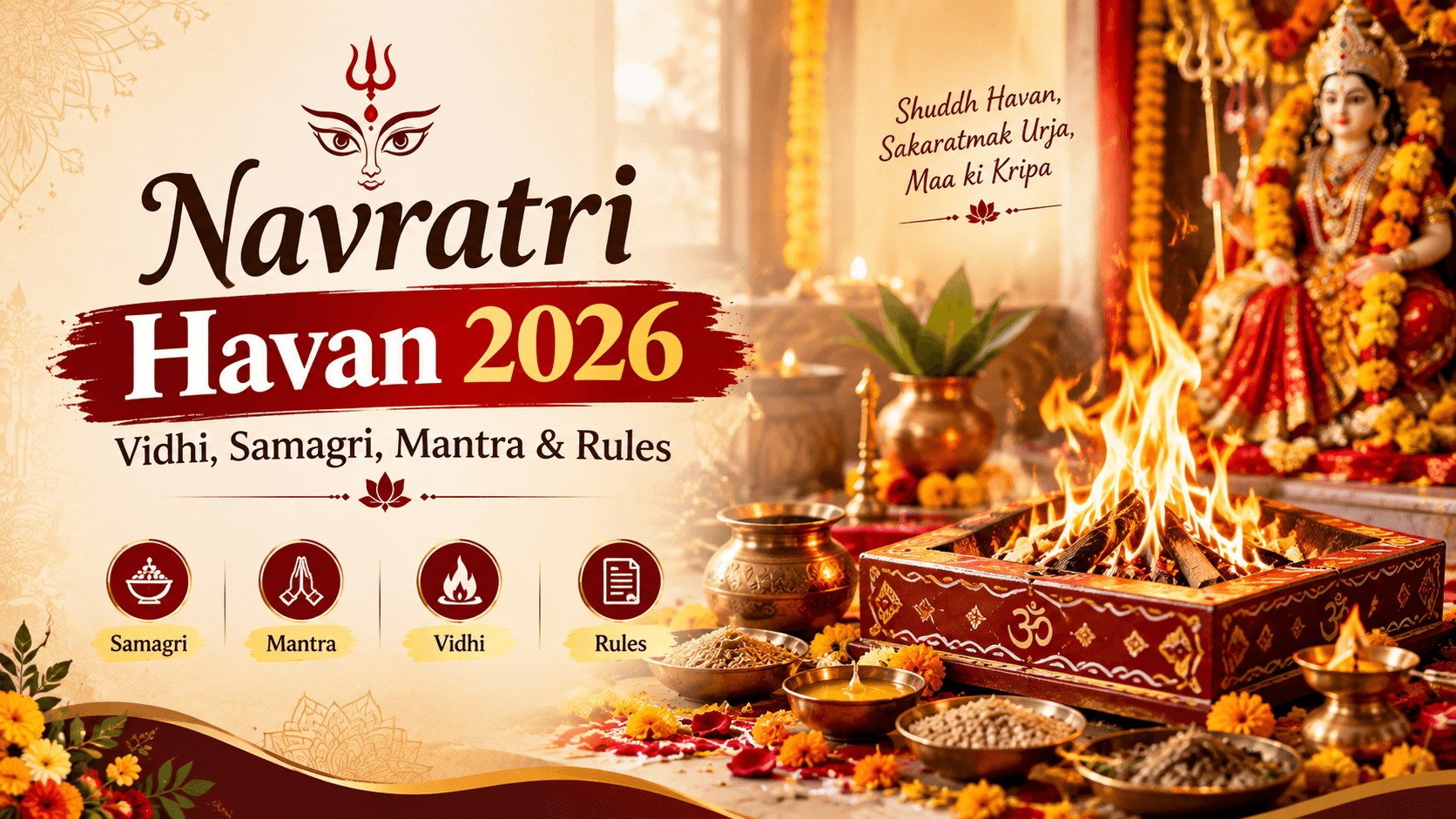
Navratri Havan is the fire ritual many households perform toward the end of the nine days, offering ghee, samagri, and mantras into a sacred fire as an act of devotion to Devi. It is traditionally performed on Ashtami or Navami, alongside or after the day's main puja, though the exact timing and scale vary considerably by family and tradition. This guide covers the practical side of performing Navratri Havan: the samagri, the step-by-step vidhi, commonly used mantras, and the safety rules that matter regardless of how elaborate the ritual is.
This site already has detailed guides on the broader Navratri puja, Kalash Sthapana, and Kanya Pujan, so rather than repeating those here, this article stays focused on the Havan itself and links out wherever a related topic deserves fuller treatment.
How to Perform Navratri Havan at Home?
Select and clean a suitable puja or havan space, ideally well-ventilated.
Prepare the havan kund or a suitable fireproof vessel.
Arrange the samagri in advance, within easy reach.
Perform a basic puja and Sankalp according to your family's tradition.
Establish the sacred fire carefully and safely.
Begin mantra recitation, generally a Durga mantra or Devi mantra.
Offer ahuti (oblations) with the appropriate mantra, ending each with "Swaha."
Complete Purnahuti, the final, larger offering.
Perform a closing prayer or aarti according to tradition.
Safely extinguish the fire and clean the area.
Each step is explained in more detail below.
What Is Navratri Havan?
Havan, also called Homa, is a Vedic fire ritual in which offerings are made into a consecrated fire while mantras are recited, traditionally regarded as a way of carrying devotion and prayer to the deity being invoked. During Navratri, this practice is directed toward Durga in her various forms, and is commonly performed as a concluding ritual toward the end of the nine days.
The difference between an ordinary Navratri puja and a Havan is mainly one of scale and structure. A daily puja generally involves a diya, flowers, and an aarti; a Havan adds a consecrated fire, specific samagri burned as offerings, and a more structured mantra sequence built around repeated ahutis. In many traditions, a simple home Havan, performed with a handful of ahutis and basic samagri, is considered quite different from an elaborate, priest-led Anushthan involving specific Sankalp, extended mantra recitation, and a large number of prescribed offerings. Devotees traditionally regard both as valid, with the choice depending on family custom, available guidance, and practical circumstances.
When Is Navratri Havan Performed in 2026?
Shardiya Navratri 2026 begins on Sunday, 11 October, with Maha Ashtami on Sunday, 18 October, and Maha Navami on Monday, 19 October, according to the Panchang followed across most of North and Central India. Havan is most commonly performed on one of these two days.
Some families perform Havan on Ashtami, often connecting it with the Ashtami-day worship of Maa Mahagauri, while others perform it on Navami, generally as part of the concluding rituals before Vijayadashami on Tuesday, 20 October. Both practices are widely followed, and neither is treated as more correct than the other; the choice generally comes down to family Sampradaya and the specific Panchang followed in a given region.
Because tithi transitions are calculated from local sunrise, the exact muhurat for Havan can shift by a few hours between cities. For the complete verified date and tithi breakdown, including how Ashtami and Navami interact this year, see the Shardiya Navratri 2026 Ashtami and Navami guide. If your family follows a specific Havan muhurat, confirming it against your local Panchang or with a family priest is the safest approach.
Navratri Havan Samagri List 2026
Havan Samagri | Approx. Quantity | Purpose / Traditional Use | Essential or Optional |
|---|---|---|---|
Havan Kund | 1 | The fire pit or vessel where the sacred fire is established | Essential |
Havan Samagri (mixed offering material) | Quantity depends on the size of the Havan | The primary material offered into the fire with each ahuti | Essential |
Dry wood / Samidha | As required for the duration of the Havan | Fuel for the sacred fire | Essential |
Ghee | Quantity depends on the number of participants and ahutis | Poured or offered with each ahuti | Essential |
Camphor | Small quantity | Used to help establish the fire and during aarti | Essential |
Cotton wicks | Small quantity | Used alongside the diya near the Havan area | Commonly used |
Kalash with water | 1 | Kept nearby as part of the broader puja setup | Commonly used |
Mango leaves | A few, where traditionally used | Sometimes used in the Kalash placed near the Havan | Optional |
Flowers | As required | Offered during the puja portion of the ritual | Essential |
Kumkum / Roli | Small quantity | Used for tilak and puja preparation | Essential |
Akshat | Small quantity | Offered during puja and sometimes with ahutis | Essential |
Sandalwood (chandan) | Small quantity | Used in tilak and sometimes added to the samagri | Optional |
Incense | 1 packet | Used through the puja and Havan | Commonly used |
Fruits | As required | Offered as naivedya | Essential |
Bhog / Prasad | As required | Prepared and offered after the Havan | Essential |
Coconut | 1, generally for Purnahuti | Offered as the final, larger oblation | Essential |
Barley (jau) | Small quantity, where used | Sometimes included in the samagri mixture | Optional |
Sesame seeds (til) | Small quantity | Commonly added to the samagri or offered separately | Commonly used |
Jaggery | Small quantity | Sometimes added to the samagri mixture | Optional |
Dry fruits | Small quantity, where traditionally used | Added to some samagri blends or offered as bhog | Optional |
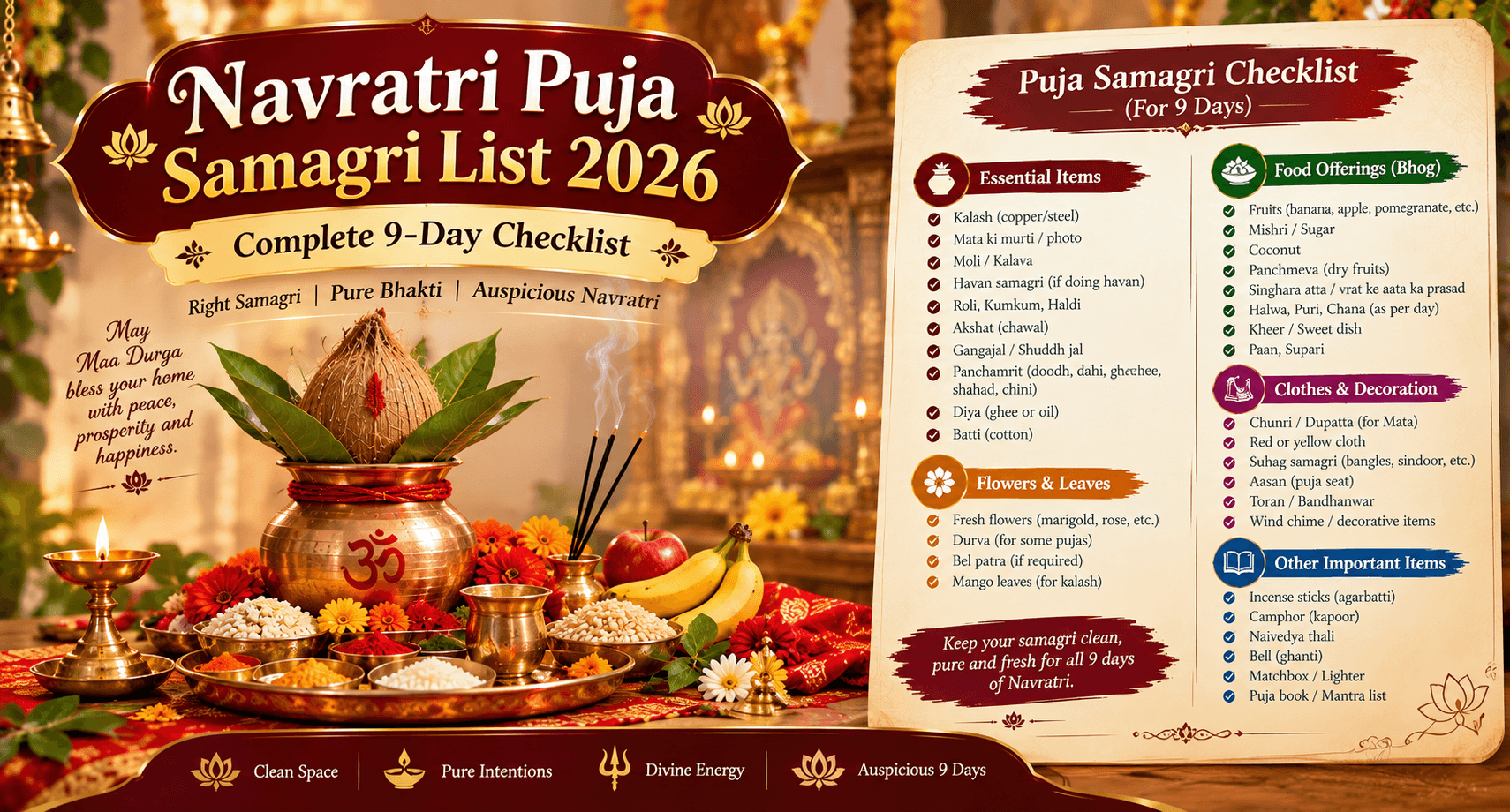
Quantities here depend heavily on how many people are participating and how elaborate the specific Havan is; a simple family Havan with a limited number of ahutis needs far less than an Anushthan-style ritual with a prescribed higher count. For a broader shopping checklist covering the rest of Navratri worship alongside Havan preparation, see the Navratri Puja Samagri List 2026. (Editor's note: confirm this article's live URL before publishing.) For a deeper look at what typically goes into havan samagri and why, the Baglamukhi Havan Samagri guide explains the composition in more detail.
Havan Kund Setup and Preparation
The Havan Kund is generally placed in a clean, well-ventilated part of the home, close to the main puja area but with enough surrounding space to sit comfortably and handle offerings safely. Many households prefer to face east or north while performing the ritual, in keeping with the broader puja setup, though this is a widely followed preference rather than a strict requirement.
Practical preparation includes:
Placing the Havan Kund on a stable, heat-resistant surface, away from curtains, paper, or other flammable material
Keeping all samagri organised within easy reach, so the ritual does not need to pause to search for an item
Arranging seating so the person performing the Havan can reach the kund comfortably without leaning across the fire
Keeping a container of water or sand nearby as a basic safety measure
Ensuring the room has adequate airflow, since a Havan does produce smoke
Navratri Havan Vidhi: Step-by-Step
Step 1 — Clean the puja and Havan area. Start with a clean, uncluttered space.
Step 2 — Prepare the Havan Kund. Set it in place, and lay the wood in a stable arrangement suitable for burning.
Step 3 — Arrange the samagri. Keep everything from the list above within reach before starting.
Step 4 — Sankalp. Take a brief spoken intention for the Havan, generally following the words used in your own family's tradition or as guided by a priest. This article does not prescribe a specific Sankalp formula, since the exact wording is tradition-specific and best followed as taught within your own family or by a priest.
Step 5 — Deity invocation. Many households begin with an invocation to Ganesha, as is customary before most Hindu rituals, followed by an invocation to Durga, according to family practice.
Step 6 — Establish the sacred fire. Light the fire carefully using the arranged wood and camphor, only once the space is confirmed to be safe, ventilated, and clear of anything flammable nearby.
Step 7 — Initial offerings. Once the fire is steady, offer a small amount of ghee and samagri as the opening offering.
Step 8 — Main mantra and ahuti. Recite the chosen mantra, generally a Durga mantra, and offer ahuti (a small portion of samagri and ghee) into the fire at the point where the mantra ends in "Swaha," the traditional word used to complete a Vedic fire offering.
Step 9 — Repeated ahuti. This is generally repeated a number of times, with the exact count and mantra sequence varying according to the specific ritual tradition being followed. See the next section for more on how this count is decided.
Step 10 — Purnahuti. The ritual concludes with Purnahuti, a final, larger and more complete offering, often including a whole coconut, along with camphor, ghee, and remaining samagri, marking the formal close of the fire offering.
Step 11 — Prayer and aarti. A closing prayer and aarti follow, generally performed by the whole household if others are present.
Step 12 — Conclusion. Once the fire has been allowed to burn down naturally or has been safely extinguished, the puja area is cleaned and prasad distributed.
Navratri Havan Mantra and Ahuti Mantra
The most widely used mantra for Navratri Havan ahutis is a short Durga mantra, generally recited as "Om Dum Durgayei Namah Swaha" with each offering. Devotees performing a day-specific Havan, particularly on Navami, sometimes also chant the day's Devi mantra, such as the Siddhidatri mantra on the ninth day, alongside the general Durga mantra.
The traditional Durga Gayatri Mantra, drawn from Vedic tradition, is also used by some households and priests during Havan:
Om Katyayanaya Vidmahe Kanyakumari Dhimahi Tanno Durgih Prachodayat
"Swaha" is the traditional word spoken at the completion of each ahuti, marking the moment the offering is made into the fire, and is used consistently across nearly all Vedic Havan traditions regardless of which specific mantra precedes it.
It is worth being direct about something many generic articles gloss over: more elaborate mantra sequences, particularly those tied to a specific Anushthan, Tantric practice, or a specialised Sadhana, are generally taught through initiation or direct guidance from a qualified priest or Acharya, rather than picked up from a general article. This guide covers the standard, widely used Havan mantra practice rather than any specialised or restricted tradition, and readers interested in a more advanced ritual are better served consulting a priest directly.
How Many Ahutis Are Offered?
There is no single universal number that applies to every Navratri Havan. Some households perform a modest number of ahutis, sufficient for a simple home ritual, while more elaborate Anushthan-style Havans commonly follow a prescribed count, such as 108, tied to the specific Sankalp and tradition being observed.
The exact count generally depends on:
The specific ritual or Sankalp being performed
The mantra being used, since some mantras are tied to a customary repetition count
Family or Sampradaya tradition
Guidance from the officiating priest, where one is involved
Rather than treating a specific number as mandatory, most traditions place more emphasis on completing the offerings with sincerity and proper attention than on hitting an exact count.
Navratri Havan on Ashtami or Navami?
Ashtami Havan | Navami Havan |
|---|---|
Often connected with the worship of Maa Mahagauri, the eighth form of Devi | Often performed as the concluding Havan of Navratri, tied to Maa Siddhidatri |
Chosen by families whose tradition marks Ashtami as the primary concluding day | Chosen by families whose fast and worship conclude on the ninth day |
Some households connect this with an earlier Kanya Pujan on the same day | Often performed alongside or just before Kanya Pujan and Paran |
Regional and family Sampradaya generally decide this choice | Same; regional and family tradition, not a fixed universal rule |
Neither day is treated as more correct than the other, and the decision generally comes down to which tithi a family's tradition emphasises. For the complete explanation of how Ashtami and Navami interact in the 2026 calendar, see the Shardiya Navratri 2026 Ashtami and Navami guide.
Can Navratri Havan Be Done at Home?
Yes, a simple Navratri Havan can generally be performed at home according to one's own family tradition, and a priest is not treated as mandatory for a modest home ritual with basic samagri and a limited number of ahutis. More elaborate Havans, particularly those involving a longer mantra sequence, a specific Sankalp, or a larger prescribed number of offerings, are more commonly performed with guidance from a trained priest, mainly to ensure the ritual sequence and mantra pronunciation are followed correctly.
Specialised Vedic or Tantric rituals in particular should not be improvised from a general article; these are typically taught through direct guidance or initiation. Fire safety also matters regardless of scale, and the precautions below apply equally to a simple home Havan and a larger one.
Navratri Havan Rules and Precautions
Traditional practice:
Wearing clean, simple, festive clothing is a widely followed custom
Facing east or north during the ritual, in keeping with general puja practice
Maintaining focus and avoiding unnecessary conversation during the mantra recitation
Essential safety precautions:
Never leave the fire unattended, even briefly
Keep children and pets at a safe distance from the Havan Kund throughout
Ensure the room has adequate ventilation, since a Havan does produce smoke
Keep water or sand nearby in case it is needed
Avoid overloading the Havan Kund with samagri or wood at once, since this can cause the fire to flare unpredictably
Handle hot ash and embers carefully, and only once they have fully cooled
Treating the first group as tradition and the second as safety is a useful distinction: the traditional points can reasonably vary by household, while the safety points apply regardless of which tradition is being followed.
What to Do After Navratri Havan?
Once Purnahuti and the closing prayer are complete, most households follow a similar wind-down process:
Allow the fire to burn down naturally rather than dousing it abruptly, where practical
Distribute prasad among those present
Handle any remaining unused samagri respectfully, according to family practice, rather than discarding it carelessly
Once fully cooled, ash is generally handled according to local or family custom; some households keep a small portion as sacred ash (vibhuti), while others dispose of it respectfully
Clean the Havan area thoroughly once the fire and ash have completely cooled
Never leave partially burnt material unattended; ensure it is fully extinguished before leaving the room
Navratri Havan and Kanya Pujan
Many households that perform both Havan and Kanya Pujan on the same day generally complete the Havan first, followed by Kanya Pujan, though the reverse order is also followed in some families. There is no single universally mandatory sequence; this depends on family tradition and, in some households, on when the girls are available to attend.
For the complete Kanya Pujan process, including age and number guidance and the full samagri list, see the dedicated Kanya Pujan 2026 guide, and for the broader Ashtami and Navami context connecting both rituals, see the Shardiya Navratri 2026 Ashtami and Navami guide. (Editor's note: confirm the Kanya Pujan article's live URL before publishing.)
Common Mistakes During Navratri Havan
Not preparing samagri in advance, causing delays or missing items mid-ritual
Using unsuitable or unsafe material as fuel for the fire
Treating one regional or family tradition as the only correct way to perform Havan
Using unfamiliar mantras copied from an unreliable source without understanding them
Attempting an elaborate or specialised ritual without proper guidance
Leaving the fire unattended, even briefly
Overloading the Havan Kund with too much samagri or wood at once
Performing the ritual in a poorly ventilated space
Not understanding the purpose or process of Purnahuti before reaching that step
Confusing the steps of a regular puja with the specific sequence of a Havan
Navratri Havan vs Regular Navratri Puja
Feature | Navratri Puja | Navratri Havan |
|---|---|---|
Main focus | Daily worship through diya, flowers, mantra, and aarti | A concluding fire ritual with structured ahuti offerings |
Fire ritual | A diya only | A consecrated Havan fire with repeated ahutis |
Samagri | Flowers, roli, akshat, fruits, bhog | All of the above, plus havan-specific items such as samidha and havan samagri |
Mantra | Day-specific Devi mantra, generally chanted a few times | Repeated mantra recitation tied to each ahuti, often a higher count |
Preparation | Relatively simple, done daily | More involved, generally done once or twice during the nine days |
Can be done at home | Yes, very commonly | Yes, for a simple Havan; more elaborate versions often involve a priest |
Priest required | Generally not required | Not required for a simple Havan; often preferred for an elaborate one |
Neither practice is considered spiritually superior to the other; they serve different roles within the same overall period of worship, and most households that perform Havan still continue their regular daily puja throughout the nine days.
Can Baglamukhi Havan Be Performed During Navratri?
Navratri is traditionally regarded as a significant period for Shakti worship, and for many devotees this extends to the ten Mahavidyas, including Maa Baglamukhi. The Navratri Havan described in this guide is a complete ritual in its own right and does not require anything further. For devotees who already hold a personal or family connection to Maa Baglamukhi, however, Ashtami or Navami is a period when a dedicated Maa Baglamukhi Hawan or a more elaborate Maa Baglamukhi Maha Hawan is commonly performed, with proper Sankalp guided by the temple's Acharya at the Nalkheda Siddha Peeth.
Devotees specifically looking for this option can book a puja or havan online or consult the temple's Acharya beforehand to plan the timing and Sankalp. This is offered as a devotional option for those already inclined toward Baglamukhi worship, not as a requirement of Navratri itself, and no puja or havan performed is presented here as guaranteeing a specific outcome, whether that is legal success, removal of a problem, or financial gain.
Frequently Asked Questions
What is Navratri Havan?
A Vedic fire ritual performed during Navratri, in which offerings and mantras are directed into a consecrated fire as an act of devotion to Devi, generally toward the end of the nine days.
When is Navratri Havan performed?
Most commonly on Ashtami or Navami, with the specific day depending on family tradition; in 2026 these fall on 18 and 19 October respectively.
Is Havan done on Ashtami or Navami?
Both are widely practised; some families perform it on Ashtami, connected to Maa Mahagauri's worship, while others perform it on Navami, tied to the concluding rituals before Vijayadashami.
Can Navratri Havan be done at home?
Yes, a simple Havan with basic samagri and a modest number of ahutis is commonly performed at home; more elaborate rituals often involve a trained priest.
What samagri is needed?
A havan kund, havan samagri, dry wood, ghee, camphor, flowers, akshat, roli, fruits, and a coconut for Purnahuti form the practical core; quantities depend on the scale of the ritual.
What mantra is used for Havan?
A short Durga mantra, commonly "Om Dum Durgayei Namah Swaha," is widely used for each ahuti, sometimes alongside the day-specific Devi mantra.
How many ahutis are offered?
There is no fixed universal number; a simple home Havan may involve a modest count, while an elaborate Anushthan often follows a prescribed count such as 108, according to the specific ritual and priest's guidance.
What is Purnahuti?
The final, larger and more complete offering that concludes the Havan, often including a whole coconut, ghee, and camphor.
Can Havan be performed without a priest?
Yes, for a simple home Havan following one's own family tradition. More specialised or elaborate rituals are more commonly performed with a priest's guidance.
What should be offered in Navratri Havan?
Havan samagri, ghee, and sesame seeds are the core offerings for each ahuti, with a coconut generally reserved for the concluding Purnahuti.
Can Havan be done during fasting?
Yes, performing a Havan does not conflict with observing a fast; many households that fast through Navratri still perform the Havan on Ashtami or Navami as part of their concluding worship.
Can Kanya Pujan and Havan be done on the same day?
Yes, many households perform both on the same day, generally completing the Havan first, though the order varies by family.
What should be done after Havan?
Distribute prasad, handle any remaining samagri respectfully, allow the fire to cool completely before cleaning the area, and follow family custom for handling the remaining ash.
How should Havan ashes be handled?
Once fully cooled, ash is generally handled according to family or local custom; some households keep a portion as sacred ash, while others dispose of it respectfully. There is no single universal method.
What are the basic Havan safety rules?
Never leave the fire unattended, keep children and pets at a safe distance, ensure good ventilation, avoid overloading the kund, and only handle ash once it has fully cooled.
Do I need special training to perform a home Havan?
Not for a simple, modest Havan following your own family's tradition. More elaborate or specialised rituals are best learned or performed under a priest's guidance.
Is a specific direction required for the Havan Kund?
Facing east or north is a widely followed preference, though this is a tradition rather than a strict universal requirement.
What is the difference between Havan and Puja?
Puja is the general daily worship through diya, flowers, and aarti; Havan specifically adds a consecrated fire and a structured sequence of mantra-led ahuti offerings.
Can women perform or lead a Havan?
Yes, there is no general restriction on this in most household traditions; practice can vary by specific family or community custom.
What if I do not have access to a priest for Navratri Havan?
A simple home Havan can still be performed following your own family's tradition; for a more elaborate ritual, many devotees choose to book guided assistance rather than improvising an unfamiliar procedure.
Conclusion
A Navratri Havan does not need to be complicated to be meaningful. Preparing the samagri in advance, following a clear step-by-step vidhi, using a mantra you understand, and keeping fire safety at the centre of the ritual covers what most households actually need. For devotees who would prefer a fully guided, Vedic-procedure Havan as part of this year's Navratri, particularly those with a specific devotional connection to Maa Baglamukhi, the temple's Maa Baglamukhi Hawan service remains available through the festival.
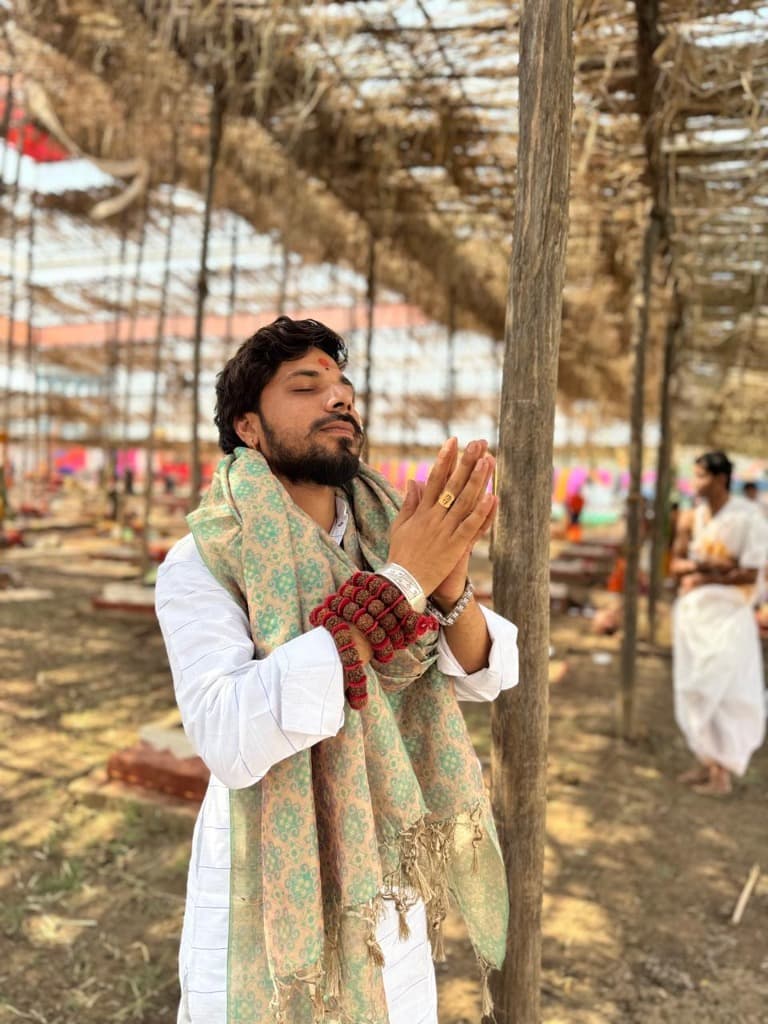
Acharya Tiwari Chetan Guru
Siddha Peethadheesh & Head Vedic Scholar
With over 15+ years of unbroken Vedic practice at Maa Baglamukhi Siddha Peeth, Nalkheda, Acharya Ji is a globally authoritative voice on Tantra Shastra, Stambhan Vidya, and Karmic Astrology. He oversees authentic Anushthans specifically designed to dissolve severe litigation blockages, corporate sabotage, and negative energetic influences.