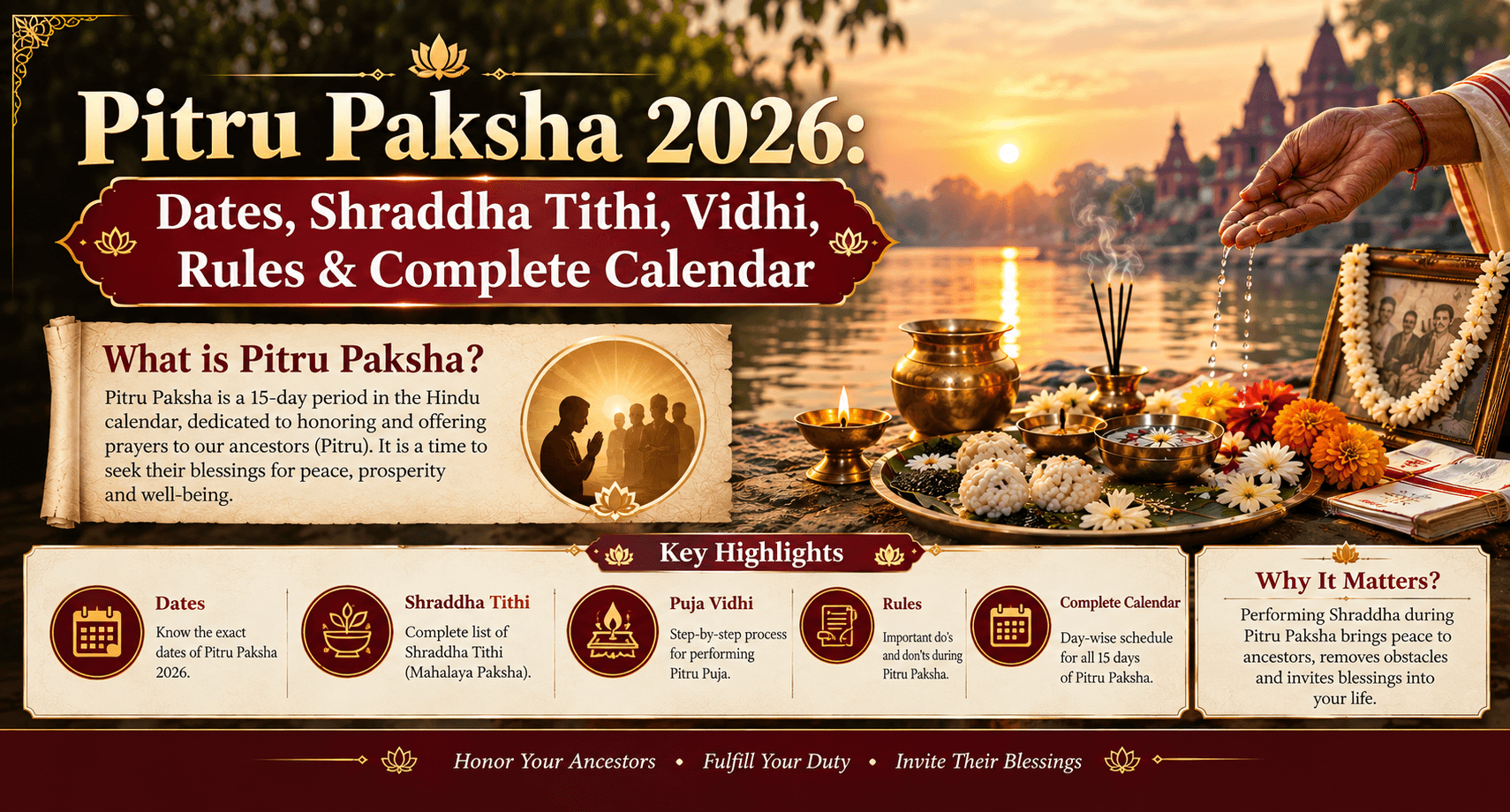
Pitru Paksha 2026 begins on 26 September 2026 (Saturday) with Purnima Shraddha and continues through 10 October 2026 (Saturday), the day of Sarva Pitru Amavasya. According to Hindu tradition, this 15-16 day fortnight is set aside to honor departed ancestors through Shradh and Tarpan. Families performing Shraddh at Nalkheda Siddha Peeth or at home should check the complete tithi calendar below before finalizing a date, since the correct day depends on the lunar tithi of an ancestor's passing rather than a fixed calendar date.
Quick Answer
When is Pitru Paksha 2026? Pitru Paksha 2026 runs from Saturday, 26 September 2026, to Saturday, 10 October 2026.
What are the start and end dates? Purnima Shraddha, the opening observance, falls on 26 September 2026. Pratipada Shraddha, the first day of the Krishna Paksha fortnight proper, falls on 27 September 2026. The period concludes on 10 October 2026.
When is Sarva Pitru Amavasya 2026? Sarva Pitru Amavasya, also called Mahalaya Amavasya, falls on Saturday, 10 October 2026.
What is Pitru Paksha? A 15-16 day period in the Hindu lunar calendar traditionally dedicated to remembering and honoring departed ancestors through Shradh, Tarpan, and related rites.
What is Shraddha? A structured ritual of remembrance performed for a specific ancestor, generally on the lunar tithi corresponding to their passing.
What is Tarpan? The offering of water, usually mixed with black sesame seeds, made as an act of spiritual nourishment to ancestors.
What should be done during Pitru Paksha? Many families perform Shraddh on the appropriate tithi, offer Tarpan, give charity in an ancestor's memory, and observe Satvik conduct during the fortnight.
Can Pitru Dosh Puja be performed during Pitru Paksha? Yes. Pitru Paksha is widely regarded in Hindu tradition as the most suitable window for a dedicated Pitru Dosh Puja, alongside routine Shraddh and Tarpan.
Disclaimer: This article reflects traditional Hindu beliefs and customs. These are matters of faith and regional practice, not scientifically verified facts, and practices may vary according to family tradition, region, and priestly guidance.
What Is Pitru Paksha?
"Pitru" means ancestors, and "Paksha" refers to a lunar fortnight. Together, Pitru Paksha translates to the "fortnight of the ancestors" - a period in the Hindu lunar calendar traditionally reserved for remembering departed family members.
According to Sanatan Dharma, a person is believed to carry three debts from birth: Deva Rin (debt to the gods), Rishi Rin (debt to teachers and sages), and Pitru Rin (debt to one's ancestors). Pitru Paksha is traditionally regarded as the time set aside to attend to this last debt, through Shraddh, Tarpan, and related ancestral observances.
The period is described in the Mahabharata through the story of Karna, who was said to have donated generously in his lifetime but never offered food specifically to his ancestors. According to the legend, he was permitted to return to earth for a period to perform Shradh, which tradition associates with the origin of this observance. Families researching the broader ancestral-worship tradition, including the astrological concept it is often discussed alongside, can also read the temple's guide on Pitru Dosh: Symptoms, Causes, Effects & Remedies.
Pitru Paksha 2026 Dates at a Glance
Event | Date (2026) | Significance |
|---|---|---|
Purnima Shraddha | Saturday, 26 September | Shraddh for ancestors who passed on a full moon (Purnima) tithi; conventionally observed alongside the fortnight |
Pratipada Shraddha | Sunday, 27 September | First day of the Ashwina Krishna Paksha, the fortnight proper |
Sarva Pitru Amavasya | Saturday, 10 October | Final and most significant day; Shraddh performed here is considered valid for all ancestors, known or unknown |
These dates are based on the North Indian Panchang for the Delhi/Madhya Pradesh timezone belt (IST). Tithi transitions occur at precise astronomical moments rather than at midnight, so families outside this region, or those following a different regional Panchang, are encouraged to confirm timings locally before finalizing a Sankalp.
Complete Pitru Paksha 2026 Shraddha Calendar
The table below sets out the full tithi-by-tithi calendar for Pitru Paksha 2026. Shraddh is traditionally performed on the tithi that corresponds to the day an ancestor passed away, not on the day's position within the fortnight, so the correct date is found by matching the tithi rather than counting days.
Date (2026) | Tithi | Shraddha Significance |
|---|---|---|
26 September (Sat) | Bhadrapada Shukla Purnima | Purnima Shraddha, for ancestors who passed on a full-moon tithi |
27 September (Sun) | Ashwina Krishna Pratipada | Pratipada Shraddha, opening day of the Krishna Paksha fortnight |
28 September (Mon) | Ashwina Krishna Dwitiya | Dwitiya Shraddha |
29 September (Tue) | Ashwina Krishna Tritiya | Tritiya Shraddha; also observed as Maha Bharani Shraddha (Bharani Nakshatra) in some traditions |
30 September (Wed) | Ashwina Krishna Chaturthi / Panchami | Chaturthi and Panchami Shraddha fall on the same civil date this year; Panchami is traditionally associated with those who passed away unmarried |
1 October (Thu) | Ashwina Krishna Shashthi | Shashthi Shraddha |
2 October (Fri) | Ashwina Krishna Saptami | Saptami Shraddha |
3 October (Sat) | Ashwina Krishna Ashtami | Ashtami Shraddha |
4 October (Sun) | Ashwina Krishna Navami | Navami Shraddha, traditionally associated in many families with mothers and married women (Avidhava Navami) |
5 October (Mon) | Ashwina Krishna Dashami | Dashami Shraddha |
6 October (Tue) | Ashwina Krishna Ekadashi | Ekadashi Shraddha |
7 October (Wed) | Ashwina Krishna Dwadashi | Dwadashi Shraddha; also observed as Magha Shraddha (Magha Nakshatra) in some traditions |
8 October (Thu) | Ashwina Krishna Trayodashi | Trayodashi Shraddha |
9 October (Fri) | Ashwina Krishna Chaturdashi | Chaturdashi Shraddha, traditionally kept for ancestors who died an untimely or unnatural death |
10 October (Sat) | Ashwina Krishna Amavasya | Sarva Pitru Amavasya (Mahalaya Amavasya), the concluding and most significant day |
Important note on variation: Different Panchangs occasionally list overlapping tithis on the same civil date, as seen above with Chaturthi and Panchami both falling on 30 September, and this is a normal feature of lunar-to-solar conversion rather than an error. Some regional Panchangs and almanacs may show the fortnight beginning a day earlier or later, or place a particular tithi shraddha on a slightly different date. Families are encouraged to confirm their exact date and Aparahna Kaal (afternoon) timing with their family priest or a current local Panchang before finalizing a Sankalp, particularly if observing outside North India.
How Is the Shraddha Date Traditionally Chosen?
The date on which a family performs Shraddh is generally determined by the lunar tithi on which the ancestor passed away, not the English calendar date of death. For example, a family whose parent passed away on a Saptami tithi would traditionally perform that Shraddh on the Saptami date within this year's Pitru Paksha, which falls on 2 October 2026.
Several traditional guidelines commonly apply:
If the exact tithi of an ancestor's passing is known, Shraddh is generally performed on the matching date from the calendar above.
If the tithi is unknown, uncertain, or if a family wishes to remember multiple ancestors together, Sarva Pitru Amavasya on 10 October 2026 is traditionally treated as the appropriate day, since it is regarded as valid for all ancestors.
Some families follow a specific regional or sampradaya-based exception, such as observing a different day for ancestors who died young, unmarried, or through unnatural causes.
Where there is any doubt, consulting a family priest or the officiating Acharya before the Sankalp is finalized is the traditionally recommended approach, rather than guessing from a generic calendar.
Because these are matters of family custom as much as astronomy, practices can differ meaningfully between households, regions, and sampradayas, and no single approach should be treated as the only correct one.
What Is Shraddha During Pitru Paksha?
Shraddha is a structured ceremony performed with devotion, Sankalp, and prescribed offerings, dedicated to a specific departed ancestor. The word itself is said to derive from "Shraddha," meaning faith, since the ritual is understood as an act performed with sincere belief rather than as a mechanical formality.
A typical Shraddh, as traditionally described, involves invoking the ancestor by name and Gotra, making offerings of food, sesame seeds, and water, and concluding with a formal Tarpan. It is distinct from a general Pitru Dosh Nivaran ritual, which is more specifically aimed at addressing a broader sense of ancestral imbalance rather than an annual act of remembrance for one relative. Devotees who want to understand how a complete Vedic ritual is structured, including preparation, Sankalp, and concluding rites, can refer to the temple's general Puja Vidhi guide.
What Is Tarpan and Why Is It Performed?
Tarpan is the offering of water, traditionally mixed with black sesame seeds (til), made to ancestors as an act of spiritual nourishment. According to the Garuda Purana, during Pitru Paksha the souls of the departed are believed to remain close to the earthly realm, and Tarpan is understood as the means by which descendants offer them sustenance during this period.
The ritual is generally performed facing south, using specific hand gestures (mudras) associated with ancestor worship, and is often accompanied by the chanting of the ancestor's name and Gotra. Many families perform a simple daily Tarpan through the fortnight, in addition to the more elaborate Shraddh performed on the specific tithi. Exact steps can vary meaningfully by region and family tradition, so first-time performers are generally advised to follow guidance from an experienced priest rather than an unverified online description.
Pitru Paksha Vidhi: General Traditional Process
The Vidhi described below reflects a commonly followed general structure. Exact steps, mantras, and sequencing can vary by region, sampradaya, and family custom, and no single version should be treated as the only correct method.
Preparing for the Ritual
Devotees typically observe Satvik conduct in the days leading up to their Shraddh, avoiding alcohol and non-vegetarian food and maintaining physical and mental purity. The ritual space, Kusha grass mats, and offering items are readied in advance.
Sankalp
A formal Sankalp is taken, in which the officiating priest or the devotee states their name, Gotra where known, and the specific intention of the ritual, dedicating it to the ancestor being remembered.
Traditional Offerings
Offerings typically include cooked rice, barley, sesame seeds, milk, honey, and ghee, prepared according to family custom. In many traditions, these offerings are also shared with cows, crows, and dogs, believed to be intermediaries who carry the offering to the ancestors.
Tarpan
Water mixed with black sesame seeds is offered, generally facing south, accompanied by the chanting of the ancestor's name.
Food or Charity Traditions
Many families conclude the day's observance with Anna Daan (food charity) or donations made in the ancestor's memory, considered an important part of the ritual's spirit.
Concluding Prayers
The ceremony typically closes with a formal prayer seeking peace for the ancestor's soul and blessings for the family. Devotees interested in the fire-ritual component that some Shraddh observances include can refer to the temple's Havan Vidhi guide for a general overview of how a Vedic Havan is structured.
Important Rules During Pitru Paksha
The points below reflect widely recognized traditional guidance. They are general observations rather than universal or strict commandments, and practices vary by family and region.
Follow family tradition first. Many households have a specific, long-followed way of observing Pitru Paksha, and this generally takes precedence over generic guidance found online.
Choose the tithi carefully. As explained above, the correct Shraddh date depends on the ancestor's death tithi, not a fixed calendar date.
Maintain simplicity and respect. The ritual is traditionally performed with humility rather than extravagance.
Include charity and offerings. Anna Daan and donations in an ancestor's name are widely considered a meaningful part of the observance.
Seek priestly guidance for unfamiliar rituals. Where a family is unsure of the correct Vidhi, consulting an experienced Acharya is generally preferred over improvising.
What Should You Do During Pitru Paksha?
Perform Shraddh on the tithi matching your ancestor's passing, or on Sarva Pitru Amavasya if the tithi is unknown.
Offer daily Tarpan where your family tradition includes it.
Set aside time for quiet remembrance and prayer for departed family members.
Give charity or donate food in the memory of ancestors.
Feed cows, crows, or dogs where this is part of your family's custom.
Maintain Satvik conduct during the days connected with your family's specific observance.
What Should Be Avoided During Pitru Paksha?
Some families traditionally avoid certain activities during this period, though customs differ meaningfully across regions and communities, and none of the following are universal Hindu requirements.
Some families traditionally avoid starting new ventures, purchases, or auspicious ceremonies during the fortnight, reserving the period for ancestral remembrance instead.
Some households avoid non-vegetarian food and alcohol during the days connected with their specific Shraddh.
Some traditions discourage haircuts or shaving until the family's Shraddh is complete, similar to customs observed during periods of mourning.
Some families prefer to avoid loud celebration or festive activity during the fortnight out of respect for the observance.
Families should treat these as commonly followed customs to discuss with elders or a priest, rather than fixed rules that apply identically everywhere.
Pitru Paksha and Pitru Dosh: What Is the Difference?
Pitru Paksha and Pitru Dosh are related but distinct concepts, and the two are often confused.
Aspect | Pitru Paksha | Pitru Dosh |
|---|---|---|
Nature | A fixed annual period in the Hindu lunar calendar | An astrological concept examined through a birth chart (Kundli) |
Basis | Lunar calendar and traditional ancestor-worship custom | Vedic astrology (Jyotish), typically linked to the Sun, Rahu, Ketu, and the 9th house |
Who observes it | Widely observed across Hindu households, generally each year | Specifically relevant to families where a Kundli reading has flagged the affliction, or those with a specific ancestral concern |
Typical rituals | Shraddh and Tarpan for a specific ancestor or all ancestors | A dedicated Pitru Dosh Nivaran Puja, alongside Shraddh and Tarpan |
Timing | Falls in Bhadrapada-Ashwina every year (26 September to 10 October in 2026) | Can be addressed at any suitable time, though Pitru Paksha is widely considered the most appropriate window |
For a detailed look at how Pitru Dosh is traditionally identified, its commonly discussed causes, and the remedies associated with it, see the temple's dedicated guide: Pitru Dosh: Symptoms, Causes, Effects & Remedies.
Can Pitru Dosh Puja Be Performed During Pitru Paksha?
Yes. Pitru Paksha is widely regarded in Hindu tradition as the most suitable window in the year for a dedicated Pitru Dosh Puja, since the fortnight is already set aside for ancestral observances. Many families choose to combine their annual Shraddh with a focused Pitru Dosh Nivaran ritual during this period rather than scheduling it separately.
A dedicated Pitru Dosh Puja generally differs from routine Shraddh in scope: where Shraddh honors a specific ancestor on their tithi, a Pitru Dosh Puja is a more focused ritual intended to address a broader sense of ancestral imbalance, often prompted by a Kundli reading or a long-standing family concern. For a complete look at the benefits, Vidhi, and best timing for this specific ritual, see the companion guide: Pitru Dosh Puja During Pitru Paksha 2026: Benefits, Vidhi, Best Time & Booking.
Considering a Pitru Dosh Puja this Pitru Paksha? Book Your Pitru Dosh Puja → baglamukhihawan.com/book-puja
Pitru Dosh Puja Cost and Booking Information
Neither the Standard nor Advanced Pitra Dosh Pooja pages at Nalkheda Siddha Peeth list a fixed published price. Cost is generally confirmed only after a free consultation, since it depends on the Sankalp involved, whether a Havan is included, and whether a single-day ritual or a longer Anushthan is required. Readers who want a full breakdown of what typically affects pricing, and what is usually included in a booking, can refer to the dedicated guide: Pitru Dosh Puja Cost 2026: Price, Charges & Booking Guide.
To begin the process, devotees can reach out through a free consultation so the appropriate Sankalp, Muhurat, and cost can be confirmed for their specific family situation before anything is booked.
Sarva Pitru Amavasya 2026
Sarva Pitru Amavasya, also known as Mahalaya Amavasya, is the closing day of Pitru Paksha and falls on Saturday, 10 October 2026. According to tradition, Shraddh performed on this day is considered valid for all ancestors collectively, including those whose exact death tithi is unknown or forgotten.
Many families specifically time their annual ancestral rituals to this date because it does not require prior knowledge of a specific tithi, making it a practical fallback for households that may have lost track of an exact date over generations. This is a matter of tradition and family conviction rather than a claim that Amavasya produces a different or superior result compared to a Shraddh performed on the correct individual tithi.
Can Pitru Paksha Rituals Be Performed at Nalkheda?
Yes. Nalkheda Siddha Peeth, in Agar Malwa district, Madhya Pradesh, offers Pitru Paksha rituals including Shraddh, combined Shraddh-Tarpan-Havan, and a more comprehensive Pitru Dosh Nivaran Anushthan, conducted by the temple's Acharyas under the guidance of Acharya Tiwari Chetan Guru. Devotees do not need to travel to Nalkheda in person; the Sankalp is performed in the devotee's name at the temple, with live participation offered over WhatsApp video for those who wish to witness the ritual remotely, and Prasad dispatched afterward.
Devotees based outside India can also enquire through the temple's dedicated international booking page for NRI participation. Families exploring related astrological afflictions alongside Pitru Dosh may also find the temple's Graha Shanti Puja and Kaal Sarp Dosh Pooja relevant, since these address broader planetary afflictions that are sometimes discussed alongside Pitru Dosh in a Kundli reading.
Plan Your Pitru Paksha Ritual at Nalkheda Siddha Peeth Start a Free Consultation → baglamukhihawan.com/book-consultation
Common Mistakes People Make During Pitru Paksha {#mistakes}
Relying on unverified dates. Copying a calendar from a previous year, or from a source that does not specify the Panchang and location used, can lead to the wrong Shraddh date.
Confusing the calendar date with the tithi. Shraddh follows the lunar tithi of the ancestor's passing, not the day's position within the fortnight.
Choosing a ritual date without checking family tradition. Some families follow specific exceptions, such as a different day for those who died unmarried or by unnatural causes.
Assuming every life difficulty indicates Pitru Dosh. As explained in the temple's dedicated guide on Pitru Dosh, ordinary practical, medical, or financial explanations should always be considered first.
Copying complex rituals from random online sources. Vidhi details differ meaningfully by region; following the guidance of an experienced Acharya is generally preferable to improvising.
Ignoring location and Panchang differences. Tithi timings can shift by a day outside North India or in different local Panchangs, so confirming locally before the Sankalp matters.
Frequently Asked Questions
1. When does Pitru Paksha start in 2026?
Pitru Paksha 2026 begins on Saturday, 26 September, with Purnima Shraddha, followed by Pratipada Shraddha on Sunday, 27 September, which marks the start of the Krishna Paksha fortnight proper.
2. When does Pitru Paksha end in 2026?
Pitru Paksha 2026 ends on Saturday, 10 October 2026, with Sarva Pitru Amavasya, the most significant day of the fortnight.
3. What are the Pitru Paksha 2026 dates?
Pitru Paksha 2026 runs from 26 September to 10 October 2026. The complete tithi-by-tithi calendar is provided earlier in this guide.
4. When is Sarva Pitru Amavasya 2026?
Sarva Pitru Amavasya falls on Saturday, 10 October 2026, and is traditionally used for ancestors whose exact tithi is unknown.
5. How do I find the correct Shraddha date for my family?
Match the lunar tithi on which your ancestor passed away to the corresponding date in this year's calendar. If the tithi is unknown, Sarva Pitru Amavasya on 10 October is traditionally used instead.
6. What is Shraddha?
Shraddha is a structured ritual of remembrance performed for a specific ancestor, generally on the lunar tithi corresponding to their passing, involving Sankalp, offerings, and Tarpan.
7. What is Tarpan?
Tarpan is the offering of water, usually mixed with black sesame seeds, made to ancestors as a traditional act of spiritual nourishment.
8. What should be done during Pitru Paksha?
Common practices include performing Shraddh on the appropriate tithi, offering daily Tarpan, giving charity in an ancestor's memory, and observing quiet remembrance and prayer.
9. What should be avoided during Pitru Paksha?
Some families avoid starting new ventures or celebrations during the fortnight, though these are regional and family customs rather than universal rules. Check with your family or priest for your own tradition.
10. Can Pitru Dosh Puja be performed during Pitru Paksha?
Yes. Pitru Paksha is widely regarded as the most suitable time in the year for a dedicated Pitru Dosh Puja, alongside routine Shraddh and Tarpan.
11. Is Pitru Paksha the same as Pitru Dosh?
No. Pitru Paksha is a fixed annual lunar-calendar period for ancestral remembrance, while Pitru Dosh is an astrological concept examined through an individual's birth chart. The two are related but not identical.
12. Can Shraddh be performed on Sarva Pitru Amavasya even if the exact tithi is known?
Some families do combine their tithi-specific Shraddh with a Sarva Pitru Amavasya Tarpan for the wider ancestral line, though practice varies by family; checking with your priest is advisable.
13. Can Pitru Paksha rituals be performed away from home?
Yes. Many devotees perform Shraddh and Tarpan at a temple or pilgrimage site rather than at home, and temple-based rituals, including remote Sankalp options, are widely available.
14. Can women participate in Pitru Paksha rituals?
Traditionally, the eldest son or a male descendant performs Shraddh in many families, though practices vary by community, and women can perform Shraddh and Tarpan with appropriate guidance where family tradition allows it.
15. What should I offer during Shraddha?
Traditional offerings include cooked rice, barley, sesame seeds, milk, honey, and ghee, along with a formal Tarpan of water and sesame seeds, though the exact items can vary by regional custom.
16. Is the exact Shraddha date different for each ancestor?
Yes. Each ancestor is traditionally remembered on the tithi corresponding to their own date of passing, which is why a family may observe more than one date within Pitru Paksha for different relatives.
17. How do I book a Pitru Paksha or Pitru Dosh related Puja?
You can begin with a free consultation or start directly through the booking page, after which the temple's team confirms the appropriate Sankalp and Muhurat.
18. Where can Pitru Dosh Puja be performed?
Pitru Dosh Puja is offered at Nalkheda Siddha Peeth in Agar Malwa, Madhya Pradesh, with both in-person and remote Sankalp options available for devotees across India and abroad.
Need Guidance for Pitru Paksha Rituals or Pitru Dosh Puja?
If you are still working out the correct Shraddh date for your family, considering Tarpan for the first time, or thinking about a dedicated Pitru Dosh Puja this Pitru Paksha, the most reliable next step is a direct conversation rather than guesswork from a generic calendar. The team at Nalkheda Siddha Peeth can help confirm the tithi that applies to your ancestor, explain the Vidhi appropriate to your family's tradition, and outline the Puja arrangements available for Pitru Paksha 2026, whether performed in person at the temple or through a remote Sankalp with live participation.
Nothing here is intended as a guarantee of any outcome. These are traditional observances performed with sincerity and respect for one's lineage, and families are always encouraged to also follow their own established customs and priestly guidance alongside anything discussed in this guide.
Explore Pitru Paksha & Pitru Dosh Puja Services Book Puja Now → baglamukhihawan.com/book-puja
This article is intended for general informational purposes and reflects traditional Hindu beliefs and customs. It is not medical, financial, or legal advice. Ritual timings and Vidhi may vary by region, Panchang, and family tradition; please confirm specific details with your family priest or the officiating Acharya before finalizing any Sankalp.
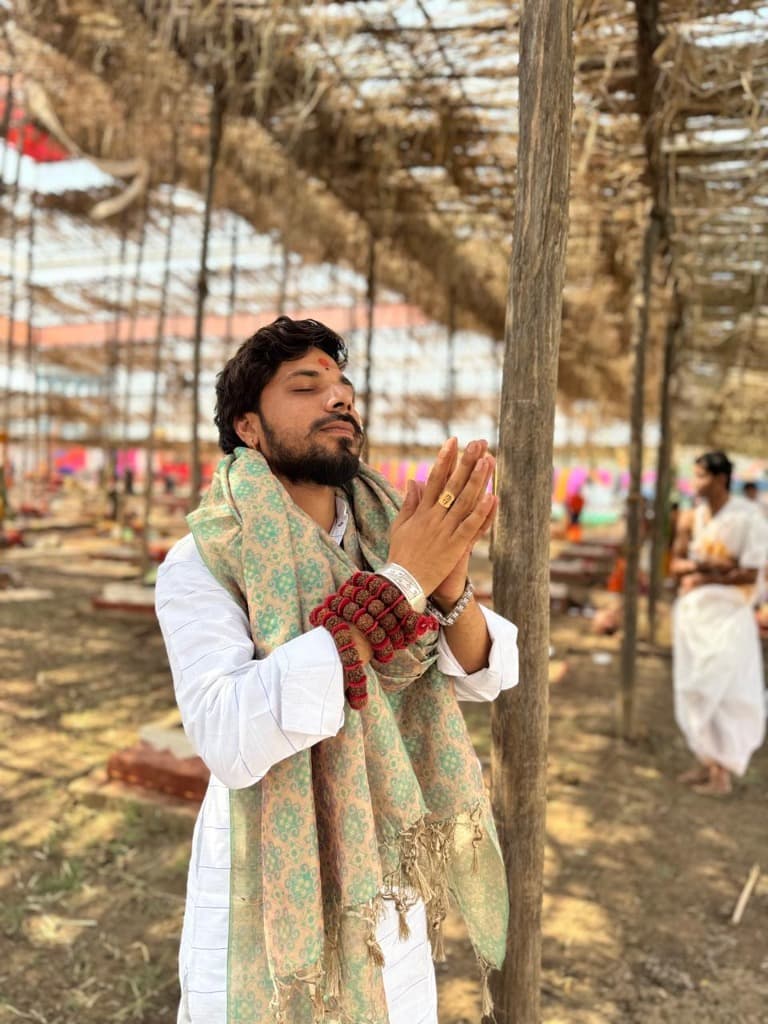
Acharya Tiwari Chetan Guru
Siddha Peethadheesh & Head Vedic Scholar
With over 15+ years of unbroken Vedic practice at Maa Baglamukhi Siddha Peeth, Nalkheda, Acharya Ji is a globally authoritative voice on Tantra Shastra, Stambhan Vidya, and Karmic Astrology. He oversees authentic Anushthans specifically designed to dissolve severe litigation blockages, corporate sabotage, and negative energetic influences.
Need Exact Hawan Cost & Shubh Muhurat?
Get direct guidance from Head Priest Acharya Tiwari Chetan Guru.