
Sarva Pitru Amavasya 2026 falls on Saturday, 10 October 2026, the final day of Pitru Paksha. According to Hindu tradition, it is the Amavasya (new moon) on which Shraddha and Tarpan can be offered for all ancestors — known or unknown, and those whose exact death tithi has been forgotten. It marks the formal conclusion of the fortnight dedicated to honouring departed family members, and is widely regarded as the most important single day within Pitru Paksha for ancestral remembrance.
Quick Answer
When is Sarva Pitru Amavasya 2026? It falls on Saturday, 10 October 2026, the final day of the Pitru Paksha fortnight.
What is Sarva Pitru Amavasya? It is the Amavasya tithi on which Hindu tradition permits Shraddha for all ancestors together, rather than for one specific individual on their own tithi.
Why is Sarva Pitru Amavasya important? It closes Pitru Paksha and is traditionally treated as the day for ancestors whose specific tithi is unknown, forgotten, or was missed earlier in the fortnight.
What is Shraddha? Shraddha is a ritual act of remembrance and offering performed for a departed ancestor, typically involving Sankalp, offerings, and prayers.
What is Tarpan? Tarpan is the offering of water, usually mixed with black sesame, made to ancestors as a gesture of respect and spiritual nourishment.
Can Shraddha be performed on Sarva Pitru Amavasya? Yes — traditionally for any ancestor, and especially for those whose individual tithi is not known or was not observed earlier.
Is Sarva Pitru Amavasya part of Pitru Paksha? Yes, it is the sixteenth and concluding tithi of the Pitru Paksha fortnight in 2026.
Where can devotees seek guidance for Pitru-related Puja? Many devotees consult a family priest or a temple's Acharyas for guidance specific to their gotra and family tradition.
Sarva Pitru Amavasya 2026 Date and Pitru Paksha Details
Sarva Pitru Amavasya 2026 falls on Saturday, 10 October 2026. It is the concluding day of Pitru Paksha, which this year runs across the following dates:
Event | Verified Date | Significance |
|---|---|---|
Pitru Paksha begins | Saturday, 26 September 2026 (Purnima Shradh) | Opening day of the ancestral fortnight |
Fortnight continues | 27 September – 9 October 2026 | Tithi-wise Shraddha for individual ancestors |
Sarva Pitru Amavasya | Saturday, 10 October 2026 | Concluding day; Shraddha for all ancestors, known or unknown |
Pitru Paksha concludes | Saturday, 10 October 2026 | Sharad Navratri traditionally begins the following day |
These dates are consistent across current 2026 Panchang calculations for Indian Standard Time. Because a tithi begins and ends at a precise astronomical moment rather than at midnight, the exact start and end time of Amavasya can shift slightly depending on your city, and occasionally by a day for devotees outside India. Treat the date above as reliable for planning purposes, and confirm the precise timing against a local Panchang if you are following a specific Muhurat. For the fortnight's full booking window and related details, see the temple's Pitru Paksha page.
What Is Sarva Pitru Amavasya?
The name breaks down into three parts. "Sarva" means "all," "Pitru" refers to ancestors or forefathers, and "Amavasya" is the no-moon (new moon) lunar day. Put together, Sarva Pitru Amavasya translates roughly to "the new moon day of all ancestors."
In Hindu tradition, Amavasya days are generally considered suitable for ancestral remembrance throughout the year, but the Amavasya that falls at the end of Pitru Paksha carries particular weight because it is treated as a collective day of remembrance — one on which offerings can be made for the whole ancestral line together, rather than for a single ancestor on their individual tithi. This is why it is also known in various regions as Mahalaya Amavasya or Sarva Pitri Amavasya. If you're still working out which tithi applies to a specific ancestor earlier in the fortnight, the Pitru Paksha 2026 festival page is a useful starting point for the temple's booking window and general guidance.
Why Is Sarva Pitru Amavasya Important?
According to Hindu tradition, Sarva Pitru Amavasya holds significance for a few connected reasons:
It concludes Pitru Paksha. As the sixteenth and final tithi of the fortnight, it closes the period during which families traditionally focus on Shraddha and Tarpan.
It covers ancestors whose tithi is unknown. Many families do not have a precise record of the lunar tithi on which a particular ancestor passed away. Sarva Pitru Amavasya is traditionally treated as the day on which Shraddha can still be offered for them.
It covers missed or forgotten observances. If a family was unable to perform Shraddha on an ancestor's specific tithi earlier in the fortnight — due to travel, ill health, or any other reason — this day is traditionally used to complete that obligation.
It is observed for both parental lines. Many families use this day to remember ancestors from both the paternal and maternal sides together.
These are traditional beliefs and practices passed down through Hindu ancestral worship, not scientifically verifiable claims. Different families and regional traditions may place different degrees of emphasis on this day, and that variation is a normal part of how Sanatan Dharma is practiced across India.
Is Sarva Pitru Amavasya the Same as Pitru Paksha?
No — the two terms are related but not identical.
Aspect | Pitru Paksha | Sarva Pitru Amavasya |
|---|---|---|
Duration | A 16-tithi fortnight (26 September – 10 October 2026) | A single day (10 October 2026) |
Scope | Covers individual tithi-wise Shraddha across the fortnight | The concluding day, for all ancestors together |
Who it's for | Ancestors remembered on their specific known tithi | Ancestors whose tithi is unknown, forgotten, or missed — and for general ancestral remembrance |
Position in the calendar | The entire observance period | The last tithi of that period |
In short, Pitru Paksha is the full fortnight, and Sarva Pitru Amavasya is its final and most significant day. For the complete tithi-by-tithi breakdown of the fortnight — including which date corresponds to which ancestor's tithi — the temple's Pitru Paksha 2026 page covers the booking window and fortnight details separately, so this article does not repeat that full calendar here.
Who Traditionally Performs Shraddha on Sarva Pitru Amavasya?
Hindu tradition generally recognises a few different situations in which families turn to this day specifically:
Families who know their ancestor's tithi typically perform Shraddha on that specific date earlier in the fortnight, and may additionally observe Sarva Pitru Amavasya as a general day of remembrance for the wider ancestral line.
Families who do not know the exact tithi — because records were lost, or the information was never passed down — traditionally use Sarva Pitru Amavasya as the appropriate day to perform Shraddha on that ancestor's behalf.
Families who missed an earlier tithi in the fortnight, for any reason, often use this day to complete their observance for the year.
Some families observe this day for their entire ancestral line collectively, regardless of individual tithis, as part of their own household tradition.
Practices differ meaningfully by region, sampradaya, and family custom, so none of the above should be read as a single mandatory rule. Where there is genuine uncertainty about which approach applies to your family, consulting a knowledgeable priest familiar with your tradition is generally more reliable than following a generic online description.
Sarva Pitru Amavasya Shraddha Vidhi
The exact Vidhi followed for Shraddha on this day can vary by family tradition, region, and sampradaya. What follows is a general overview of the structure many Vedic Shraddha ceremonies share, not a single prescribed method.
Preparation
The performer typically bathes early in the day and wears clean, simple clothing. Materials for the ritual — including items commonly used in Havan Samagri where a fire ritual is also performed — are usually prepared in advance.
Sankalp
A formal vow is taken, in which the performer states their name, gotra, and the intention behind the ritual — in this case, remembrance of ancestors collectively, or of a specific ancestor whose tithi is unknown.
Traditional Offerings
Common offerings include water, black sesame seeds, and, in many households, rice or other Satvik food items, depending on family custom.
Shraddha
The core ceremony, in which the ancestors are formally remembered through prayers and consecrated offerings, generally guided by a priest familiar with the correct sequence.
Tarpan
Water mixed with black sesame is offered, typically facing south, while the ancestor's name and gotra are recited, if known. On this particular day, many families also include a general offering for "all ancestors," without naming each one individually.
Food Offerings or Charity According to Tradition
Many households offer food to a Brahmin, a family member, or someone in need, and some feed a cow, crow, or dog — a practice traditionally understood as a way of reaching the ancestors. Charitable giving in the ancestors' memory is also widely practiced on this day.
Concluding Prayers
The ceremony generally closes with prayers seeking peace for the ancestors and blessings for the family, followed by a closing pranam.
For a fuller look at how a temple-conducted Puja and Havan are generally structured, the Puja Vidhi and Havan Vidhi guides describe the sequence followed at Nalkheda Siddha Peeth in more detail.
How Is Tarpan Traditionally Performed?
Tarpan is, at its core, an offering of water made to ancestors as a gesture of respect, gratitude, and spiritual nourishment. The word itself relates to the idea of "satisfying" or "gratifying" — in this context, satisfying the ancestors through a simple, sincere offering.
In general Hindu practice, Tarpan involves:
Offering water, usually mixed with black sesame, while facing south — the direction traditionally associated with the ancestral realm.
Reciting the ancestor's name and gotra, where known, along with a traditional prayer requesting their peace and satisfaction.
Repeating the offering for each ancestor being remembered, and, on Sarva Pitru Amavasya specifically, often including a general offering on behalf of the whole ancestral line.
Family and regional traditions vary in the finer details — the number of repetitions, the specific prayers recited, and whether the ritual is performed at home, at a temple, or at a river or tirtha. This overview describes the general shape of the practice rather than a fixed, universal instruction set; for the exact sequence appropriate to your family, a priest familiar with your tradition is the right person to guide you.
What Is Traditionally Offered on Sarva Pitru Amavasya?
Offerings on this day vary by family and region, but commonly include the following, according to widely followed Hindu tradition:
Offering | Traditional Purpose |
|---|---|
Water mixed with black sesame | Core Tarpan offering to ancestors |
Rice or rice-based preparations | Common Shraddha food offering in many households |
Food for a Brahmin, family member, or person in need | Offered before the family eats, as an act of respect |
Food for a cow, crow, or dog | Traditionally regarded as a way of reaching the ancestors |
Charity or daan in the ancestors' name | Widely practiced act of remembrance and merit |
Simple flowers and incense | Used in many households as part of the general ritual space |
This is not an exhaustive or mandatory checklist — some families offer considerably more, others keep the observance simple, and specific items can differ by region and community. What is consistent across traditions is the underlying intention: a sincere, respectful offering made in remembrance of one's ancestors.
Important Rules and Traditions on Sarva Pitru Amavasya
A few points are commonly emphasised across Hindu households observing this day, though the specifics can vary:
Following family tradition matters more than a generic rule. If your family has an established practice for this day, that practice generally takes precedence over a general description found online.
Selecting the correct tithi where relevant. If you are unsure whether your ancestor's Shraddha falls on this day specifically or on an earlier tithi in the fortnight, it's worth confirming with a family elder or priest rather than assuming.
Simplicity is acceptable. Hindu tradition does not require an elaborate ceremony for the ritual to be considered meaningful — a sincere Tarpan performed at home is widely accepted as valid.
Charitable acts are encouraged. Giving to those in need, in the ancestors' memory, is a consistently emphasised practice across most traditions for this day.
Priestly guidance helps with uncertainty. Where a family is unsure about gotra details, the correct Sankalp wording, or which ancestors to include, a knowledgeable priest can offer clarity specific to that family's situation.
None of the above should be read as strict universal law — Hindu practice recognises considerable regional and family variation, and no single approach is "the only correct one."
What Should Be Avoided on Sarva Pitru Amavasya?
Some families traditionally avoid the following on this day, though customs differ meaningfully across communities:
Scheduling weddings, engagements, or other celebratory ceremonies.
Starting new, celebratory purchases such as a new vehicle or moving into a new home.
Non-vegetarian food, alcohol, onion, and garlic, particularly on the day of the ritual itself — though the extent of this varies by household.
Approaching the day with a purely transactional or fear-based mindset; most traditional teaching frames Shraddha as an act of respect and gratitude rather than an obligation performed out of fear of consequences.
Customs may differ significantly by region and family, and none of these should be treated as a rule that applies identically to every Hindu household.
Sarva Pitru Amavasya and Pitru Dosh — What Is the Difference?
These two terms are frequently searched together, but they describe different things.
Aspect | Sarva Pitru Amavasya | Pitru Dosh |
|---|---|---|
Nature | A specific calendar day, observed annually | An astrological concept, identified through an individual's birth chart |
Basis | Lunar tithi (Amavasya at the end of Pitru Paksha) | Planetary combinations, traditionally involving the Sun, Rahu, Ketu, and the 9th house |
Who it applies to | All families observing Hindu ancestral tradition | Only individuals whose Kundli is read as showing this affliction |
What is done | Shraddha and Tarpan for ancestors | A dedicated Pitru Dosh Nivaran Puja, alongside general Shraddha practices |
Sarva Pitru Amavasya is a traditional ancestral observance day that most Hindu families mark in some form. Pitru Dosh, by contrast, is generally discussed as an astrological concept rather than a date on the calendar. For a detailed look at what Pitru Dosh is traditionally believed to involve — including its commonly associated signs, causes, and remedies — see Pitru Dosh: Symptoms, Causes, Effects & Remedies.
Can Pitru Dosh Puja Be Performed on or During Pitru Paksha?
Yes. Pitru Paksha, including Sarva Pitru Amavasya, is widely regarded in Hindu tradition as one of the most suitable periods for a Pitru Dosh Nivaran Puja, since the fortnight is already centred on ancestral remembrance. That said, the specific day chosen, the Sankalp used, and whether the ritual is combined with a family Shraddha or performed separately can vary depending on the devotee's situation and the guidance of the officiating priest.
For a more detailed look at how this ritual is generally approached within the fortnight — including timing considerations — see Pitru Dosh Puja During Pitru Paksha 2026. If you're unsure whether this applies to your situation, a personal consultation with the temple's Acharyas can help clarify what, if anything, is appropriate for your family.
Pitru Dosh Puja Cost and Booking Information
This article focuses on the date, significance, and general Vidhi of Sarva Pitru Amavasya rather than pricing. Readers specifically looking for cost details — what is typically included, how charges are structured, and what to expect when booking a Pitru Dosh Puja — can refer to the dedicated Pitru Dosh Puja Cost 2026 guide. As a general note, no fixed price is quoted for these rituals without first understanding the devotee's specific situation and the type of Puja required.
Can You Book Pitru-Related Puja Services Online?
Yes. Devotees who wish to arrange a Shraddha, Tarpan-related ritual, or a dedicated Pitru Dosh Puja at Nalkheda Siddha Peeth can begin the process through the temple's Book Puja page. The temple offers a Pitra Dosh Puja service specifically for ancestral concerns, and devotees who are unsure which ritual fits their situation can start with a consultation before booking. For questions ahead of booking, the contact page lists the temple's direct contact details.
If your family is also exploring other astrologically discussed concerns alongside ancestral rituals, the temple separately lists services such as a Graha Shanti Puja for planetary matters more broadly. As with any Puja booking, it is worth having a conversation with the temple team about your specific situation before finalising a date, since no fixed package or price is confirmed without that context.
Common Mistakes to Avoid When Following Pitru Paksha Dates
A number of avoidable errors lead families to the wrong date or the wrong understanding of this observance each year:
Using an incorrect year's calendar. Because Amavasya and other Shraddha tithis are lunar, the Gregorian date shifts every year — a date correct for 2025 will not be correct for 2026.
Following unverified social media dates. Dates shared informally online are sometimes copied from a different year or a different regional Panchang without correction.
Confusing Gregorian dates and lunar tithis. The ancestor's date of death in the English calendar is not what determines the ritual date — the corresponding lunar tithi is.
Ignoring location-based Panchang differences. Tithi timings are calculated from local sunrise, so the exact start and end of Amavasya can shift by a day depending on where you are.
Assuming all Pitru-related rituals are identical. A general Shraddha, a Tarpan, and a dedicated Pitru Dosh Nivaran Puja serve different purposes and are not interchangeable.
Confusing Pitru Dosh with Pitru Paksha. As explained above, one is a calendar observance and the other is an astrological concept — treating them as the same can lead to confusion about what a family actually needs.
Copying complex ritual instructions without guidance. Detailed Sankalp wording and mantra sequences are best confirmed with a priest familiar with your family's tradition, rather than followed from a generic online source.
Need Guidance for Pitru Paksha Rituals or Pitru Dosh Puja?
If you're planning Shraddha, Tarpan, or a Pitru Dosh Nivaran ritual around Sarva Pitru Amavasya this year and would like guidance specific to your family's gotra and tradition, the Acharyas at Nalkheda Siddha Peeth are available to help you understand what's appropriate for your situation. You can explore the Pitra Dosh Puja options offered at the temple, or begin with a straightforward consultation if you're unsure which ritual applies to you. Devotees ready to proceed can visit the Puja booking page directly, or reach out through the contact page with any questions beforehand.
Frequently Asked Questions About Sarva Pitru Amavasya 2026
1. When is Sarva Pitru Amavasya in 2026?
Sarva Pitru Amavasya 2026 falls on Saturday, 10 October 2026, marking the final day of the Pitru Paksha fortnight.
2. What is Sarva Pitru Amavasya?
It is the Amavasya (new moon) tithi that concludes Pitru Paksha, traditionally regarded as suitable for performing Shraddha on behalf of all ancestors, known or unknown.
3. Why is Sarva Pitru Amavasya important?
It is traditionally considered the day for ancestors whose exact tithi is unknown, forgotten, or was missed earlier in the fortnight, and it marks the formal conclusion of Pitru Paksha.
4. Is Sarva Pitru Amavasya the last day of Pitru Paksha?
Yes. It is the sixteenth and final tithi of the fortnight, falling on 10 October 2026 in 2026's Panchang.
5. Can Shraddha be performed on Sarva Pitru Amavasya?
Yes — traditionally for any ancestor, and it is especially used for ancestors whose specific tithi is not known or could not be observed earlier in the fortnight.
6. Who should perform Shraddha on Sarva Pitru Amavasya? Families whose ancestor's tithi is unknown, those who missed an earlier observance, or those who traditionally remember their whole ancestral line on this day commonly perform Shraddha on this date.
7. What is Tarpan?
Tarpan is the traditional offering of water, usually mixed with black sesame, made to ancestors while facing south, as a gesture of respect and spiritual nourishment.
8. What is offered during Sarva Pitru Amavasya?
Common offerings include water and black sesame for Tarpan, rice or Satvik food, and charity given in the ancestors' memory, though specifics vary by family and region.
9. Can Tarpan be performed at home?
Yes, many families perform Tarpan at home, particularly when travel to a temple or tirtha isn't possible; guidance from a family priest is commonly sought for the correct approach.
10. What should be avoided on Sarva Pitru Amavasya?
Many families avoid scheduling celebratory events such as weddings on this day, and some observe dietary restrictions, though customs differ meaningfully across households and regions.
11. Is Sarva Pitru Amavasya related to Pitru Dosh?
They are related topics but not the same thing — Sarva Pitru Amavasya is a calendar observance day, while Pitru Dosh is an astrological concept identified through a birth chart.
12. Can Pitru Dosh Puja be performed during Pitru Paksha?
Yes, this fortnight — including Sarva Pitru Amavasya — is widely considered a suitable time for it, though the exact day and Sankalp are generally decided with a priest based on the devotee's situation.
13. What is the difference between Pitru Paksha and Sarva Pitru Amavasya?
Pitru Paksha is the full 16-tithi fortnight; Sarva Pitru Amavasya is its concluding day, reserved for collective ancestral remembrance and for ancestors whose individual tithi is unknown.
14. How do I find the correct Shraddha date?
Match your ancestor's known lunar tithi against the current year's Panchang. If the tithi is unknown, Sarva Pitru Amavasya is traditionally used instead.
15. Can women participate in Shraddha or ancestral rituals? Practices vary by family and region; many traditions do permit women to participate in or perform Shraddha, particularly where no son is available, though this is best confirmed with your family's own custom or a priest.
16. Can Pitru-related Puja be booked online?
Yes, the process generally begins with a phone or WhatsApp enquiry or a consultation, after which the details of the ritual and Sankalp are confirmed before the Puja is booked and performed.
17. Where can I get guidance for Pitru-related Puja?
Many devotees consult a family purohit, or reach out to a temple's Acharyas, for guidance specific to their gotra, ancestral tithi, and family tradition.
18. When does Pitru Paksha 2026 end?
Pitru Paksha 2026 ends on Saturday, 10 October 2026, which is also Sarva Pitru Amavasya, the concluding day of the fortnight.
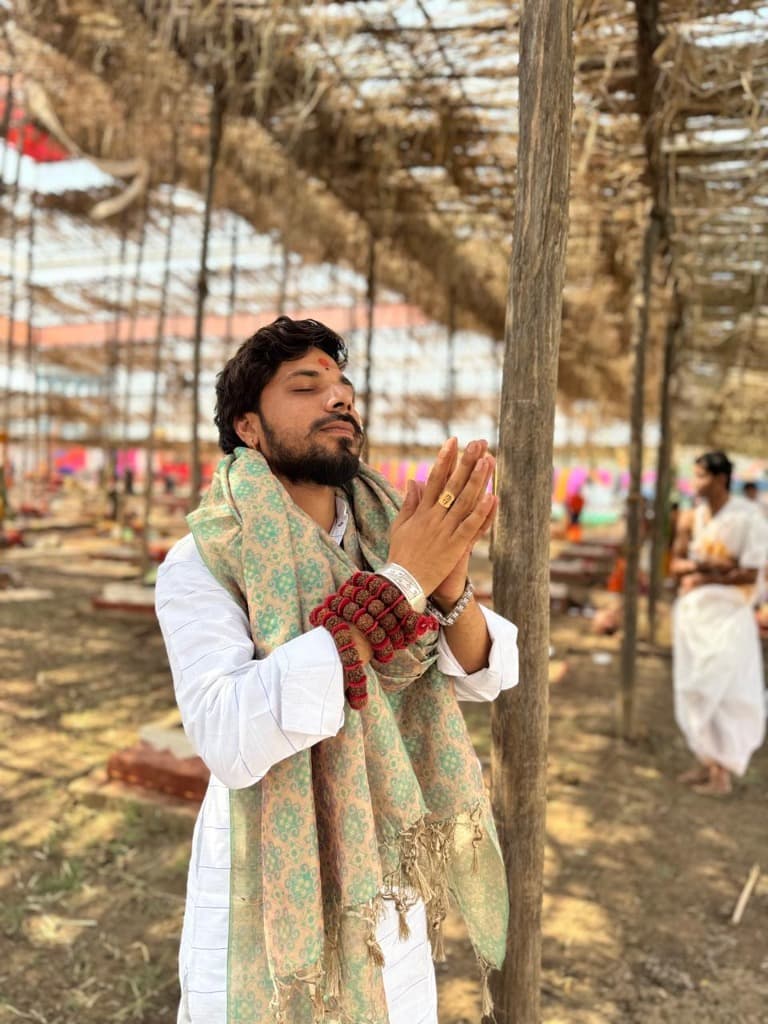
Acharya Tiwari Chetan Guru
Siddha Peethadheesh & Head Vedic Scholar
With over 15+ years of unbroken Vedic practice at Maa Baglamukhi Siddha Peeth, Nalkheda, Acharya Ji is a globally authoritative voice on Tantra Shastra, Stambhan Vidya, and Karmic Astrology. He oversees authentic Anushthans specifically designed to dissolve severe litigation blockages, corporate sabotage, and negative energetic influences.
Need Exact Hawan Cost & Shubh Muhurat?
Get direct guidance from Head Priest Acharya Tiwari Chetan Guru.