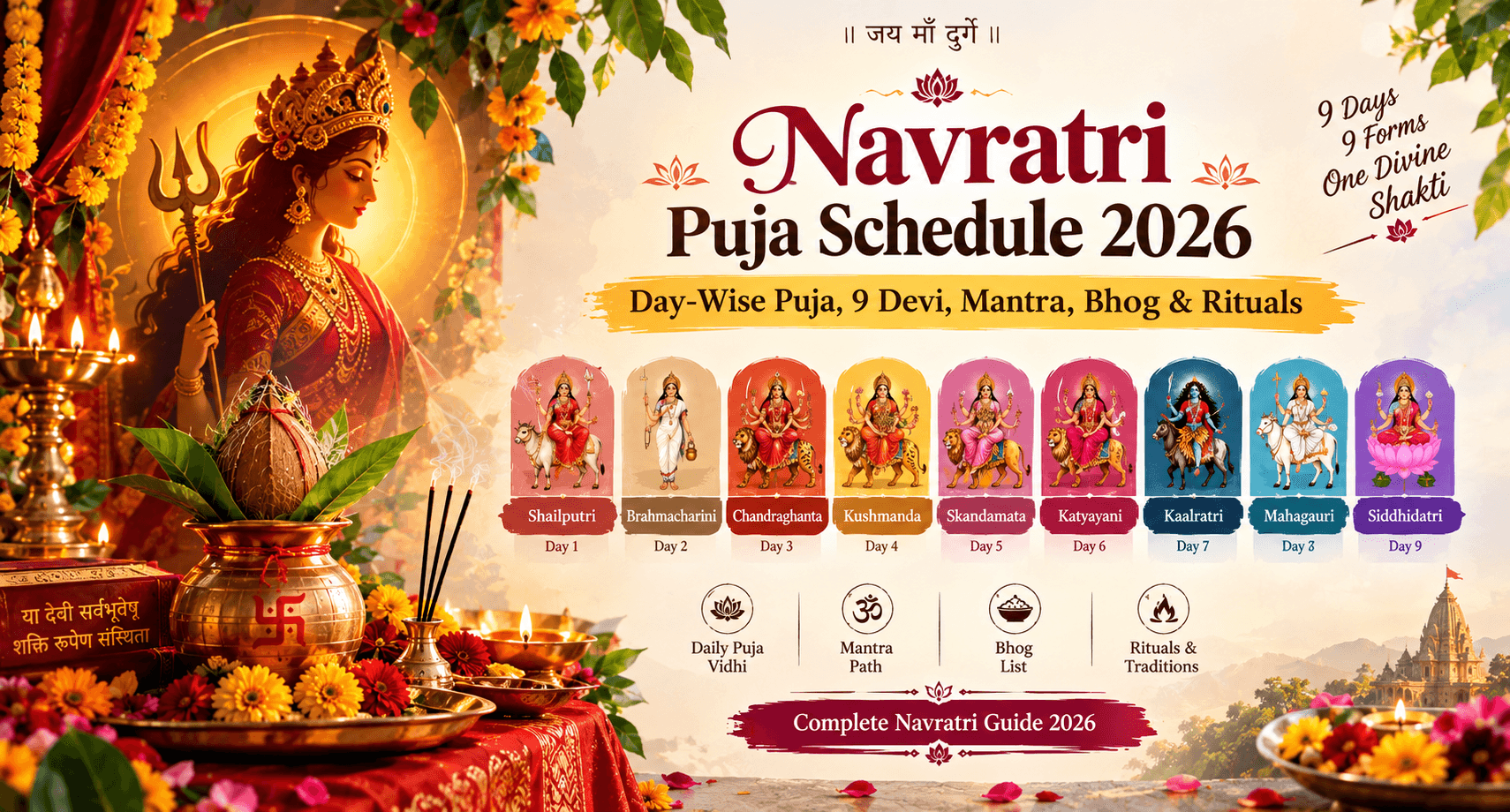
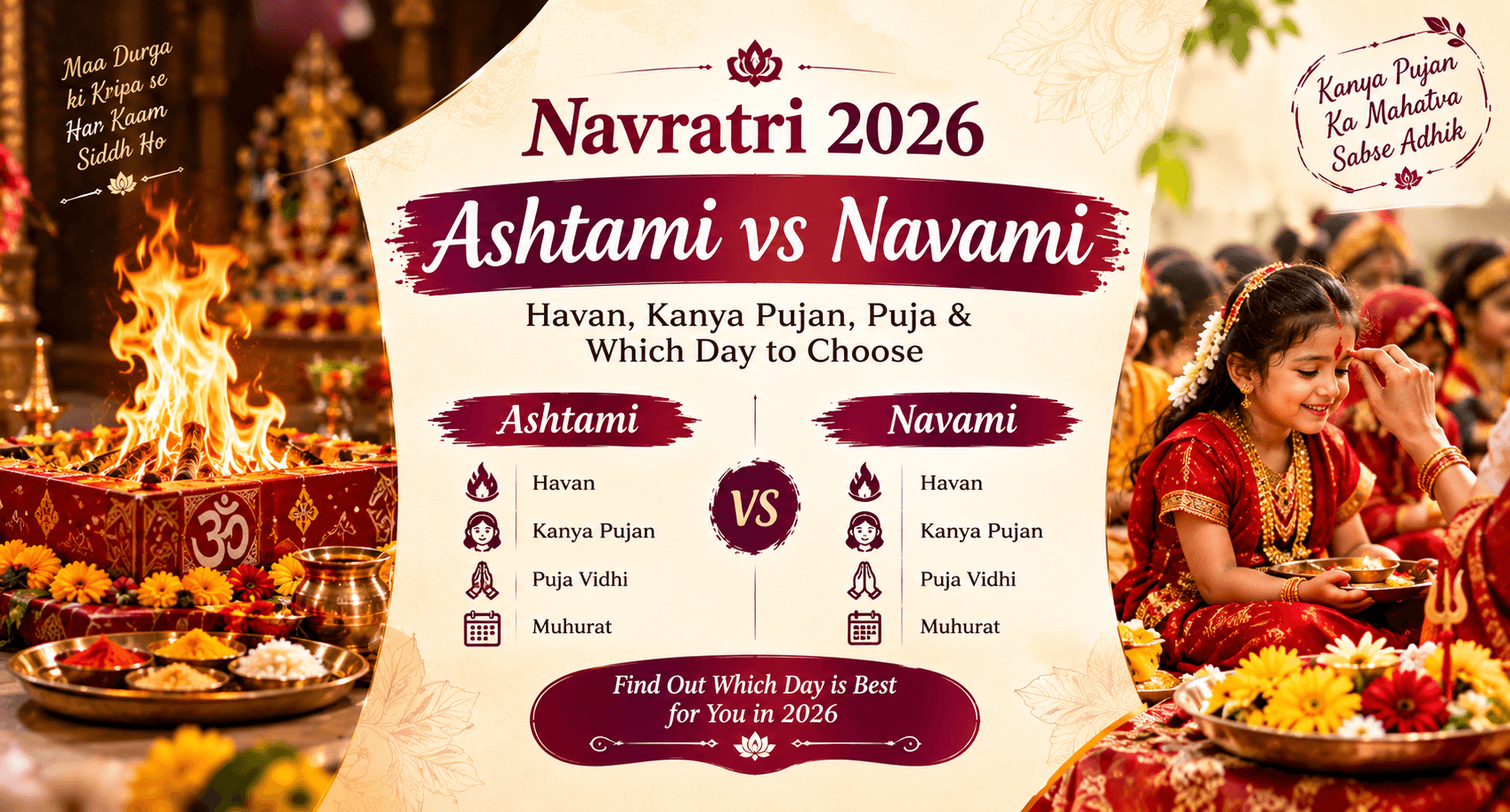
In 2026, Ashtami and Navami create genuine confusion, because the Tithi transition between the two falls within the same civil date in several Panchang calculations. Some Panchangs mark Maha Ashtami on 18 October and Maha Navami on 19 October. Others, applying the sunrise rule strictly at the transition point, place both on 19 October. Devotees are then left asking whether to do Kanya Pujan on the 18th or the 19th, which day is correct for Havan, and what to do if their family's tradition does not match the date shown on a generic online calendar.
This article does not tell you to simply "choose Ashtami" or "choose Navami." It explains what each Tithi means, why the 2026 dates overlap the way they do, how Ashtami Havan and Navami Havan differ in common practice, and how to decide based on your own family tradition, the ritual you are performing, and your local Panchang.
Ashtami vs Navami 2026: Quick Answer
Maha Ashtami (Durga Ashtami) is traditionally observed on Sunday, 18 October 2026, dedicated to Maa Mahagauri. Maha Navami is traditionally observed on Monday, 19 October 2026, dedicated to Maa Siddhidatri. Because the Ashtami Tithi runs from the morning of 18 October into the late morning of 19 October before Navami begins, a smaller number of Panchangs that apply the sunrise rule strictly to the transition point observe both Ashtami and Navami together on 19 October.
Most families perform Kanya Pujan on whichever of the two days their tradition follows — either is correct. Havan is more commonly performed on Navami, though some households and temples perform it on Ashtami or even Saptami night. Vijayadashami on Tuesday, 20 October is consistent across all sources. Always confirm the exact Tithi and timing for your own city with a local Panchang or your family priest before a time-sensitive ritual.
Ashtami vs Navami — At a Glance
↔ Swipe horizontally to view the complete table
Point | Ashtami | Navami |
|---|---|---|
2026 Tithi (most Panchangs) | Sunday, 18 October | Monday, 19 October |
Devi | Maa Mahagauri | Maa Siddhidatri |
Main significance | Serenity after penance; height of the nine-night observance | Completion of the Navadurga; fulfilment of sadhana |
Puja | Full Devi puja, often with Durga Saptashati path | Full Devi puja, often the most elaborate of the nine days |
Kanya Pujan | Common, especially in Ashtami-tradition households | Equally common, especially where the fast concludes this day |
Havan | Performed by some households and temples | Most common day for the concluding Havan and Purnahuti |
Fasting | Many intensify or continue the fast | Most households break the fast (Parana) after this day |
Purnahuti | Less common on this day | Traditionally associated with Navami's concluding fire ritual |
Common regional practice | Widely followed in North and Central India; Sandhi Puja tail-end in the East | Widely followed for concluding rituals; Ayudha Puja in parts of the South |
2026 practical consideration | Prevailing Tithi through most of 18 Oct and into 19 Oct morning | Begins once Ashtami ends, roughly late morning of 19 Oct in Delhi-based calculations |
What Is Ashtami During Navratri?
Maha Ashtami, also called Durga Ashtami, is the eighth day of Shardiya Navratri, dedicated to Maa Mahagauri, the serene and luminous eighth form of the Navadurga. It is traditionally regarded as the height of the nine-night observance, when fasting intensifies and worship becomes more elaborate.
Common rituals associated with Ashtami include a fuller Devi puja, often with a Durga Saptashati or Argala Stotram path, Kanya Pujan in the many households that follow the Ashtami tradition, and Sandhi Puja in the eastern tradition, performed at the precise junction of Ashtami and Navami Tithis. Some households and temples also perform a Havan on this day, though it is not the most common day for the concluding fire ritual. Devotees observing a strict fast often continue it through Ashtami and break it only after Kanya Pujan is complete, whichever day that falls on.
For the full 2026 date, Puja Vidhi and Kanya Pujan detail, see Shardiya Navratri 2026 Ashtami & Navami: Date, Puja Vidhi & Kanya Pujan.
What Is Navami During Navratri?
Maha Navami, the ninth and concluding day of Devi worship, is dedicated to Maa Siddhidatri, believed to grant spiritual accomplishment (siddhi) to sincere devotees. It is the day most commonly associated with completing the nine-day observance.
Navami's rituals typically include a full Devi puja, the concluding Havan and Purnahuti (the final, complete offering into the sacred fire) in most temple traditions and many households, Kanya Pujan in families that did not perform it on Ashtami, and Parana — the breaking of a full nine-day fast — usually taken after the Navami rituals are complete. In parts of South India, Ayudha Puja, the worship of tools and instruments of one's trade, is also associated with this day.
Why Are Ashtami and Navami on the Same Date in 2026?
This is the part of the 2026 calendar that causes most of the confusion, and it comes down to how a lunar Tithi relates to a solar civil date. A Tithi does not reset at midnight; it can begin partway through one day and end partway through the next.
18 October → Ashtami Tithi begins during the morning and continues through the day and night ↓ 19 October, early morning → Ashtami is still the prevailing Tithi ↓ 19 October, roughly mid-to-late morning (around 10:51 AM in Delhi-based Panchang calculations) → Navami Tithi begins ↓ 20 October → Navami continues into the day before Vijayadashami's Tithi takes over
Because Ashtami is the Tithi present through most of 18 October and continues into the morning of 19 October, most Panchangs — including the calendar followed elsewhere on this site — mark Maha Ashtami on 18 October and Maha Navami on 19 October, once the Tithi changes over. A smaller number of Panchangs, applying the sunrise rule strictly to the exact transition point, treat Ashtami and Navami as merging into a single day of observance on 19 October, with both sets of rituals performed together.
Neither approach is an error. It is the normal, well-documented behaviour of Tithi reckoning, and it happens to some degree most years. The exact clock time of the transition shifts by city, since it depends on local sunrise, so the practical takeaway is to confirm the transition time for your own location through a current local Panchang rather than relying on a Delhi-based figure for a different city.
Ashtami vs Navami — Which Day Is Used for Havan?
There is no single, universally "correct" day for Navratri Havan. Both Ashtami Havan and Navami Havan are documented, well-established traditions, and the right one for you depends on your family's custom, the temple tradition you follow, and the specific ritual being performed.
Ashtami Havan
Some households and temples perform a Havan on Ashtami, often alongside or shortly after the day's Kanya Pujan, particularly in traditions where the family's main Devi worship is timed to this day. Ashtami Havan is also connected, in the eastern tradition, to the ritual sequence around Sandhi Puja at the Ashtami-Navami junction. Devotees seeking relief from obstruction or opposition sometimes choose this day, or the preceding Saptami night, for a dedicated fire ritual as part of a broader Navratri Anushthan.
Navami Havan
Navami is the more commonly followed day for the concluding Havan and Purnahuti across North Indian households and most temple traditions, since it marks the completion of the nine-day worship. Many families and temples time their final, complete offering into the sacred fire to this day, and it is also the day most nine-day Anushthans are structured to conclude. Where a full nine-day fast has been observed, the Havan on Navami is often followed directly by Parana.
Both Ashtami Havan and Navami Havan traditions exist side by side. The correct date for your household depends on your family's tradition, your local Panchang, and which specific ritual — a simple daily Havan, a Kanya Pujan-linked Havan, or a concluding Anushthan Havan — you are performing. For the general Navratri Havan Vidhi, samagri and mantra sequence that applies across these days, see Navratri Havan 2026: Vidhi, Samagri, Mantra & Rules.
Should Kanya Pujan Be Done on Ashtami or Navami?
Either day is correct, and the choice depends on your family and regional tradition rather than a single rule that applies to everyone.
Many North and Central Indian families perform Kanya Pujan on Ashtami, following their regional Panchang's designation of that day. Many other families perform it on Navami instead, often because that is the day their fast concludes. Some households simply follow the day on which their broader Navratri Puja or Anushthan concludes, regardless of the Tithi label. Because of the 2026 Tithi overlap described above, it is worth checking your relevant local Panchang, or asking your family priest, to confirm which day your tradition intends — rather than assuming the date shown on a generic online source applies to your city. Full step-by-step Kanya Pujan guidance, including Vidhi and Samagri, is available at Kanya Pujan 2026: Date, Vidhi, Samagri & Rules.
Can Havan and Kanya Pujan Be Done on the Same Day?
Yes, and many households do exactly this, particularly on Navami. A commonly followed sequence in some traditions is Havan → Purnahuti → Kanya Pujan, Bhog and Dakshina, with the fire ritual completed first and the young girls welcomed and fed afterward as part of the same morning's worship. Other households structure it differently — performing Kanya Pujan first, followed by the Havan later in the day, or spreading the two rituals across Ashtami and Navami respectively.
There is no single sequence that applies universally. If you are coordinating both rituals on one day, it is generally more practical to plan the timing in advance — deciding whether the Havan or the Kanya Pujan comes first — based on your family's custom or, for a priest-guided ritual, the Purohit's recommendation for that day's Muhurat.
Ashtami Havan vs Navami Havan — Complete Comparison
↔ Swipe horizontally to view the complete table
Factor | Ashtami Havan | Navami Havan |
|---|---|---|
Tithi | Ashtami — 18 October in most Panchangs | Navami — 19 October in most Panchangs |
Common purpose/context | Devi worship at the height of the nine nights; sometimes linked to Sandhi Puja | Concluding the nine-day Navratri observance |
Associated puja | Mahagauri puja, often with Durga Saptashati path | Siddhidatri puja, often the most elaborate of the nine |
Kanya Pujan | Common on this day in Ashtami-tradition households | Equally common, especially where the fast concludes this day |
Purnahuti | Performed by some households | Traditionally the most common day for the final Purnahuti |
Fasting connection | Many continue a strict fast through this day | Most households take Parana (break the fast) after this day |
Regional variations | More prominent in traditions tied to Sandhi Puja (Bengal, Assam, Odisha) | More prominent as the concluding day across North and Central India |
2026 consideration | Ashtami Tithi prevails through most of 18 Oct and into 19 Oct morning | Navami Tithi begins once Ashtami ends, roughly late morning of 19 Oct in Delhi-based calculations |
If Ashtami and Navami Fall on the Same Civil Date, What Should You Do?
Scenario 1 — You follow an Ashtami-based family tradition. Check whether your local Panchang places Ashtami on 18 October or, in the minority calculation, on 19 October. Perform your usual Ashtami rituals — puja, Kanya Pujan and any Havan your family observes — on whichever date your Panchang assigns.
Scenario 2 — You follow a Navami-based tradition. Confirm the Navami date and timing for your city, since the Tithi's start time on 19 October shifts by location. Time your concluding Havan, Purnahuti and Parana accordingly.
Scenario 3 — You are completing a nine-day Anushthan. The completion date matters more than the Tithi label here, since a formal Anushthan is usually structured around a fixed number of days from its Sankalp. Confirm the concluding day with whoever guided the Sankalp, typically the officiating priest.
Scenario 4 — You want to perform Havan and Kanya Pujan together. Decide in advance which comes first based on your family's custom, and confirm the practical Muhurat for both with your local Panchang or priest if either ritual is time-sensitive.
Scenario 5 — You are booking a priest-guided Havan at Nalkheda. Confirm the exact local Muhurat with the priest before the booking is finalised, since Ashtami-Navami timing is genuinely city-dependent and a generic online date should not be the final word for a scheduled ritual.
Navratri 2026 Ashtami–Navami Ritual Schedule
↔ Swipe horizontally to view the complete table
Time / Tithi | Ritual | What to Do |
|---|---|---|
Before Ashtami begins | Preparation | Clean the puja area, arrange Kanya Pujan and Havan samagri in advance |
Ashtami Tithi (18 Oct, most Panchangs) | Ashtami Puja | Invoke Mahagauri, offer coconut bhog, perform Kanya Pujan if this is your family's day |
Ashtami–Navami transition | Sandhi Puja (eastern tradition) or a pause in worship | Confirm the exact local transition time before this ritual |
Navami Tithi (19 Oct, most Panchangs) | Navami Puja | Invoke Siddhidatri, offer sesame (til) bhog |
Havan window | Havan / Purnahuti | Perform on Ashtami or Navami per your tradition; confirm Muhurat locally |
Kanya Pujan | Kanya Puja, Bhog, Dakshina | Perform on whichever day — Ashtami or Navami — your family follows |
After completion | Parana, if applicable | Break a full nine-day fast after the concluding rituals are complete |
Exact clock timings are not given here beyond what has already been verified for Delhi-based Panchang calculations, since Muhurat shifts by city. Check the local Panchang for your city, particularly for Sandhi Puja and any scheduled Havan.
What Should You Do If You Are Unsure Whether to Choose Ashtami or Navami?
Check your local Panchang. Delhi-based timings do not apply uniformly to every city, including Nalkheda.
Follow your family or community tradition first. If your household has always done Kanya Pujan on a specific day, continue that practice rather than switching based on an online article.
Identify which ritual you are performing. A regular daily puja, Kanya Pujan, a Havan, or a full Anushthan may each have a different customary day in your tradition.
Check the Tithi active during your intended ritual window, not just the calendar date, particularly if the ritual is time-sensitive.
For a specialised or priest-guided Havan, confirm with the Acharya beforehand. A qualified priest can verify the correct Muhurat for your city and the specific ritual you intend to perform.
Baglamukhi Havan During Navratri — Ashtami or Navami?
Navratri, including its Ashtami and Navami days, is traditionally regarded as a significant window for Devi worship, and some devotees extend this to the ten Mahavidyas, of which Maa Baglamukhi is one. Devotees who already hold a personal or family connection to Maa Baglamukhi commonly choose Ashtami, Navami, or both, for a dedicated Maa Baglamukhi Havan or Maa Baglamukhi Puja, performed with proper Sankalp taken in the devotee's name and gotra.
At the Maa Baglamukhi Temple, Nalkheda, such rituals are conducted under traditional Vedic procedure by the temple's Purohits, who confirm the appropriate local Muhurat before a Havan is scheduled — the exact timing is never assumed from a generic online date. Devotees planning a structured, multi-day practice across the Navratri period can also explore a Baglamukhi Anushthan timed to conclude on Ashtami or Navami according to their preference.
Speak with the Acharya to confirm the right day and Muhurat → baglamukhihawan.com/book-consultation
This connection is offered as a traditional devotional option for those already inclined toward Baglamukhi worship, and is not presented as a requirement of Navratri observance, nor as a guarantee of any specific worldly outcome. Devotees traditionally seek relief from prolonged obstruction, litigation or hostility through this practice, performed alongside — not in place of — appropriate professional or legal counsel where relevant. A broader account of Baglamukhi worship across the nine days is at Baglamukhi Puja During Shardiya Navratri 2026.
Book Ashtami or Navami Havan at Nalkheda → baglamukhihawan.com/book-puja
Frequently Asked Questions
1. Is Ashtami or Navami better for Havan?
Neither is universally "better." Both Ashtami Havan and Navami Havan are established traditions; Navami is more commonly chosen for the concluding Havan and Purnahuti, while some households and temples perform it on Ashtami instead, depending on family custom.
2. Can Havan be done on both Ashtami and Navami?
Yes. Some households perform a Havan on Ashtami and a separate, more elaborate concluding Havan on Navami. There is no rule against performing a fire ritual on both days if your tradition includes it.
3. When is Ashtami in Navratri 2026?
Maha Ashtami falls on Sunday, 18 October 2026, according to most North Indian Panchangs.
4. When is Navami in Navratri 2026?
Maha Navami falls on Monday, 19 October 2026, in most Panchang calculations.
5. Are Ashtami and Navami on the same date in 2026?
In most Panchangs, no — they fall on 18 and 19 October respectively. A smaller number of Panchangs that apply the sunrise rule strictly at the Tithi transition observe both together on 19 October.
6. When should Kanya Pujan be done in 2026?
Most families perform it on either 18 October (Ashtami) or 19 October (Navami), based on family and regional tradition. Neither day is more correct than the other.
7. Is Kanya Pujan done on Ashtami or Navami?
Both are traditional. Some families follow their Panchang's Ashtami designation; others perform it on Navami because that is when their fast concludes.
8. Can Kanya Pujan and Havan be done on the same day?
Yes. A commonly followed sequence in some traditions is Havan, then Purnahuti, then Kanya Pujan with bhog and dakshina, though other households structure the order differently.
9. Which Devi is worshipped on Ashtami?
Maa Mahagauri, the eighth form of the Navadurga, associated with serenity and purity after long penance.
10. Which Devi is worshipped on Navami?
Maa Siddhidatri, the ninth and final form of the Navadurga, associated with the fulfilment of sadhana and the granting of siddhis.
11. When should Navratri Havan be performed?
Most commonly on Navami, though some households and temples perform it on Ashtami or Saptami night instead. The specific day depends on family and temple tradition.
12. Can Havan be performed at home on Navami?
Yes, many households perform a home Havan on Navami as part of concluding their nine-day observance, following the standard Havan Vidhi and samagri for the day.
13. Why do Ashtami and Navami fall so close together in 2026? Because the Ashtami Tithi runs from the morning of 18 October into the late morning of 19 October before Navami begins — Tithis follow the lunar cycle, not the 24-hour civil day, so they can span parts of two Gregorian dates.
14. Does Havan have to be performed on Navami?
No. While Navami is the most common day for the concluding Havan, some traditions perform it on Ashtami, and there is no requirement that ties Havan exclusively to Navami.
15. Should Kanya Puja be done before or after Havan?
Practices vary. A common sequence in some households is Havan first, then Kanya Pujan; others perform Kanya Pujan first. Follow your family's custom or your priest's guidance for a structured ritual.
16. What happens if Navami Tithi starts during the day rather than at sunrise?
This is exactly the situation in 2026 for most cities — Navami begins mid-morning rather than at sunrise. Panchangs handle this differently, which is why the Ashtami and Navami dates can appear to overlap or merge depending on the source.
17. Which Panchang should I follow for Ashtami and Navami? Whichever Panchang your family, community or temple traditionally follows. If you do not have one, a reputable local Panchang for your specific city is more reliable than a generic national listing.
18. Can Baglamukhi Havan be performed during Navratri?
Yes. Some devotees choose Ashtami, Navami, or both, for a dedicated Maa Baglamukhi Havan or Puja alongside their Navratri observance, with the exact Muhurat confirmed locally before the ritual.
19. How can I book a priest-guided Havan at Nalkheda?
Through baglamukhihawan.com/book-puja, or by booking a consultation first to confirm the appropriate day and Muhurat with the Acharya.
20. Is one tradition — Ashtami or Navami — more authentic than the other?
No. Both are well-documented, long-standing traditions followed by different regions, communities and families. Neither is a lesser or incorrect form of Navratri observance.
Tithi timings, Muhurat and regional practice can vary significantly by city, community and family tradition. This article presents the commonly documented North and Central Indian structure alongside the eastern and southern variations where relevant. Always confirm exact timings with a local Panchang or your family priest before a time-sensitive ritual.
Acharya Tiwari Chetan Guru
Siddha Peethadheesh & Head Vedic Scholar
With over 15+ years of unbroken Vedic practice at Maa Baglamukhi Siddha Peeth, Nalkheda, Acharya Ji is a globally authoritative voice on Tantra Shastra, Stambhan Vidya, and Karmic Astrology. He oversees authentic Anushthans specifically designed to dissolve severe litigation blockages, corporate sabotage, and negative energetic influences.