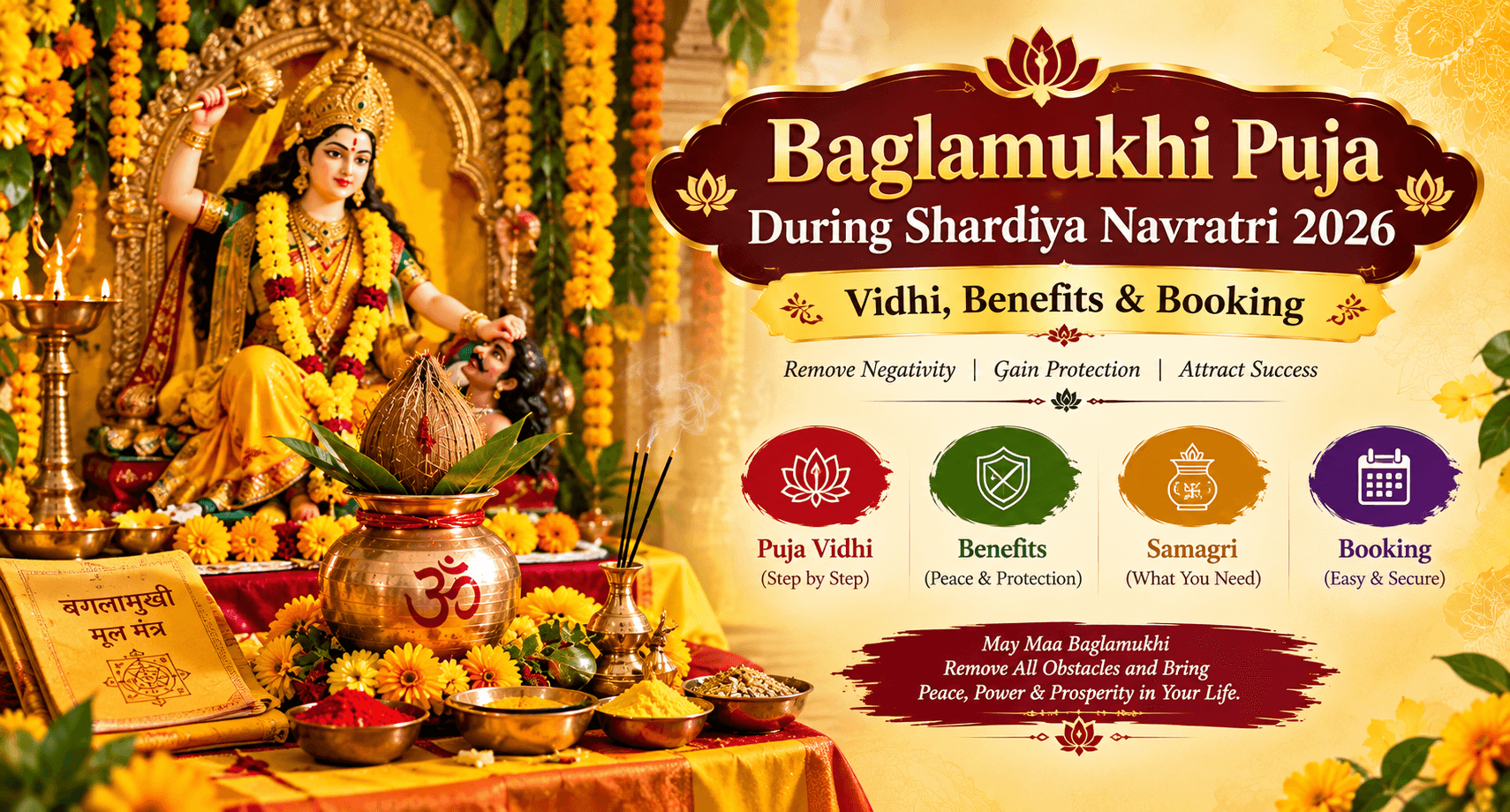
Shardiya Navratri is the autumn period of Devi and Shakti worship in the Hindu calendar, observed in 2026 from 11 to 20 October. According to Hindu tradition, Maa Baglamukhi is the eighth of the ten Mahavidyas, a form of the Divine Mother associated with stillness, speech and protection. Many devotees who already hold a family or personal connection to her choose to keep a focused Baglamukhi Puja, Mantra Jaap or Havan alongside the regular Shardiya Navratri 2026 observances.
This guide explains how that worship is traditionally done. It covers the verified 2026 dates, the Vidhi, the commonly published Mantra, the role of Havan, the traditional purposes of the Puja, what Nalkheda offers, and how to book online with the right information in hand.
Is Baglamukhi Puja Performed During Shardiya Navratri?
Yes. Devotees do observe focused Maa Baglamukhi worship during Shardiya Navratri, usually as a personal Sankalp added to the wider Devi worship of the nine nights. The exact ritual, Mantra, Sankalp wording and scale of Anushthan vary by family tradition, lineage and the guidance of the priest.
Simple devotional worship at home, such as a lamp, yellow flowers, prayer and a short recitation, is different from a specialised Vedic or Tantric Anushthan, which is traditionally performed under qualified guidance. Devotees who want an elaborate ritual often choose a priest-guided Puja or Havan. None of these is presented as a guaranteed way to obtain a particular worldly result.
Who Is Maa Baglamukhi?
In Shakta traditions, Maa Baglamukhi is counted among the Dasha Mahavidyas, the ten wisdom forms of the Devi. Her name is often linked to the idea of Stambhana, a word usually translated as stilling or halting. Devotees traditionally understand this as the power to quieten confusion, harmful speech and inner restlessness. You can read more on the Maa Baglamukhi Mahavidya page.
She is commonly described as Pitambara, the Goddess in yellow. Popular iconography shows a golden-complexioned Devi seated on a throne, holding a mace and restraining the tongue of a demon. Devotees read this as a symbol of controlled speech and disciplined thought. Yellow is associated with her in worship, so yellow clothing, turmeric and yellow flowers are traditional offerings.
Nalkheda, in the Agar Malwa district of Madhya Pradesh, is one of the best-known centres of her worship. The temple stands near the Lakhundar River. According to local tradition, its origins go back to the Mahabharata era, when Yudhishthira is said to have sought the Goddess's blessings here. These are traditional accounts, not established historical findings.
Why Perform Baglamukhi Puja During Shardiya Navratri?
Shardiya Navratri is primarily devoted to the nine forms of Durga, the Navadurga. Baglamukhi belongs to the Mahavidya tradition, which is a related but separate scheme. In many households and lineages, Gupt Navratri is the season more explicitly tied to Mahavidya sadhana. Baglamukhi worship in Shardiya Navratri is therefore best understood as a devotional choice, not a scriptural requirement.
Devotees who make that choice usually give these reasons:
A period of Shakti worship. The nine nights are already set aside for Devi, so many people feel the atmosphere suits sustained prayer.
Discipline. Fasting, early rising, cleanliness and daily Mantra Jaap give the worship structure.
Sankalp. Navratri is a time when many people formally state an intention and keep it for several days.
Havan. The concluding fire offering on Ashtami or Navami is a familiar part of Navratri, and some devotees add a Baglamukhi Havan to it.
The purposes devotees traditionally associate with this worship include protection, overcoming obstacles, inner strength, focus, peace and stability, and Devi's blessings in general. These are devotional beliefs. Puja is not a guarantee of any result in a court case, business, health matter, relationship or career, and it is not a substitute for legal, medical, financial or professional advice.
Baglamukhi Puja During Navratri 2026: Important Dates
Dates below are cross-checked against several current Panchang and news sources. Tithi timings depend on sunrise and location, so confirm the final timing for your own city or with your priest.
Navratri Date | Tithi / Day | Relevant Worship |
|---|---|---|
11 October (Sunday) | Ashwin Shukla Pratipada, Day 1 | Navratri begins. Ghatasthapana and Maa Shailputri worship. Many devotees take their Sankalp here. |
12 to 17 October | Dwitiya to Saptami | Daily Navdurga worship, Mantra Jaap and daily Puja. |
18 October (Sunday) | Ashtami tithi begins | Maa Mahagauri. Some regional and family calendars observe Ashtami on this day. |
19 October (Monday) | Ashtami ends late morning, then Navami | Many current Panchang sources observe Durga Ashtami and Maha Navami together on this date. Concluding Havan and Purnahuti are common. See the Ashtami and Navami guide. |
20 October (Tuesday) | Vijayadashami | Navratri concludes. All sources agree on this date. |
The variation on Ashtami and Navami is real, not an error. Because the Ashtami tithi runs into the late morning of 19 October, some calendars mark Ashtami on the 18th and others place both observances on the 19th. Follow your family Panchang or priest.
Devotees may choose different days for a Baglamukhi Puja or Havan depending on their Sankalp, family tradition and the temple's or priest's guidance. There is no widely accepted source for a single "best day" for Baglamukhi worship within Shardiya Navratri, so this article does not name one.
Baglamukhi Puja Vidhi During Navratri
This is a high-level outline of a simple devotional Puja. If you are also keeping the wider festival at home, the Navratri Puja at Home 2026 guide covers the general Navratri routine. Family and regional customs differ, so follow your own tradition where it is different.
Step 1: Preparation and purification. Bathe, wear clean clothes (yellow is traditional) and keep the day simple and sattvic.
Step 2: Set up the Puja space. Choose a clean, quiet place and spread a yellow cloth on the seat or altar.
Step 3: Idol or image. Place an image, idol or Yantra of Maa Baglamukhi on the altar. Light a ghee lamp and incense.
Step 4: Sankalp. State your name, Gotra if you know it, the date and a sincere intention in your own words. If you do not know your Gotra, follow your family's guidance or ask a priest.
Step 5: Invocation and offerings. Invoke the Goddess with a short prayer and offer water, sandalwood paste, akshat and incense.
Step 6: Yellow flowers and turmeric. Yellow flowers, turmeric, yellow sweets and fruit are traditionally offered. A full list for the nine days is in the Navratri Puja Samagri List 2026.
Step 7: Mantra Jaap. Recite a Mantra you have been taught, counting on a mala. The next section covers this.
Step 8: Havan, if part of the chosen ritual. A simple Havan is done by many households. Elaborate Havans are usually priest-led.
Step 9: Aarti and prayer. Close with Aarti, a prayer for forgiveness of any mistakes and a moment of silence.
Step 10: Prasad and conclusion. Share the prasad with the household and end the day's worship.
Please note the difference between the two kinds of practice. What is described above is simple devotional Puja. Baglamukhi Anushthan, extended Jaap counts, Yantra energisation and Tantric procedures belong to a specialised tradition. They are traditionally learned from a qualified Guru and should not be attempted from a general article.
Explore Priest-Guided Maa Baglamukhi Puja →
baglamukhihawan.com/puja/maa-baglamukhi-pujaExplore the Maa Baglamukhi Puja if you prefer the ritual to be performed by an Acharya with your Sankalp.
Baglamukhi Mantra During Navratri
Mantra Jaap is the heart of most Navratri worship. Devotees keep a daily count, often with a turmeric or sandalwood mala, at a fixed time each day.
The Mool Mantra most commonly published for Maa Baglamukhi, in the version used here, is:
ॐ ह्लीं बगलामुखि सर्वदुष्टानां वाचं मुखं पदं स्तम्भय जिह्वां कीलय बुद्धिं विनाशय ह्लीं ॐ स्वाहा॥
Om Hleem Baglamukhi Sarvadushtanam Vacham Mukham Padam Stambhaya Jihvam Keelaya Buddhim Vinashaya Hleem Om Swaha.
Printed sources differ slightly in spelling, such as बगलामुखि and बगलामुखी, or जिह्वां and जिव्हां. The version above is the one found most often across published sources. If your family or Guru follows another reading, use that one.
The Beej syllable Hleem (ह्लीं) is the seed sound in this Mantra. Devotees also recite the Baglamukhi Gayatri, Chalisa and Kavach as gentler practices.
Correct pronunciation matters in this tradition, and the Mool Mantra in particular is traditionally taken with guidance from a Guru. Beginners are usually advised to start with a Chalisa, Aarti or Beej recitation, and to speak to a qualified priest before committing to a large Jaap count. The Baglamukhi Mantra Complete Guide explains each Mantra and its traditional rules in detail.
Baglamukhi Havan During Shardiya Navratri
A Havan is a Vedic fire ritual. Offerings, called Ahuti, are made into a consecrated fire while Mantras are recited, and devotees regard the fire as a carrier of prayer to the Deity. A Havan differs from ordinary Puja in scale and structure. Puja centres on worship with a lamp, flowers and Aarti, while a Havan adds the fire, the samagri and a counted Mantra sequence.
In a Baglamukhi Havan, the Ahutis are traditionally offered with yellow-coloured samagri such as turmeric and yellow mustard, together with ghee and other items chosen by the priest. The ritual ends with Purnahuti, the final complete offering.
Some devotees choose Havan during Navratri because the festival already includes a concluding Havan on Ashtami or Navami. General Navratri Havan practice is covered in the Navratri Havan 2026 guide. Devotees who want a Baglamukhi-specific Havan performed by an Acharya can read about the Maa Baglamukhi Havan service.
A Havan involves open flame, so it should be done in a safe, ventilated space and never left unattended. For anything beyond a very simple home offering, priest-led Havan is the safer route.
Traditional Benefits Associated With Maa Baglamukhi Puja
These are the purposes devotees traditionally associate with the worship of Maa Baglamukhi:
Protection. A sense of being sheltered during a difficult period.
Overcoming obstacles. Prayer for strength and steadiness when things feel blocked.
Mental focus and confidence. Regular Jaap and fixed timings build routine.
Clarity. Many devotees say a quiet daily practice helps them think more calmly.
Spiritual discipline. Fasting, purity and routine are part of the tradition.
Devi's blessings. The simplest and most widely held reason for any Navratri worship.
The line between traditional belief and guaranteed outcome matters. Devotees describe experiences of peace or steadiness, and those are personal. No Puja, Mantra or Havan can be promised to win a court case, remove a person, bring money, cure an illness, secure a marriage or guarantee business success. Anyone facing a legal, medical or financial problem should also work with qualified professionals, and treat worship as a spiritual support alongside that.
Baglamukhi Puja at Nalkheda During Navratri
Devotees travel to Nalkheda for darshan, prayer, Mantra practice and arranged rituals. The temple is in the Agar Malwa district of Madhya Pradesh, close to the Lakhundar River. Accounts describe the presiding form as three-faced, sometimes called Trishakti, though sources differ on which goddesses are named alongside her. It is traditionally regarded as a Siddha Peeth. The Baglamukhi Temple Nalkheda page has the visiting details, timings and travel information.
Our Acharya team, led by Acharya Tiwari Chetan Guru, arranges Puja, Havan and Navratri Anushthan at Nalkheda. For Shardiya Navratri 2026 the Shardiya Navratri page lists a Baglamukhi Puja, a Havan with Purnahuti and a 9-day Anushthan. In each of these, the Acharya takes the Sankalp in the devotee's name and Gotra.
Devotees can take part in one of two ways. Those who can travel may visit for darshan and take their Sankalp in person. Those who cannot may take part remotely. Our team offers a live Sankalp on a WhatsApp video call, photos and video of the ritual, and prasad sent by courier.
Please note that visiting the temple for darshan and booking an arranged ritual with our Acharya team are separate things. Devotees who are visiting only for darshan do not need a booking.
Speak to the Team About Nalkheda →
baglamukhihawan.com/book-pujaAsk about Navratri rituals at Nalkheda and we will guide you on the next steps before anything is confirmed.
Can Baglamukhi Puja Be Booked Online?
Yes. You can send a booking request through the form on the Book Puja page, by WhatsApp or by phone. The team then contacts you, discusses the right ritual, schedules the date and arranges a live Sankalp over WhatsApp video. The initial consultation is free, and the team says it will guide you before any booking is confirmed.
The team typically asks for:
Full name of the person the Puja is for.
Gotra, if known. The team advises that Kashyap Gotra is used when a devotee does not know theirs.
Birth details and a short description of your Sankalp or intention.
Preferred date, subject to the Acharya's schedule and Muhurat.
Contact details, including a WhatsApp number.
Delivery address, if you want prasad sent by courier.
The Shardiya Navratri page says up to five family members can be included in one Sankalp. It also states that devotees outside India, including in the USA, UK, Canada, Australia and the Gulf, can participate remotely.
Prices are not fixed in this article. Our Baglamukhi Puja Cost 2026 guide explains what shapes the cost, such as the type of ritual, duration, samagri and number of priests. Ask for a quote for your specific ritual on the booking page. The full booking process is on the Book Puja page.
Which Baglamukhi Ritual Should You Choose?
These four formats are described neutrally. None is ranked above another, and suitability depends on your intention, tradition and the guidance you receive.
Ritual | General Purpose / Format | Typical Context | Who May Consider It |
|---|---|---|---|
Baglamukhi Puja | Worship with Sankalp, invocation, offerings and Aarti | One day, at home or arranged with a priest | Those who want a devotional ritual without a fire ceremony |
Baglamukhi Havan | Puja plus fire offerings and Purnahuti | Usually one day, often priest-led | Those who want a fire ritual, and a Purnahuti on Ashtami or Navami |
Mantra Jaap | Counted recitation of a Mantra | Daily, over several days | Devotees who want a personal discipline, taught by a Guru |
Anushthan | A structured multi-day practice with counted Jaap and daily rites | Three to nine days or longer, under qualified guidance | Those seeking a sustained, guided practice across Navratri. See the Maa Baglamukhi Anushthan page. |
If you are unsure which one suits your Sankalp, it is reasonable to ask before booking.
Talk to the Acharya Before You Choose →
baglamukhihawan.com/book-consultationNot sure which ritual fits your Sankalp? Speak with the Acharya first. The initial consultation is free and there is no obligation to book.
Baglamukhi Puja During Navratri vs Regular Baglamukhi Puja
Aspect | During Navratri | Regular Puja |
|---|---|---|
Timing | Within the nine nights, 11 to 19 October 2026 | Any day chosen by tradition or Muhurat |
Context | Part of a wider festival of Devi worship | Stands on its own |
Sankalp | Many devotees take a Navratri Sankalp | Sankalp for a specific date or intention |
Havan | Often connected to the concluding Havan on Ashtami or Navami | Optional, chosen by the devotee |
Jaap | Often daily across several days | Single sitting or a counted period |
Tradition regards Navratri as a spiritually significant period, so many devotees prefer it. A ritual performed on another day is equally valid in the tradition, and Navratri does not automatically make a Puja stronger.
Who May Consider Baglamukhi Puja During Navratri?
Devotees who take up this worship usually do so for reasons such as:
a wish for spiritual discipline and a daily routine,
a family or personal devotion to Maa Baglamukhi,
a desire for steadiness and clarity during a hard time,
a specific Sankalp they would like a priest to take on their behalf,
focused Devi worship during the nine nights.
Nobody needs a Puja because of some alleged supernatural problem. If a reader is being told they are cursed or in danger unless they pay for a ritual, they should treat that as a red flag and speak to someone they trust.
What to Ask Before Booking
A few practical questions help any devotee decide with confidence:
Who will perform the ritual, and where?
Which Mantra, Havan or Anushthan format is included, and for how many days?
Will I receive a live video link, a recording, or both?
Is prasad included, and how is it shipped?
What exactly does the price cover, and what is not included?
Can family members be added to the Sankalp?
How early should I book for Navratri? The Nalkheda page advises booking in advance for festival periods, and availability during Navratri may be limited.
Baglamukhi Puja Booking Guide 2026
Decide the type of ritual. Puja, Havan, Jaap or Anushthan, as described above.
Review the ritual information. Read the relevant service page and the cost guide.
Contact or book through the website. Use the form, WhatsApp or phone.
Share your details. Name, Gotra if known, birth details and your Sankalp.
Confirm date and availability. The team confirms the Muhurat and schedule with you.
Take part in the live Sankalp. You join over WhatsApp video, from Nalkheda or from home.
Receive prasad. Sent by courier after Purnahuti, according to the website.
Frequently Asked Questions
1. Can Baglamukhi Puja be performed during Shardiya Navratri?
Yes. Devotees perform focused Baglamukhi worship during Navratri as a personal Sankalp. It is a devotional choice, and the format varies by family tradition and priest.
2. Is Navratri a suitable time for Baglamukhi worship?
Many devotees think so, because the nine nights are devoted to Devi worship. Gupt Navratri is the season more explicitly tied to Mahavidya sadhana in many traditions.
3. What is the Vidhi for Baglamukhi Puja during Navratri?
Purification, a Puja space, an image or Yantra, Sankalp, invocation, yellow offerings, Mantra Jaap, optional Havan, Aarti and prasad. The steps are listed in the Vidhi section above.
4. Which Mantra is used for Baglamukhi Puja?
The Mool Mantra and the Beej syllable Hleem are commonly used. Both are traditionally learned with guidance, and the Complete Guide explains them.
5. Can Baglamukhi Havan be performed during Navratri?
Yes. Some devotees add it to the Ashtami or Navami Havan. Elaborate Havans are usually done with a priest, and fire safety matters.
6. What are the traditional benefits of Baglamukhi Puja?
Devotees associate it with protection, steadiness, focus, discipline and Devi's blessings. It is a belief, not a guaranteed outcome.
7. Can Baglamukhi Puja be booked online?
Yes. You can use the booking form, WhatsApp or phone on the Book Puja page, and the team guides you before confirming.
8. Can I book Baglamukhi Puja at Nalkheda?
Yes. Our Acharya team arranges Puja, Havan and Anushthan at Nalkheda, and you can either visit or participate remotely.
9. Is Gotra required for Sankalp?
It is normally asked for. According to the team, Kashyap Gotra is used if a devotee does not know theirs.
10. Can devotees participate remotely?
Yes, according to the website. A live Sankalp over WhatsApp video is offered, with recordings and prasad by courier.
11. Can Puja and Havan be performed together?
Yes. Havan is often built on top of a Puja, and many devotees ask the Acharya to combine them.
12. Which day of Navratri is suitable for Baglamukhi Puja?
No widely accepted source names a single day. Devotees choose based on Sankalp, family tradition and priest guidance.
13. How is Baglamukhi Puja different from regular Durga Puja?
Durga Puja during Navratri honours the nine Navadurga forms. Baglamukhi is a Mahavidya, and her worship uses different Mantras and offerings, notably yellow items.
14. Is a priest required for Baglamukhi Puja?
Not for a simple devotional Puja at home. Havan, Anushthan and Tantric practices are traditionally done under qualified guidance.
15. What should I provide when booking?
Your full name, Gotra if known, birth details, a short description of your Sankalp, a preferred date and contact details.
16. How early should Navratri Puja be booked?
Earlier is better. Navratri availability may be limited, and the team confirms Muhurat and schedule after your enquiry.
17. Can family members be included in one Sankalp?
The Shardiya Navratri page states that up to five family members can be included in a single Sankalp.
18. Does the Puja replace legal or medical advice?
No. It is a devotional practice, and anyone facing a legal, health or financial problem should consult a qualified professional as well.
Puja dates, Muhurat and ritual procedures vary by location, Panchang and Sankalp. Baglamukhi Puja and Havan are traditional devotional practices, and no specific worldly outcome is guaranteed.
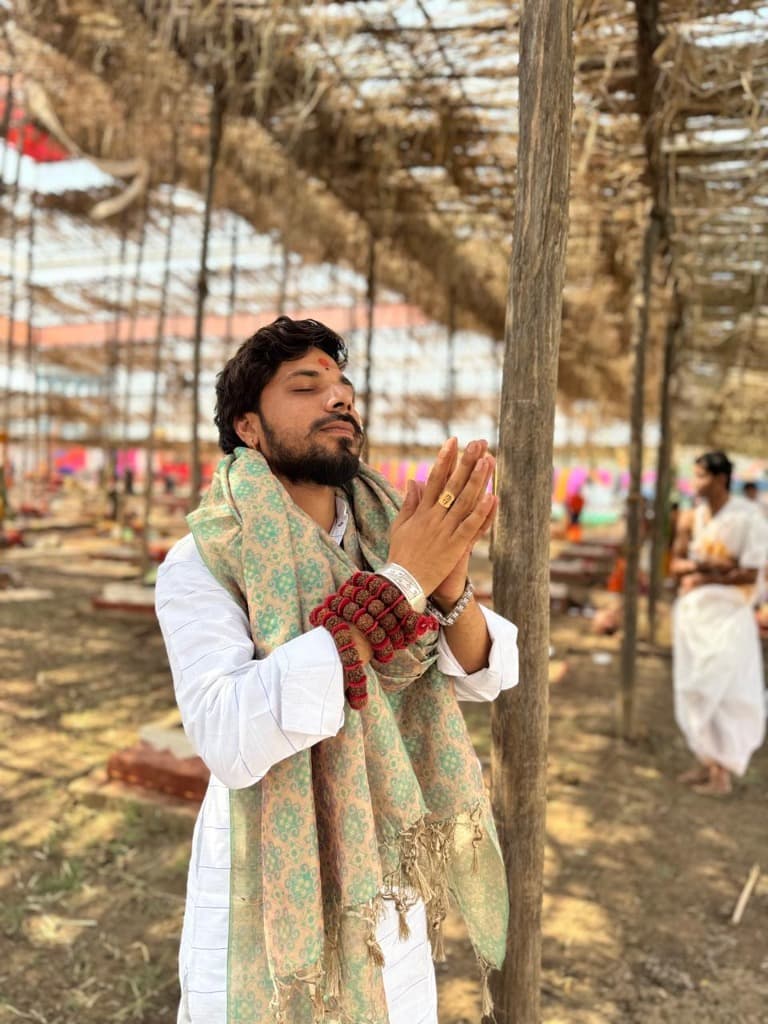
Acharya Tiwari Chetan Guru
Siddha Peethadheesh & Head Vedic Scholar
With over 15+ years of unbroken Vedic practice at Maa Baglamukhi Siddha Peeth, Nalkheda, Acharya Ji is a globally authoritative voice on Tantra Shastra, Stambhan Vidya, and Karmic Astrology. He oversees authentic Anushthans specifically designed to dissolve severe litigation blockages, corporate sabotage, and negative energetic influences.