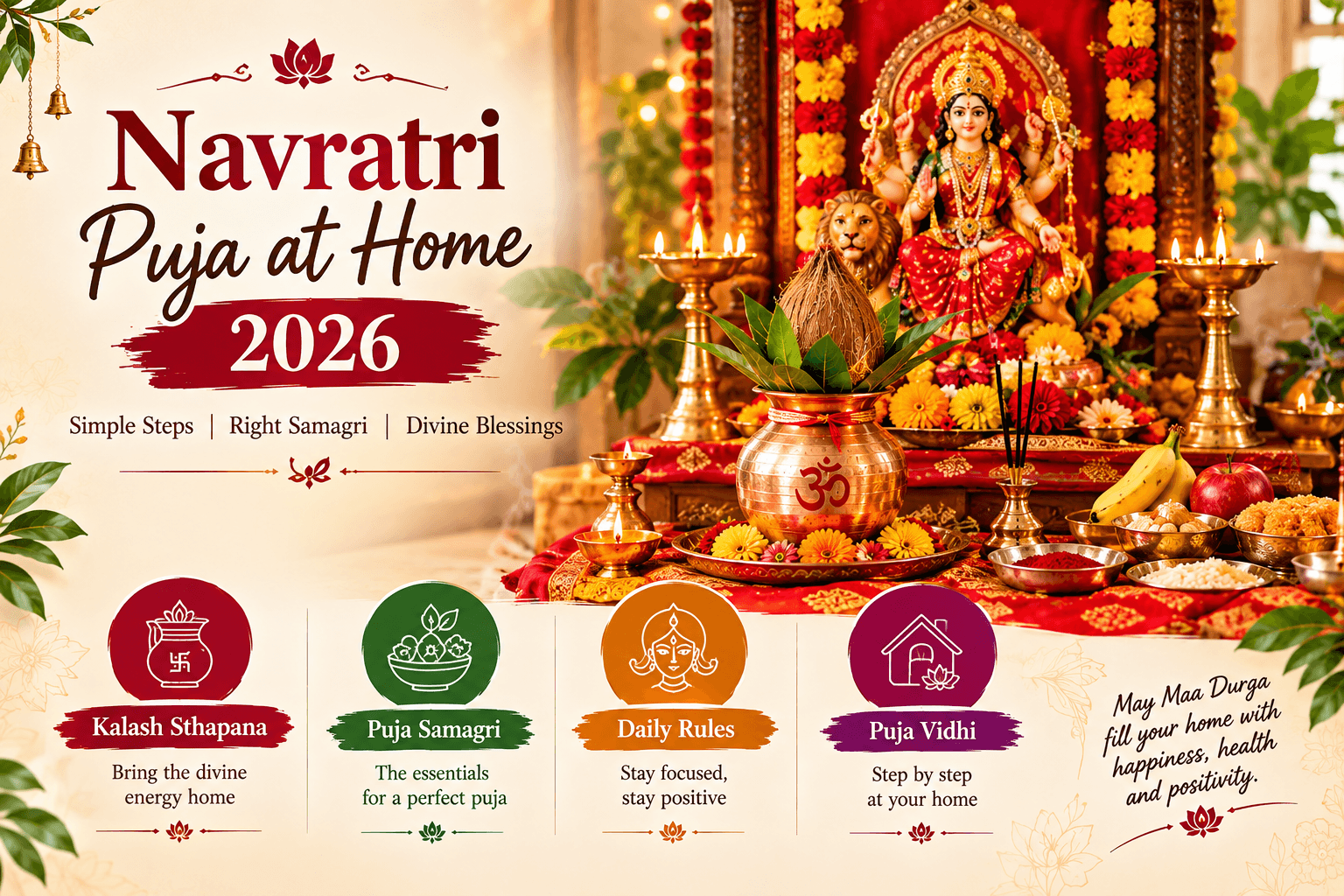
Navratri Puja at home involves setting up a simple worship space, performing Ghatasthapana on the first day, and then following a daily routine of aarti, mantra, and bhog dedicated to a different form of Devi for nine days. Shardiya Navratri 2026 begins on Sunday, 11 October, and elaborate rituals can vary considerably by region and family tradition, so this guide covers the widely followed core practice while pointing to detailed resources for each part of the worship.
This article is built as a central hub: it gives you everything you need to actually perform the puja, and links out to dedicated guides on this site wherever a topic deserves a fuller treatment.
Quick Answer: How to Perform Navratri Puja at Home in 2026?
Clean the puja space and set up a chowki with a Durga idol or photo.
Prepare the puja samagri in advance, including the Kalash items if Ghatasthapana is planned.
Perform Ghatasthapana (Kalash Sthapana) on the first day, within the chosen muhurat.
Worship the day's form of Devi, offering flowers, akshat, and roli.
Offer bhog and perform aarti each morning or evening, according to household routine.
Chant the appropriate mantra for the day's Devi, or a general Durga mantra.
Repeat this daily routine across all nine days, adjusting for fasting or work schedules.
Complete Kanya Pujan, Havan, or other concluding rituals on Ashtami or Navami, according to family tradition.
Each of these steps is explained in full below.
Navratri Puja at Home 2026: Date and Basic Setup
Shardiya Navratri 2026 runs from Sunday, 11 October, with Maha Ashtami on Sunday, 18 October, Maha Navami on Monday, 19 October, and Vijayadashami on Tuesday, 20 October. This is confirmed by the Panchang followed across most of North and Central India; because tithi transitions are calculated from local sunrise, exact muhurat windows can shift slightly by city, so it is worth checking a local Panchang for a precise timing. The full breakdown of all nine days is available in the Shardiya Navratri 2026 main guide.
Basic Home Puja Setup
A simple, workable setup for home worship generally includes:
A clean corner or small table used as a puja chowki
A red or yellow cloth spread over the chowki
A Durga idol or photo placed on the chowki
A Kalash, if Ghatasthapana is being performed
A diya, incense, and a small plate for offerings
Many households traditionally prefer to set up the puja facing east or north, since these directions are commonly associated with auspiciousness in Vedic tradition. This is a widely followed preference rather than a strict rule, and a clean, undisturbed space matters more than the exact compass direction if that is not practical in a particular home.
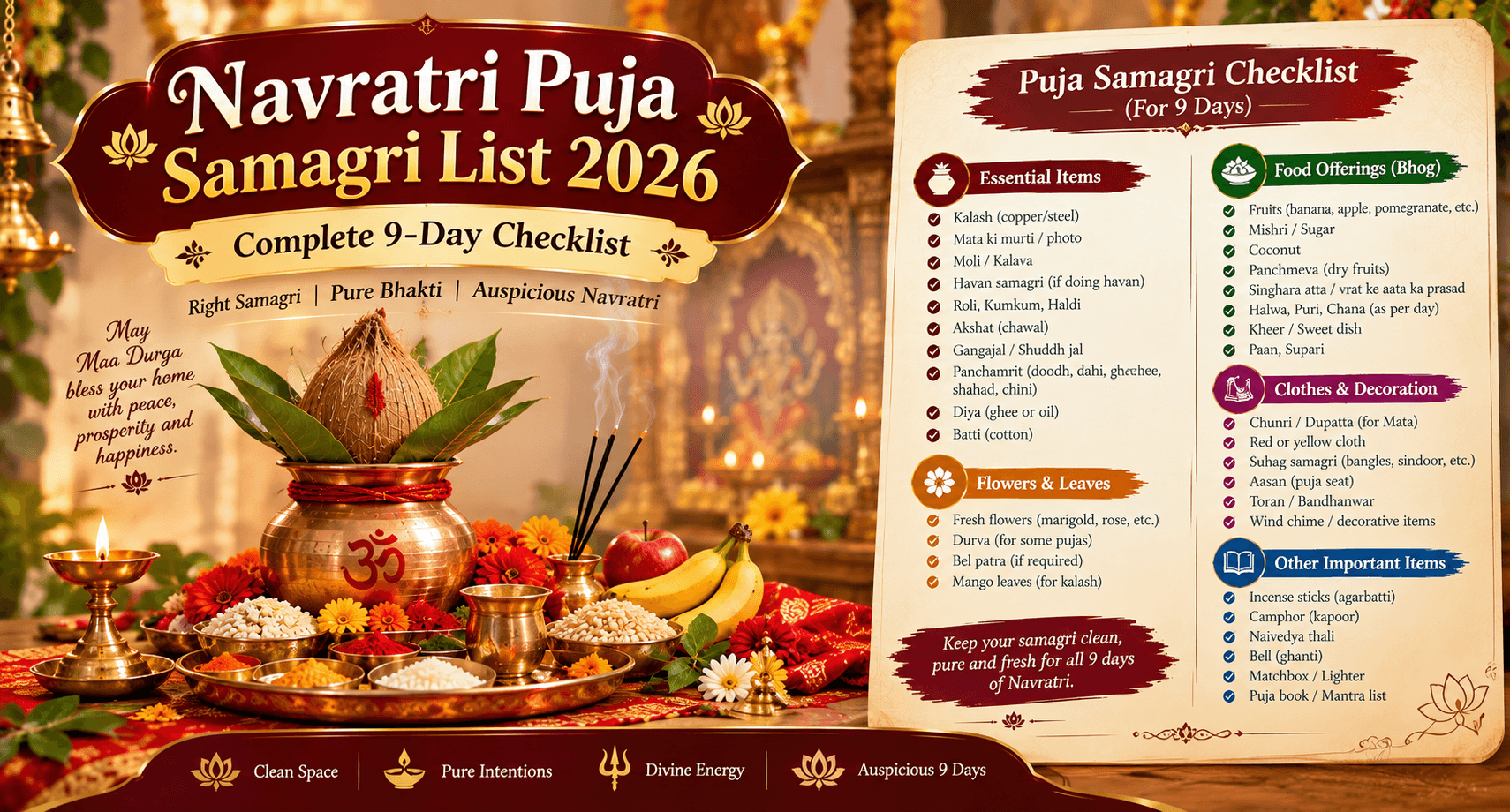
Navratri Puja Samagri List 2026
Before the festival begins, it helps to gather everything in one place rather than searching for a missing item midway through a ritual. The core categories are:
Basic puja items: Durga idol or photo, diya, cotton wicks, oil or ghee, incense, camphor, flowers, garland, kumkum, haldi, akshat, roli or moli, chandan, Gangajal or water, and prasad.
Kalash and Ghatasthapana items: the Kalash itself, water, mango or Ashoka leaves, a coconut, red cloth, moli, akshat, and jau (barley) with soil for sowing, each explained further in the next section.
Bhog and prasad items: fruits, sweets, and dishes such as halwa, puri, and kala chana, which vary by household and are covered in detail separately.
Akhand Jyoti items: a dedicated lamp, ghee or suitable oil, and thicker cotton wicks, for households that keep a continuously burning lamp through the nine days.
Kanya Pujan items: bhog ingredients, dakshina, and small gifts such as chunari or bangles, needed only if the family performs Kanya Pujan.
Havan items: a havan kund, havan samagri, ghee, and fuel, needed only if a Havan is planned.
This is a working summary rather than a full shopping list. The Navratri Puja Samagri List 2026 sets out a complete, printable checklist with quantities and a buying timeline for every category above. (Editor's note: confirm this article's live URL before publishing.)
Ghatasthapana / Kalash Sthapana at Home
Ghatasthapana, also called Kalash Sthapana, is the ritual invocation of Devi's presence performed on the first day of Navratri, generally within a specific muhurat window. In 2026, this falls on Sunday, 11 October.
A basic home setup typically involves:
Placing the Kalash, filled with water, at the puja chowki
Adding a coconut wrapped in red cloth on top of the Kalash
Placing mango or Ashoka leaves around the neck of the Kalash
Sowing jau (barley) seeds in a separate tray of clean soil, kept beside or beneath the Kalash
Tying moli around the neck of the Kalash and applying roli
Daily care: the barley bed should be watered lightly each day, and the Kalash area kept clean through the nine days. A basic precaution worth noting is to keep the Akhand Jyoti, if one is lit nearby, at a safe distance from the barley tray and any dry material.
This is only a summary of the setup. For the exact 2026 muhurat window, the complete step-by-step vidhi, and a full explanation of what is traditionally kept inside the Kalash, see the dedicated Ghatasthapana 2026 guide.
Step-by-Step Navratri Puja Vidhi at Home
A beginner-friendly daily process, followed by most households with only minor variation:
Step 1 — Clean and prepare the puja space. Wipe down the chowki and surrounding area before starting.
Step 2 — Prepare or tend to the Kalash. On day one, complete Ghatasthapana; on later days, simply check that the barley bed and Kalash area remain clean.
Step 3 — Invoke Maa Durga. Light the diya, and mentally or verbally invite the Devi's presence for the day's worship.
Step 4 — Light diya and dhoop. Keep the flame steady and away from any draft.
Step 5 — Offer flowers, akshat, kumkum, and roli. Present each with both hands, generally to the idol or photo rather than eating or handling them casually afterward.
Step 6 — Chant the day's mantra. A short Durga mantra or the specific mantra for that day's form of Devi.
Step 7 — Offer bhog. Present the day's prepared food before the family eats.
Step 8 — Perform aarti. A short aarti, with the household gathered if possible.
Step 9 — Complete the daily puja. Distribute prasad, and close the space until the next day's worship.
9 Days of Navratri Puja: Day-Wise Guide
Each of the nine days of Navratri is dedicated to a different form of the Devi, collectively known as the Navadurga. Traditional details are summarised below; regional and family practices on specific offerings can vary.
Day | Goddess | Main Puja Focus | Suggested Offering | Suggested Mantra |
|---|---|---|---|---|
1 | Maa Shailputri | Invoking strength and new beginnings; day of Ghatasthapana | White flowers, ghee | Om Devi Shailaputryai Namah |
2 | Maa Brahmacharini | Devotion, penance, and self-discipline | Sugar, white flowers | Om Devi Brahmacharinyai Namah |
3 | Maa Chandraghanta | Courage and protection from negativity | Milk, kheer | Om Devi Chandraghantayai Namah |
4 | Maa Kushmanda | Creative energy and vitality | Malpua, pumpkin-based dishes | Om Devi Kushmandayai Namah |
5 | Maa Skandamata | Motherhood, nurturing, protection | Bananas, dishes made with banana | Om Devi Skandamatayai Namah |
6 | Maa Katyayani | Courage and determination | Honey | Om Devi Katyayanyai Namah |
7 | Maa Kalaratri | Removal of ignorance and darkness | Jaggery-based sweets | Om Devi Kalaratryai Namah |
8 | Maa Mahagauri | Purity and forgiveness; Kanya Pujan in many households | Coconut, coconut-based sweets | Om Devi Mahagauryai Namah |
9 | Maa Siddhidatri | Completion, siddhi, and fulfilment | Sesame seeds, halwa-puri-chana | Om Devi Siddhidatryai Namah |
For a page dedicated to each individual form, see Maa Shailputri, Maa Brahmacharini, Maa Chandraghanta, Maa Kushmanda, Maa Skandamata, Maa Katyayani, Maa Kalaratri, Maa Mahagauri, and Maa Siddhidatri.
Navratri Daily Puja Routine
A typical day, followed with variation across households, breaks into three parts:
Morning: clean the space, light the diya, perform the day's puja, chant the mantra, and make the day's offering.
During the day: many devotees continue naam jaap, or read a stotra or chalisa according to family tradition, alongside whatever fasting practice they follow.
Evening: relight the diya if it was extinguished, perform aarti, offer bhog, and close the day with a short prayer.
Families following different regional or personal traditions may add or skip individual steps, and that is entirely normal. For the day-wise mantra tradition in more depth, see the Navratri 2026 Mantra List, and for how the vrat fits around this daily routine, see the Navratri Vrat Rules 2026 guide. (Editor's note: confirm this article's live URL before publishing.)
Navratri Mantra and Aarti
Mantra chanting is included in the daily puja as a way of focusing devotion on the day's form of Devi, alongside the visual and ritual elements of worship. A short, widely used option for daily chanting is a simple Durga mantra such as "Om Dum Durgayei Namah", alongside the day-specific mantra listed in the table above.
Aarti, generally performed at the close of the puja, is treated as a devotional offering of light and sound to the Devi, and most households sing a familiar Durga aarti rather than switching aartis daily. For the complete day-wise mantra list, including how each mantra connects to that day's form of Devi, the Navratri 2026 Mantra List is the fuller resource, rather than reproducing every mantra and its context here.
Navratri Bhog and Prasad
Bhog is generally prepared fresh and offered before the family eats, and what is offered varies considerably across households. Common home-friendly options include fruit, milk-based sweets, halwa, and simple dishes made from vrat-friendly ingredients on fasting days.
Rather than repeating a full nine-day bhog breakdown here, the Navratri 2026 Bhog List sets out the day-by-day tradition tied to each form of Devi in detail. No single regional bhog list should be treated as universally mandatory; families are encouraged to follow their own established custom.
Navratri Vrat and Puja Rules
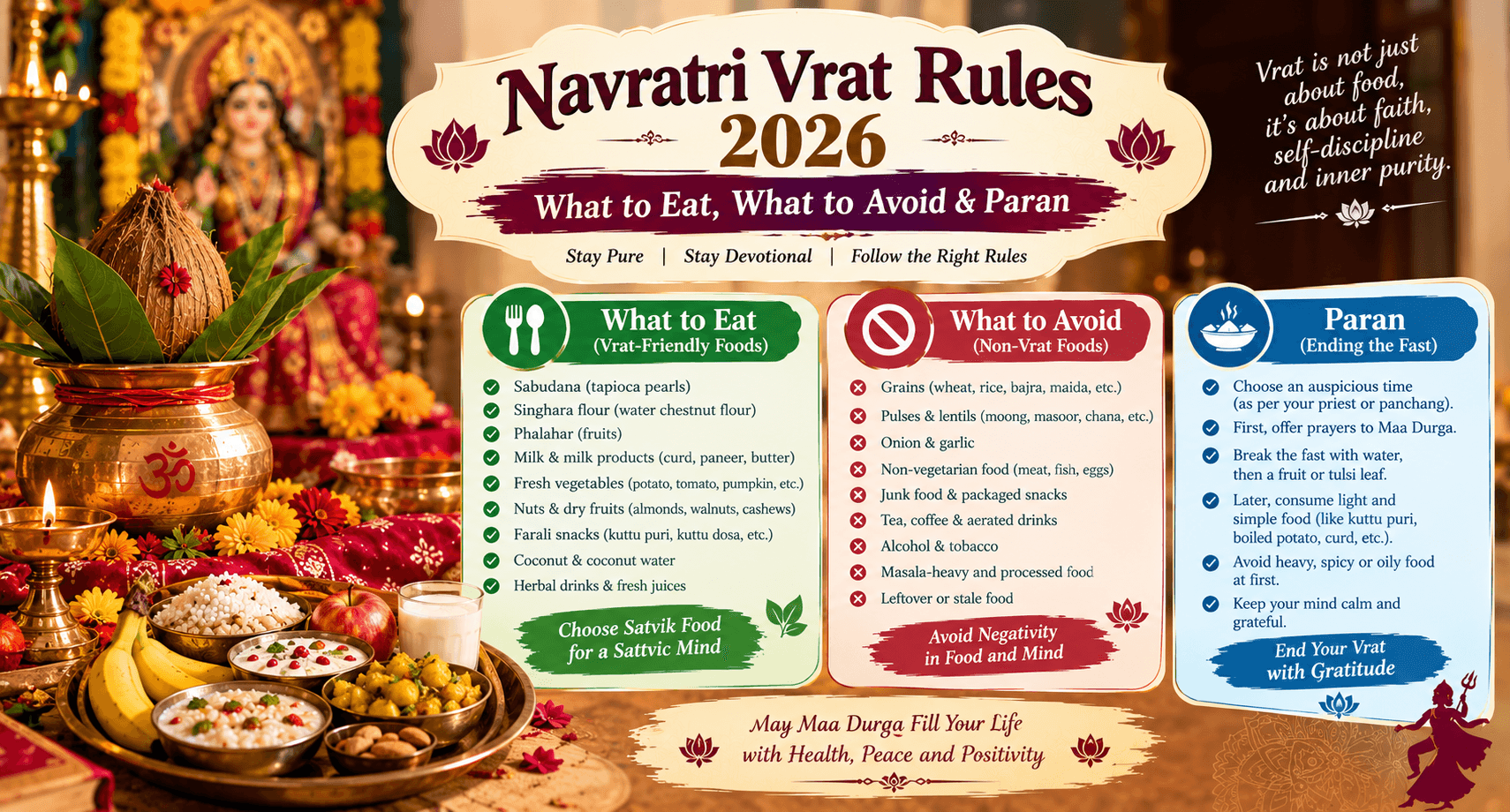
Fasting is traditionally observed by many devotees during Navratri, though it is not a universal requirement of the puja itself. Some households fast for all nine days, others for selected days such as the first and last, and some perform the daily puja without fasting at all.
Commonly followed vrat foods include fruits, dairy, sabudana, kuttu and singhara atta, and samak rice, with sendha namak used in place of regular salt. Foods commonly avoided include wheat, regular rice, pulses, onion, and garlic. Paran, the formal breaking of the fast, is generally performed after Navami or Ashtami, according to family tradition, with the exact timing dependent on the local Panchang.
This is not medical advice, and people with medical conditions, those on regular medication, pregnant or breastfeeding individuals, and anyone advised against fasting should follow appropriate professional guidance rather than treating fasting as mandatory. The Navratri Vrat Rules 2026 guide covers the complete food list, allowed and avoided items, and Paran timing in full detail. (Editor's note: confirm this article's live URL before publishing.)
Ashtami and Navami Special Puja
Ashtami and Navami are generally treated as the most significant days of Navratri in most North Indian households, since they mark the conclusion of the main worship period before Vijayadashami. In 2026, Ashtami falls on Sunday, 18 October, and Navami on Monday, 19 October.
The most distinctive practices on these days include:
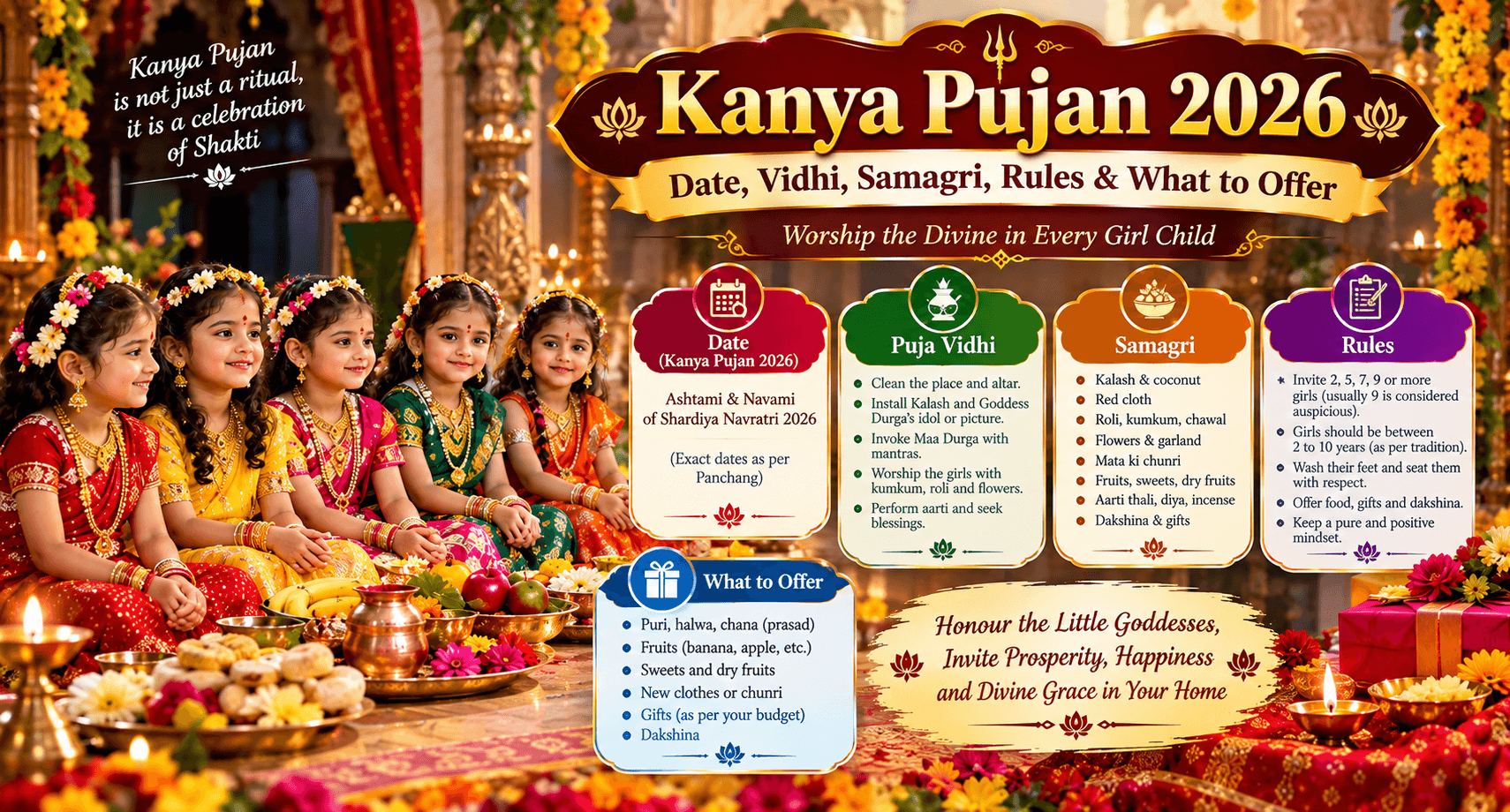
Kanya Pujan, the worship of young girls as living forms of Devi, generally performed on whichever of the two days matches the family's tradition
A more elaborate bhog, often including halwa, puri, and kala chana
Havan, performed by families who include a fire ritual as part of their concluding worship
Paran, the breaking of the fast, for households that have observed a full nine-day vrat
For the complete date breakdown, tithi explanation, and how families choose between the two days, see the Shardiya Navratri 2026 Ashtami and Navami guide, and for the full Kanya Pujan process, age and number guidance, and samagri list, see the dedicated Kanya Pujan 2026 guide. (Editor's note: confirm this article's live URL before publishing.)
Navratri Havan at Home
Havan is traditionally performed by many households on Ashtami or Navami as a concluding fire ritual, offering ahutis (oblations) into a sacred fire alongside mantra chanting.
A basic home Havan generally needs a havan kund or a suitable fireproof vessel, havan samagri, ghee, appropriate fuel, and a coconut for the final purnahuti offering. Because this involves an open flame and specific mantra sequencing, many households prefer to perform a genuinely elaborate Havan under the guidance of a trained priest rather than attempting a complex Vedic or tantric procedure without that experience. A simple home Havan, performed carefully with adequate ventilation and away from anything flammable, is a different undertaking from a fuller Anushthan-style ritual, and it is worth being clear with yourself about which one you are actually planning before starting.
For readers who would prefer a professionally guided Havan rather than arranging one independently, the Maa Baglamukhi Hawan service is conducted under proper Vedic procedure by the temple's Acharya.
What to Do After Navratri
Once Navratri concludes on Vijayadashima, most households wind down the puja setup over the following day or two:
The Kalash water is generally offered to a plant or immersed respectfully, rather than simply discarded
The grown jaware (barley shoots) are often distributed among family members as a symbol of the Devi's blessing, or immersed along with the Kalash water
Remaining prasad is distributed or consumed by the household
The diya and puja items are cleaned and put away for future use
Some families perform a small concluding prayer or visarjan-style ritual before dismantling the setup
Exactly how this is done differs by region and family, and no single method should be treated as the only correct way to conclude the festival.
Common Mistakes During Navratri Puja at Home
Starting Ghatasthapana without having the full samagri ready in advance
Confusing Ghatasthapana, a one-time ritual, with the ongoing daily Kalash care needed afterward
Ignoring the local Panchang and assuming a muhurat quoted for another city applies universally
Treating one regional tradition, such as a specific bhog or samagri list, as the only correct version
Treating optional practices, such as an elaborate Havan or a nine-day strict fast, as mandatory
Handling fire carelessly during Havan, without adequate space or ventilation
Copying mantras from an unreliable source without understanding basic pronunciation
Overcomplicating what can, for most households, remain a simple and sincere daily puja
Can Navratri Puja Be Done Without a Priest?
Yes, simple home worship, including the daily puja, Ghatasthapana, and even Kanya Pujan, is generally performed by devotees themselves according to their family tradition, without requiring a priest. More elaborate rituals, particularly a full Havan, Anushthan, or a specialized Puja tied to a specific deity or purpose, often benefit from the guidance of a trained priest who can ensure the mantra sequencing and ritual steps are followed correctly.
There is no exaggerated claim to make here either way: a sincerely performed home puja is considered complete in its own right, and a guided ritual is simply a different, more elaborate option for those who want it.
Can Baglamukhi Puja Be Performed During Navratri?
Navratri is traditionally regarded as a significant window for Shakti worship, and for many devotees this extends to the ten Mahavidyas, of which Maa Baglamukhi is one. The daily Navadurga puja described throughout this guide does not require any additional ritual to be complete on its own. For devotees who already hold a personal or family connection to Maa Baglamukhi, however, Navratri, and particularly Ashtami or Navami, is a period when a dedicated Maa Baglamukhi Puja or Maa Baglamukhi Hawan is commonly performed, with proper Sankalp guided by an Acharya.
Devotees seeking this specific ritual can book a puja online or consult the temple's Acharya beforehand to plan the timing and Sankalp appropriately. This is offered as a devotional option for those already inclined toward Baglamukhi worship, not as a requirement of Navratri itself, and no puja or havan is presented here as guaranteeing any specific outcome, whether that is removing a problem, winning a legal matter, or gaining wealth.
Frequently Asked Questions
Can Navratri Puja be done at home?
Yes, Navratri Puja, including Ghatasthapana, the daily routine, and Kanya Pujan, is very commonly performed at home and does not require a temple setting.
How to perform Navratri Puja at home?
Clean the puja space, prepare the samagri, perform Ghatasthapana on day one, then follow a daily routine of worship, mantra, bhog, and aarti dedicated to each day's form of Devi across the nine days.
What are the essential Navratri Puja items?
A Durga idol or photo, diya, oil or ghee, cotton wicks, incense, roli, akshat, flowers, fruits, and a Kalash if Ghatasthapana is performed form the practical core.
What should be kept in the Navratri Kalash?
Water, often with Gangajal, along with items such as a coin, akshat, turmeric, and betel nut, according to family tradition. The full Ghatasthapana guide covers this in detail.
Can we perform Navratri Puja without a priest?
Yes, for the standard daily home puja and Ghatasthapana. A trained priest is more commonly involved for elaborate rituals such as a full Havan or a specialized Anushthan.
What should we do every day during Navratri?
A morning routine of cleaning, diya, puja, and mantra, followed by an evening aarti and bhog offering, repeated with the day's specific form of Devi in mind.
When does Navratri 2026 begin?
Shardiya Navratri 2026 begins on Sunday, 11 October, according to the Panchang followed across most of North and Central India.
What is the difference between Ghatasthapana and daily Kalash worship?
Ghatasthapana is the one-time invocation ritual performed on day one; daily Kalash worship afterward is simply ongoing care, such as watering the barley bed and keeping the area clean.
Do I need to fast for the full 9 days?
No, fasting practices vary; some households fast all nine days, others only on select days, and some do not fast at all while still performing the daily puja.
What is offered as bhog during Navratri?
Fruits, milk-based sweets, and dishes such as halwa, puri, and kala chana are common, though the specific bhog varies by family and region.
When is Kanya Pujan performed in 2026?
On Ashtami (18 October) or Navami (19 October) 2026, depending on family tradition.
Is Havan compulsory during Navratri?
No, Havan is performed by some households, typically on Ashtami or Navami, but it is not a requirement of the core Navratri puja.
What mantra should be chanted during Navratri Puja?
A simple Durga mantra, such as "Om Dum Durgayei Namah", along with the specific mantra for that day's form of Devi, is commonly chanted.
What is the significance of each of the 9 days?
Each day is dedicated to a different form of the Navadurga, moving from Shailputri on day one through to Siddhidatri on day nine, each associated with a different aspect of the Devi's power.
What should be done after Navratri ends?
The Kalash water and jaware are generally offered respectfully or immersed, remaining prasad distributed, and puja items cleaned and stored, though the exact method varies by family.
Can Navratri Puja be performed by a single person, without family present?
Yes, the daily puja can be performed individually; several steps, such as aarti or Kanya Pujan, are simply easier or more traditional with family present, but this does not make individual worship invalid.
Is it necessary to buy a new idol or photo of Durga every year?
No, this is not a general requirement; many households reuse the same idol or photo across years, keeping it stored respectfully between festivals.
Can working professionals manage the daily Navratri Puja routine? Yes, many households simplify the daily routine to a shorter morning or evening puja that fits around work, since sincerity and consistency matter more than the length of the ritual.
What if I make a small mistake during the puja?
Occasional small mistakes are generally not treated as invalidating the worship; most traditions emphasise sincere intent over flawless execution.
Can Baglamukhi Puja be combined with regular Navratri worship? Yes, for devotees who already have a connection to Maa Baglamukhi, a dedicated Puja or Havan can be planned alongside the regular Navratri routine, typically around Ashtami or Navami.
Conclusion
Navratri Puja at home does not need to be complicated. A clean space, the right samagri gathered in advance, a properly performed Ghatasthapana, and a consistent daily routine of worship, mantra, and bhog cover the essentials for most households. Where a specific part of the worship, whether Kalash Sthapana, the vrat, Kanya Pujan, or Havan, calls for more detail, the dedicated guides linked throughout this article take you further. For devotees who would also like a guided Puja or Havan performed as part of this year's Navratri, the temple's Maa Baglamukhi Puja and Havan services remain available throughout the festival.
Acharya Tiwari Chetan Guru
Siddha Peethadheesh & Head Vedic Scholar
With over 15+ years of unbroken Vedic practice at Maa Baglamukhi Siddha Peeth, Nalkheda, Acharya Ji is a globally authoritative voice on Tantra Shastra, Stambhan Vidya, and Karmic Astrology. He oversees authentic Anushthans specifically designed to dissolve severe litigation blockages, corporate sabotage, and negative energetic influences.