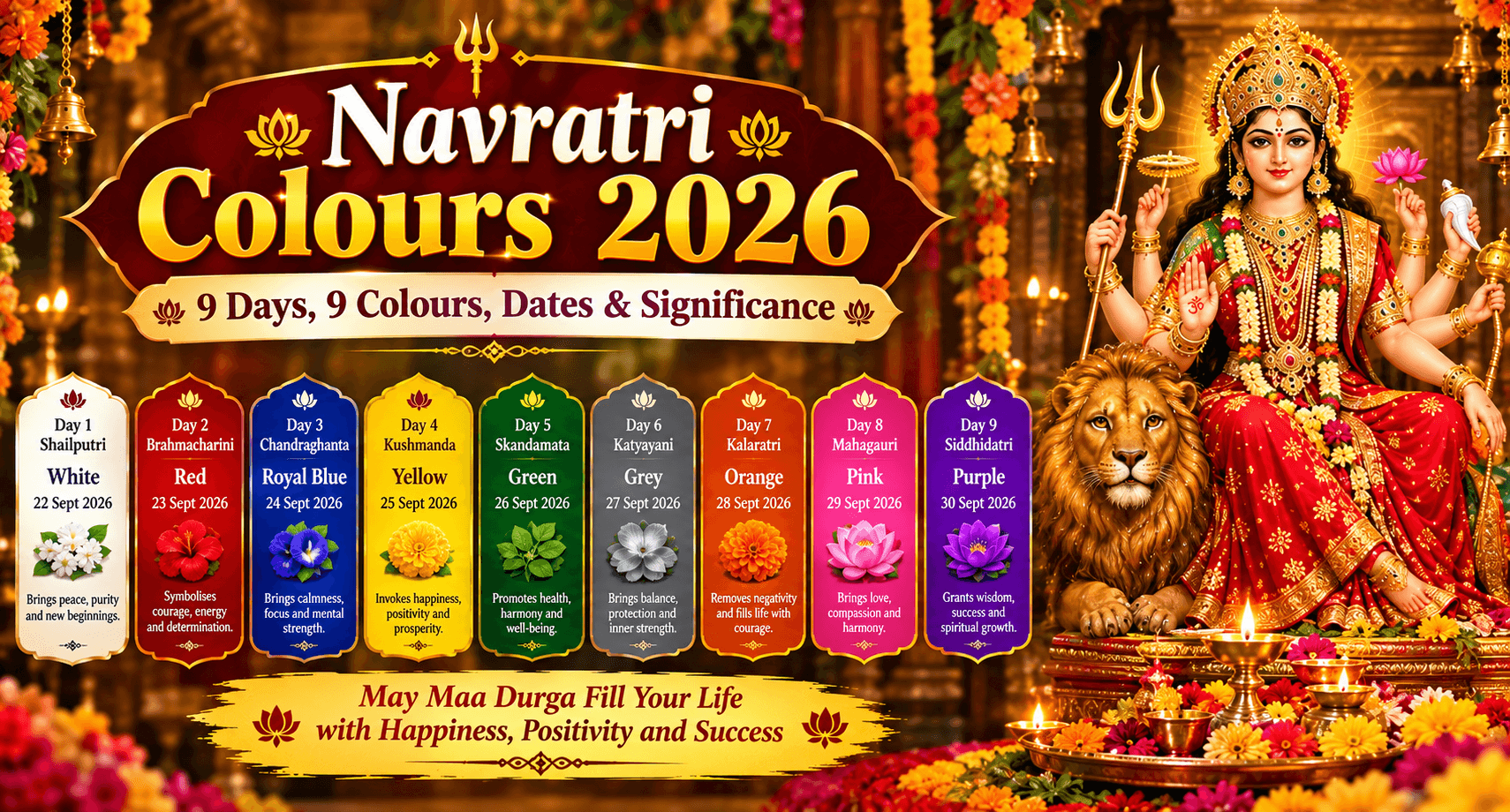
Quick Answer — Navratri Colours 2026 at a Glance
Shardiya Navratri 2026 begins on Sunday, 11 October 2026 with Ghatasthapana and the nine-day colour observance runs until Monday, 19 October 2026, followed by Vijayadashami (Dussehra) on Tuesday, 20 October 2026.
The nine Navratri colours for 2026, in order, are:
Orange → White → Red → Royal Blue → Yellow → Green → Grey → Purple → Peacock Green
Because Navratri 2026 opens on a Sunday, the sequence begins with orange. The colour of each day is tied to the weekday, not to a fixed festival day number — which is exactly why the list changes from one year to the next. Wearing the colour of the day is a much-loved cultural custom, not a scriptural requirement, and devotees are free to follow it in whatever way suits their family tradition.
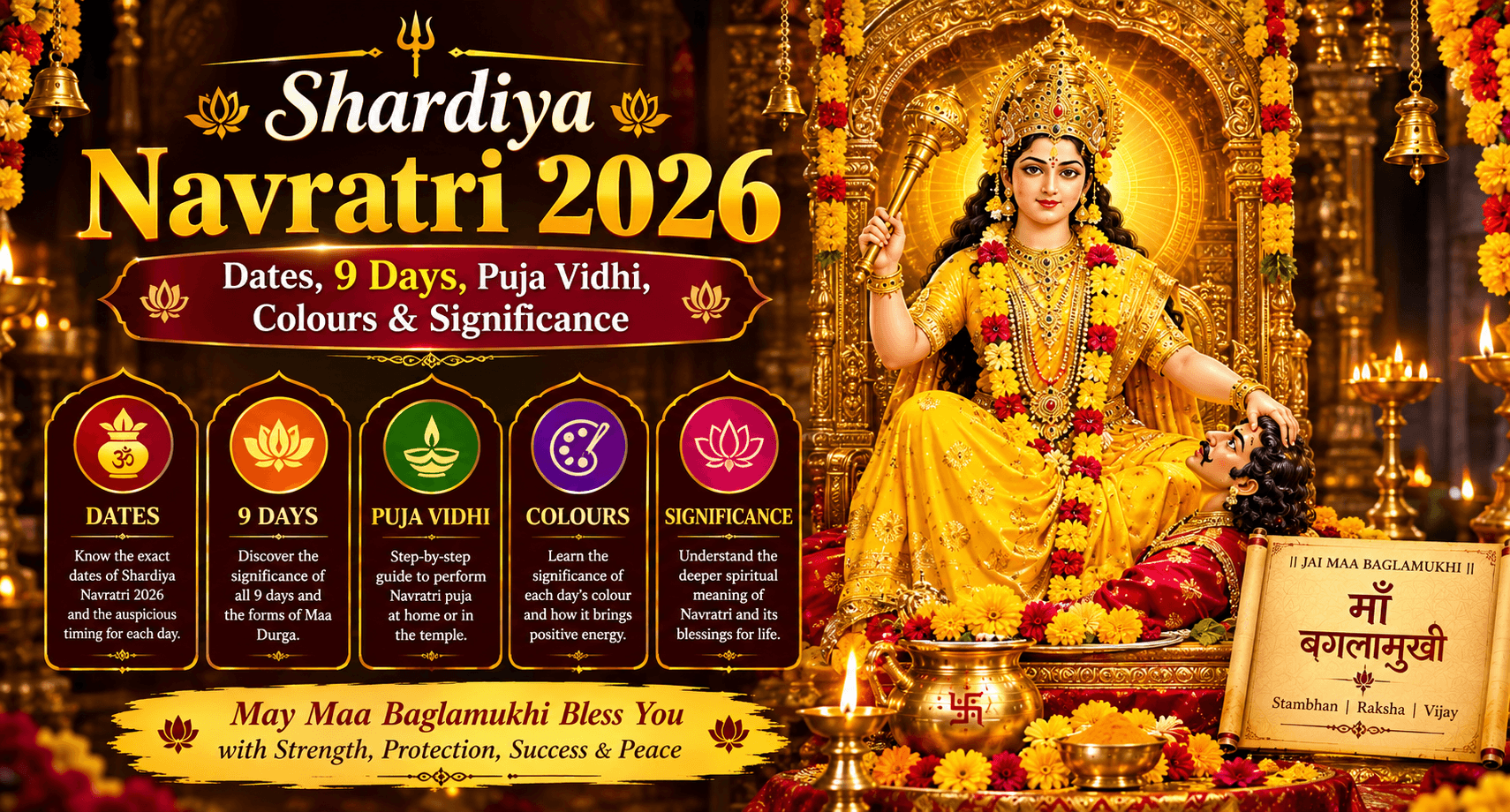
If you are planning the full nine days of worship rather than only the wardrobe, our complete guide to Shardiya Navratri 2026 dates, 9 days and puja vidhi covers the rituals, fasting practice and day-wise worship in detail.
Navratri Colours 2026 — 9 Days, 9 Colours & Dates
Day | Date | Day of Week | Navratri Colour | Goddess Worshipped |
|---|---|---|---|---|
Day 1 | 11 October 2026 | Sunday | Orange | Maa Shailputri (Ghatasthapana) |
Day 2 | 12 October 2026 | Monday | White | Maa Brahmacharini |
Day 3 | 13 October 2026 | Tuesday | Red | Maa Chandraghanta |
Day 4 | 14 October 2026 | Wednesday | Royal Blue | Maa Kushmanda |
Day 5 | 15 October 2026 | Thursday | Yellow | Maa Skandamata |
Day 6 | 16 October 2026 | Friday | Green | Maa Katyayani |
Day 7 | 17 October 2026 | Saturday | Grey | Maa Kalaratri |
Day 8 | 18 October 2026 | Sunday | Purple | Maa Mahagauri (Durga Ashtami) |
Day 9 | 19 October 2026 | Monday | Peacock Green | Maa Siddhidatri (Maha Navami) |
Day 10 | 20 October 2026 | Tuesday | — | Vijayadashami / Durga Visarjan |
A note worth reading before you print this table. Navratri days follow the lunar tithi, not the clock, so a few panchangs place the Ashtami vrat on 19 October instead of 18 October because the Ashtami tithi is still running at sunrise that morning. The colour order itself is not affected. Confirm the vrat date with the panchang your family or temple follows, particularly if you are observing outside India.
Each of the nine forms has her own worship practice, offerings and mantra. You can read them one by one on our dedicated pages, beginning with Maa Shailputri on Day 1 and continuing through the full Shardiya Navratri nine-day section.
What Are the 9 Navratri Colours in 2026?
The nine colours of Navratri 2026 are orange, white, red, royal blue, yellow, green, grey, purple and peacock green.
Seven of these belong to the seven weekdays. In the traditional colour calendar followed widely across Gujarat, Maharashtra and North India, Sunday is orange, Monday white, Tuesday red, Wednesday royal blue, Thursday yellow, Friday green and Saturday grey. Each weekday is associated with a ruling graha, and the colour is drawn from that association.
Navratri, however, runs for nine days. Once the seven weekday colours are used up, two additional shades — purple and peacock green — complete the cycle. That is why the last two days of any Navratri always carry colours outside the weekday set, and why 2026 closes on peacock green.
Popular tradition or religious rule?
This distinction matters, and most colour listicles skip it.
The worship of the Navadurga across nine nights, the Ghatasthapana, the fast, the Durga Saptashati path and the Navami havan are rooted in long-standing shastra-based practice. The nine-colour dress calendar is a cultural custom that grew popular through community celebrations, Garba groups, newspapers and, more recently, social media. It is a joyful way to participate. It is not a condition for the Goddess to accept your prayer.
So follow the colours if they add meaning to your days. Skip them without guilt if they do not. What the tradition asks of a devotee during Navratri is sincerity, cleanliness, regularity of worship and restraint — not a new outfit every morning.
Navratri Colours 2026 — Day-Wise Meaning & Significance
Day 1 — Orange (Sunday, 11 October 2026)
The first day belongs to Maa Shailputri, the daughter of the Himalayas, worshipped as the steady, grounded first form of the Goddess. Orange carries warmth, enthusiasm and the energy of the rising sun — a fitting shade for a beginning.
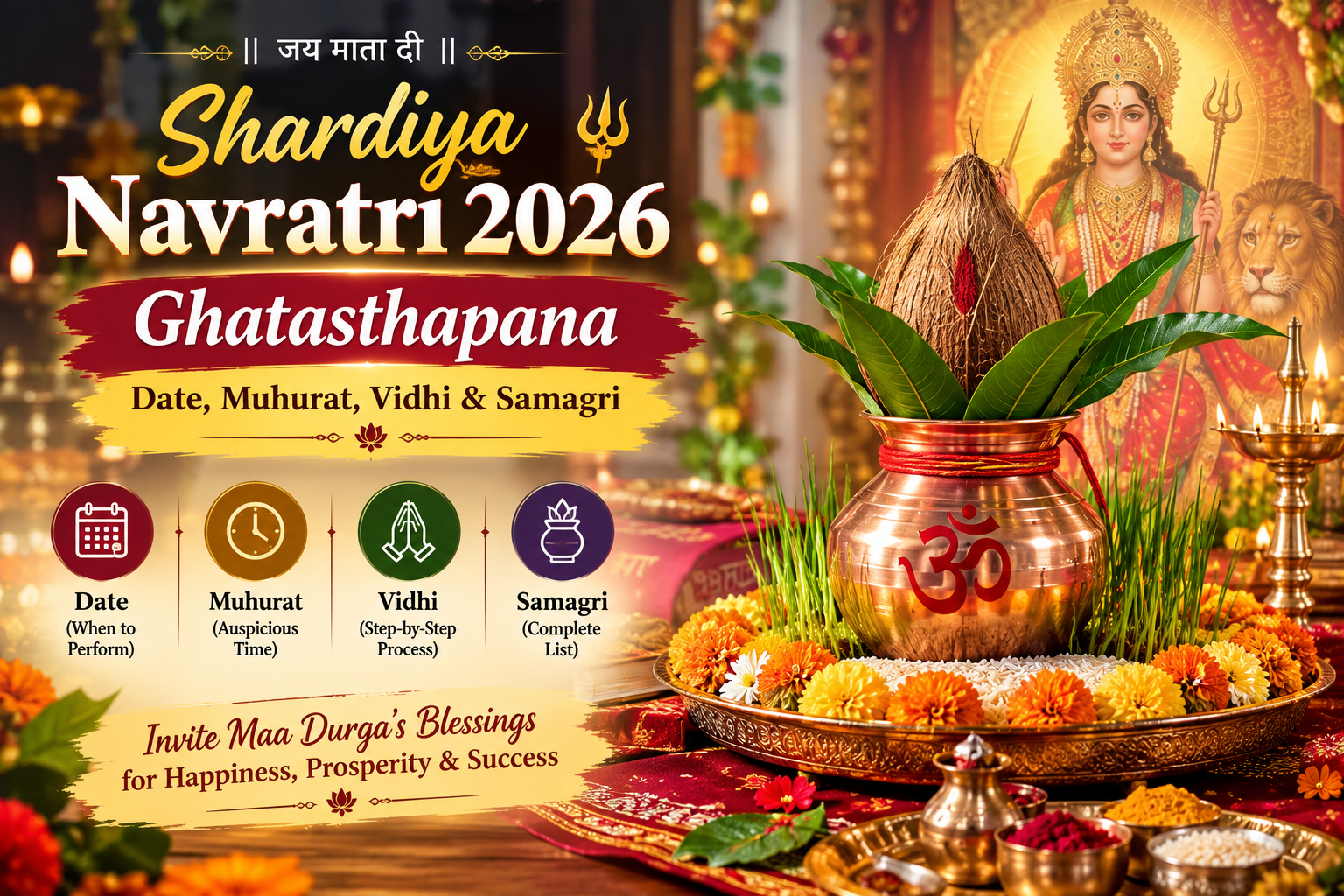
This is also the day of Ghatasthapana, when the kalash is installed and the Goddess is invoked into the home. Devotees commonly wear orange or saffron for the morning puja and bring the colour into the mandir through marigold garlands. If you are setting up the kalash this year, our step-by-step guide to Ghatasthapana 2026 muhurat, vidhi and samagri covers the timing and the samagri list, and the Day 1 Maa Shailputri page explains her worship.
Day 2 — White (Monday, 12 October 2026)
Maa Brahmacharini represents tapasya, discipline and unwavering devotion. White stands for purity, peace and clarity of mind — the quality a devotee needs on the second day, when the fast settles in and the routine of daily worship takes shape. A simple white kurta, saree or dupatta suits the mood of the day. Many families keep the mandir deliberately plain on this day. Her worship is detailed on our Day 2 Maa Brahmacharini page.
Day 3 — Red (Tuesday, 13 October 2026)
Red is the colour most closely associated with Devi worship in Indian tradition. It is the shade of the chunri offered at the temple, of sindoor, and of the shakti that Maa Chandraghanta carries — the warrior form with the half-moon on her forehead.
Red signifies courage, vitality and auspiciousness. Practically, it is also the safest colour if you ever lose track of the sequence, since red is dear to the Goddess on any day of Navratri. See the Day 3 Maa Chandraghanta page for her mantra and offerings.
Day 4 — Royal Blue (Wednesday, 14 October 2026)
Maa Kushmanda is revered as the form whose smile brought the universe into being. Royal blue suggests depth, richness and a calm that balances the intensity of the previous day. It is a colour that reads as dignified rather than festive, which many devotees find suits the middle of the nine days. Upang Lalita Vrat also falls on this date in 2026. Read more on the Day 4 Maa Kushmanda page.
Day 5 — Yellow (Thursday, 15 October 2026)
Maa Skandamata, the mother of Kartikeya, is worshipped in her nurturing aspect. Yellow is brightness, optimism and the warmth associated with learning and growth. Households often use yellow flowers and a yellow cloth beneath the kalash on this day, and many prepare a sweet bhog. Her worship is described on the Day 5 Maa Skandamata page.
Day 6 — Green (Friday, 16 October 2026)
Maa Katyayani is the fierce, victorious form born of the collective tejas of the devas. Green stands for growth, harmony and new beginnings. In 2026, Saraswati Avahan also falls on this date, which is why many South Indian households begin their Saraswati observance here. Details are on the Day 6 Maa Katyayani page.
Day 7 — Grey (Saturday, 17 October 2026)
Maa Kalaratri is the most fearsome of the nine forms, worshipped as the destroyer of fear, darkness and negative influence. Grey represents balance, groundedness and the dissolving of what no longer serves. It is a restrained colour for a powerful day.
Saptami is traditionally an important night for protective worship, and many devotees at Nalkheda choose this window for Maa Baglamukhi havan seeking relief from obstacles and hostility. The Day 7 Maa Kalaratri page explains her worship in full.
Day 8 — Purple (Sunday, 18 October 2026)
Maa Mahagauri is worshipped on Durga Ashtami as the serene, luminous form who grants peace after penance. Purple signifies nobility, grandeur and spiritual richness — a shade many devotees save for the most elaborate puja of the nine days.
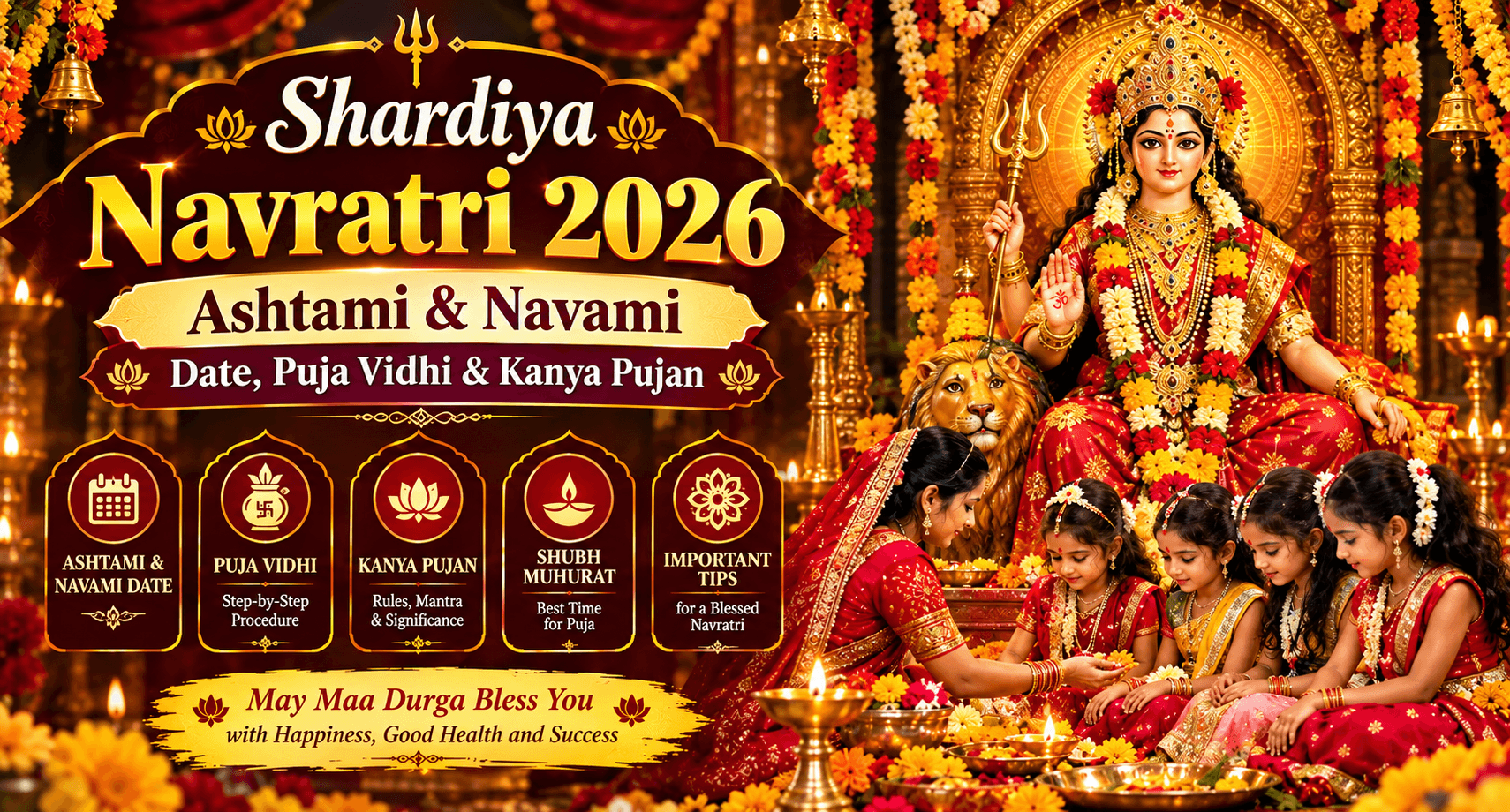
Ashtami is the day of Sandhi Puja in the eastern tradition and, in many homes, of Kanya Pujan. Worship guidance for the day is on the Day 8 Maa Mahagauri page.
Day 9 — Peacock Green (Monday, 19 October 2026)
Maa Siddhidatri, the bestower of siddhis, completes the Navadurga. Peacock green blends blue and green and is read as a colour of uniqueness, fulfilment and completion. Maha Navami in 2026 also carries Ayudha Puja and Navami Homa, which makes it the most common day for the concluding havan. See the Day 9 Maa Siddhidatri page for the closing rituals.
Why Do People Wear Different Colours During Navratri?
Colour has always carried meaning in Indian devotional life — the red chunri, the yellow cloth of a Thursday vrat, the white of a renunciate. The Navratri colour calendar extends that instinct across nine days.
Four reasons explain why the custom spread so widely:
Symbolism. Each shade maps to a quality — courage, purity, growth, balance — that devotees consciously bring to mind during the day's worship.
Participation. Wearing the colour is a small daily act that keeps the festival present even for people working full days away from home.
Community. Garba groups, offices, housing societies and families coordinate colours. In Gujarat and Maharashtra especially, this became a visible part of the celebration.
Continuity. Newspapers and almanacs have published the year's colour list before Navratri for decades, and the habit passed down through households.
What the custom does not promise is a specific outcome. No colour guarantees wealth, a job, a court verdict or a cure. Treat the practice as an expression of devotion, not a transaction.
Is Wearing the Navratri Colour Compulsory?
No. Wearing the Navratri colour of the day is not compulsory.
There is no shastra that requires a devotee to wear a prescribed colour on a given day of Navratri, and no tradition treats a missed colour as a lapse in the vrat. Families that have followed the practice for generations may keep it strictly; others ignore it entirely and observe an equally complete Navratri.
If you would like to participate without rearranging your wardrobe, a dupatta, chunri, bangles, a rangoli, a handkerchief or a flower in the day's shade is enough. And when in doubt on any day, red or yellow is always appropriate for Devi worship.
The parts of Navratri that tradition does emphasise are different: performing Ghatasthapana at the right muhurat, keeping the puja space clean, maintaining the daily worship and fast honestly, avoiding harsh speech and conduct, and completing the observance with the closing havan and parana.
Navratri Colours 2026 With 9 Devi Names
Day | Goddess | Colour | Main Significance |
|---|---|---|---|
1 | Maa Shailputri | Orange | Grounding, beginning, awakening of worship |
2 | Maa Brahmacharini | White | Discipline, purity, steadiness of mind |
3 | Maa Chandraghanta | Red | Shakti, courage, auspiciousness |
4 | Maa Kushmanda | Royal Blue | Depth, creative energy, calm |
5 | Maa Skandamata | Yellow | Nurture, optimism, learning |
6 | Maa Katyayani | Green | Growth, harmony, new beginnings |
7 | Maa Kalaratri | Grey | Removal of fear and negativity, balance |
8 | Maa Mahagauri | Purple | Serenity, nobility, spiritual richness |
9 | Maa Siddhidatri | Peacock Green | Fulfilment, siddhi, completion |
Which Colour Should You Wear on Each Day of Navratri 2026?
A one-line answer for each day, for quick reference:
Navratri Day 1 colour (11 Oct, Sunday): Orange — worn for Ghatasthapana and Shailputri puja.
Navratri Day 2 colour (12 Oct, Monday): White — for Brahmacharini and a quiet, disciplined day.
Navratri Day 3 colour (13 Oct, Tuesday): Red — the classic Devi shade, worn for Chandraghanta.
Navratri Day 4 colour (14 Oct, Wednesday): Royal Blue — for Kushmanda puja.
Navratri Day 5 colour (15 Oct, Thursday): Yellow — for Skandamata and the bhog of the day.
Navratri Day 6 colour (16 Oct, Friday): Green — for Katyayani and Saraswati Avahan.
Navratri Day 7 colour (17 Oct, Saturday): Grey — for Kalaratri, the protective night.
Navratri Day 8 colour (18 Oct, Sunday): Purple — for Mahagauri and Durga Ashtami.
Navratri Day 9 colour (19 Oct, Monday): Peacock Green — for Siddhidatri and Maha Navami.
On Vijayadashami (20 October) there is no fixed colour in the nine-day calendar. Most households simply wear new or festive clothes, with red, orange and yellow being the usual choice.
Navratri Colours for Puja, Dupatta, Chunri & Home Decoration
The colour tradition is easiest to follow when you stop thinking of it as clothing alone.
Clothing. A full outfit works, but a dupatta, stole, shirt, kurta or saree border in the day's shade does just as well. Many working devotees keep nine dupattas and rotate them.
Chunri and mandir cloth. The chunri offered to the Goddess is traditionally red; you need not change it daily. What you can change is the asan cloth beneath the kalash or the small cloth draped over the chowki, which is an easy way to bring the day's colour into worship.
Flowers. Marigold for orange and yellow days, white chrysanthemum or mogra for Day 2, red hibiscus and roses for Day 3 — hibiscus is particularly dear to Devi worship. Fresh flowers are always preferred over artificial ones in the mandir.
Rangoli and decoration. A rangoli at the entrance in the day's colour, coloured torans, or simply a diya arrangement set on cloth of that shade keeps the colour visible without expense.
Puja thali. Even a coloured cloth under the thali, or coloured bangles placed as an offering, counts. Keep the essentials — kalash, jyoti, incense, naivedya — unchanged.
One practical caution: do not change or move the kalash, the jyoti or the sowed jau to suit a colour scheme. Those are placed once at Ghatasthapana and stay undisturbed through the nine days.
Navratri Colours for Ashtami & Navami 2026
Durga Ashtami 2026 falls on Sunday, 18 October, with purple as the colour of the day. Maha Navami falls on Monday, 19 October, with peacock green.
These are the two days most families mark with the fullest worship — Kanya Pujan, Sandhi Puja in the eastern tradition, Ayudha Puja and the Navami homa. If your panchang observes the Ashtami vrat on 19 October because of the tithi position at sunrise, keep the vrat by your panchang and the colour by the calendar date; the two are independent customs and neither disturbs the other.
The detailed worship for these days, including the offerings and mantras, is covered on the Maa Mahagauri Ashtami page and the Maa Siddhidatri Navami page, and the full nine-day ritual sequence is set out in the Shardiya Navratri 2026 guide. For devotees who conclude the nine days with a fire ritual, our note on why Navratri is considered the most powerful time for a Baglamukhi havan explains the traditional reasoning, and the nine-day significance of the Navratri havan breaks it down day by day.
Navratri Colours and Regional Traditions
The nine-colour calendar is followed enthusiastically in some regions and barely noticed in others. Presenting it as a pan-Indian rule would be inaccurate.
Gujarat. The strongest association. Garba and dandiya nights are organised around the colour of the day, and chaniya cholis are coordinated across whole communities. Much of the popular momentum behind the colour tradition comes from here.
Maharashtra. Widely followed, particularly in Mumbai and Pune, where the colour list is published in newspapers before the festival and worn to workplaces. The custom gained its modern visibility largely through Maharashtra's press.
North India (UP, MP, Rajasthan, Delhi, Haryana, Bihar). Observed casually rather than strictly. Households give more weight to the Ghatasthapana muhurat, the daily path, the Ashtami or Navami Kanya Pujan and the havan. Many families here follow a single colour association — red or yellow for Devi — instead of nine.
West Bengal, Odisha and the East. Durga Puja follows its own calendar of Shashthi to Dashami with traditions such as Navpatrika, Sandhi Puja, Dhunuchi and Sindoor Khela. The nine-colour dress list has little place in it; the red-and-white saree of Dashami is the far stronger colour custom.
South India. Navratri centres on Golu, the Saraswati Puja and Ayudha Puja. Colour customs are followed in some families, but the weekday list is not a primary tradition.
The practical takeaway: follow your own family, region and temple practice. None of these traditions is a lesser Navratri than the others.
Devi Worship at Nalkheda Siddha Peeth During Navratri
Alongside the household colour customs, Navratri is the period when devotees travel to Devi shrines for specific, structured worship. At the Maa Baglamukhi Temple, Nalkheda, one of the most revered Siddha Peeths of the Dasha Mahavidya tradition, the nine days see a marked rise in anushthan and havan performed under acharya guidance.
Maa Baglamukhi is worshipped within the Dasha Mahavidya tradition as the stambhana shakti — the power that stills hostility and obstruction. Devotees facing prolonged litigation, opposition, professional obstruction or persistent negativity traditionally undertake Maa Baglamukhi Puja or a nine-day anushthan during this period, with the sankalp taken on the first day and the concluding havan on Navami.
If you are considering it for the first time, our guide to Maa Baglamukhi Navratri puja at Nalkheda, its rituals and significance explains what the ritual actually involves, and the comparison of a single-day puja versus a nine-day anushthan helps you judge which is appropriate. Devotees planning to travel can check the Nalkheda temple timings and the Nalkheda darshan guide before the Navratri rush.
Frequently Asked Questions About Navratri Colours 2026
1. What are the 9 colours of Navratri 2026?
Orange, white, red, royal blue, yellow, green, grey, purple and peacock green, in that order from Day 1 to Day 9. The sequence applies to 11–19 October 2026. It begins with orange because Shardiya Navratri 2026 starts on a Sunday, and the first seven colours follow the weekdays.
2. When does Shardiya Navratri 2026 start and end?
Shardiya Navratri 2026 begins on Sunday, 11 October 2026 with Ghatasthapana and the nine days conclude on Monday, 19 October 2026 with Maha Navami. Vijayadashami, or Dussehra, falls on Tuesday, 20 October 2026. Tithi timings vary slightly by city, so confirm with your local panchang.
3. What is the Navratri colour for Day 1 in 2026?
Orange, on Sunday, 11 October 2026, the day of Ghatasthapana and Maa Shailputri puja. Orange is associated with warmth, enthusiasm and the energy of a beginning. Many devotees wear orange or saffron for the morning kalash sthapana and add marigold flowers to the mandir.
4. What is the Navratri colour for Day 2?
White, on Monday, 12 October 2026, for Maa Brahmacharini. White signifies purity, peace and mental clarity, matching the discipline and tapasya that this form of the Goddess represents. A plain white kurta, saree or dupatta is the usual choice.
5. Which colour should I wear on Navratri Day 3?
Red, on Tuesday, 13 October 2026, for Maa Chandraghanta. Red represents shakti, courage and auspiciousness, and it is the colour of the chunri traditionally offered to the Goddess. It is also the safest choice on any Navratri day if you lose track of the sequence.
6. How are Navratri colours decided?
The colour of each day follows the weekday it falls on — Sunday orange, Monday white, Tuesday red, Wednesday royal blue, Thursday yellow, Friday green, Saturday grey. Since Navratri has nine days and a week has seven, two extra shades, purple and peacock green, complete the last two days.
7. Do Navratri colours change every year?
Yes. The nine shades stay the same, but which colour lands on which festival day shifts each year because Navratri begins on a different weekday. In 2026 the festival starts on Sunday, so the order opens with orange. A year beginning on a Monday would open with white.
8. Is wearing the Navratri colour compulsory?
No. It is a cultural and festive tradition, not a religious requirement, and no scripture prescribes it. Devotees follow it according to family, regional or personal practice. Missing a colour does not affect your vrat or your puja in any way.
9. Can I wear a different colour during Navratri?
Yes, freely. Many devotees wear red or yellow throughout the nine days, since both are traditionally associated with Devi worship. What matters more is that clothes are clean and modest, particularly when entering a temple or sitting for puja.
10. What is the Navratri colour for Ghatasthapana 2026?
Orange, since Ghatasthapana falls on Sunday, 11 October 2026. It is customary to wear clean, preferably new or freshly washed clothes for the kalash sthapana. The colour is optional; performing the ritual within the correct muhurat is the part that tradition emphasises.
11. Which colour should be worn on Ashtami 2026?
Purple, on Sunday, 18 October 2026, the day of Durga Ashtami and Maa Mahagauri puja. Purple is associated with nobility, serenity and spiritual richness. If your panchang observes the Ashtami vrat on 19 October instead, keep the vrat by the panchang and the colour by the date.
12. Which colour should be worn on Navami 2026?
Peacock green, on Monday, 19 October 2026, for Maha Navami and Maa Siddhidatri. Peacock green blends blue and green and signifies fulfilment and completion — appropriate for the concluding day, which also carries Ayudha Puja and the Navami homa in many traditions.
13. What is the Navratri colour for Kanya Pujan?
Kanya Pujan has no separate colour of its own. It follows the colour of the day it is performed on — purple if you do it on Ashtami, 18 October 2026, or peacock green on Navami, 19 October 2026. Many families dress the invited kanyas in red, which is customary rather than prescribed.
14. Which colour is associated with Maa Durga?
Red is the colour most closely associated with Devi worship across India — the chunri, the sindoor and the shringar are traditionally red. Within the nine-day calendar, red is assigned to whichever day falls on a Tuesday, which in 2026 is Day 3, 13 October.
15. Are Navratri colours the same in every state?
No. The nine-colour calendar is followed most closely in Gujarat and Maharashtra, casually in North India, and hardly at all in Bengal and Odisha, where Durga Puja has its own customs such as Sindoor Khela. South Indian Navratri centres on Golu, Saraswati Puja and Ayudha Puja instead.
16. What is the significance of Navratri colours?
Each shade is read as a quality of the Goddess worshipped that day — courage, purity, growth, balance, completion. Wearing it is a way of keeping that quality in mind through the day. The colours carry symbolic meaning; they are not believed to produce any guaranteed material result.
17. What is the Navratri colour of the day today?
Check the date against the table above. During 11–19 October 2026 the order runs orange, white, red, royal blue, yellow, green, grey, purple, peacock green. Outside those dates Navratri is not in progress, so there is no colour of the day.
18. What are the Navratri colours with Devi names for 2026? Shailputri–orange, Brahmacharini–white, Chandraghanta–red, Kushmanda–royal blue, Skandamata–yellow, Katyayani–green, Kalaratri–grey, Mahagauri–purple, Siddhidatri–peacock green. The pairing follows the calendar order; it is not a scriptural attribute of the goddesses themselves.
19. Why do some websites show a different Navratri colour list? Because some sites republish an older year's sequence without updating it for the new starting weekday, and a few assign colours to festival day numbers rather than weekdays. Cross-check any list against the 2026 start date of Sunday, 11 October, which must begin with orange.
20. Is there a colour for Dussehra 2026?
The nine-colour calendar covers only the nine days and stops at 19 October, so Vijayadashami on Tuesday, 20 October 2026 has no assigned colour. Most families wear new or festive clothing, commonly in red, orange or yellow, for the Dashami rituals and Durga Visarjan.
Planning Your Navratri 2026 Worship
The colours give the nine days their visible character. The worship gives them their meaning.
If you intend to observe Navratri 2026 fully, three things are worth settling in advance: the Ghatasthapana muhurat for your city, the form your fast will take, and whether you wish to conclude with a havan. Our Shardiya Navratri 2026 guide and Ghatasthapana 2026 article cover the first two.
For the third — devotees who wish to have a traditional Devi puja, havan or a nine-day anushthan performed at the Maa Baglamukhi Temple, Nalkheda, under the guidance of the temple acharya — you can book a puja for Navratri 2026, or book a consultation first if you would like to discuss which ritual suits your situation before committing to a date. Navratri slots at Nalkheda fill early, so an enquiry a few weeks ahead is advisable.
No ritual is offered here with a promise of a fixed outcome. What tradition holds is that sincere worship, performed correctly and with the right intention, is worthwhile in itself.
Acharya Tiwari Chetan Guru
Siddha Peethadheesh & Head Vedic Scholar
With over 15+ years of unbroken Vedic practice at Maa Baglamukhi Siddha Peeth, Nalkheda, Acharya Ji is a globally authoritative voice on Tantra Shastra, Stambhan Vidya, and Karmic Astrology. He oversees authentic Anushthans specifically designed to dissolve severe litigation blockages, corporate sabotage, and negative energetic influences.