
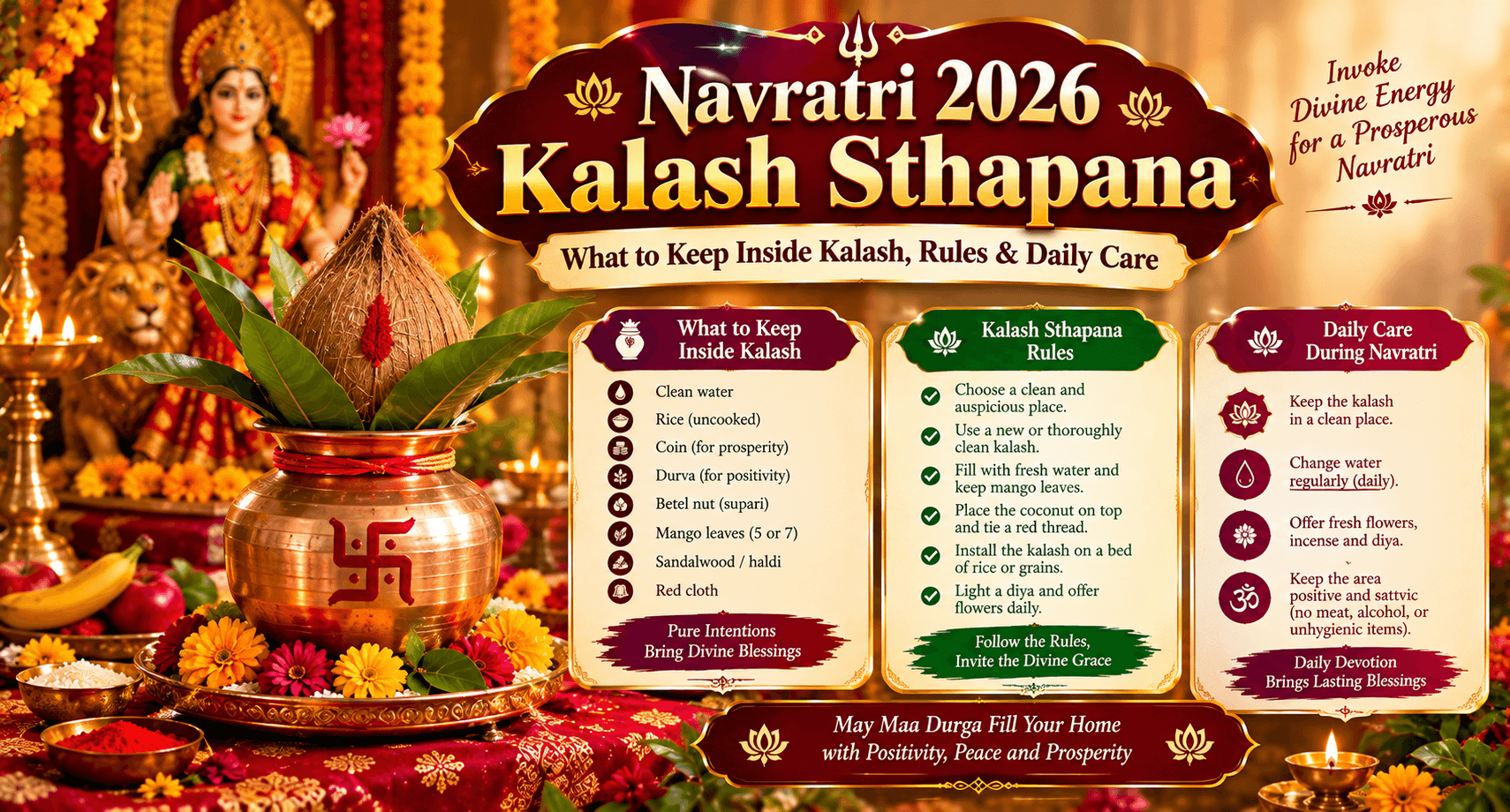
Every year, the same practical questions surface just before Navratri begins. What exactly goes inside the Kalash? Which leaves and which coconut? How much water? What if the coconut slips, and what happens to everything on the last day? This guide is a dedicated Navratri Kalash reference for Shardiya Navratri 2026. It covers the contents, the daily care and the closing of the Kalash. For dates and the wider festival, see our Shardiya Navratri 2026 guide. Practices may vary by region, family tradition and Panchang, so please read this as a practical framework and not as a single fixed rule.
Navratri 2026 Kalash Sthapana at a Glance
Kalash Sthapana, also called Ghatasthapana, falls on Sunday, 11 October 2026, the first day of Shardiya Navratri. The nine days of worship run to 19 October, with Vijayadashami on Tuesday, 20 October 2026. Some Panchangs differ slightly on Ashtami and Navami timing, so please confirm locally.
On muhurat, Drik Panchang lists 6:19 AM to 10:12 AM for New Delhi, with an Abhijit Muhurat of 11:44 AM to 12:31 PM. These are Delhi reference times only. Exact Muhurat should be checked according to the local Panchang and location. The same listing notes that Chitra Nakshatra and Vaidhriti Yoga remain active that day, which some Panchangs advise avoiding, so families may wish to ask their priest. The full date, muhurat and vidhi are covered in our Ghatasthapana 2026 Muhurat and Vidhi guide.
Component | Common Practice |
|---|---|
Purpose | Invoke the Devi's presence for nine days of worship |
Water | Clean water, often with a little Gangajal |
Inside the Kalash | Supari, coin, akshat, durva, fragrance (varies by family) |
Moli | Tied around the neck of the Kalash |
Leaves | Mango or Ashoka, commonly five, at the mouth |
Coconut | Whole, unpeeled, wrapped in red cloth, placed on top |
Barley (Jaware) | Sown in soil below or around the Kalash |
Daily care | Kalash left undisturbed, light sprinkling for Jaware, clean space, fresh flowers |
Closing | After Navami or on Dashami, as per family tradition |
What Is Kalash Sthapana During Navratri?
Kalash Sthapana is the installation of a sanctified pot on the first day of Navratri. In Hindu worship, the Kalash is traditionally regarded as the seat of the Devi for the nine days and as a symbol of fullness and auspiciousness. Water symbolically represents life, leaves represent growth, and the coconut is commonly seen as an offering. Devotees traditionally keep it at the centre of the puja space, so that every aarti and offering is made in its presence. The ritual is performed once, and the same Kalash remains until the close of Navratri.
What to Keep Inside the Navratri Kalash?
What should be kept inside a Navratri Kalash?
A Navratri Kalash is commonly filled with clean water, often with a little Gangajal. Traditional additions include a supari (betel nut), a coin, akshat (unbroken rice), a few durva blades and a drop of fragrance. Moli is tied around its neck, and mango or Ashoka leaves and a coconut are placed on top. Contents vary by family tradition.
Item | How It Is Used | Traditional Significance |
|---|---|---|
Clean water | Fills the Kalash up to the neck, keeping the rim clear | Symbolises life and purity |
Gangajal | A few drops mixed into the water | Traditionally regarded as purifying |
Akshat | A pinch in the water; unbroken rice also on the lid as a base for the coconut | Symbolises wholeness and abundance |
Supari | One whole betel nut dropped in; some traditions use five | Regarded as an auspicious offering |
Coin | One coin dropped in | Symbolises prosperity and offering |
Moli or Kalawa | Tied around the neck | A thread of dedication and protection |
Durva | A few blades in the water | Associated with freshness and longevity |
Fragrance | A drop of attar or perfume | An offering of fragrance to the Devi |
Most families do not use every item. Some add a little sugar, or mark the outside of the Kalash with a red swastika. If your family has an established list, follow it. If not, the table above is a widely followed baseline and not a compulsory set.
What Goes on Top of the Kalash?
Mango or Ashoka Leaves
Fresh, unbroken leaves are arranged around the mouth of the Kalash, with the stems kept clear of the water so they do not soak. Five is a commonly followed number, and some traditions use other odd numbers. Leaves are traditionally associated with freshness and growth.
Coconut
A whole, mature, unpeeled coconut with its husk and tuft is commonly used. It is placed upright on top of the Kalash, or on a lid holding unbroken rice as a stable base. Some traditions turn the tuft toward the worshipper, and others place it upward. Cracked or dried coconuts are usually avoided. Traditionally, the coconut is seen as a symbol of offering and abundance.
Red Cloth or Chunri
The coconut is wrapped in red cloth and tied with moli. In Devi worship, red is traditionally associated with Shakti and auspiciousness. Some families instead drape a small chunri over the Kalash. Keep the cloth well away from any diya flame.
What Goes Under the Kalash?
Beneath the Kalash sits a wide earthen pot or tray of clean soil in which barley is sown. The Kalash rests at the centre of this bed, so the vessel of water and the bed of seeds are seen as one setup.
To prepare the bed, spread a layer of clean soil, scatter barley, add a thin layer of soil, scatter a little more, and finish with a top layer. Press lightly and dampen the soil. Some households sow sapta dhanya (seven grains) instead of only barley. Leave the centre firm so the Kalash sits steadily, and you may set its base slightly into the soil.
Barley is traditionally regarded as one of the earliest grains, and sowing it symbolises new beginnings, growth and abundance. Some families traditionally read healthy green growth as an auspicious sign. This is a belief and not a prediction. The height and colour of Jaware depend on seed quality, moisture, temperature and light, and have no scientific link to future events.
Complete Navratri Kalash Samagri Checklist
Essential items
Clean, uncracked Kalash (clay, copper or brass, per your tradition)
Clean water
Whole unpeeled coconut
Mango or Ashoka leaves
Moli and red cloth
Wide earthen pot or tray, clean soil, barley seeds
Commonly used items
Gangajal, supari, a coin, akshat, durva, fragrance
Flowers (marigold is common), roli or kumkum
Diya with ghee or oil, incense, camphor
Optional or tradition-specific items
Sapta dhanya in place of barley
A lid (sarava) to hold rice under the coconut
Sindoor markings, a little sugar
Akhand Jyot, a small chowki, or Nav Kalash in some traditions
For the broader festival items, the Ghatasthapana samagri list covers additional worship materials.
How to Prepare the Navratri Kalash Step by Step
This section covers Kalash preparation only. The Sankalp and invocation are covered in the Ghatasthapana guide.
Clean the puja space and set a chowki with a fresh cloth.
Prepare the soil bed in a wide earthen pot.
Sow the barley in thin layers and dampen lightly.
Wash the Kalash and mark it with roli or a swastika if your tradition does so.
Fill it with clean water up to the neck, keeping the rim clear.
Add Gangajal and the commonly used items: supari, coin, akshat, durva, fragrance.
Tie moli around the neck.
Arrange the leaves at the mouth, stems clear of the water.
Wrap the coconut in red cloth and tie it with moli.
Place the coconut on top, on a rice-filled lid if you use one.
Set the Kalash at the centre of the soil bed and check that it is stable.
Begin the Sankalp and invocation at your confirmed muhurat.
Discuss Your Navratri Puja Setup →
baglamukhihawan.com/book-consultation
How to Take Care of the Kalash for 9 Days
This is where most guides stop, so here is a practical routine. Where customs differ, common practice is separated from tradition-specific practice.
Should the Kalash be moved? Common practice is to leave it in place for all nine days. Wipe around it instead of lifting it. If it must be moved for safety, lift it gently with both hands, and many families offer a brief prayer for forgiveness.
Should the water be changed? Most households do not change it. If the level drops noticeably, top it up gently with clean water. Some families add a drop of Gangajal. Tradition-specific advice can differ, so ask your family priest.
Should the coconut be touched? It is not usually handled. If it needs straightening, wash your hands first and adjust it gently.
How to care for Jaware: Sprinkle a little clean water once a day, enough to keep the soil damp and not waterlogged. Overwatering can cause white mould. Sprouts grown indoors often look pale or yellowish in low light, which is a normal effect of light and not a sign of anything.
Should the area stay clean? Yes. Wipe the space daily and replace withered flowers.
Can daily puja be done near the Kalash, and can it stay overnight? Yes to both. Morning and evening aarti are commonly performed in front of it, and it stays through the nights of Navratri.
Diya safety: If you keep an Akhand Jyot, place the lamp on a stable base away from the red cloth and leaves, and do not leave it unattended around children or pets.
Navratri Kalash Rules: What to Do and Avoid
Commonly followed:
Bathe and wear clean clothes before puja
Keep the space tidy and uncluttered
Follow your own family's list and method
Offer fresh flowers and water for Jaware daily
Commonly avoided:
Footwear, leftover food or unclean items near the puja space
Using a cracked or damaged Kalash
Moving or opening the Kalash unnecessarily
Mixing unrelated customs without understanding them
What If Something Goes Wrong With the Kalash?
Accidents happen in busy homes, and they are practical matters and not omens. No tradition requires panic. Where beliefs exist, they are beliefs and not facts.
If the water spills: Wipe the area, refill with clean water, add a drop of Gangajal if you wish, and continue.
If the coconut falls: Pick it up and wash it with clean water. If it is intact, tie it and place it back. If it is cracked or spoiled, replace it with a fresh one.
If the Kalash is accidentally touched: Nothing needs to be done beyond washing your hands. Touching it to adjust it is normal.
If the Kalash breaks: Transfer the contents into a clean replacement vessel with a short prayer, and set the old vessel aside respectfully. Ask your priest if unsure.
If the Jaware do not grow: Check seed freshness, moisture and room temperature. This does not invalidate the puja.
If the Jaware grow too much: Give the tray more space or tie the shoots loosely. This is not a problem.
If the Kalash becomes dirty: Wipe the outside gently with a clean damp cloth and replace flowers.
If someone moves the Kalash: Place it back gently in its original position and continue with your puja.
Navratri Kalash and the 9 Days of Devi Worship
The Kalash stays at the centre of the puja space while each day's Devi is worshipped in front of it. Some Panchangs show Saptami spanning two days, so count the days according to your Panchang and family practice.
Day 1: Maa Shailputri Puja begins with the newly installed Kalash.
Day 2: Maa Brahmacharini worship starts the daily routine of watering the Jaware.
Day 3: Maa Chandraghanta is worshipped with fresh flowers before the Kalash.
Day 4: Maa Kushmanda Puja is a good day to check that the sprouts are healthy.
Day 5: Maa Skandamata is worshipped with aarti at the Kalash.
Day 6: Maa Katyayani Puja continues the same steady routine.
Day 7: Maa Kalaratri Puja is when many families re-check diya safety.
Day 8: Maa Mahagauri is worshipped as the Kalash begins to near its conclusion.
Day 9: Maa Siddhidatri Puja is usually followed by preparations for the close.
For daily details, see the Navratri Colours 2026 calendar, the Navratri 2026 Bhog List, the Navratri 2026 Mantra List, and the Ashtami and Navami 2026 Kanya Pujan guide.
What to Do With the Kalash After Navratri?
When is it removed? Practice differs. Many families close the Kalash after the Navami rituals or on the morning of Dashami, and some conclude after a final aarti and havan. Vijayadashami is on 20 October 2026, so households closing on Dashami will do so that day. Confirm with your priest and Panchang. Before removal, offer a final aarti and a short prayer seeking forgiveness for any lapses.
Water: Many households sprinkle a little around the home and pour the rest at the base of a Peepal tree or a garden plant.
Coconut: Some keep it in the home temple, some break it and share it as prasad, and some offer it in the havan. Use it only if it is fresh.
Jaware: Commonly shared as prasad in small portions. Return the remaining sprouts and soil to a garden, pot or tree base.
Kalash vessel: Wash and reuse it for puja, or store it respectfully. Return a clay pot to the soil.
Coins, supari and akshat: Coins and the coconut are often tied in the red cloth and kept in the home temple or a safe place. Akshat can go into the soil.
No river or pond nearby: Visarjan does not require a natural water body. Return biodegradable materials (water, soil, leaves, flowers, sprouts) to a garden or tree base.
For environmental responsibility, avoid dropping cloth, plastic, metal coins, synthetic thread or mixed puja waste into rivers and ponds.
10 Common Kalash Sthapana Mistakes to Avoid
Using an unclean or cracked vessel
Skipping the barley bed where your tradition requires it
Overwatering the Jaware
Keeping the Kalash in an unclean or unsuitable place
Moving the Kalash unnecessarily
Adding random items without understanding your family tradition
Treating every internet checklist as mandatory
Following a muhurat without verifying it for your location
Creating fear around accidental mistakes
Disposing of puja materials carelessly
Navratri Worship and Maa Baglamukhi Puja at Nalkheda
Navratri is traditionally regarded as an important time for Devi worship, and some devotees extend their observance to the Mahavidyas, of which Maa Baglamukhi is one. The Maa Baglamukhi Temple at Nalkheda is a well-known Siddha Peeth for this worship. Devotees who already feel drawn to it may consider a Maa Baglamukhi Hawan or a larger Maa Baglamukhi Maha Hawan alongside their home Kalash puja. These are devotional practices rooted in faith and tradition, and not guarantees of any outcome.
Explore Shardiya Navratri Puja at Nalkheda →
baglamukhihawan.com/shardiya-navratri
Frequently Asked Questions
1. What should be kept inside the Navratri Kalash?
Clean water is commonly filled up to the neck, with items such as Gangajal, supari, a coin, akshat, durva and fragrance. Moli is tied on the neck. The exact set varies by family.
2. Can Gangajal be added to Kalash water?
Yes. Many families mix a few drops of Gangajal into clean water. It is traditional but not compulsory if you do not have it.
3. How many mango leaves are placed in a Kalash?
Five is commonly followed, and some traditions use other odd numbers. Keep the stems clear of the water.
4. Which coconut is used, and why is it placed on top?
A whole, unpeeled coconut is commonly used. It sits on top as a traditional symbol of offering and abundance, often wrapped in red cloth.
5. What is kept under the Navratri Kalash, and why is barley sown?
A bed of clean soil with barley. Barley is traditionally regarded as one of the earliest grains and symbolises growth and new beginnings.
6. Should Kalash water be changed during Navratri?
Most households do not change it. If the level falls, top up gently with clean water.
7. Can the Kalash be moved after Sthapana?
Common practice is to leave it in place. If it must move, lift it gently with both hands.
8. What if the coconut falls?
Wash it, and if it is intact, tie it and set it back. If it is cracked, replace it with a fresh coconut.
9. What if the Kalash breaks?
Move its contents to a clean replacement vessel with a short prayer. Ask your priest for tradition-specific guidance.
10. How should Jaware be watered?
Sprinkle lightly once a day, keeping the soil damp and not waterlogged.
11. What should be done with Jaware after Navratri?
Share small portions as prasad and return the rest to soil or a plant.
12. What should be done with Kalash water after Navratri?
Many households sprinkle a little around the home and pour the rest on a Peepal tree or garden plant.
13. What should be done with the coconut after Navratri?
Some keep it in the home temple, others share it as prasad or offer it in a havan. Use only a fresh coconut.
14. When should Navratri Kalash be removed?
Commonly after Navami rituals or on Dashami, depending on family tradition and Panchang.
15. Can Kalash Sthapana be done at home?
Yes. Most households do it at home, following their family's samagri and method.
16. Can I perform Kalash Sthapana without a priest?
Yes, many families do. If you are unsure about the Sankalp or a step, a priest's guidance can help.
A Navratri Kalash is simple in its parts and meaningful in its care. Prepare it cleanly, keep it undisturbed, tend the Jaware lightly, and close it respectfully. Where customs differ, your own family's tradition matters more than any generic list. If you would like guidance on your Navratri puja, Acharya Ji's team can help you plan it before the festival begins.
Book Puja or Speak With Acharya Ji →
baglamukhihawan.com/book-puja
Acharya Tiwari Chetan Guru
Siddha Peethadheesh & Head Vedic Scholar
With over 15+ years of unbroken Vedic practice at Maa Baglamukhi Siddha Peeth, Nalkheda, Acharya Ji is a globally authoritative voice on Tantra Shastra, Stambhan Vidya, and Karmic Astrology. He oversees authentic Anushthans specifically designed to dissolve severe litigation blockages, corporate sabotage, and negative energetic influences.