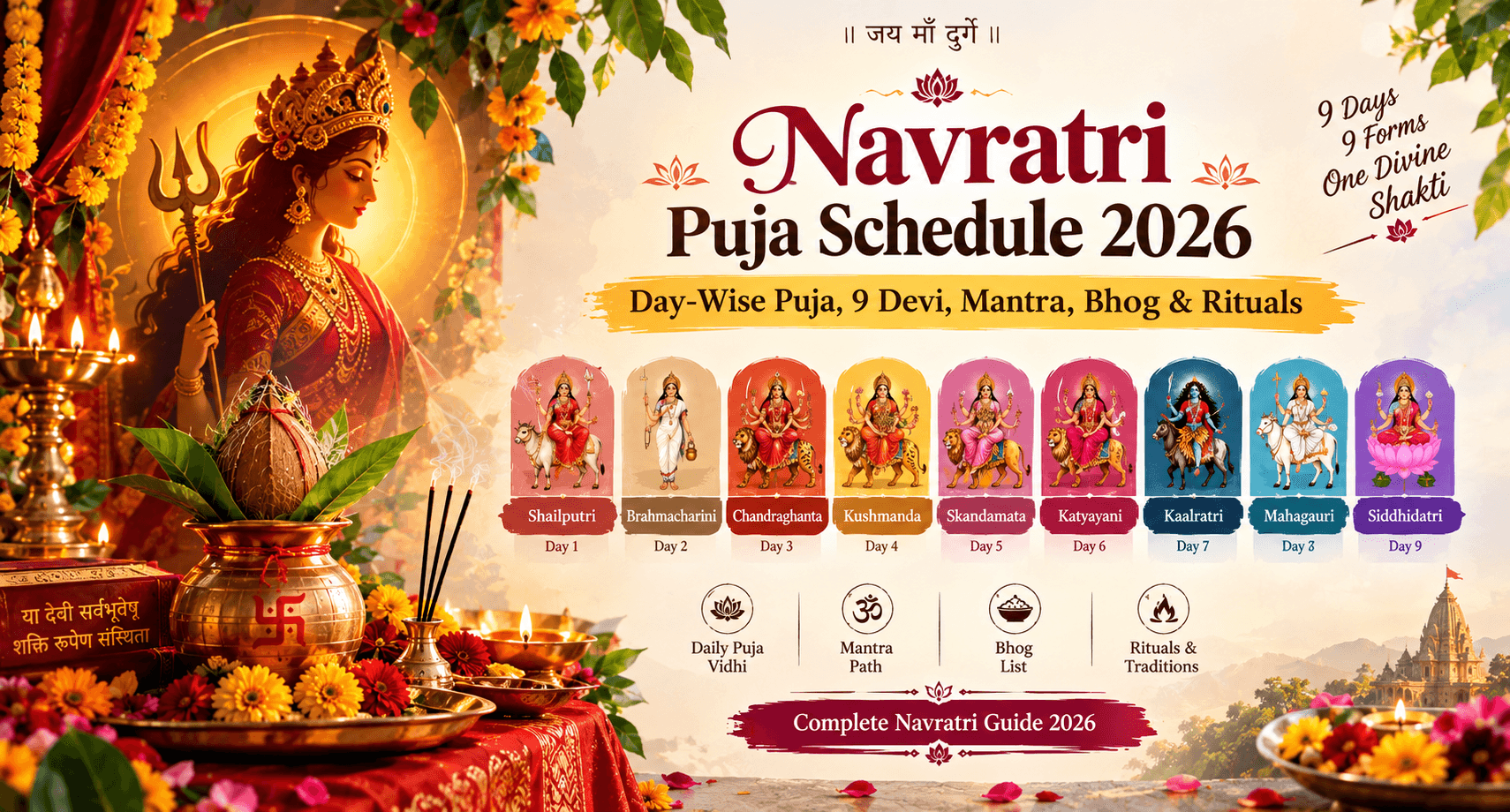
The Navratri Puja Schedule 2026 covers what to do each day of Shardiya Navratri, from Ghatasthapana on the first day to Vijayadashami on the tenth. Shardiya Navratri 2026 runs from Sunday, 11 October to Monday, 19 October, followed by Vijayadashami on Tuesday, 20 October. Each of the nine days is dedicated to one form of the Navadurga, and this schedule sets out the morning puja, main ritual, mantra, bhog and evening worship for every single day, so you can open this page each morning and know exactly what to do.
This is a practical, day-by-day planner rather than a general overview of the festival. If you are looking for the full background on dates, tithis and significance, see the Shardiya Navratri 2026 dates and puja guide. Timings mentioned below are based on North Indian Panchang references and may vary by location — always check the local Panchang for your city before a time-sensitive ritual.
Navratri Puja Schedule 2026 at a Glance
↔ Swipe horizontally to view the complete table
Day | Date | Devi | Main Puja Focus | Mantra | Bhog |
|---|---|---|---|---|---|
1 | Sun, 11 Oct | Shailputri | Ghatasthapana, Kalash Sthapana | Om Devi Shailaputryai Namah | Desi ghee |
2 | Mon, 12 Oct | Brahmacharini | Simple, disciplined worship | Om Devi Brahmacharinyai Namah | Sugar / mishri |
3 | Tue, 13 Oct | Chandraghanta | Evening jaap with bell | Om Devi Chandraghantayai Namah | Kheer |
4 | Wed, 14 Oct | Kushmanda | Full puja, richer naivedya | Om Devi Kushmandayai Namah | Malpua |
5 | Thu, 15 Oct | Skandamata | Family worship, children join | Om Devi Skandamatayai Namah | Banana |
6 | Fri, 16 Oct | Katyayani | Resolve-focused worship | Om Devi Katyayanyai Namah | Honey |
7 | Sat, 17 Oct | Kalaratri | Protective night worship | Om Devi Kalaratryai Namah | Jaggery (gur) |
8 | Sun, 18 Oct | Mahagauri | Durga Ashtami, Kanya Pujan | Om Devi Mahagauryai Namah | Coconut |
9 | Mon, 19 Oct | Siddhidatri | Maha Navami, Havan, Kanya Pujan | Om Devi Siddhidatryai Namah | Sesame (til) |
10 | Tue, 20 Oct | — | Vijayadashami | — | — |
A minority of Panchangs observe Ashtami and Navami together on 19 October because the Ashtami tithi runs into the late morning of the 19th. Both dates are correct within their own calculation method — see the Ashtami Navami 2026 guide for the full explanation.
How to Follow the Navratri Daily Puja Schedule
Every day of Navratri follows roughly the same two-part rhythm: a morning puja and an evening puja, with the day's specific mantra, bhog and ritual layered in between.
Morning: bathe and wear clean clothes, clean the puja area, light the diya, invoke the day's Devi, chant the mantra, offer bhog, and say a short prayer.
Evening: light the diya again, perform aarti, recite the mantra or a path, offer bhog again if your household does so, and close with the daily family prayer.
Household traditions vary a fair amount — some families do an elaborate 16-step puja every day, others keep it to a five-minute morning ritual. Both are complete observances. Nothing below is presented as mandatory; it is the commonly followed structure for North India and Madhya Pradesh.
Day 1 — Maa Shailputri (Sunday, 11 October)
Tithi: Pratipada. Colour: Orange.
Shailputri, the daughter of the Himalaya, is worshipped on the opening day alongside Ghatasthapana, when the kalash is installed and the Goddess invoked into the home. For New Delhi, the Ghatasthapana muhurat runs roughly 6:19 AM–10:12 AM, with an Abhijit window at 11:44 AM–12:31 PM — this timing shifts by city, so confirm your own local Panchang before installing the kalash.
Morning puja: set up the kalash, sow jau if your tradition includes it, invoke Shailputri, offer flowers and akshat. Mantra: Om Devi Shailaputryai Namah. Bhog: pure desi ghee, or suji halwa made in ghee. Evening: light the diya, perform the first aarti of the nine nights. Checklist: ☐ Kalash installed within muhurat ☐ Akhand Jyoti lit if observed ☐ Ghee bhog offered
Full guide: Ghatasthapana 2026 muhurat, vidhi and samagri · Maa Shailputri worship.
Day 2 — Maa Brahmacharini (Monday, 12 October)
Tithi: Dwitiya. Colour: White.
Brahmacharini represents tapasya and restraint, and the day's worship is deliberately simple.
Morning puja: clean altar, invoke Brahmacharini with white flowers. Mantra: Om Devi Brahmacharinyai Namah. Bhog: sugar or mishri, with fresh fruit. Evening: aarti, a quiet, unhurried jaap session. Checklist: ☐ Kalash and jyoti checked and undisturbed ☐ Mishri or sugar offered ☐ Diya refilled
Full guide: Maa Brahmacharini worship.
Day 3 — Maa Chandraghanta (Tuesday, 13 October)
Tithi: Tritiya. Colour: Red.
Chandraghanta, the warrior form with the bell-shaped half-moon, is associated with courage and protection.
Morning puja: offer red flowers, ring a bell at the start of worship. Mantra: Om Devi Chandraghantayai Namah. Bhog: kheer, or plain milk if you cannot cook. Evening: aarti at dusk, bell rung again to close the jaap. Checklist: ☐ Kheer or milk offered ☐ Red flowers placed ☐ Evening aarti done together as a family
Full guide: Maa Chandraghanta worship.
Day 4 — Maa Kushmanda (Wednesday, 14 October)
Tithi: Chaturthi. Colour: Royal Blue.
Kushmanda, whose smile is said to have brought the cosmos into being, receives a richer offering than the previous days.
Morning puja: full 16-step puja if your family follows one; royal blue cloth under the kalash. Mantra: Om Devi Kushmandayai Namah. Bhog: malpua, or any ghee-fried sweet. Evening: aarti, path of a chapter from Durga Saptashati if observed. Checklist: ☐ Malpua or halwa prepared ☐ Blue flowers or cloth used ☐ Jaap completed at the usual time
Full guide: Maa Kushmanda worship.
Day 5 — Maa Skandamata (Thursday, 15 October)
Tithi: Panchami. Colour: Yellow.
Skandamata, the mother of Kartikeya, is worshipped in her nurturing aspect — a good day to involve children in the puja.
Morning puja: yellow flowers, family gathered for a short joint prayer. Mantra: Om Devi Skandamatayai Namah. Bhog: fresh bananas, or any seasonal fruit. Evening: aarti, children join the naam mantra. Checklist: ☐ Fresh fruit offered ☐ Yellow accents in mandir ☐ Children included in the evening prayer
Full guide: Maa Skandamata worship.
Day 6 — Maa Katyayani (Friday, 16 October)
Tithi: Shashthi. Colour: Green.
Katyayani, the warrior form born to confront Mahishasura, is traditionally invoked for resolve and strength.
Morning puja: green flowers, a firm sankalp for the day's intention. Mantra: Om Devi Katyayanyai Namah. Bhog: raw honey, or a honey-sweetened sweet (avoid honey for infants under one year). Evening: aarti, a longer jaap session if you are observing a personal anushthan. Checklist: ☐ Honey offered ☐ Green flowers placed ☐ Sankalp renewed
Full guide: Maa Katyayani worship.
Day 7 — Maa Kalaratri (Saturday, 17 October)
Tithi: Saptami. Colour: Grey.
Kalaratri, the most intense of the nine forms, is worshipped as the destroyer of fear and negative influence. Saptami night is traditionally significant for protective worship, and some devotees at Nalkheda choose this window for a Maa Baglamukhi Havan seeking relief from obstruction.
Morning puja: simple, restrained worship; naam mantra is usually enough for this day. Mantra: Om Devi Kalaratryai Namah. Bhog: jaggery (gur), or gur laddoo. Evening: aarti, keep the household calm and disciplined. Checklist: ☐ Jaggery offered ☐ Naam mantra chanted ☐ Havan considered if planned for this night
Full guide: Maa Kalaratri worship.
Day 8 — Maa Mahagauri (Sunday, 18 October) — Durga Ashtami
Tithi: Ashtami. Colour: Purple.
Mahagauri, the serene form who emerges after long penance, is worshipped on Durga Ashtami — one of the two most significant days of the nine. Many families perform Kanya Pujan today; others perform it the following day on Navami. Because Ashtami tithi extends into the late morning of the 19th in most Panchangs, a few traditions observe both Ashtami and Navami together on 19 October — see the Ashtami Navami 2026 guide for why this happens.
Morning puja: sankalp, invoke Mahagauri with white or purple flowers, read Durga Saptashati or Argala Stotram if observed. Mantra: Om Devi Mahagauryai Namah. Bhog: whole coconut, or nariyal laddoo; halwa-puri-chana if Kanya Pujan is today. Evening: fuller aarti, Sandhi Puja in the eastern tradition, Kanya Pujan if this is your family's chosen day. Checklist: ☐ Coconut offered ☐ Kanya Pujan samagri ready if performing today ☐ Fast considered for breaking after rituals if this is the day your household concludes it
Full guide: Maa Mahagauri worship · Kanya Pujan 2026 vidhi and samagri.
Day 9 — Maa Siddhidatri (Monday, 19 October) — Maha Navami
Tithi: Navami. Colour: Peacock Green.
Siddhidatri, the bestower of siddhis, completes the Navadurga. This is the most common day for the concluding Havan and Purnahuti, and for households that did not perform Kanya Pujan on Ashtami.
Morning puja: sankalp, invoke Siddhidatri with peacock-green offerings. Mantra: Om Devi Siddhidatryai Namah. Bhog: sesame (til), often alongside halwa-puri-chana for Kanya Pujan. Evening: concluding Havan with final Purnahuti, elaborate aarti, Parana (breaking the fast) if your household has observed all nine days. Checklist: ☐ Til offered ☐ Havan or Purnahuti arranged if concluding an anushthan ☐ Kanya Pujan completed if not done on Ashtami
Full guide: Maa Siddhidatri worship · Navratri Havan 2026 vidhi, samagri and mantra.
Navratri 2026 Ashtami and Navami — What Changes This Year?
This is the one part of the 2026 calendar worth reading carefully. Most Panchangs place Maha Ashtami on Sunday, 18 October and Maha Navami on Monday, 19 October, because the Ashtami tithi is the prevailing tithi at sunrise on the 18th. But because that same Ashtami tithi continues into the late morning of the 19th before Navami begins, a smaller number of Panchangs that apply the sunrise rule strictly to the transition point observe both Ashtami and Navami together on 19 October. This is not an error on either side — it is standard tithi behaviour.
If you are doing Kanya Pujan → check which day your family's Panchang assigns, and go by that rather than a generic online date.
If you are doing Havan → Navami (19 October) is the more common day for the concluding Havan and Purnahuti in most households.
If you are performing a priest-guided puja → confirm the exact local timing and day with the priest before proceeding, since Sandhi Puja and other junction rituals depend on the precise tithi transition for your city.
Vijayadashami on Tuesday, 20 October is consistent across all sources.
Navratri Morning Puja Routine — What to Do Every Day
Clean the puja space
Take bath and wear clean clothes
Light the diya
Offer water and flowers
Invoke the day's Devi
Chant the day's mantra
Offer bhog
Perform a short prayer
Maintain the kalash and Akhand Jyoti, if observed, without disturbing them
This sequence works whether your morning has fifteen minutes or an hour. Elaborating it is a matter of personal devotion, not a requirement.
Navratri Evening Puja Routine
The evening routine is generally lighter than the morning one: light the diya again, perform aarti, recite the day's mantra or a short path, offer bhog if your family does so twice a day, and close with a brief family prayer. Some households add a chapter of Durga Saptashati or Devi Mahatmya reading in the evening — this is optional and varies widely by family.
Navratri 2026 Daily Checklist
☐ Bath and clean clothes ☐ Clean puja space ☐ Light diya ☐ Day's Devi worship completed ☐ Mantra or jaap done ☐ Bhog offered ☐ Aarti performed ☐ Evening prayer said ☐ Kalash and jyoti checked before sleeping ☐ Prepared for next day's mantra and bhog
What to Prepare Before Navratri Begins
Buy or arrange these before 11 October so the nine days run smoothly: kalash, diya and pure ghee or oil, fresh flowers, incense, roli and kumkum, akshat (rice), fruits for naivedya, the bhog ingredients listed in the table above for each day, a clean puja thali, fasting-appropriate foods (kuttu, singhara atta, sendha namak) if observing a vrat, and Havan samagri if you plan a concluding fire ritual. A complete, itemised list is in the Navratri Puja Samagri List 2026.
Navratri Puja at Home vs Priest-Guided Puja
Home puja suits regular household worship — the daily routine above, performed by the family, is a complete and traditional observance. A full step-by-step guide is available at Navratri Puja at Home 2026: vidhi, samagri and rules.
Priest-guided puja is useful for devotees who want assistance with a Havan, a structured Anushthan, correct Sankalp, or the full traditional procedure — particularly for Ashtami-Navami worship or a nine-day Anushthan tied to a specific personal intention. At the Maa Baglamukhi Siddha Peeth in Nalkheda, such rituals are conducted under Vedic procedure by the temple's purohits.
Book a priest-guided Navratri puja or Havan → baglamukhihawan.com/book-puja
Can Baglamukhi Puja Be Performed During Navratri?
Navratri is traditionally regarded as one of the most significant windows for Devi worship, and many devotees extend this practice to the ten Mahavidyas, of which Maa Baglamukhi is one. Devotees who already hold a personal or family connection to Maa Baglamukhi commonly choose the nine-day period — and especially Ashtami and Navami — for a dedicated Maa Baglamukhi Puja or Baglamukhi Havan, performed with proper Sankalp in the devotee's name and gotra.
At the Maa Baglamukhi Temple, Nalkheda, such rituals are conducted through traditional Vedic procedure. Devotees wishing to structure their practice across all nine days can also explore a Baglamukhi Anushthan timed to Navratri. This connection is offered as a traditional devotional option for those already inclined toward Baglamukhi worship — it is not presented as a requirement of Navratri, and no ritual here is offered with a promise of a specific outcome. A fuller account of this practice is at Baglamukhi Puja During Shardiya Navratri 2026.
Speak with the Acharya before booking → baglamukhihawan.com/book-consultation
Book Navratri Havan or Anushthan at Nalkheda → Navratri Puja Booking 2026: online Havan and Anushthan
Frequently Asked Questions
1. What is the Navratri Puja Schedule 2026?
It is the day-by-day plan of morning and evening rituals, mantras and bhog for each of the nine days of Shardiya Navratri, running from 11 to 19 October 2026, followed by Vijayadashami on 20 October.
2. When does Shardiya Navratri 2026 start?
Shardiya Navratri 2026 begins on Sunday, 11 October 2026, with Ghatasthapana, and the nine days of Devi worship run through Monday, 19 October.
3. What are the 9 days of Navratri 2026?
11 October Shailputri, 12 Brahmacharini, 13 Chandraghanta, 14 Kushmanda, 15 Skandamata, 16 Katyayani, 17 Kalaratri, 18 Mahagauri (Ashtami), 19 Siddhidatri (Navami).
4. Which Devi is worshipped on each day of Navratri?
Each day honours one form of the Navadurga in the order above, beginning with Shailputri on Day 1 and concluding with Siddhidatri on Day 9.
5. What should I do every day during Navratri?
Bathe, clean the puja space, light a diya, invoke the day's Devi, chant her mantra, offer the day's bhog, and close with a short prayer — repeated each morning and evening.
6. What is the daily puja routine during Navratri?
A short morning routine of purification, invocation, mantra and bhog, followed by an evening routine of diya, aarti, mantra and prayer. See the routines above for the full sequence.
7. What mantra should I chant during Navratri?
Each day has its own naam mantra, listed in the table above. The full Sanskrit forms, meanings and jaap guidance are in the Navratri 2026 Mantra List.
8. What bhog is offered on each day of Navratri?
Ghee, sugar, kheer, malpua, banana, honey, jaggery, coconut and sesame across the nine days. The complete list with alternatives is in the Navratri 2026 Bhog List.
9. What should I do during Navratri morning puja?
Clean the space, bathe, light the diya, invoke the day's Devi, chant her mantra, and offer the bhog, ideally at the same time each day.
10. What should I do during Navratri evening puja?
Light the diya again, perform aarti, recite the mantra or a short path, and close with the family's evening prayer.
11. Can Navratri Puja be done at home?
Yes. Home worship following the daily routine above is a complete and traditional way to observe Navratri. See Navratri Puja at Home 2026 for the full vidhi.
12. When is Ashtami in Navratri 2026?
Maha Ashtami falls on Sunday, 18 October 2026, according to most North Indian Panchangs.
13. When is Navami in Navratri 2026?
Maha Navami falls on Monday, 19 October 2026.
14. When is Kanya Pujan in 2026?
Most families perform Kanya Pujan on 18 or 19 October, depending on family and regional tradition. See Kanya Pujan 2026: date, vidhi and samagri.
15. Can Havan be performed during Navratri?
Yes. Many households and most temple traditions perform a Havan on Navami, and some also perform one on Saptami or Ashtami. See Navratri Havan 2026.
16. Which day is best for Navratri Havan?
Navami (19 October 2026) is the most common day for the concluding Havan and Purnahuti, though some households perform one earlier in the nine days as well.
17. What should be prepared before Navratri?
Kalash, diya, flowers, incense, roli, akshat, fruits, the day-wise bhog ingredients, a puja thali, and fasting essentials if observing a vrat. Full list: Navratri Puja Samagri List 2026.
18. What are common Navratri puja mistakes to avoid?
Rushing the daily routine, tasting bhog before it is offered, following an online muhurat meant for a different city, and treating the nine-colour dress calendar as compulsory when it is a cultural custom, not a scriptural rule.
19. Can Baglamukhi Puja be performed during Navratri?
Yes. Devotees with a personal connection to Maa Baglamukhi commonly choose Navratri, especially Ashtami and Navami, for a dedicated puja or Havan with proper Sankalp — see Baglamukhi Puja During Shardiya Navratri 2026.
20. How can I book Baglamukhi Puja or Havan at Nalkheda?
Through baglamukhihawan.com/book-puja, or book a consultation first to discuss which ritual suits your situation.
Puja Vidhi, fasting rules and exact Muhurat can vary by region, Panchang and family custom. This guide presents the widely followed structure for Madhya Pradesh and North India. Timings may vary by location — check the local Panchang for your city, particularly for Ghatasthapana and the Ashtami-Navami transition.
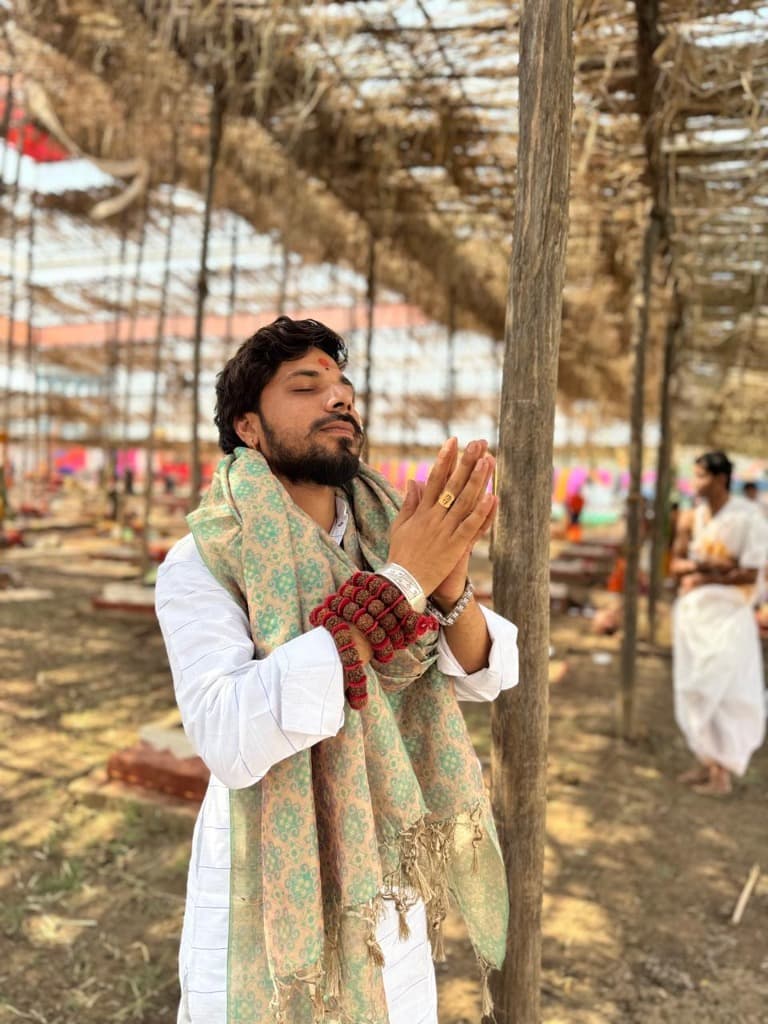
Acharya Tiwari Chetan Guru
Siddha Peethadheesh & Head Vedic Scholar
With over 15+ years of unbroken Vedic practice at Maa Baglamukhi Siddha Peeth, Nalkheda, Acharya Ji is a globally authoritative voice on Tantra Shastra, Stambhan Vidya, and Karmic Astrology. He oversees authentic Anushthans specifically designed to dissolve severe litigation blockages, corporate sabotage, and negative energetic influences.