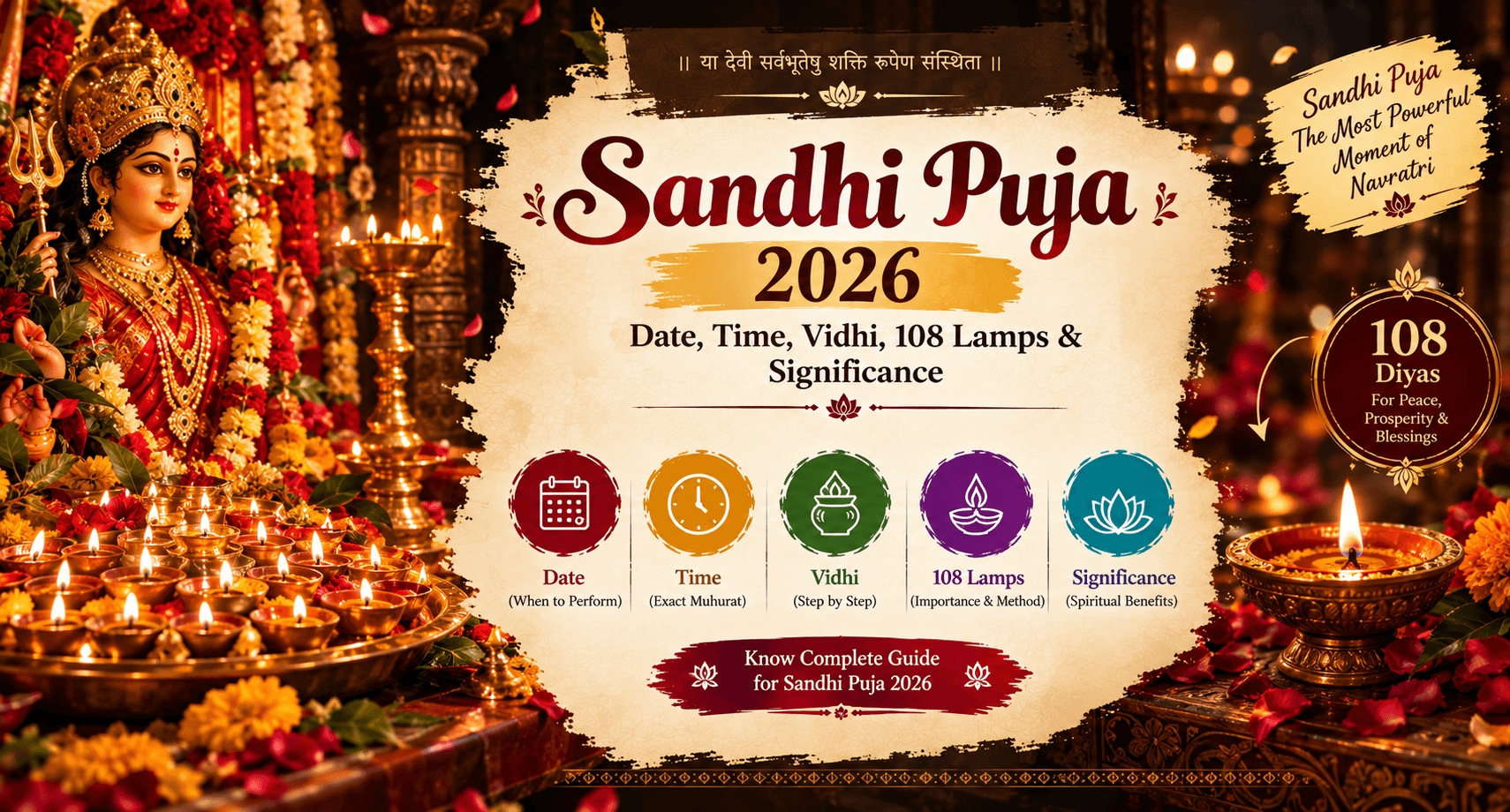
Sandhi Puja is a short, precisely timed worship of Goddess Durga, performed at the junction (sandhi) where the Ashtami tithi ends and the Navami tithi begins during Durga Puja and Shardiya Navratri. Traditionally it lasts 48 minutes: the last 24 minutes of Ashtami and the first 24 minutes of Navami. In 2026 this junction falls on Monday, 19 October, and the Sandhi Puja window is 10:27 AM to 11:15 AM IST.
Devotees search for the exact timing because this ritual follows a moment, not a calendar date. Most Navratri observances are assigned to a day, whereas Sandhi Puja is assigned to the instant one tithi hands over to the next. This year it also needs planning, because the window falls in the late morning of a working day rather than at dusk, as many people expect.
This guide covers the timing and how it is calculated, the meaning of the 108 lamps, a step-by-step vidhi, samagri, mantras and what can reasonably be done at home. For the full nine-day calendar, see the Shardiya Navratri 2026 guide.
Quick Answer
What it is: Worship of Devi at the Ashtami-Navami junction, traditionally linked to her Chamunda form
Date: Monday, 19 October 2026
Timing (IST): 10:27 AM to 11:15 AM (48 minutes)
Ashtami ends / Navami begins: about 10:51 AM IST
Signature offering: 108 lamps, and in eastern tradition 108 lotuses
Verify with: your local Panchang or family priest
What Is Sandhi Puja?
"Sandhi" means a junction or meeting point. In Panchang terms it is the moment one tithi (lunar day) ends and the next begins. Sandhi Puja is the worship performed at the meeting of Ashtami and Navami, the eighth and ninth tithis of Navratri. It is also called Sandhikshan in some regions.
According to the Devi Mahatmya, part of the Markandeya Purana, the goddess assumed the fierce form of Chamunda to slay the demons Chanda and Munda, and received the name Chamunda from that act. Devotees traditionally associate the Ashtami-Navami junction with this moment. Popular retellings often fold the episode into the Mahishasura story, but the Devi Mahatmya places it in the Shumbha-Nishumbha narrative.
The ritual is best known from Durga Puja in Bengal and other eastern regions, where it is a high point of Maha Ashtami. Households elsewhere may observe it in a simpler form or not as a separate ritual at all. Practices vary by region and family tradition, and the beliefs described here are matters of faith.
Sandhi Puja 2026 Date & Time
Detail | Information |
|---|---|
Sandhi Puja | 2026 |
Sandhi Puja date | Monday, 19 October 2026 (IST) |
Sandhi Puja timing | 10:27 AM to 11:15 AM IST (48 minutes) |
Ashtami tithi | Begins about 8:27 AM on 18 October; ends about 10:51 AM on 19 October (IST) |
Navami tithi | Begins about 10:51 AM on 19 October (IST) |
Sandhi period | 10:27 to 10:51 AM (last 24 minutes of Ashtami) plus 10:51 to 11:15 AM (first 24 minutes of Navami) |
Timing basis | Panchang tithi transition |
How the time is calculated. Ashtami ends at 10:51 AM. Subtracting 24 minutes gives 10:27 AM, and adding 24 minutes gives 11:15 AM. That 48-minute span is the Sandhi Puja window.
Sources. Drik Panchang's Sandhi Puja page lists Ashtami ending at 12:21 AM CDT on 19 October for Houston. Converted to IST, that is 10:51 AM. A Kolkata-based tithi table in Divine Hindu's Durga Puja 2026 guide gives the same transition and the same 10:27 to 11:15 AM window. Belur Math is reported to print 10:28 to 11:16 AM under the Vishuddha Siddhanta almanac, and families following other Bengali panjikas may see different figures. A few websites quote an early-morning window, which does not match the tithi transition above.
Does the timing change by location? The moment a tithi ends is an astronomical instant, so it is the same everywhere in the world. What changes is the local clock, the civil date and the almanac school. A devotee in Houston, for example, sees the window at 11:57 PM to 12:45 AM CDT on the night of 18 to 19 October, which is why some international listings show 18 October. Readers abroad should convert from IST to their own time zone.
Date labelling. Many Panchangs list Maha Ashtami on 18 October and Maha Navami on 19 October. Sunrise-based reckoning, including the Bengal calendar, treats 19 October as Ashtami. Sandhi Puja is unaffected by this, because it is fixed by the transition itself. For the day-wise picture, see the Ashtami and Navami 2026 guide.
Why Is Sandhi Puja Performed Between Ashtami & Navami?
Several traditional strands explain the choice of this junction.
The Chamunda narrative. In the Devi Mahatmya, Chanda and Munda attack the goddess Ambika. Her face darkens with anger and Chamunda emerges to slay them. Devotees traditionally hold that this fierce aspect is most vividly present at the tithi junction.
The idea of a threshold. In many Hindu traditions, junctions are regarded as spiritually charged. Dawn and dusk (sandhya) are one example, and the meeting point of two tithis is another. According to this view, worship at a threshold has a special quality.
The Rama tradition. Popular Bengali retellings of the Ramayana describe Rama worshipping Durga out of season (akal bodhan) with 108 lotuses before the battle with Ravana. This is a regional tradition rather than part of the Valmiki Ramayana, and the Sandhi Puja offering of 108 lotuses is often linked to it.
A symbolic reading. Some devotees also read the junction as the hinge between the intensity of Ashtami and the fulfilment associated with Navami. This is an interpretation, not a textual rule.
Significance of 108 Lamps in Sandhi Puja
Why 108. The number 108 is widely regarded as sacred in Hindu practice. A japa mala has 108 beads, and the Ashtottara Shatanamavali of Durga lists 108 names. Devotees commonly read the number as a symbol of completeness.
Why lamps. A lamp represents light dispelling darkness, and the flame gives the brief window a visible focus. In eastern practice the lamps are lit together as the window opens and kept burning through it, alongside offerings such as 108 lotuses. Some accounts add a garland of 108 bel leaves.
Is 108 mandatory? No single rule applies everywhere. The full 108 lamps are customary in many Bengali and eastern pujas, while smaller pandals and home worshippers often light fewer. Traditionally the emphasis is on lighting the lamps with devotion at the correct time. The number reflects custom, and families should follow their own tradition or priest.
A practical note. Place lamps on a metal tray or thali, away from curtains and clothing, and keep a small container of water nearby.
Sandhi Puja Vidhi: Step-by-Step
This is a commonly followed sequence. Your family or priest may add or change steps.
Preparation. Confirm the window with a local Panchang and arrange all items the day before. Some devotees fast until the Sandhi Puja is complete.
Cleaning and purification. Clean the puja space, bathe, wear clean clothes (red or white are common) and sprinkle Gangajal.
Sankalp. Take water in the right hand and state your name, the date and your intention to worship. Add your gotra if you know it.
Devi invocation. Invoke Durga (Chamunda) before an image, photograph or yantra and light the main lamp.
Kalash and setup. Use the kalash already installed for Navratri, or prepare a simple one with water, mango leaves and a coconut. The Kalash Sthapana guide explains the items.
Lamp arrangement. Arrange the lamps with ghee or oil and wicks ready but unlit. Begin lighting them at 10:27 AM.
Offerings. Offer red hibiscus or marigold, bel leaves, unbroken rice, kumkum, fruit and sweets. Lotuses are offered where available.
Mantra and chanting. Chant your chosen mantras or read Devi verses (see the mantra section below).
Main worship. Continue the offerings and chanting through the window. In Bengali practice, the exact moment of transition at about 10:51 AM is treated as the focal point.
Aarti. Perform aarti with a bell, conch and camphor or a ghee lamp.
Prasad. Offer fruit and sweets as bhog and distribute them afterwards.
Completion. Ask forgiveness for any lapses (kshama prarthana), bow to the Devi and allow the lamps to burn down safely. Those who fasted may break the fast after the puja.
Sandhi Puja Samagri List
The full list is in the Navratri Puja Samagri guide. Below are the items specific to Sandhi Puja.
Essential items
Item | Use |
|---|---|
Durga image, photograph or yantra | Focus of worship |
Clean chowki with red cloth | Seat for the Devi |
Earthen lamps (108 for the full custom, fewer for a simple puja) | Main offering of the ritual |
Ghee or oil, cotton wicks, matchbox | To light the lamps |
Red hibiscus or marigold flowers, bel leaves | Floral offerings |
Unbroken rice (akshat), kumkum or roli | Tilak and offerings |
Incense, aarti thali, bell | Aarti |
Fruit and sweets | Bhog and prasad |
Clean water or Gangajal, kalash | Purification and setup |
Optional and traditional items
Item | Note |
|---|---|
108 lotus flowers | Customary in eastern pujas; hard to source in many cities |
Garland of 108 bel leaves | Reported in some regional accounts |
Red sari or chunari, ornaments | Offered to the Devi in larger pujas |
Conch (shankh) | Sounded during aarti |
Camphor, betel leaf and supari | Used in aarti and offerings |
Panchamrit | Used where an abhishek is performed |
Sandhi Puja Mantra & Prayer
There is no single universal Sandhi Puja mantra. Priests typically recite verses from the Devi Mahatmya (Chandi Path) and Durga or Chamunda mantras, and usage varies by region and lineage. Chapter 7 of the Devi Mahatmya narrates the slaying of Chanda and Munda, and some devotees choose to read it.
Three widely used devotional texts are given below. Please check the spelling against a printed source before chanting.
1. Devi Mahatmya prayer
सर्वमङ्गलमाङ्गल्ये शिवे सर्वार्थसाधिके ।
शरण्ये त्र्यम्बके गौरि नारायणि नमोऽस्तु ते ॥
Sarva-mangala-mangalye shive sarvartha-sadhike | Sharanye tryambake gauri narayani namo 'stu te ||
Meaning: Salutations to the Goddess, auspicious among all that is auspicious, the refuge who fulfils all aims.
2. Devi Stuti refrain
या देवी सर्वभूतेषु शक्तिरूपेण संस्थिता ।
नमस्तस्यै नमस्तस्यै नमस्तस्यै नमो नमः ॥
Ya devi sarvabhuteshu shakti-rupena samsthita | Namastasyai namastasyai namastasyai namo namah ||
Meaning: Salutations again and again to the Goddess who abides in all beings in the form of power.
3. Navarna mantra of Chamunda
ऐं ह्रीं क्लीं चामुण्डायै विच्चे
Aim Hreem Kleem Chamundayai Vichche
Popular sources sometimes write "Chamundaye", and many traditions place "Om" before it. This bija-based mantra is often taken with a teacher's guidance for regular japa.
Mantra chanting is an act of devotion, and no mantra guarantees a particular worldly result. Devotees who are unsure of pronunciation may listen to a priest or recite along with one. More Devi mantras for the nine days are in the Navratri 2026 Mantra List.
Can Sandhi Puja Be Performed at Home?
Yes, in a simplified form. Many families observe a short home version, while the large public version with priests and a full ritual set is performed in pandals and temples.
What a devotee can reasonably do at home:
Clean the puja space and set up an image or kalash
Keep the lamps, flowers and offerings ready before the window
Light the lamps at 10:27 AM and chant a mantra or read a Devi verse
Offer flowers, perform aarti and distribute prasad
Cleanliness and sincerity matter more than scale. If you cannot light 108 lamps, a smaller number offered with devotion is generally considered acceptable, though you should follow your family's custom.
What may need trained priestly guidance: a complete Chandi Path, a homa (fire ritual), the full lotus and bel offerings according to a specific panjika, and any tantric elements. Some households also do not observe Sandhi Puja as a separate ritual at all and do their Ashtami puja instead.
Because 2026 falls on a Monday morning, set an alarm for 10:15 AM and keep everything ready. The Navratri Puja at Home guide covers the wider home routine.
Sandhi Puja vs Ashtami Puja vs Navami Puja vs Havan
Ritual | When | Main Purpose/Focus | Typical Practices |
|---|---|---|---|
Sandhi Puja | At the Ashtami-Navami junction; 10:27 to 11:15 AM IST on 19 Oct 2026 | Worship of Devi as Chamunda at the tithi junction | 108 lamps, lotuses, mantras, aarti; brief and time-bound |
Ashtami Puja | During Ashtami tithi | Maa Mahagauri; the height of the nine nights | Full Devi puja, Saptashati path, Kanya Pujan in many homes |
Navami Puja | During Navami tithi | Maa Siddhidatri; completion of Navratri | Full puja, concluding havan and Purnahuti, Parana |
Navratri Havan | Ashtami, Navami or as per tradition | Fire ritual with mantra offerings (ahutis) | Samagri, mantras, Purnahuti; often lasts hours |
Sandhi Puja does not replace the other rituals. It is the brief hinge between the two days and can be observed on its own or within the larger sequence. This article does not repeat those detailed guides. For the comparison, see Ashtami vs Navami 2026. For the fire rituals, see the guides to Ashtami Havan and Navami Havan. For the girls' worship, see Kanya Pujan 2026.
Sandhi Puja During Shardiya Navratri 2026
Sandhi Puja is one small moment inside the nine nights of Shardiya Navratri. In 2026 the sequence around it may unfold as follows on 19 October (IST), depending on your tradition.
Time | What happens |
|---|---|
Before 10:27 AM | Ashtami puja and, in Ashtami-tradition households, Kanya Pujan; lamps prepared |
10:27 to 11:15 AM | Sandhi Puja; Ashtami ends and Navami begins at about 10:51 AM |
After 11:15 AM | Navami puja and, for many families, the concluding havan |
Families who follow the Navami tradition for Kanya Pujan or havan will time those rituals after the transition. For the full nine-day flow, use the Navratri Puja Schedule 2026.
Sandhi Puja and Maa Baglamukhi Worship During Navratri
Sandhi Puja belongs to the Durga and Chamunda tradition of the Devi Mahatmya and Bengali Shakta worship. It is not a Baglamukhi ritual, and this article does not present it as one.
Shardiya Navratri is nonetheless an important period for Devi worship generally, and devotees follow different forms of Shakti according to their own tradition. Maa Baglamukhi is one of the ten Mahavidyas, and Baglamukhi Puja and Havan form a separate, specialised worship with their own mantras, rules and Sankalp. Some devotees who already follow this path choose to perform it during Navratri, alongside or apart from Durga worship.
For devotees interested in that path, the site explains Baglamukhi Puja During Shardiya Navratri 2026 and Baglamukhi Havan During Navratri 2026. These are offered as traditional devotional options and not as a guarantee of any worldly outcome.
Sandhi Puja, Navratri Puja & Baglamukhi Havan With Priest Guidance
Some devotees prefer a priest-guided ritual, especially where the Sankalp, mantra pronunciation or muhurat needs expert handling. The temple's own guidance is that the local muhurat is confirmed with the priest before a havan is scheduled, rather than assumed from a generic online date.
If you are looking for priest-guided Baglamukhi Puja or Havan during Navratri, you can explore the available services and booking options at Maa Baglamukhi Siddha Peeth, Nalkheda. Service details, availability and any charges are confirmed at the time of booking. You can read about the Maa Baglamukhi Havan service before you decide.
Book Puja / Havan at Nalkheda →
baglamukhihawan.com/book-puja(Developer note: gold-filled button, white bold text, arrow, link to the Book Puja page.)
Frequently Asked Questions
1. What is Sandhi Puja?
Sandhi Puja is the worship of Goddess Durga at the moment Ashtami ends and Navami begins. It is traditionally associated with her Chamunda form and is best known from Durga Puja in the eastern states.
2. When is Sandhi Puja in 2026?
Sandhi Puja falls on Monday, 19 October 2026 in India. Devotees abroad may see 18 October in some listings because of the time difference.
3. What time is Sandhi Puja in 2026?
The window is 10:27 AM to 11:15 AM IST, built around the 10:51 AM tithi change. Belur Math is reported to print 10:28 to 11:16 AM, and other panjikas may differ, so confirm with your local Panchang or priest.
4. Why is Sandhi Puja performed between Ashtami and Navami?
According to the Devi Mahatmya, Chamunda emerged to slay Chanda and Munda, and devotees associate the tithi junction with that moment. Many traditions also regard junctions as spiritually significant thresholds.
5. Is Sandhi Puja performed for 48 minutes?
Traditionally, yes. It covers the last 24 minutes of Ashtami and the first 24 minutes of Navami, which two ghatis add up to in the Panchang system. The window is centred on the exact transition.
6. Why are 108 lamps used in Sandhi Puja?
The number 108 is widely regarded as sacred, seen in the 108 beads of a mala and the 108 names of Durga. Lamps symbolise light over darkness. The full 108 is a custom, and many homes light fewer.
7. What items are needed for Sandhi Puja?
The basics are a Devi image or yantra, earthen lamps with ghee or oil, flowers, bel leaves, rice, kumkum, incense, fruit and sweets. Lotuses, a bel garland and a red cloth for the Devi are traditional extras.
8. Can Sandhi Puja be performed at home?
Yes, in a simple form, with lamps, flowers, a mantra and aarti during the window. A full ritual with Chandi Path or havan is better done with a trained priest.
9. What mantra is chanted during Sandhi Puja?
There is no single universal mantra. Devotees commonly use Devi Mahatmya verses and the Chamunda Navarna mantra, and practice varies by region and lineage. No mantra guarantees a specific result.
10. What is the difference between Sandhi Puja and Ashtami Havan?
Sandhi Puja is a brief worship timed to the tithi junction, while Ashtami Havan is a fire ritual with ahutis performed during Ashtami. One is defined by an exact moment and the other by the day and the ritual form.
Conclusion
Sandhi Puja is the worship of Devi at the junction of Ashtami and Navami, traditionally linked to Chamunda and observed with 108 lamps. In 2026 the window is 10:27 AM to 11:15 AM IST on Monday, 19 October, built around the 10:51 AM change of tithi.
The timing matters because the ritual follows a moment rather than a date. Devotees should confirm the window with a local Panchang or priest, prepare in advance and follow their family tradition on the number of lamps and offerings. Readers can learn more through the linked Navratri guides and the site's Baglamukhi worship pages.
If you are looking for priest-guided Baglamukhi Puja or Havan during Navratri, you can explore the available services at Maa Baglamukhi Siddha Peeth, Nalkheda.
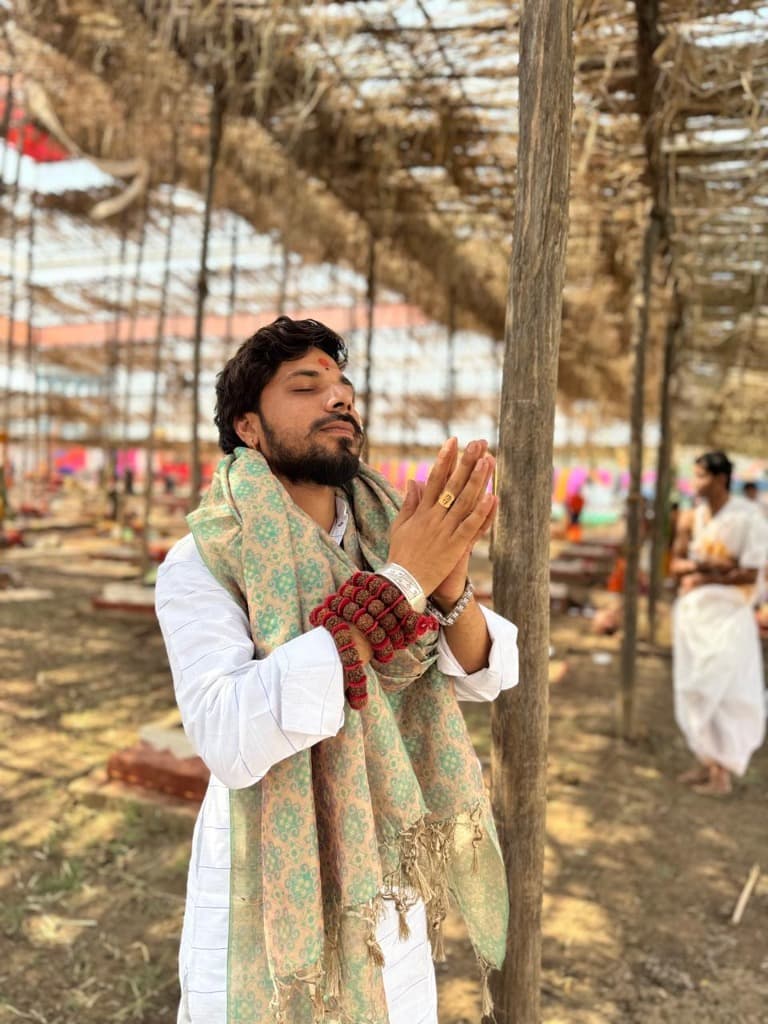
Acharya Tiwari Chetan Guru
Siddha Peethadheesh & Head Vedic Scholar
With over 15+ years of unbroken Vedic practice at Maa Baglamukhi Siddha Peeth, Nalkheda, Acharya Ji is a globally authoritative voice on Tantra Shastra, Stambhan Vidya, and Karmic Astrology. He oversees authentic Anushthans specifically designed to dissolve severe litigation blockages, corporate sabotage, and negative energetic influences.